*This page contains affiliate links. We may earn a commission if you make a purchase through these links.
Solanin takes its name from solanine, the poison that builds up in sprouting potatoes. You don’t notice it at first. It just collects, a little at a time, while everything still looks fine. That is the title Inio Asano gave his manga about two twenty-somethings drifting through a comfortable, going-nowhere life by the Tama River in suburban Tokyo, and in 2010 it became a live-action film starring Aoi Miyazaki, whom some Western fans will know as Hachi from the live-action Nana.
I read the manga and saw the film when I was young, and I came back to both years later. Some of it looks different from this side. The final live performance, where Miyazaki sings the title song herself, does not. Below: where the Solanin movie stands for US viewers right now (the short answer is not good), what makes that last song land so hard, and whether to read the manga or watch the film first.
📺 Where to Watch Solanin (October 2026)
| Service | Status | Notes |
|---|---|---|
| Netflix (US) | Not available | No listing |
| Amazon Prime Video (US) | Not available | No stream, no rental |
| Hulu | Not available | No listing |
| HBO Max | Not available | No listing |
| Apple TV | Not available | Not sold on the US store |
| Crunchyroll | Not available | Live-action films are outside its catalog |
| Japanese services | Japan only | U-NEXT streams it; Prime Video Japan rents it |
As of October 18, 2026, you cannot legally stream, rent or buy the Solanin movie from any American service. TMDB’s US listings and JustWatch’s US catalog both came back empty when I checked them that day. I also could not find a US Blu-ray or DVD. Availability can change without notice, so check the services yourself before you give up on it.
Back home, the picture is different. In Japan the film is part of the regular U-NEXT subscription, and Prime Video Japan offers it as a rental or through a paid add-on channel for Japanese movies. None of that reaches a US account. What you can get in the US today is the story itself: VIZ Media’s English edition of the manga, covered in the manga vs movie section below, and Asian Kung-Fu Generation’s single of the title song, which is on Apple Music in the US.
🎬 Trailer
This one is in Japanese. The film was never released on US streaming or disc, and I could not find an English trailer on any official channel. This is the Japanese trailer from the channel of Cinema Today, a Japanese film news site.
Work Info
- Title: Solanin (Japanese title: Soranin)
- Released: April 3, 2010 (Japan)
- Director: Takahiro Miki (his first feature film, after years directing music videos)
- Screenplay: Izumi Takahashi
- Based on: Solanin by Inio Asano (Shogakukan; English edition from VIZ Media)
- Cast: Aoi Miyazaki, Kengo Kora, Kenta Kiritani, Yoichi Kondo, Ayumi Ito, Arata (now Arata Iura)
- Theme song: “Solanin” by Asian Kung-Fu Generation
- Runtime: 126 minutes
- Source: TMDB
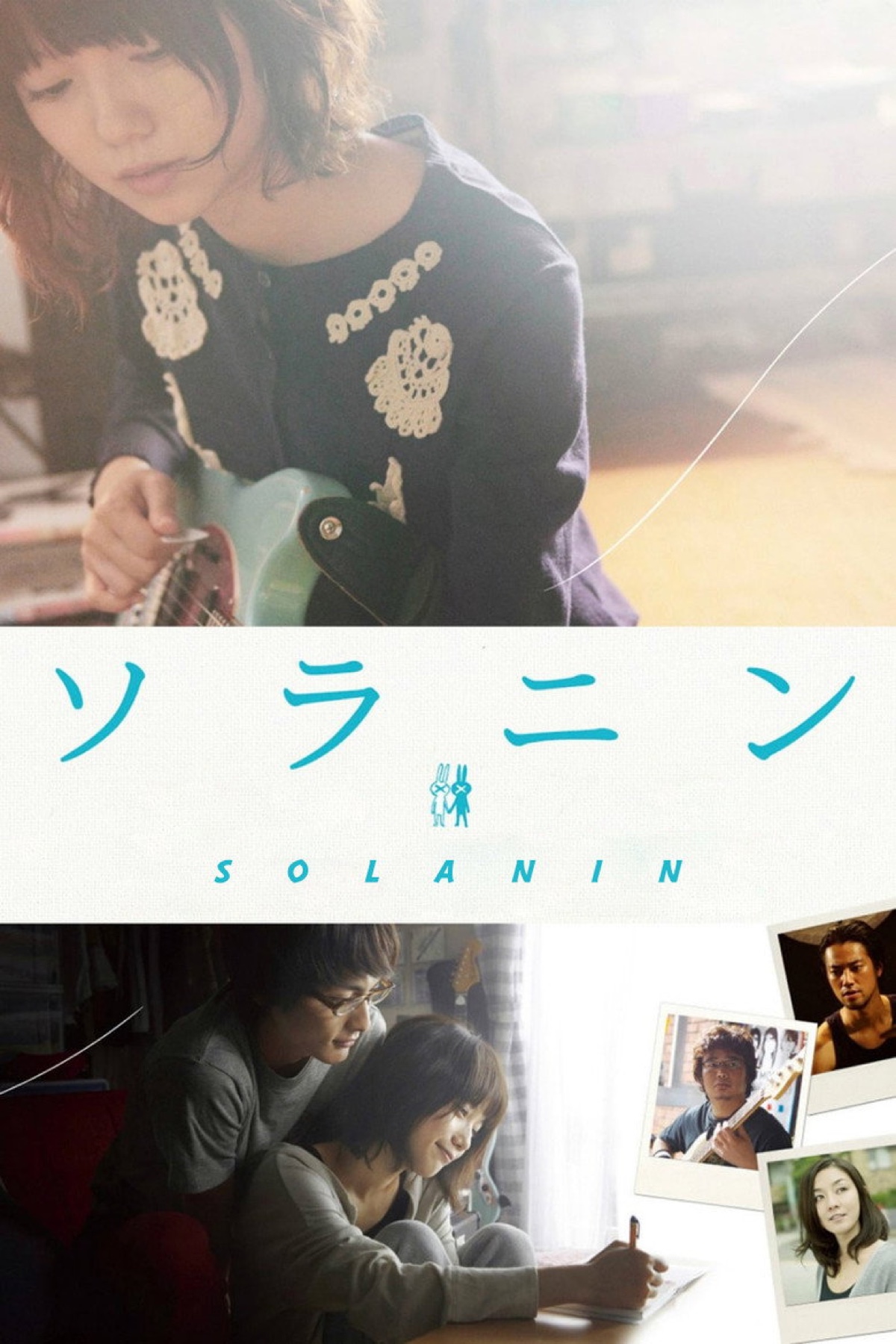
📖 Synopsis – No Spoilers
Meiko Inoue (Aoi Miyazaki) is two years out of college and stuck in an office job she can’t stand, so she quits. Her boyfriend, Naruo Taneda (Kengo Kora), lives with her in a small apartment and works part-time, still playing in a band with his college friends: Kato (Yoichi Kondo) on bass, a sixth-year student who has never quite graduated, and Billy (Kenta Kiritani) on drums, who works at his family’s pharmacy. Their days are loose and happy, more or less.
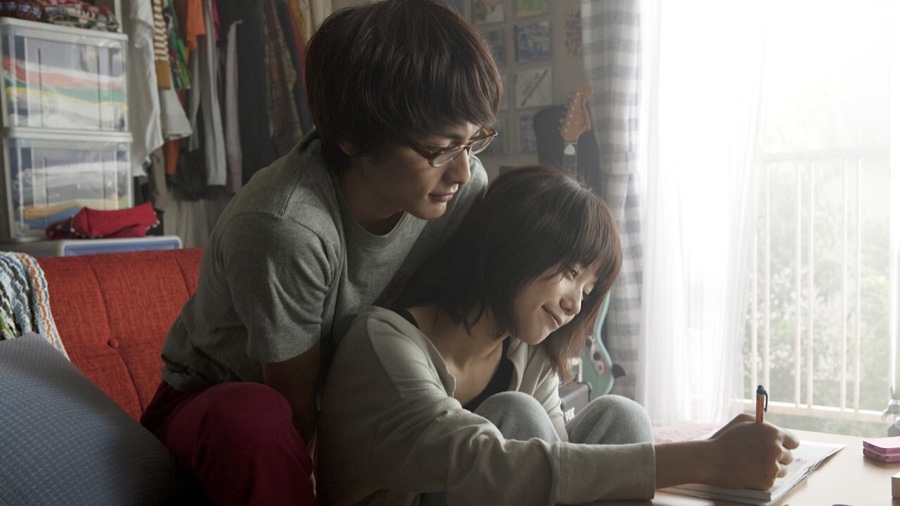
Neither of them really believes it can go on this way forever, though. Something Meiko says pushes Taneda to quit his job and take the band seriously, and he writes a new song called “Solanin.” Go back to chasing the dream, or stay on the side of ordinary life? The film follows that fork in the road, the one that tends to show up in your mid-twenties, through the small texture of how these four friends live.
✨ What Makes It Special
Why It’s Exceptional
- The final live show, with Aoi Miyazaki singing and playing guitar herself
- A structure that saves its one big song for the very end
- The same song turns into a different song as the story moves
- A cast that feels lifted straight off Asano’s pages
The song is finished when Miyazaki sings it as Meiko
Above everything else, the version of “Solanin” that Aoi Miyazaki sings at the final live show is wonderful. Of course Asian Kung-Fu Generation’s song is great on its own. But my honest feeling goes further than that. I think that song was only finished when Miyazaki sang it as Meiko. That is how much I love this scene.
Some context for anyone outside Japan. Two years before this film, Miyazaki had carried NHK’s year-long period drama Atsuhime, and she was one of the most famous actresses in the country. Solanin was her first time singing and playing guitar on screen, and during the 2009 shoot she told reporters she was allowed to play each song all the way through, start to finish. It is not a big voice. It is a little thin, straight and slightly unsteady, and that fragility matches Meiko on that stage, holding on to her guitar as if it might get away from her.
The reason the last performance hits so hard is that the whole story is riding on the song. The day she quit her job, the room she shared with Taneda, the things the friends said to each other. Every minute you spent with these people makes that one song heavier. Even if you already know the track, hearing it after the film gives it another layer.
Once that song plays, Solanin has already won as a music movie. I have complaints, and they come later in this review.
126 minutes of build-up to one song
The film keeps its key song away from you for a long time. You see the band rehearse in a studio, and you see the song being worked on. But it isn’t played for an audience until the final show. So when the guitar intro starts, you understand right away that the whole film was there for this song.
That is a gamble. If the last song weren’t a great one, the film would fall apart. The song carries it.
The same “Solanin” becomes a different song
Taneda writes the song to draw a line under the drifting life he has settled into, and under the part of himself that is happy to keep drifting. On first listen it plays as a breakup song, but the one he is saying goodbye to is closer to his old self.
Partway through the story, the way the song sounds starts to change. The “Solanin” you hear at the end is not the same song Taneda finished writing. How Meiko comes to be the one singing it is something I will leave for the film.
Deeper Themes
Back to that potato poison. A soft, easy happiness can seem as if it will last forever, and meanwhile something collects in you while you let the days slide by. I think viewers in their twenties see themselves in this film because they recognize that slow build-up. The story also refuses to hand anyone a big break. It cares less about whether the dream comes true than about how you keep living afterward. If you expect a success story, it will feel flat. I think that refusal is the film being honest.
🎭 Memorable Scenes
The final live show. On a small live-house stage, Meiko holds her guitar and sings “Solanin.” Her expression and the sound of her voice are things to take from the film itself, not from a trailer.

Taneda’s promise, early on. Meiko mutters that she wants to quit her job, and Taneda tells her he’ll take care of it. The man saying this has one foot in a part-time job and the other in a band, and is not standing firmly on either. Depending on how old you are when you watch it, that line sounds either reassuring or reckless, and the film’s youthful naivety is packed into that one exchange.
💭 How It Made Me Feel
There are plenty of great scenes where actors sing or play inside the story. The Live Aid set in Bohemian Rhapsody. The imagined musical numbers in Dancer in the Dark. The last drum solo in Whiplash. The live show in Solanin leaves a feeling none of those do.
The difference is who is on stage. Not a legendary star, and not a genius driven to the edge. It is Meiko, who quit her job and has spent the film not knowing what comes next. Because you have been sitting right next to that ordinary life the whole time, her song plays very close to your own.
Who Should Watch This?
- People a few years into working life who have started asking whether this is it
- Anyone who ever played in a band, a school club or a garage
- Readers of the manga who saw the film young and wonder whether to see it again as an adult (my strongest recommendation)
🎸 The Song: Asian Kung-Fu Generation’s “Solanin,” Lyrics by Inio Asano
If you watch anime, you already know this band. Asian Kung-Fu Generation did “Haruka Kanata” for Naruto and “Rewrite” for Fullmetal Alchemist. Their single “Solanin” came out in Japan on March 31, 2010, a few days before the film opened, and reached No. 3 on the Oricon chart. The lyrics are by Inio Asano himself, and the music is by the band’s singer, Masafumi Gotoh. The manga only ever printed the words Taneda wrote. AKG gave them a melody, so a song that manga readers had only been able to hear in their heads finally had a sound.
The B-side, “Mustang (mix for Meiko),” is the one that plays over the end credits. Inside the film, the person who sings “Solanin” on stage is Aoi Miyazaki, as Meiko.
One thing to know: as far as I could find, Miyazaki’s version was never released as a recording. Below is AKG’s own version from the band’s official channel.
📚 Solanin Manga vs Movie: Which Should You Start With?
My answer: both, and the manga first if you can.
The story sits more naturally in the manga. The film is a very faithful adaptation and there is almost nothing to object to; the script keeps a lot of Asano’s dialogue as written. That faithfulness is also where the one real catch comes from, which I get into under Where It Falls Short.
But the film has something the manga cannot: the song. On paper, “Solanin” is something you can only read. In the film it plays in Miyazaki’s voice. If you know the story from the manga before you watch, the final show takes you one step further than it would otherwise. That is why I put the manga first; it is the order that lets the song hit hardest.
I have no complaints about the casting at all. Kengo Kora’s Taneda, Kenta Kiritani’s Billy, and Kato played by Yoichi Kondo, the real-life bassist of the rock band Sambomaster. None of them breaks the feel of the manga. And above all, there is Aoi Miyazaki’s singing.
English readers are luckier with the manga than with the film. VIZ Media published Solanin in English as a single volume in October 2008, and that edition was nominated for the 2009 Eisner Award for Best U.S. Edition of International Material, Japan. In Japan, Shogakukan reissued it in 2017 as one book with a new epilogue set years after the story. VIZ sells that epilogue in English as a separate digital-only chapter, “solanin: an epilogue.” If you know Asano from Goodnight Punpun, this is the gentler, earlier book, and it is a good place to start.
📚 Source Manga
Inio Asano, Solanin (VIZ Media, English edition). The complete story in one volume, read right to left. Since the movie has no US release, this is the way to meet Meiko and Taneda in English.
😅 Where It Falls Short
I’ve spent most of this review on the song. But here’s where I have to be honest: I can’t recommend the whole film without a few reservations.
Manga dialogue sounds slightly off out loud
Some lines I never noticed while reading the manga stand out a little when actors say them. Asano’s dialogue works together with the silent gaps from panel to panel, and with the faces he draws. When a real person says the same words, there are moments where the words step out ahead of everything else. Because the film is so faithful, this is the one place where the page simply works better.
With age, the naivety shows
When I was young, the manga included, none of this bothered me much. Meiko and Taneda can’t make up their minds: the dream, or an ordinary life? Watching again years later, the green, half-thought-through side of them is the first thing I see. I understand why some viewers get irritated with them. Everyone has had that kind of naivety, which may be exactly why it is hard to look at directly.
It is a little hard to rewatch
Because of those snags, if you asked whether I want to watch it again and again, I’d have to say it is a bit hard. There are long, quiet stretches with little dialogue, and if you are used to films that move quickly, the middle may feel long.
Who Might Not Enjoy This?
- Viewers who want a story that moves fast
- Viewers who can’t help getting annoyed at young people chasing a dream without a plan
📺 Streaming Guide by Service
The Available Routes
- Netflix, Prime Video, Hulu, HBO Max, Apple TV, Crunchyroll (US): not available
- Japan: streaming on U-NEXT, rental on Prime Video Japan (Japanese accounts only)
- The story in English: the VIZ Media manga
For now, the honest answer for a US viewer is to read the manga and keep an eye on the film. If a US service picks it up, I will update this table.
Theme Song & Soundtrack
The film’s score is by ent, the solo project of Atsushi Horie, singer of the Japanese rock band Straightener. The easiest thing to listen to in the US is AKG’s single, with “Solanin” and the end-credits track “Mustang (mix for Meiko)”: Apple Music (Solanin - Single).
🎬 If You Loved Solanin, Watch These 3 Next
Three films I would put next to the Solanin live show, where a song or a performance carries the whole story.
Bohemian Rhapsody (2018)
The life of Queen’s Freddie Mercury, ending on a re-creation of the band’s 1985 Live Aid set, where the whole story gets paid off through one performance. Putting the entire film on the shoulders of a final live show is exactly what Solanin does. The singing here leans heavily on Freddie’s own recordings, so although both films end on a stage, the temperature is completely different from Meiko’s thin, live voice. Rami Malek won the Oscar for Best Actor. US viewers can rent it or buy it digitally from Amazon and Apple TV.
Dancer in the Dark (2000)
I could not find an English trailer from any official source, so here is the Japanese one made for the 2021 4K remaster, via Cinema Today’s channel.
Lars von Trier’s film starring Björk, winner of the Palme d’Or at Cannes. Selma, a factory worker who is losing her sight, slips out of the sounds of daily life into imagined musical numbers. Like Solanin, its lead sings for herself, but the song does the opposite job. For Selma, singing is a place to escape a cruel reality. Meiko sings to turn and face hers. It is the kind of film that takes a while to recover from, so save it for a night with nothing planned the next day. In the US it streams on MUBI.
Whiplash (2014)
Damien Chazelle’s film about a young jazz drummer at an elite music school, pushed to the edge by a teacher who borders on madness. Its final performance overpowers you with sheer technique pushed to the limit. Solanin’s ending reaches you through the singer’s ordinary life; this one comes at you from the exact opposite direction. J.K. Simmons won the Oscar for Best Supporting Actor as the teacher. US viewers can rent it digitally, or buy it, from Amazon and Apple TV.
👉 For a Japanese story where the last performance goes past what a manga page can do, and that streams on Netflix in the US, try Blue Giant. For more bands, including the anime of Nana, see the 10 best band anime to stream in the US.
❓ Solanin Movie FAQ
Is Solanin on Netflix or Crunchyroll?
No. As of October 18, 2026, neither carries it in the US, and no other American service does either. In Japan it streams on U-NEXT.
Is the Solanin movie faithful to the manga?
Very. Much of the dialogue comes straight from Asano’s pages. The big addition is sound: the title song you can only read in the manga is actually performed in the film.
Did Aoi Miyazaki really sing and play guitar?
Yes. It was her first time doing either on screen, and she said during the shoot that she performed each song from start to finish herself.
📝 Final Thoughts
Some of the manga’s dialogue sounds off out loud, and with grown-up eyes the leads’ naivety is hard to miss. Ask me whether I want to watch it on repeat and I hesitate. The conclusion does not change, though. Aoi Miyazaki’s singing alone more than makes up for all of it.
If you are starting from zero, read the manga first. Then, whenever the film reaches a service near you, watch it straight through to the final show without stopping. The better you know the story, the more that one song gives back.
⭐ Series at a Glance
| Category | Rating |
|---|---|
| Story | ★★★☆☆ |
| Acting | ★★★★☆ |
| Visuals & Direction | ★★★★☆ |
| Music | ★★★★★ |
| Accessibility for newcomers | ★★★☆☆ |
Usagi’s Recommendation Score
⭐⭐⭐⭐⭐⭐⭐☆☆☆
7.5 / 10
All the naivety, all the green edges: the song Meiko sings at the end takes on every bit of it.

 is not streaming in the US as of October 2026. A Japanese fan on Aoi Miyaza)