*This page contains affiliate links. We may earn a commission if you make a purchase through these links.
The deadliest weapon in Beyond Outrage is an argument. This is the second film in the Outrage series, and the first time Takeshi Kitano ever made a sequel to one of his own films. The dry violence and the shifting gang hierarchy of the first film are still here. What is new is how much of the fun now lives in the talking. Two rival syndicates, one from Tokyo and one from the Kansai region, sit down at the same table and scream at each other, and a scene that should be terrifying kept making me grin.
The other lead is Kataoka, the organized crime detective. He spends the film pouring fuel on the eastern syndicate, the western syndicate and Otomo, then stepping back to watch them burn each other down. For me he is the MVP of the film. Below: where Beyond Outrage streams in the US today (very different from Japan), a who’s who chart for the bigger cast, and my take as a Japanese fan.
📺 Where to Watch Beyond Outrage (October 2026)
| Service | Status | Notes |
|---|---|---|
| Amazon Prime Video | Streaming | Included with Prime. Listed to leave on January 19, 2027 |
| Tubi | Free with ads | No subscription needed |
| The Roku Channel | Free with ads | No subscription needed |
| Kanopy | Free | With a participating library card |
| Hoopla | Free | With a participating library card |
| Apple TV | Rent / Buy | Fandango at Home too |
| Netflix (US) | Not available | Not in the catalog |
| Hulu | Not available | No listing found |
| HBO Max | Not available | Not carried |
| Crunchyroll | Not available | Anime service, no live-action films |
As of October 2, 2026, any US Prime member can watch Beyond Outrage on Prime Video at no extra cost. It is also free with ads on Tubi and The Roku Channel, and free on Kanopy or Hoopla if your public library takes part. TMDB’s US listings and JustWatch agreed on all of this when I checked them on the same day. JustWatch also shows an end date for the Prime Video run, January 19, 2027, so Prime members have a little over three months. Streaming catalogs change without warning, so confirm on the service before you plan a night around this table.
Compare that with Japan. In Japan, Beyond Outrage is not on a single subscription service, and you cannot even rent it digitally. The same goes for the first film and for the final chapter, Outrage Coda. Japanese fans who want to watch it today order a DVD by mail or buy the Blu-ray. You are in the better position here.
📣 If you have not seen the first film, read my Outrage (2010) review and who’s who chart first. Beyond Outrage opens on the assumption that you know how that one ended.
🗺 Beyond Outrage Who’s Who: The Sanno-kai, the Hanabishi-kai, Kataoka and Otomo
Note: this section reveals where the first film left everyone.
The story picks up five years after Outrage, and a second syndicate joins the board: the Hanabishi-kai from western Japan. Names and ranks come at you fast from the first minutes, so the chart below shows 14 key players and where each one stands when the story begins. What happens to any of them during this film is not on it.
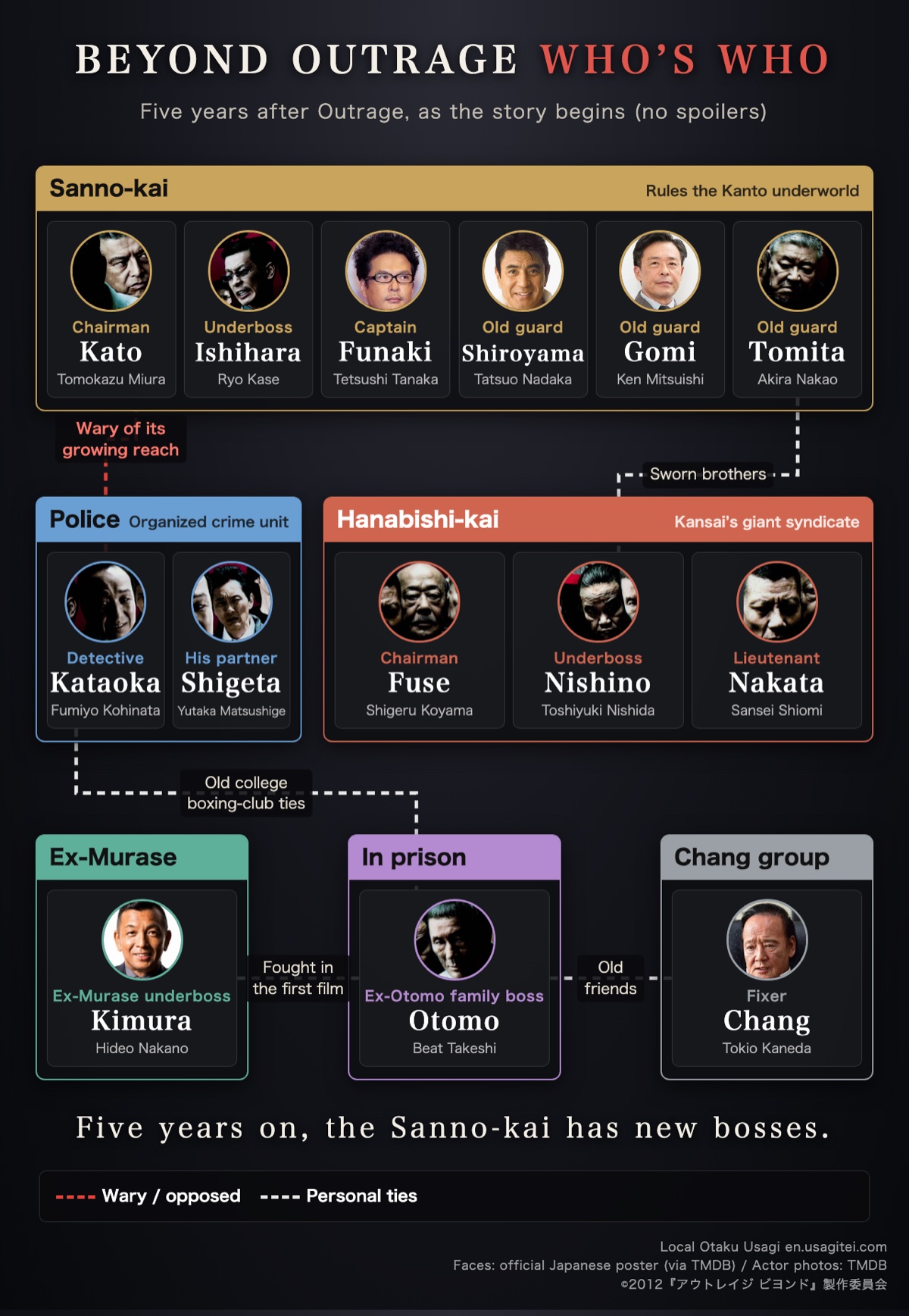
Start with the gold box at the top. After the first film, Kato (Tomokazu Miura) has become the second chairman of the Sanno-kai, and his underboss and right hand is Ishihara (Ryo Kase), who used to keep the books for Otomo’s crew. The new regime measures people by how much money they bring in, and old-guard executives such as Tomita (Akira Nakao) have been pushed to the edges. Below them sits the Hanabishi-kai, based in the Kansai region around Osaka: Fuse (Shigeru Koyama) is chairman, Nishino (Toshiyuki Nishida) is underboss, and Nakata (Sansei Shiomi) is his lieutenant. Nishino and the Sanno-kai’s Tomita are sworn brothers, and that single line is what connects east to west.
Outside the gangs are Detective Kataoka (Fumiyo Kohinata) and his partner Shigeta (Yutaka Matsushige) of the Tokyo police organized crime unit. The police are alarmed by how far the Sanno-kai has spread, all the way into politics, and Kataoka is sent back to the front line. Otomo (Beat Takeshi, Kitano’s performing name) has been in prison since the war in the first film, and the rumor is that he died there. Kimura (Hideo Nakano), whom Otomo fought in that war, is already out. Chang (Tokio Kaneda), a fixer who works across Japan and Korea, is an old friend of Otomo’s. Notice that every line running from Otomo points away from the Sanno-kai.
| Group | Position | Character | Actor |
|---|---|---|---|
| Sanno-kai | Chairman | Kato | Tomokazu Miura |
| Sanno-kai | Underboss | Ishihara | Ryo Kase |
| Sanno-kai | Captain | Funaki | Tetsushi Tanaka |
| Sanno-kai | Old guard | Shiroyama | Tatsuo Nadaka |
| Sanno-kai | Old guard | Gomi | Ken Mitsuishi |
| Sanno-kai | Old guard | Tomita | Akira Nakao |
| Police | Detective | Kataoka | Fumiyo Kohinata |
| Police | Detective | Shigeta | Yutaka Matsushige |
| Hanabishi-kai | Chairman | Fuse | Shigeru Koyama |
| Hanabishi-kai | Underboss | Nishino | Toshiyuki Nishida |
| Hanabishi-kai | Lieutenant | Nakata | Sansei Shiomi |
| Ex-Murase family | Former underboss | Kimura | Hideo Nakano |
| In prison | Former boss | Otomo | Beat Takeshi |
| Chang group | Fixer | Chang | Tokio Kaneda |
🎬 Trailer
Magnolia Pictures released Beyond Outrage in the US, and this is the official trailer from its YouTube channel.
Work Info
- Title: Beyond Outrage (Japanese title: Autoreiji Biyondo)
- Released: October 6, 2012 (Japan)
- Director and screenplay: Takeshi Kitano
- Cinematography: Katsumi Yanagijima
- Music: Keiichi Suzuki
- Cast: Beat Takeshi, Toshiyuki Nishida, Tomokazu Miura, Ryo Kase, Hideo Nakano, Yutaka Matsushige, Fumiyo Kohinata, Katsunori Takahashi, Kenta Kiritani, Hirofumi Arai, Sansei Shiomi, Akira Nakao, Shigeru Koyama
- Runtime: 112 minutes (rated R15+ in Japan, R in the US)
- Festival: In competition at the 69th Venice International Film Festival (2012)
- Series: Outrage (2010), Beyond Outrage (2012), Outrage Coda (2017)
- Source: TMDB
📖 Synopsis – No Spoilers
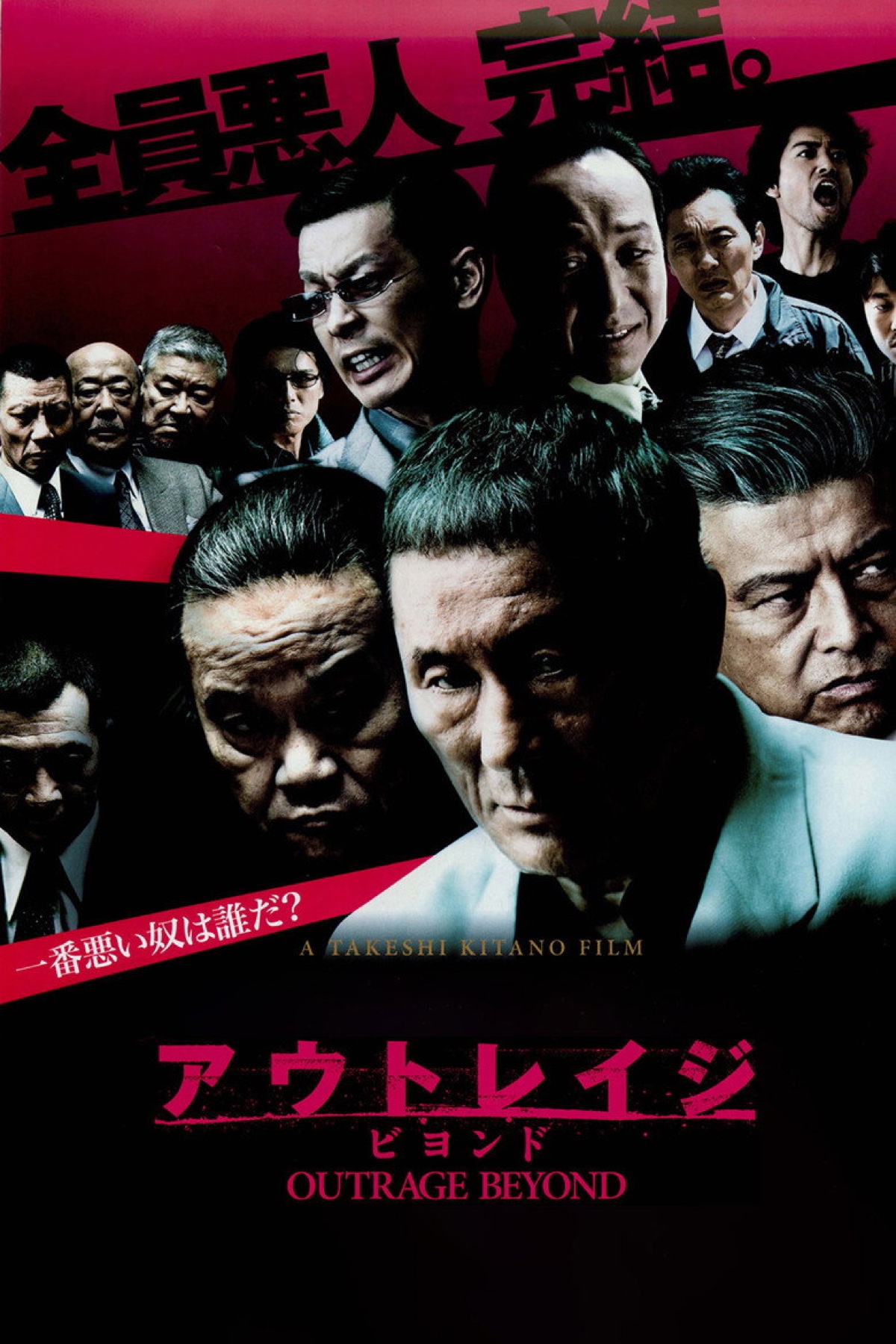
Five years have passed since the last gang war. Under its second chairman, Kato, and his underboss, Ishihara, the Sanno-kai has been rebuilt into an organization that values earning power above everything, and it has grown big enough to lean on politicians. Worried, the police put Detective Kataoka back on the front line. Kataoka sets his sights on two things: the old-guard executives who resent the new regime, and the Hanabishi-kai, the giant syndicate out west.
The other card Kataoka plays is Otomo, the man everyone believed had died in prison. Otomo is alive, and with Kataoka pulling strings, he is let out partway through his sentence. The trouble is that Otomo has no interest in going back to war. If the man himself will not move, how does Kataoka drag him back onto the board? That is where the story takes off.
✨ What Makes It Special
Why It’s Exceptional
- A Tokyo-versus-Osaka shouting match whose timing turns menace into comedy
- Detective Kataoka quietly running the whole gang war from the sidelines
- A revenge story told from Otomo’s side, easier to follow than the first film
- Actors loved in Japan for gentle roles, reborn as Kansai gangsters
- Even the bit parts have faces you remember
The Tokyo-versus-Osaka shouting match is a comedy routine in disguise
The scene I enjoyed most is the one where Otomo’s side walks into a sit-down with the Hanabishi-kai’s top brass. Nishino and Nakata pick a fight on purpose, to grab the upper hand, and Otomo will not give an inch. Insults fly, the room is one wrong word from bloodshed, and I could not stop smiling. Honestly, this is a scene I would happily replay on its own.
The pleasure is in the tempo and the pauses. Nishino leans forward and rattles off threats in a rolling Kansai accent. Nakata stays slumped back in his chair and lands the follow-up in a low growl. The pressure comes from the front, then from above, then from the front again. Kitano answers with short, flat lines in Tokyo speech. The abuse goes back and forth with the timing of a two-man comedy act, and it never sounds as if actors are reading a script; each man seems to wait for the other’s breath before cutting in.
Here is something the English subtitles cannot carry. In Japan, the Kansai dialect of Osaka is the accent most people tie to manzai, the fast two-man stand-up that fills Japanese TV, and Kitano himself started out as half of a manzai duo before he ever directed a film. So when Kansai gangsters and a Tokyo gangster go at each other, a Japanese ear hears two regional voices colliding, one of them the voice of comedy. I suspect this scene plays differently if you grew up with those accents. Read the subtitles for the content, but listen to the music of it too.
And there are many kinds of yelling. An old executive gets chewed out by a younger underboss. Another man struts until he realizes the other side is stronger, then changes his tone in a heartbeat. The harder these men try to intimidate, the smaller they look. Cowardice, self-protection, age. The villains here are all a little weaker than the ones in the first film, and that weakness rides on their voices, so a frightening scene flips over into something funny. That is how two hours of screaming become something you enjoy listening to.
Kataoka: villain to the yakuza, hero to everyone else?
My MVP is Kataoka, without a doubt. He feeds the Sanno-kai, the Hanabishi-kai and Otomo one spark after another and lets them tear into each other. He never fires a gun, yet he is the one moving the ranks up and down. The gangsters are shouting at the center of the frame, but Kataoka is the one running the show from backstage. Fumiyo Kohinata plays him without a trace of tragedy. He seems to be having a good time in the role, and that is what I love most about him.
Seen from Otomo’s side, there is no more infuriating man alive, and since the story follows Otomo, Kataoka reads as the one you are supposed to hate. But I cannot call him a simple villain. To the yakuza he is a total scoundrel. To ordinary citizens he is the officer who got the gangs to wear each other down. Which face you see depends on where you stand, and his work, right through to the last scene, is the best thing in the film.
Gentle faces, Kansai gangsters
The first film’s trick of casting nice-guy actors as villains goes further this time. Toshiyuki Nishida is known to a whole generation in Japan as Hama-chan, the cheerful fishing-mad salaryman of the long-running Tsuribaka Nisshi comedies, and here he threatens people in thick Kansai dialect as the Hanabishi-kai’s underboss. Sansei Shiomi seems to be the real thing the moment he appears. Katsunori Takahashi gets almost no lines, and the air still cools whenever he stands in frame. Knowing how soft these faces usually are makes the menace hit harder.
Deeper Themes
The Japanese marketing slogan was the same as the first film’s: “Zen’in akunin,” everyone’s a villain. So who is the worst of them? By the yakuza yardstick, it is Kataoka, who tramples on every code of honor and every exchange of sake cups without a second thought. By an ordinary citizen’s yardstick, he is a police officer taking organized crime apart from the inside. In a world with nothing but villains, who counts as evil depends on where you are standing. Side with Otomo and Kataoka makes you furious; take one step back and you find yourself admiring his technique. That swing is the most interesting thing about the film.
🎭 Memorable Scenes
First, the Hanabishi-kai meeting I described above. At the peak of the shouting, Kimura settles the room with one act. In the first film he read as a small-timer; in that instant you understand how much resolve he carries. The fun of the shouting match and the weight of Kimura’s nerve sit in the same scene.
Second, the batting cage. Otomo invites a certain man, all smiles, to hit a few balls. I will not say what happens, but it is the most satisfying piece of payback in the film. It is a cruel scene, and the method is perfect.
Third, the final scene. I will say nothing about it, except that it is where Kataoka’s role in the whole story comes into the sharpest focus.
💭 How It Made Me Feel
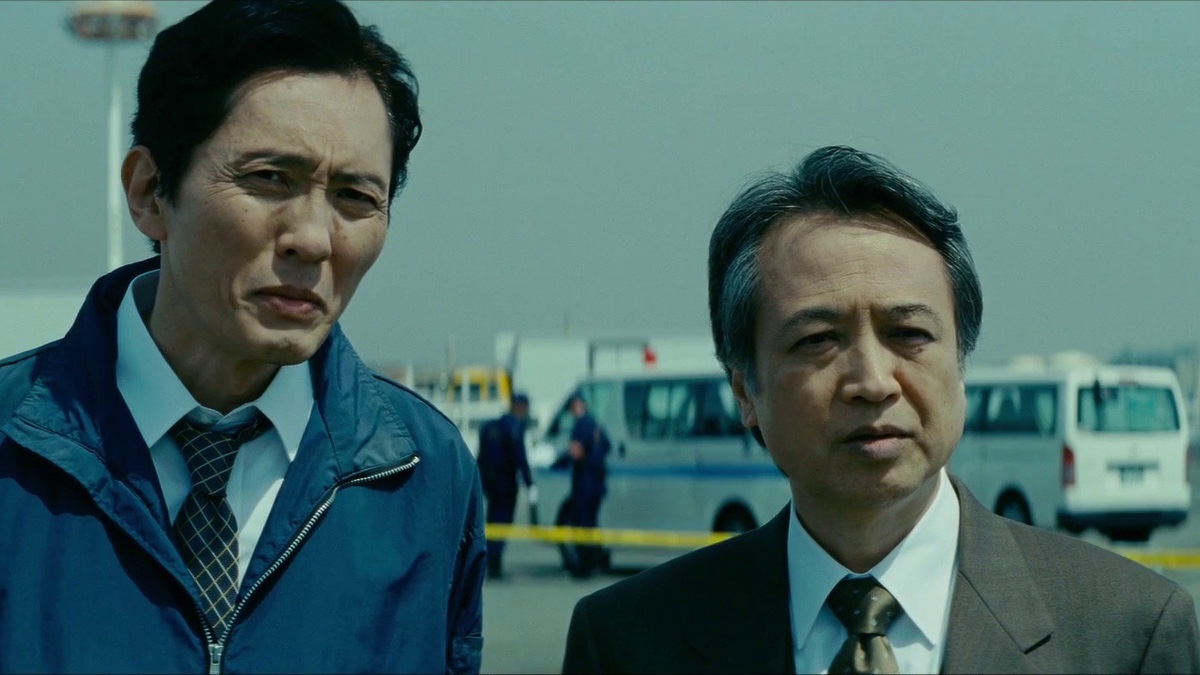
What stayed with me was a rush, not a weight. Watching it, you feel as if you are settling the scores one by one right alongside Otomo. As entertainment, it is clearly easier to follow than the first film. It is not a film that sends you deep into anything, but it is a well-made sequel that is a pleasure to watch. Japanese audiences agreed: it reportedly opened at number one at the Japanese box office in its first three days, a first for any Kitano film.
Who Should Watch This?
- Anyone who enjoyed Outrage (2010) (the strongest reason)
- Viewers who love watching actors spar with each other, especially at full volume
- Anyone in the mood for a revenge story that leaves you feeling good
😅 Where It Falls Short
I have been listing everything I enjoyed, but I owe you the comparison with the first film too. Two things fell short.
Leaning into entertainment made the violence lighter
There is still nasty violence in this film. It just feels lighter somehow. The first film had several moments where the pain came through the screen and you wanted to look away. Rebuilt as an easy-to-follow revenge story, Beyond Outrage puts its violence on the side of the story’s satisfaction. You feel “that was satisfying” before you feel “that hurt.” There are also fewer of the quiet, dialogue-free pauses that define Kitano’s films. I think that was the price of clarity. The one exception is the batting cage: that payback is the best-designed act of violence in the film.
Skip the first film and the lines get tangled
The story starts from the ending of the first film. Who became chairman, who betrayed whom, why Otomo is in prison: almost none of it is explained. Then the Hanabishi-kai crew arrives on top of that, so without the first film, the web of characters gets knotted early. Watch Outrage (2010) first if you can. If you are short on time, the chart and table above will carry you a long way.
Who Might Not Enjoy This?
- Anyone who has not seen the first film and does not want to read up on the characters
- Viewers hoping for the quiet, lingering Kitano of Sonatine
- Anyone who struggles with long stretches of shouting and violence (rated R15+ in Japan)
📺 Streaming Guide by Service
The Available Routes
- Amazon Prime Video: included with Prime (listed through January 19, 2027)
- Tubi and The Roku Channel: free with ads
- Kanopy and Hoopla: free with a participating library card
- Apple TV, Fandango at Home: rent or buy
- Netflix, Hulu, HBO Max, Crunchyroll: not available
Already paying for Prime? Then Prime Video is the easy route, while the January date holds. Without Prime, Tubi costs nothing but a few ad breaks. Watch the trilogy in release order: Outrage (2010), Beyond Outrage (2012), then Outrage Coda (2017). The story runs straight on from one film to the next, so do not shuffle them. To own it, look for the US Blu-ray or DVD on Amazon. The Hanabishi-kai shouting match goes by too fast to catch in one viewing, and a disc lets you rewind it as often as you like.
Soundtrack
Keiichi Suzuki returns from the first film. The soundtrack album, OUTRAGE BEYOND, has 27 tracks: the 15 cues from the film, then the trailer music, alternate takes and demos. The titles read as chapter headings (“A Detective,” “Go West on the Highway,” “The Black Summit Conference”), so the track list alone walks you back through the film. The album is on Apple Music in Japan, but it was not listed in the US store when I checked, so there is no US link to give you.
🎬 If You Loved Beyond Outrage, Watch These 3 Next
Three ways out of Beyond Outrage: a detective who works the gangs from the inside, a crew that wins every fight with words alone, and a Korean noir built on the same slogan.
The Blood of Wolves (2018)
Kataoka’s side of the line, given a whole film. In a fictional Hiroshima city in 1988, veteran detective Ogami (Koji Yakusho) drinks with gangsters, takes their money and breaks the law on the job, with two families one incident away from open war, while the rookie paired with him (Tori Matsuzaka) is quietly sent to gather evidence against him. Kataoka feeds the fire from a distance. Ogami lives inside it. If you came away admiring Kataoka’s technique, this shows what working that close to the flames does to a man. US viewers will find it on Shudder or AMC+, and I wrote it up here: The Blood of Wolves.
Tokyo Swindlers (2024, Netflix series)
A crew of land swindlers who pose as property owners to cheat buyers out of huge sums. There are almost no guns and very little yelling; they win by moving the other side’s judgment one conversation at a time and taking control of the room. If the Hanabishi-kai meeting was your favorite part of Beyond Outrage, this gives you that kind of verbal chess for seven straight episodes. The crew’s leader, Harrison Yamanaka (Etsushi Toyokawa), steers people while never raising his voice, and, just as with Kataoka, there is no tragic air about him at all. As an ensemble of villains fighting with words, it sits right next to Kitano’s film. It streams on Netflix.
Asura: The City of Madness (2016, South Korea)
I have not seen this one yet; it is the Korean noir I want to watch next. In a fictional city, a detective (Jung Woo-sung) does the dirty work for a corrupt mayor, then gets leaned on by a prosecutor who wants the mayor’s crimes exposed, until both sides are using him. Kataoka is the one who throws fuel on the fire; this detective is the one it gets thrown on. After a film sold in Japan on the slogan “everyone’s a villain,” I want to see how that same idea plays with Korean cinema’s ruthlessness. In the US it streams free with ads on The Roku Channel and rents on Amazon.
👉 More Japanese crime and yakuza movies, and where to stream them in the US
⚠ Spoilers: What Is Kataoka Actually After?
This section covers the middle and later parts of the film. It does not give away the ending, but if you have not watched yet, stop here and come back afterward.
Put simply, Kataoka wants the gangs to destroy each other, bring down the Sanno-kai, and ride the credit upward himself. He never fires a shot. He uses the resentments and grudges between the families as fuel and lets them grind each other down.
His first attempt uses the two forces at the top of the chart: the Sanno-kai old guard shut out by the new regime, and the Hanabishi-kai, where Tomita’s sworn brother Nishino sits. Through that line he hopes to split the Sanno-kai from within. But Kato’s Sanno-kai has already made a secret deal with the Hanabishi-kai. The plan leaks, and Kataoka hits a dead end.
So he plays the Otomo card. He gets Otomo, who has every reason to hate the Sanno-kai, out of prison, brokers a reconciliation with Kimura, his old enemy from the first film, and plants the idea that the real enemy is the Sanno-kai. When Otomo still will not move, Kataoka goes as far as setting up a situation where Ishihara wants Otomo dead, leaving him no choice but to fight. Otomo’s revenge plays out on a stage Kataoka has built.
As the Sanno-kai weakens, the Hanabishi-kai grows in its place. Voices inside the police start asking whether Kataoka should answer for all this, and he turns the same playbook on the Hanabishi-kai. To Kataoka, Otomo is a piece for moving the board, right to the end. How that piece makes its last move is something to see for yourself.
❓ Beyond Outrage FAQ
Do I need to see Outrage (2010) first?
You can follow the plot without it, but you will get about half the fun. The film starts five years after the first one ends and assumes you know who betrayed whom and who ended up in charge. If you are short on time, read the chart and table above before you press play.
What order should I watch the Outrage movies in?
Release order: Outrage (2010), Beyond Outrage (2012), Outrage Coda (2017). The story follows that order too.
Who is Kataoka?
An organized crime detective with the Tokyo police, played by Fumiyo Kohinata. He appears in the first film too, and he was Otomo’s junior in their college boxing club. In Beyond Outrage he is sent back to the front line to rein in the Sanno-kai and becomes the man moving the story from behind the scenes.
📝 Final Thoughts
Beyond Outrage keeps the first film’s dry violence and its shifting ensemble, then adds the pleasure of a good argument and a revenge story you can cheer for. The Hanabishi-kai sit-down where Tokyo and Kansai speech collide, and a detective quietly feeding fuel to both coasts: those two things alone make 112 minutes go by fast. The first film keeps the edge on pain and aftertaste. For pure fun, this is the easier one to recommend.
If you have Prime, it is waiting for you until January; if not, Tubi has it for free. Before you start, trace the one line on the chart that connects east and west. Once you know who is sworn brother to whom and who holds a grudge against whom, you can hear which line each insult is shaking.
⭐ Series at a Glance
| Category | Rating |
|---|---|
| Story | ★★★☆☆ |
| Dialogue & sparring | ★★★★★ |
| Casting | ★★★★★ |
| Felt pain of the violence | ★★★☆☆ |
| Music | ★★★☆☆ |
| Ease of watching | ★★★★☆ |
Usagi’s Recommendation Score
⭐⭐⭐⭐⭐⭐⭐⭐☆☆
7.5 / 10
The shouting turns into a comedy act, and a detective keeps feeding the fire. Easier to follow than the first film, and a sequel that is simply fun.

 streams on Prime Video in the US and free on Tubi, yet nowhere in Japan. A Jap)