*This page contains affiliate links. We may earn a commission if you make a purchase through these links.
What does Major Motoko Kusanagi’s laugh sound like? If you only know Mamoru Oshii’s 1995 film, you have probably never asked. I’m a fan of that film and of its sequel, Innocence, so I went into Science SARU’s ten-episode The Ghost in the Shell (2026) with my guard up. I came out having enjoyed it a lot.
In one line: this is the light, noisy Ghost in the Shell that follows Masamune Shirow’s original manga. The Major trades jabs with her team, Section 9 never stops talking, and the action moves fast. It also shows you, scene by scene, which parts of the manga Oshii picked up to build his two films. Still, if you ask me which version I prefer, I’ll pick Oshii’s, nostalgia bias and all. Below: where it streams in the US, the main differences from the 1995 film, what I loved, and the three things that bugged me.
📺 Where to Watch The Ghost in the Shell (2026) (October 2026)
| Service | Status | Notes |
|---|---|---|
| Amazon Prime Video | Streaming | All 10 episodes, included with Prime |
| Crunchyroll | Not available | Not in the US catalog |
| Netflix | Not available | Streams on Netflix in Japan only |
| Hulu | Not available | Not in the US catalog |
| HBO Max | Not available | Not in the US catalog |
| Disney+ | Not available | Not in the US catalog |
Checked on October 30, 2026: Prime Video is the only place to stream The Ghost in the Shell (2026) in the US, and it comes with a regular Prime membership. Amazon streams it worldwide, in more than 240 countries and territories by its own count, with Japan and Vietnam excluded. Back here in Japan it is the opposite story: as of today, seven services carry it, Netflix, Disney+, Hulu and U-NEXT among them, and in its broadcast run Prime Video put each episode up 30 minutes after it aired on TV. Catalogs change, so check Prime Video before you plan a weekend around it.
📣 If you want to compare, the next one to watch is Oshii’s Ghost in the Shell (1995), which is free with ads on Tubi in the US. It tells the same manga’s Puppet Master case as a quiet film with almost no jokes in it.
🎬 Trailer
The Season 1 trailer, posted by Rotten Tomatoes TV the week before the premiere.
The Series in Three Lines
- Ten episodes that follow the manga, with Section 9 closing one case at a time
- The first half leans comedy on the Major’s banter with her team; the second half turns serious
- Same source as Oshii’s film, a completely different mood
Work Info
- Title: The Ghost in the Shell (Japanese title: Kōkaku Kidōtai THE GHOST IN THE SHELL)
- Broadcast in Japan: July 7 to September 8, 2026, on Kansai TV and the Fuji TV network
- Episodes: 10, in a half-hour slot
- Original Work: Masamune Shirow, Ghost in the Shell (Kodansha)
- Director: Moko-chan / Series Composition and Screenplay: Toh EnJoe
- Character Design and Chief Animation Director: Shuhei Handa
- Music: Taisei Iwasaki, Ryo Konishi, YUKI KANESAKA
- Japanese Voice Cast: Maaya Sakamoto (Motoko Kusanagi), Hiroki Yasumoto (Batou), Kazuhiro Yamaji (Daisuke Aramaki)
- Theme Songs: opening “GO GHOST” by King Gnu / ending “Blue” by MILLENNIUM PARADE feat. Saya Gray, Daniel Caesar
- Animation Production: Science SARU
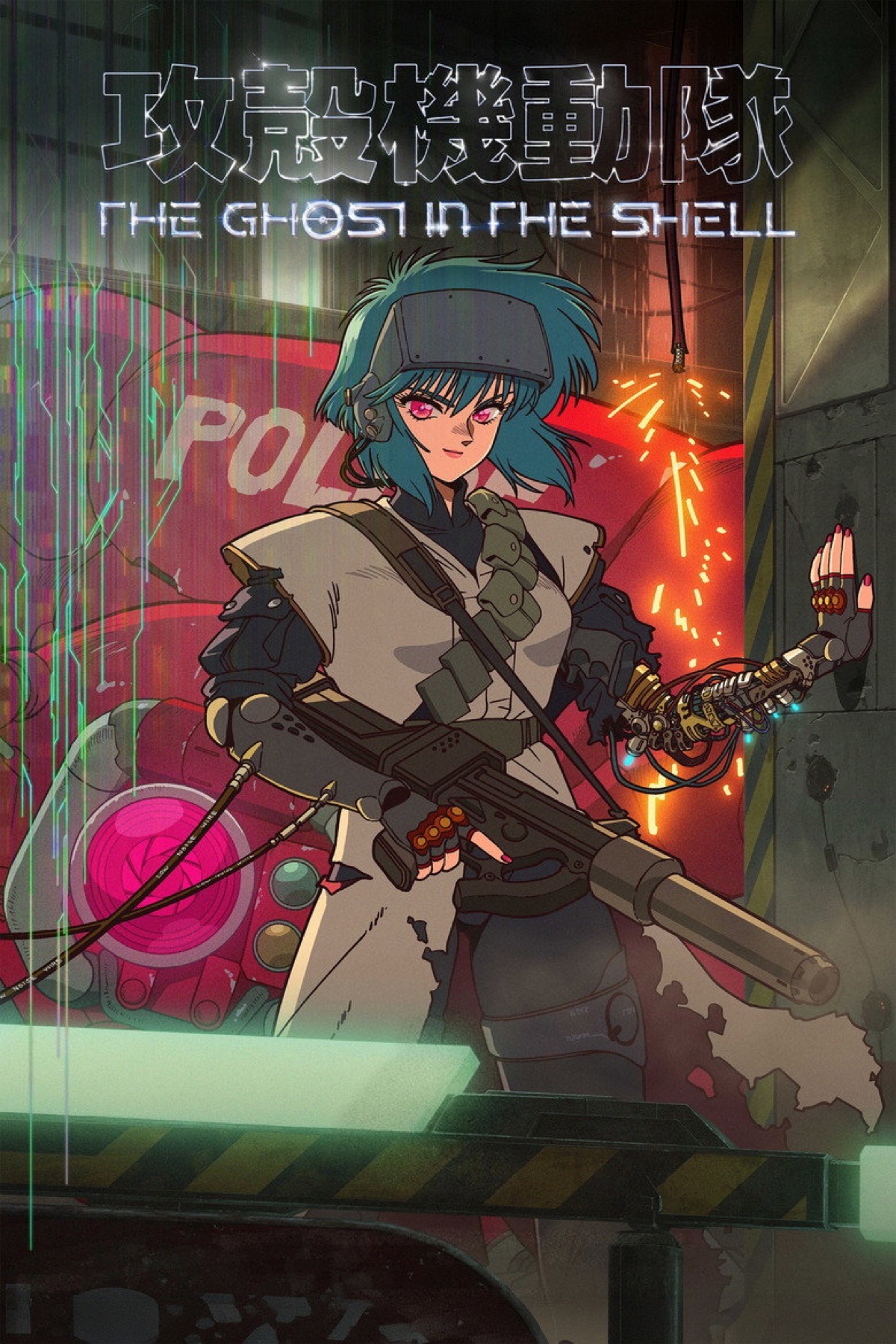
📖 Synopsis – No Spoilers
Japan, 2029. Wiring your brain straight into the network is normal, and so is swapping part or all of your body for a cybernetic one. Motoko Kusanagi, a full-body cyborg, is recruited with her squad by Daisuke Aramaki of the Ministry of Home Affairs, and they start work as Public Security Section 9, a small unit built to stop cybercrime and terrorism before it happens. The Japanese title is the unit’s own nickname: Kōkaku Kidōtai. Batou, Togusa, Ishikawa, Saito, Borma and Paz make up the team, with the Fuchikoma think tanks running alongside them.
Most cases wrap up in one or two episodes. An assassination at a secret meeting, a raid on a facility suspected of abusing children, a virus planted in someone’s cyberbrain. In between, the shadow of the Puppet Master, an unidentified hacker who slips into other people’s cyberbrains and steers them, grows a little darker each week.
How Many Episodes, and Is There a Season 2?
The series is 10 episodes long and adapts the first book of the manga. A direct Season 2 has not been announced. What was announced, on October 23, 2026, is a new Ghost in the Shell anime from Bandai Namco Filmworks, again animated by Science SARU. Its format and release date have not been revealed yet.
👥 The Ghost in the Shell (2026) Characters and Voice Cast
These are the people the official site introduces, with what you learn about them in the early episodes. Nothing from the second half is here, and the Puppet Master’s identity stays off the page.
The chain of command is simple. Aramaki, from the Public Security side of the Ministry of Home Affairs, recruits the Major and founds the unit; the official site calls him Section 9’s strategist. The Major runs Section 9 in the field. Batou is her No. 2, Togusa is the new recruit from the police, Ishikawa is the veteran, and the Operators and the Fuchikoma back the team up.
Section 9 and Aramaki
Backup, and the Puppet Master on the Case File
Character images: TV anime The Ghost in the Shell official site ©2026 Shirow Masamune/KODANSHA/THE GHOST IN THE SHELL COMMITTEE
🆚 The Ghost in the Shell 2026 vs the 1995 Film
Two adaptations of the same manga, and they feel nothing alike while you watch them. Here is the short version.
| 2026 series | 1995 film | |
|---|---|---|
| Made by | Science SARU, directed by Moko-chan | Production I.G, directed by Mamoru Oshii |
| Length | 10 TV episodes | One 83-minute film |
| The Major | Laughs, snaps, gets flustered | Quiet, searching for proof of who she is |
| Section 9 | A chatty team; Togusa gets teased as the rookie | Mostly the Major with Batou |
| Mood | Comedy first, serious later | Still, heavy from start to finish |
| Use of the manga | Follows it closely, margin notes included | Picks a few threads, rebuilds them |
| US streaming | Prime Video | Free with ads on Tubi |
What fascinated me most was seeing which parts of the manga Oshii cut out to make his films. Episode 4, “ROBOT RONDO,” is the manga chapter that became the basis for Innocence.
As an Oshii fan, I came away seeing both what his approach gave us and what it cost. What it gave us is the two films themselves. What it cost: the worldview he planted was so strong that, for many of us, it became the only Ghost in the Shell. This series hands back the lightness the manga always had, and puts it in motion.
Which Should You Watch First, the 2026 Series or the 1995 Film?
My answer: either one. Pick by taste, then watch the other and compare.
If you’re still stuck, start with the 2026 series if you want an easy way in through banter and action, and with the 1995 film if quiet, heavy cinema is more your taste. If you go on from the 1995 film to Innocence, episode 4 of this series gets a lot more fun. For every version of the franchise in one place, see our Ghost in the Shell watch order.
✨ What Makes It Special
Why It’s Exceptional
- The Major’s banter with Section 9 makes it a real team show
- Fast, light action with the Science SARU touch
- The mood shifts halfway, so you get two kinds of Ghost in the Shell in one series
- So faithful to the manga that even Shirow’s margin notes appear on screen
A Major Who Laughs, and a Section 9 That Never Shuts Up
The biggest fun for me was Section 9 itself, which has a different charm from the films. In Oshii’s version, the Section 9 story is mostly the Major and Batou. Here, her subordinates gossip about her behind her back, the new guy Togusa gets ribbed as the rookie, and the Fuchikoma chatter away while they scramble around a crime scene. The Major gives as good as she gets. She loses her temper a lot, and she gets embarrassed.
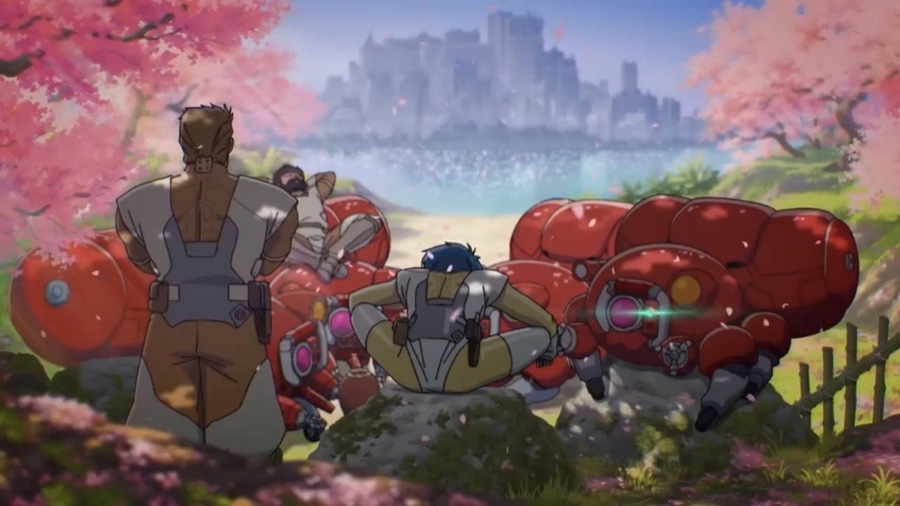
I think Oshii’s Major was quiet because she was a woman forever searching for proof that she is herself. This Major is simply a person from the very first scene. Same Motoko Kusanagi, different woman. Once that sank in, every wisecrack she threw out felt new to me, a small “oh, so this is who she was.”
Look, I know how this sounds coming from an Oshii fan. But then Science SARU’s action lands on top of all that. Gunfights on the run, Fuchikoma swinging through the gaps between buildings on wires, the Major melting into the scenery with thermoptic camouflage. Where Oshii lets a shot breathe, this show keeps moving, one beat after the next. An action-first, fast-moving Ghost in the Shell turned out to be a completely new kind of fun, even for an Oshii fan. A team that trades insults all day and then gets the job done when it counts: the pleasure is close to watching Lupin the Third and his gang.
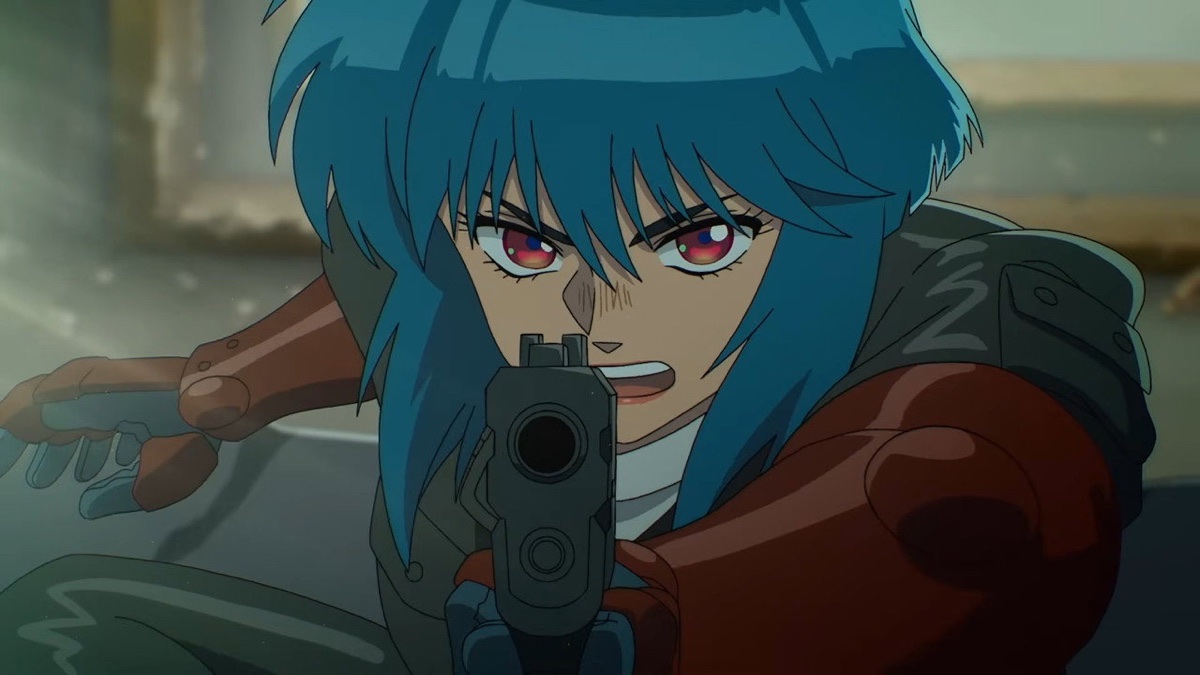
Comedy First, Then Serious: Two Treats in One
The first half of the ten episodes is upbeat, even when the cases are ugly. You’re enjoying the back-and-forth, and the episode is over. In the second half the laughs thin out and the story turns serious. The weight that Oshii fans think of as “real” Ghost in the Shell does show up, right on schedule.
A light Ghost in the Shell and a heavy one, back to back in a single series. A show that starts bright and then reveals another face reminded me of Gurren Lagann. Because you’ve grown fond of these people in the first half, the heavy turn actually lands.
Even the Margin Notes Make It to the Screen
Shirow’s manga is famous for the handwritten notes crammed into the margins outside the panels. This series puts those notes on screen as text at the edge of the frame. The episode subtitles reuse the manga’s chapter titles, such as “SUPER SPARTAN” and “JUNK JUNGLE,” and the character art leans toward Shirow’s drawings instead of a smoothed-out modern look. On streaming you can pause to read the notes, so treating it as a close read of the manga, stopping again and again, is a perfectly good way to enjoy it.
Deeper Themes: Asking About the Ghost, or Starting From It
Oshii’s film keeps asking one question: once a person has replaced their whole body with a prosthetic one, is their soul, their ghost, still in there? This series, following the manga, takes the ghost as a given, and Section 9 simply gets on with the job. Because the question is set up differently, the same Puppet Master case means something different by the time each version reaches it. The more you know the 1995 film, the more there is to compare here.
🎭 Memorable Scenes
Early in episode 1, the Major leaps off a building. She shoots an official at a secret meeting, throws herself off the skyscraper, and vanishes into the night skyline under thermoptic camouflage. Oshii’s film opened on a similar shot, and this series puts it at the top of its first episode. In that moment you know it comes from the same source, and the lighter drawing and the speed tell you it’s a different animal.
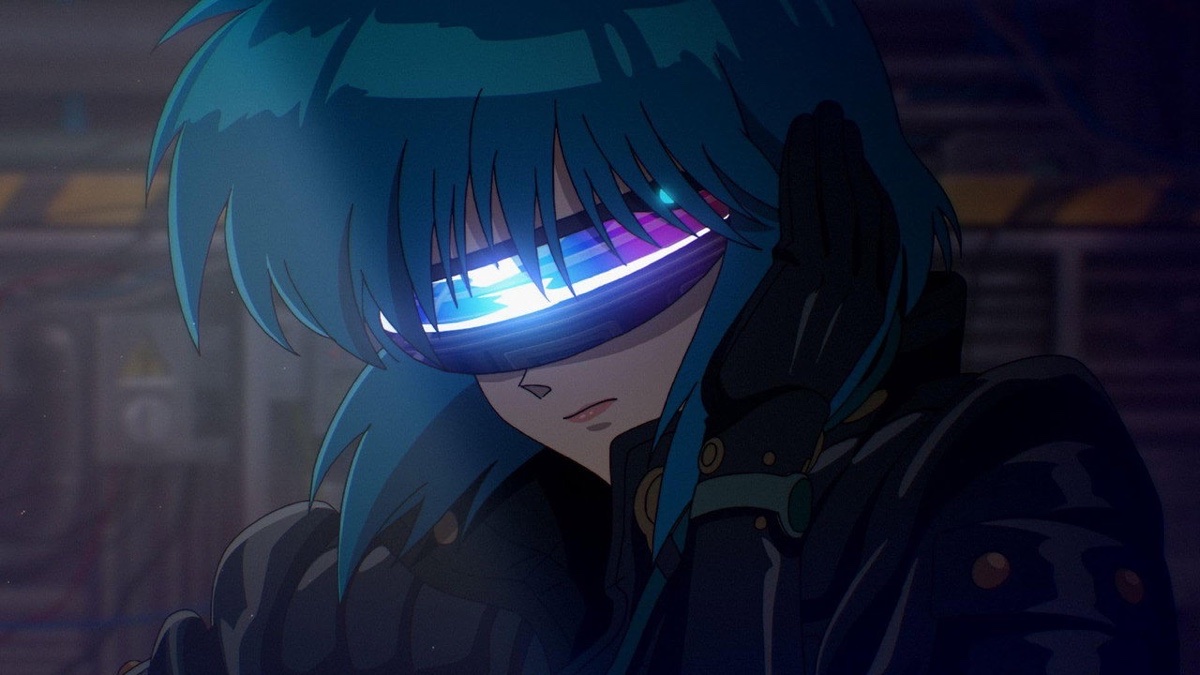
The Major finding out she’s been called a “mesu gorilla,” a she-gorilla, behind her back. She hears it and gets genuinely furious. Oshii’s Motoko would never be in that scene, and it tells you exactly who this Major is in one go.
One line the Major says to a terrorist. In a case midway through, she delivers a line that readers of the manga have been waiting for. I’ll keep the line itself to myself. It shows that the woman who seemed to do nothing but crack jokes can silence someone with a single sentence when she’s on the job.
💭 How It Made Me Feel
I had a good time through all ten episodes. And yet, while the light banter was playing, I often found myself wanting to watch the heavy, difficult Oshii films again. Those two feelings don’t contradict each other. Watching the light Ghost in the Shell is what reminded me what’s good about the heavy one.
This series and Oshii’s are not a choice of one over the other; they’re meant to sit side by side. For me the summit is still, almost reflexively, Oshii’s version. (I know nostalgia is doing some of the talking.) Even so, the thing that made me want to see that film again was this show.
😅 Where It Falls Short
But here’s where I have to be honest. I’ve said how much fun I had, and there are still three things that stop me from recommending it without a warning.
No Glossary, and the Dialogue Moves Fast
Like Oshii’s film, the series never explains its terms. The difference is that the banter here is quick, so cyberbrains, prosthetic bodies, ghosts and thermoptic camouflage fly past before the next exchange starts. The manga works the same way, so a faithful adaptation was always going to, but it’s rough on newcomers. Subtitles help a lot, since you can catch with your eyes the terms you missed with your ears. Don’t try to understand everything; follow the Major and her team’s back-and-forth and the plot will hold together.
The On-Screen Notes Go By Too Fast to Read
The margin notes I praised above have a flip side. Text at the edge of the frame flashes past in an instant, and at normal speed you can’t read it all. Each episode is packed, too. Episode 4, the one I mentioned, covers in a single half-hour episode the manga story that Innocence spent about 100 minutes on. Let it run as regular TV and you can move on to the next episode without being sure what just happened. The show more or less assumes you’re streaming it and pausing as you go.
If You’ve Seen the 1995 Film, the Puppet Master Arc Holds Few Surprises
The Puppet Master lurks from the early episodes and moves to the center of the story in the second half. It’s the same manga, so if you’ve seen Oshii’s film, you can roughly guess where it ends up. I’ll admit the ending held few surprises for me. The comedy also drains out in the second half, so if you came only for the early tone, it may be a letdown. Viewers who haven’t seen the 1995 film will probably take the second half much more freshly than I did.
The Weak Spots
- Terms go unexplained while the dialogue races ahead
- On-screen notes are too quick to read unless you pause
- Few surprises at the end if you know the 1995 film
Who Should Watch This?
- Fans of Oshii’s films or Stand Alone Complex who want to see a Ghost in the Shell that sticks to the manga
- Readers of Shirow’s manga who want to see its noisy energy in motion
- Anyone who has never seen a single Ghost in the Shell and wants an easy way in (my top pick for you)
Who Might Not Enjoy This?
- Viewers who only want the cool, near-silent Major from the 1995 film
- Anyone planning to half-watch while doing chores (miss the on-screen text and the jargon, and you lose the plot)
📺 Streaming Guide by Service
Which Service Should You Use?
In the US there is only one choice: Prime Video, which has all ten episodes with a standard Prime membership. If you also want the older versions, they are spread around. The 1995 film is free with ads on Tubi, Stand Alone Complex streams free on Tubi too, and Netflix has SAC_2045. Innocence is not streaming anywhere in the US right now, so it means buying the disc.
Where to Start Watching
- Amazon Prime Video: Streaming (all 10 episodes, included with Prime)
- Crunchyroll, Netflix, Hulu, HBO Max, Disney+: Not available in the US
Theme Songs
- Opening: “GO GHOST” by King Gnu
- Ending: “Blue” by MILLENNIUM PARADE feat. Saya Gray, Daniel Caesar
The score is by Taisei Iwasaki, Ryo Konishi and YUKI KANESAKA. In Japan the original soundtrack album is out digitally, on Spotify and Apple Music.
📚 The Source Manga
The series tells the story of the first book of Masamune Shirow’s manga. Kodansha publishes it in English as a hardcover, The Ghost in the Shell Deluxe Edition, read right to left as in Japan. If you want to read the margin notes at your own pace, the ones the anime flashes past in a second, the manga is the better fit.
The sequel, The Ghost in the Shell 2: Man-Machine Interface, and the short story collection The Ghost in the Shell 1.5: Human-Error Processor have not been adapted by this series. Kodansha also collects all three books in one volume, The Ghost in the Shell: Fully Compiled.
🎬 If You Loved The Ghost in the Shell (2026), Watch These 3 Next
Patlabor 2: The Movie (1993)
No English-language trailer from an official channel exists for this one, so here is the Japanese trailer from Bandai Namco Filmworks.
If this series leaves you missing Oshii’s weight, start here. Patlabor has long been loved in Japan as a team show full of wisecracks. Oshii turned its second film into a story about a crisis spreading quietly through Tokyo. There is almost no humor; what you see is winter Tokyo and grown men moving with few words. “Oshii takes a light source and makes a heavy film” happened twice, not just with Ghost in the Shell. Watch the two back to back and you’ll understand what kind of director he is. It is not streaming in the US right now; Maiden Japan put out a Blu-ray with English audio.
Gurren Lagann (2007)
For anyone who liked how the mood shifts partway through. It starts as a cheerful robot anime about boys who burst out of an underground village and charge ahead on pure momentum, and then the air of the story clearly changes. Across 27 episodes the swing from bright to heavy is even wider than in Ghost in the Shell. If that kind of structure is your thing, this one won’t miss. US viewers can find all of it on Netflix, Hulu and Crunchyroll. My full take is in the Gurren Lagann review.
Inception (2010)
Getting inside someone’s head, planting an idea, and moving them with it. That is what Ghost in the Shell’s cyberbrain hackers do, and Inception does it with dreams. It also explains a lot of its setup, and you won’t catch all of it the first time, which is one more thing it shares with this series. In my Japanese review on our sister site I wrote that it’s fine not to get it on the first watch. Living with the confusion and getting it on the second pass is its own pleasure. If Ghost in the Shell’s information overload wore you out, that way of watching takes the pressure off. In the US it is not on a subscription service right now; you can rent it on Prime Video, Apple TV and other digital stores.
📝 Final Thoughts
The 2026 The Ghost in the Shell is a way into the franchise through a different door from Oshii’s. You laugh at the Major and Section 9’s banter, get swept up in Science SARU’s action, and then the story turns heavy. For an Oshii fan, it was also ten episodes of checking what Oshii chose from the manga. My score is 7.0 out of 10.
Remember the question at the top, about the sound of the Major’s laugh? Now I know, and hearing it made me want to see the film where she barely smiles all over again. With a new Science SARU anime announced on October 23 and nothing yet known about its format or timing, now is a good moment to watch both the 2026 series and the 1995 film. Start with either one. Just don’t stop at one.
⭐ Series at a Glance
| Category | Rating | Comment |
|---|---|---|
| Characters | ★★★★★ | A Major who laughs, a Section 9 that talks |
| Action | ★★★★☆ | Fast, light, always moving |
| Faithfulness to the Manga | ★★★★★ | Even the margin notes made it in |
| Easy to Follow | ★★☆☆☆ | No glossary, fast dialogue |
| Pacing | ★★★☆☆ | Dense episodes; pausing helps |
| For Fans of the 1995 Film | ★★★☆☆ | Fresh first half, a familiar destination |
Usagi’s Recommendation Score
⭐⭐⭐⭐⭐⭐⭐☆☆☆
7.0 / 10
Watch it next to the 1995 film, and both get better

 in the US (Prime Video only), how Science SARU’s 10-epi)