*This page contains affiliate links. We may earn a commission if you make a purchase through these links.
My taste runs quiet. Long stretches where nobody raises their voice, films that trust you to sit still. So, up front: Gurren Lagann is the opposite of everything I normally reach for, and I finished all 27 episodes with my pulse up anyway. The show never asks what you like. It simply arrives at full volume and keeps going, and the pace is fast enough that there is no convenient place to get off.
There is also something worth knowing before you start: this series turns into a different show partway through. Episode 16 is a clip show covering the first two arcs, and episode 17 jumps seven years forward. The boy who dug holes for a living comes back as a man running a government. Almost every argument fans have about this series happens on one side or the other of that line. Below is where to watch it in the US right now, what the first half does better than nearly anything in the genre, and why I still think the back half widens the map further than it can fold it back up.
📺 Where to Watch Gurren Lagann (October 2026)
| Service | Status | Notes |
|---|---|---|
| Netflix (US) | Streaming | All 27 episodes on the base plan |
| Hulu | Streaming | Full series, included with a Hulu subscription |
| Crunchyroll | Streaming | Full series on a standard Crunchyroll plan |
| Amazon Prime Video | Add-on | Requires the paid Crunchyroll channel on top of Prime |
| Fandango At Home | Rent / Buy | Buy the complete season |
| HBO Max | Not available | No US listing |
| Disney+ | Not available | No US listing |
| Apple TV | Not available | No US listing found |
Gurren Lagann is on Netflix, Hulu and Crunchyroll in the United States, and any one of the three gets you all 27 episodes on a regular plan. The series does appear under a Prime Video search, but it arrives through the Crunchyroll Amazon Channel, which is a separate monthly charge on top of Prime. Prime membership alone will not open it.
To own it, Fandango At Home lists the whole season for digital purchase, and the Blu-ray is the other route.
Japan: U-NEXT and Hulu Japan, among others. Not on Netflix Japan.
🔢 How Many Episodes Is Gurren Lagann, and Do You Need the Movies?
The TV series is 27 episodes of about 24 minutes, close to eleven hours in all, and it is the complete story. The two movies, Childhood’s End (2008) and The Lights in the Sky Are Stars (2009), retell it with new animation and do not continue it, so the order is simple: the series first, then the films if you want the story again on a bigger canvas.
Childhood’s End condenses the first fifteen episodes and adds about twenty minutes of new footage. The Lights in the Sky Are Stars takes the second half and changes more, with a substantially reworked final battle. I would not use either as a shortcut. Fifteen episodes folded into one film has to lose something, and the stretch after Kamina works because it takes its time. Neither film turned up on a US streaming service when I checked.
The second film’s English title has a history worth knowing. It is the title of the final TV episode, 天の光はすべて星, and that phrase is itself borrowed: it is the Japanese title of Fredric Brown’s 1953 science-fiction novel The Lights in the Sky Are Stars. So the film’s English name is an American novel’s title that went into Japanese and came back out again. For a show about drilling upward until the sky gives way, it is a fitting thing to have borrowed.
🎬 Trailer
A television series never gets a theatrical trailer, so there is no 2007 original to point you at. This is the English-language promo cut by Aniplex of America, the current North American license holder, for their home video release. It is the closest thing to an official English trailer that exists for the TV run.
Work Info
- Title: Gurren Lagann (Japanese title: 天元突破グレンラガン / Tengen Toppa Gurren Lagann)
- Broadcast: April 1 to September 30, 2007, on TV Tokyo and affiliates, 27 episodes
- Director: Hiroyuki Imaishi (later a founder of Studio Trigger, 2011)
- Series composition and scripts: Kazuki Nakashima
- Character design: Atsushi Nishigori
- Animation production: GAINAX
- Music: Taku Iwasaki
- Opening theme: Sorairo Days by Shoko Nakagawa
- English release: ADV Films (2007), then Bandai Entertainment (2008), then Aniplex of America (2013). Aired on Sci Fi Channel from 2008 and on Toonami from 2014
- Source: TMDB, plus the broadcast and licensing record
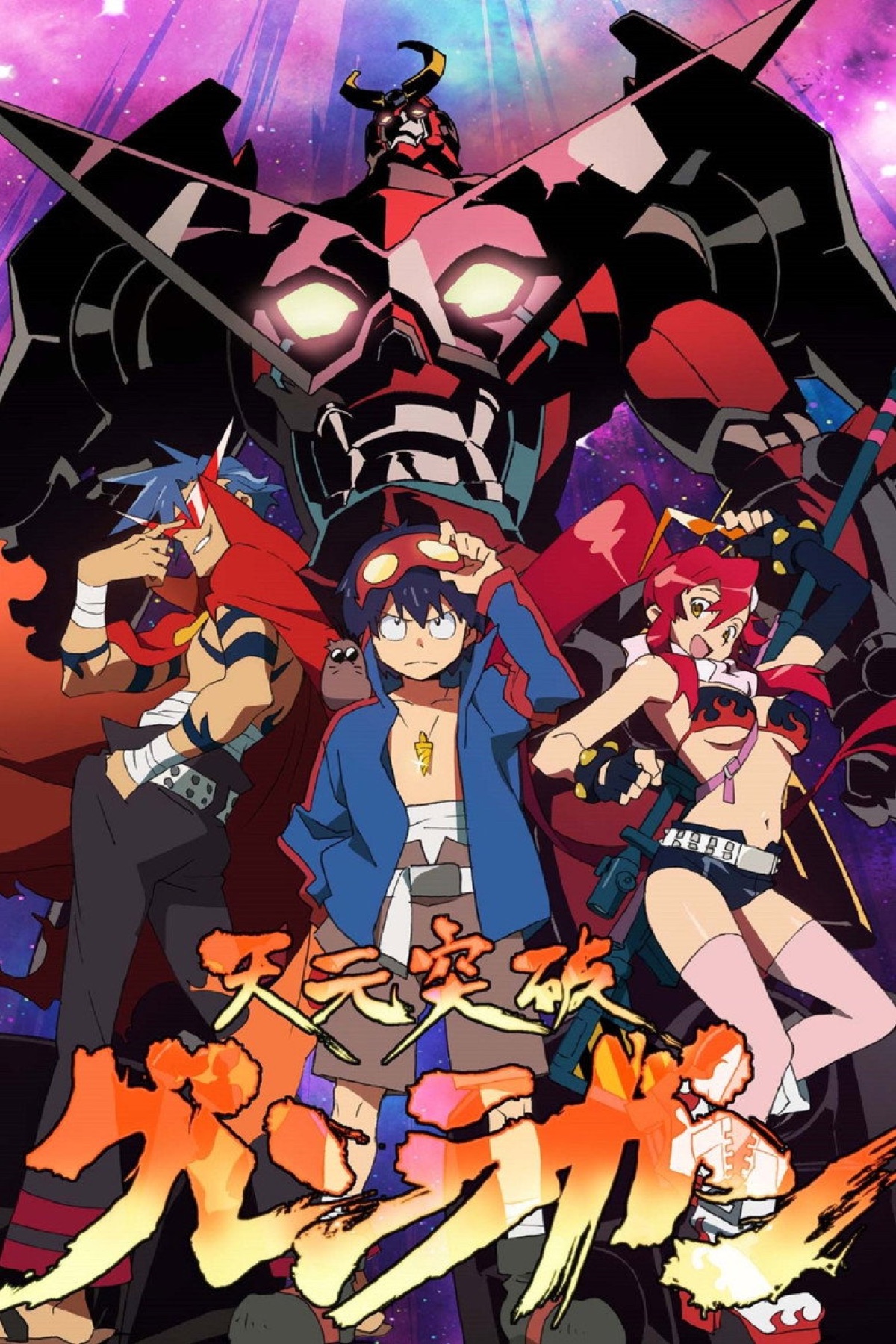
📖 Synopsis, No Spoilers
Humanity lives underground in sealed villages, and nobody remembers why. Simon is a boy whose only skill is digging, which the village treats as a small and slightly embarrassing job. His self-appointed big brother Kamina has one idea and repeats it constantly: there is a surface above them, and he intends to reach it. When the ceiling breaks, the two of them get their wish, and the surface turns out to be ruled by beastmen piloting enormous machines called Gunmen.
What Simon dug up is a tiny drill, and the drill turns out to be the ignition key for a small Gunman of his own. Bolt that to a captured enemy machine and you get Gurren Lagann.
✨ What Makes It Special
Why It Is Exceptional
- One hand-sized drill scales up to galactic size without the logic ever changing
- A character who exits at episode 8 keeps powering the remaining 19
- The show settles the question of how seriously to take its science in the first ten minutes, and the answer is freeing
- Shoko Nakagawa’s opening is the rare one I never once skipped on a binge
A drill you can hold, scaled up until it is the size of a galaxy
Try to summarize this series and you notice you never need to explain any setting. A boy finds a small drill. The drill starts a small machine. The small machine docks with a bigger one. The bigger one rides inside a battleship. The battleship is eventually outclassed by something the size of a moon, and by the closing episodes the scale has grown to galactic. That is not a plot summary with the details removed. It is the actual plot, and it is one continuous motion in one direction.
What stops that from becoming empty escalation is the order of operations. Every increase in scale is preceded by somebody joining the crew. Power creep normally flattens a story because the numbers rise on their own; here the numbers rise because the cast got bigger, and the sequence never inverts. So when the picture gets larger, it registers as a group having earned something rather than a writer topping up the threat.
The first fifteen episodes are where this runs at its tightest. Leave the underground village, steal a machine, convert an enemy into an ally, and arrive at a head-on fight with the Spiral King. There is almost no detour in that stretch. Plenty of shows tell you their hero cannot be stopped once he starts moving. This one is built so that stopping is structurally impossible, and it holds that for a full season and a bit.
The man who leaves at episode 8 fuels the other 19
Kamina is off the board by episode 8. He is present for under a third of the running time. He is also, by a wide margin, the character people still name first when this show comes up in Japan almost twenty years later. That is not an accident of charisma. The series is engineered to produce exactly that effect.
I watched from Simon’s side, not Kamina’s, and that is where the writing pays off. The show does not treat the loss as a shock beat and move on. It spends real episodes on a boy who stops functioning, and only at episode 11 does it let him stand up again. Grief and recovery both get their screen time, which is why the line running from there to the Spiral King fight reads as one unbroken thread, not two separate stories.
The words Kamina hands over before he goes are built the same way. Without quoting them, the instruction is carefully aimed: not at himself, not at his own opinion of Simon, but at what Simon thinks of Simon. It is phrased to keep working after the speaker is gone. And it does, right through the final episode.
Deeper Themes
Watching a dead man go on setting the agenda for the living, the show it reminded me of was Legend of the Galactic Heroes. Nobody would put those two in the same sentence on tone: one is a space opera conducted in conference rooms at conversational volume, the other spends 27 episodes shouting. But the mechanism is identical. A departure is not an ending; it is a measuring device for what the survivors decide to do next. Under the giant robots, what this show keeps returning to is inheritance.
Permission, granted early, to stop thinking
By the last act there is talk of probability and parallel universes, and the answer to all of it remains willpower plus drills. The show declines to explain itself, and in exchange you are released from the obligation to keep the rules straight. That trade is offered plainly in the first couple of episodes, so nobody is ambushed by it. Series that let you watch a fight with your brain switched off and do not make you feel cheap about it are scarcer than they sound.
A footnote from this side of the Pacific, about the opening theme. In 2007 Shoko Nakagawa was known in Japan at least as much for her blog, which had drawn hundreds of millions of hits and the nickname Queen of Blogs, as for her singing, and Sorairo Days is the song that fixed her as a voice people recognize. It is still the first thing I hum when somebody says this title out loud. I binged this series and skipped the opening exactly zero times.
🎭 Memorable Scenes
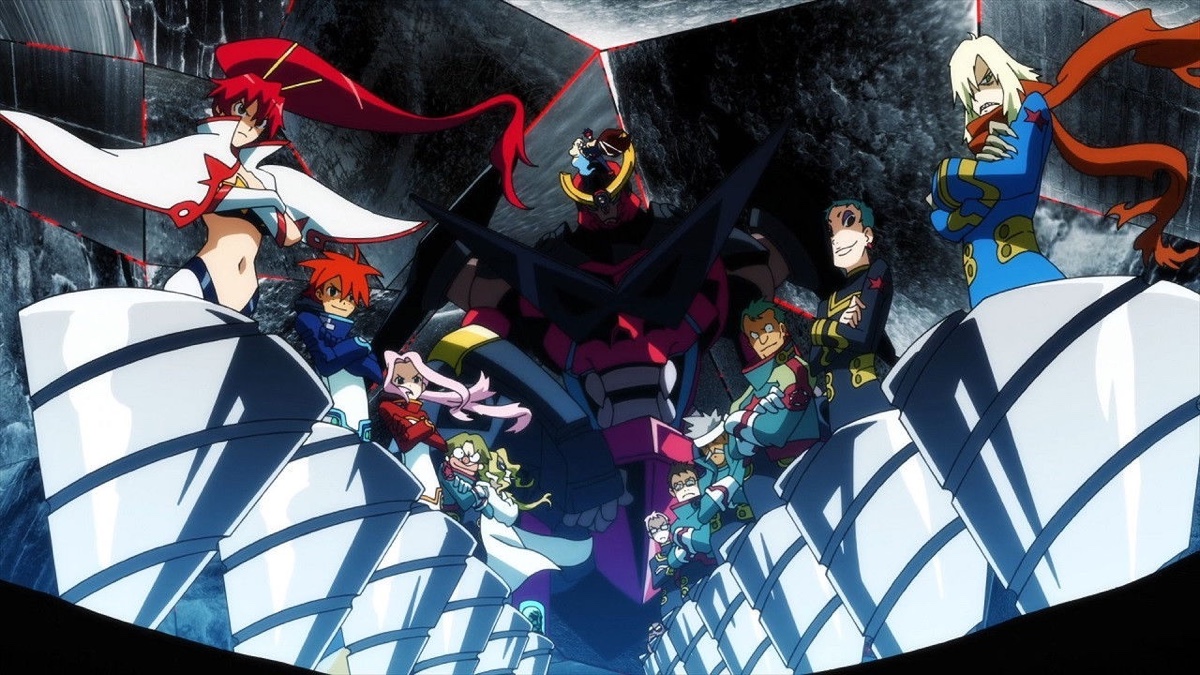
Episode 8 is the one everybody carries out of this show, and I am not going to describe how it plays or what it does to the people left behind. What matters practically is that the center of gravity moves there. Whether the series works for you is decided almost entirely by whether you clear that episode.
Then there is the endgame, where the machines have grown to galactic scale and are throwing punches at that size. By then the scale has stopped carrying any information. I could not confidently tell you what is being fought over in the final battles. The spectacle does not dip for a second, though, and somewhere in there the question changes from whether you follow it to whether you are willing to ride along.
💭 How It Made Me Feel
Satisfaction was not the main thing left over at the end. Residual heat was. Every character in this show is loud, forward-facing and enormous, and 27 episodes in their company leaves a physical aftertaste. It took a while to wear off.
The ending is lonely, and I am at peace with it. A series that looked straight at the cost of episode 8 would be cheating if it wrapped itself up conveniently at the last minute. Carrying the sadness properly is the thing this show is honest about, and I would not trade that for a tidier final scene.
Who Should Watch This?
- Anyone who has swerved around mecha anime their whole life and wants one serious attempt at the genre
- Anyone who bailed on this show years ago and has been wondering whether to give it another go
- Anyone standing at a hard decision at work or in life who wants conviction injected directly, no argument attached
- Viewers who came to Studio Trigger through Promare or Cyberpunk: Edgerunners and want to see where that style started
😅 Where It Falls Short
The first three episodes lose people
Dropping this show early is common enough to be a recognized phenomenon, even though I was fine from episode 1. The opening episodes lead with maximum volume and a run of crude gags, and if that combination is not for you, you quit before the series shows you what it actually is. The art is also at its least stable in that stretch.
There is a story from the Japanese side of this, and it is a strange one. Episode 4 was handed to guest director Osamu Kobayashi, who put it on screen in a deliberately different, looser style, and Japanese fans reacted badly. Animation producer Takami Akai then wrote dismissively about those complaining fans, the comments surfaced online, and he resigned as a director of GAINAX on April 27, 2007. His name came off the animation producer credit from episode 5, which aired two days later. A show now remembered as a monument of pure conviction was, four episodes in, a minor scandal at home.
If you are undecided after episode 1, the practical advice is to run to episode 8. Everything you need to judge this show is on the table by then. Get as far as episode 11 and the rest carries you without any effort on your part.
From episode 17 the scale keeps widening past what the show can land
I can see what the second half wants, and this is where it loses me. Winning the war is the easy question; governing what you won is the interesting one, and the friction between Simon and Rossiu is properly argued rather than manufactured. The ambition is real.
It is still more than the show can land. Each escalation in enemy scale brings new cosmology with it, and by the closing episodes a good share of my attention was spent simply tracking what was being fought. My position is that the back half is surplus. It is not a collapse, and it does not tarnish what came before. Simon carrying the whole weight is as compelling as ever, and the fighting stays excellent right through the last battle against the Anti-Spirals.
The thing that bothered me most is not scale, it is speed. The plot moves so quickly that the interior lives of the characters cannot keep up, and several turns that should have landed hard go by at a jog. A few more quiet minutes in the right places would have given the last act a different kind of weight. Because the show wraps everything in heat, none of this registers while you are watching. It shows up afterwards, when you go back over what you were actually given.
The Weak Points
- The early volume and the crude humor push people out before the show turns
- From episode 17 the cosmology keeps expanding past what the runtime can resolve
- The pace outruns the inner lives of the cast in several late episodes
Who Might Not Enjoy This?
- Viewers who need science fiction to obey its own rules to the end
- Viewers who want an ensemble drama that accumulates feeling quietly
- Viewers who want everyone assembled and smiling in the final scene
📺 Streaming Guide by Service
Which of the three should you actually use?
The episodes are identical wherever you press play.
For someone subscribing fresh, Crunchyroll is the natural pick, since the rest of its catalog points the same direction and it offers a trial. Go with Netflix if the account is shared with people who will never watch anime, and with Hulu if it already comes bundled into something else you pay for. An English dub has existed since the Bandai release, with Yuri Lowenthal as Simon and Kyle Hebert as Kamina, though which audio tracks a given service exposes can differ, so check the audio menu on your service of choice before assuming.
The Available Routes
- Crunchyroll: all 27 episodes, the best fit for anyone building an anime habit
- Netflix (US): all 27 episodes, and the cheaper ad-supported tier carries it too
- Hulu: all 27 episodes, handy if you hold it as part of a bundle
- Amazon Prime Video: reachable only by adding the Crunchyroll channel, a separate monthly charge
- Blu-ray: the physical copy
- Fandango At Home: buy the complete season digitally
Soundtrack
The music is easier to find in pieces than as an album. A US Apple Music search on the day of writing returned covers and tribute versions instead of Taku Iwasaki’s actual score, while individual cuts credited to him, Libera Me From Hell among them, do sit on Spotify. Search by track title, not by album.
- Apple Music (US): Sorairo Days by Shoko Nakagawa is available
- Spotify: Taku Iwasaki score cuts are on the service individually
🎬 If You Loved Gurren Lagann, Watch These 3 Next
Legend of the Galactic Heroes (1988)
Call it Gurren Lagann with the shouting removed. It runs on speeches, committee meetings and slow strategy, so the volume could not be further apart. The interesting part is how each handles absence. Gurren Lagann has its survivors say the missing man’s words out loud again and again; here nobody says anything, and you only notice the loss in how the remaining characters quietly start deciding differently. Same mechanism, opposite register.
👉 Read the Legend of the Galactic Heroes guide
Cyberpunk: Edgerunners (2022)
Made by Studio Trigger, the company the Gurren Lagann team founded afterwards, and compressed into ten episodes you will finish in one sitting. What changes is the direction of travel. Gurren Lagann points its energy upward for 27 episodes; this one takes the identical energy and rides it down. Watching it shortly after you have enjoyed the climb shows you how frightening the same fuel is when it is aimed the other way.
👉 Read the Cyberpunk: Edgerunners review
One-Punch Man Season 1 (2015)
The other way to handle runaway power levels. Gurren Lagann escalates completely sincerely and dares you to come along; One-Punch Man escalates as a joke and then quietly turns the joke into a character study. If the willpower logic here made you roll your eyes, this is the show that takes the same premise and arrives from the opposite side, with animation every bit as unreasonable.
👉 Read the One-Punch Man Season 1 review
📺 Want more shows that finish what they start in a single run? Try 10 Best One-Season Anime That Tell a Complete Story.
📝 Final Thoughts
I have complaints about the second half and none of them make me hesitate to recommend this. Through episode 15 it is close to a textbook for what a mecha series can do, dense enough that you could lift that stretch out and screen it as a complete work. And the material from episode 17 onward is not worthless; it is badly arranged. Seen whole, the right word is overextension, not decline.
I can describe the wrong audience for this more precisely than the right one. Anyone who needs internal consistency maintained to the final scene should skip it, because the endgame discards its own reasoning and settles matters on sheer conviction, and if that sours you the damage cannot be undone. Flip that around and the deal is simple: swallow that one thing and all 27 episodes are yours. On the nights when you would rather be carried than convinced, this show does the job better than almost anything.
⭐ Series at a Glance
| Category | Rating | Comment |
|---|---|---|
| Story | ★★★★☆ | Faultless to episode 15, overextended after 17 |
| Characters | ★★★★★ | Loud, forward-facing, impossible to confuse with each other |
| Animation | ★★★★☆ | Wobbly early, enormous by the end |
| Music | ★★★★★ | An opening I never skipped in 27 episodes |
| Pacing | ★★★★★ | Fast to a fault, in both directions |
| Internal consistency | ★★★☆☆ | Willpower settles what physics cannot |
| Broad appeal | ★★★☆☆ | The first three episodes decide it for most people |
Usagi’s Recommendation Score
⭐⭐⭐⭐⭐⭐⭐⭐☆☆
8.5 / 10
A perfect first half, minus what the second half could not bring home

