*This page contains affiliate links. We may earn a commission if you make a purchase through these links.
The 110-episode anime that a large share of Japanese fans will name as the greatest ever made has no legal stream in the United States. Legend of the Galactic Heroes is the exception to the idea that everything turns up on some service eventually.
What you can stream is the 2018 remake. That gap is why this page exists, because the remake is not a smaller version of the same thing. It is a different reading of the same book. Below is where it stands in the US, followed by what a Japanese viewer thinks you would actually be getting, and giving up, if you take the version that is one click away.
📺 Where to Watch Legend of the Galactic Heroes (October 2026)
| Service | Status | Notes |
|---|---|---|
| HIDIVE | Not available | Carried all 110 episodes from 2017 until mid-2024 |
| Crunchyroll | Not available | Has the 2018 remake Die Neue These, not this series |
| Netflix | Not available | Neither version |
| Amazon Prime Video | Not available | The original streams on Prime in Japan only |
| Blu-ray (Amazon US) | Rent / Buy | Disc only. Mostly Japanese imports and resale copies of the out-of-print Sentai Filmworks set |
The 1988 series is not streaming anywhere in the United States, and no US store rents or sells it digitally either. The remake Die Neue These is the only version of this story on a US service.
HIDIVE carried all 110 episodes from 2017 until the series left it in mid-2024. If the original ever comes back to a US service, the one that held it for seven years is the likeliest place.
In Japan the original streams on Prime Video and U-NEXT with an ordinary subscription, all 110 episodes. So the version that is hard to reach in the US is the one Western fans want, and the version that is easy to reach is the one nobody argues about.
🧭 What Is the Legend of the Galactic Heroes Watch Order?
Start with the 110-episode main series at episode 1, and save the films and the Gaiden side stories for afterwards. The main run came out in four seasons between December 1988 and March 1997, and everything else on the shelf orbits it. Die Neue These is a separate remake from 2018, so it does not slot into this order at all.
The extras, briefly. My Conquest Is the Sea of Stars (1988) was released before the series and covers the first battle between Reinhard and Yang; it works as a sampler before you commit, and we have a separate review of it. Overture to a New War (1993) expands on the events of episodes 1 and 2, so it is a second, longer look at the opening rather than a missing piece. Golden Wings (1992) adapts a short side story. The 52-episode Gaiden (1998 to 2000) is a prequel.
I put the prequels last on purpose. They land harder once you know where everyone ends up, and the main series is better met cold, with no idea where any of these people are headed.
🎬 Trailer
That is Sentai Filmworks, the US licensor, cutting a trailer for their home video release. Watch what it chooses to show you. Fleets, yes, but also a great deal of men in rooms deciding things, which is a more honest advertisement for this series than a pure battle reel would have been.
Work Info
- Title: Legend of the Galactic Heroes, the main OVA series
- Released: 1988 to 1997, 110 episodes across four seasons
- Original novels: Yoshiki Tanaka
- Director: Noboru Ishiguro
- Animation: Kitty Film, K-Factory
- Music: licensed classical recordings, including Mahler, Beethoven, Bruckner and Dvorak
- Runtime: about 25 minutes per episode
📖 Synopsis, No Spoilers
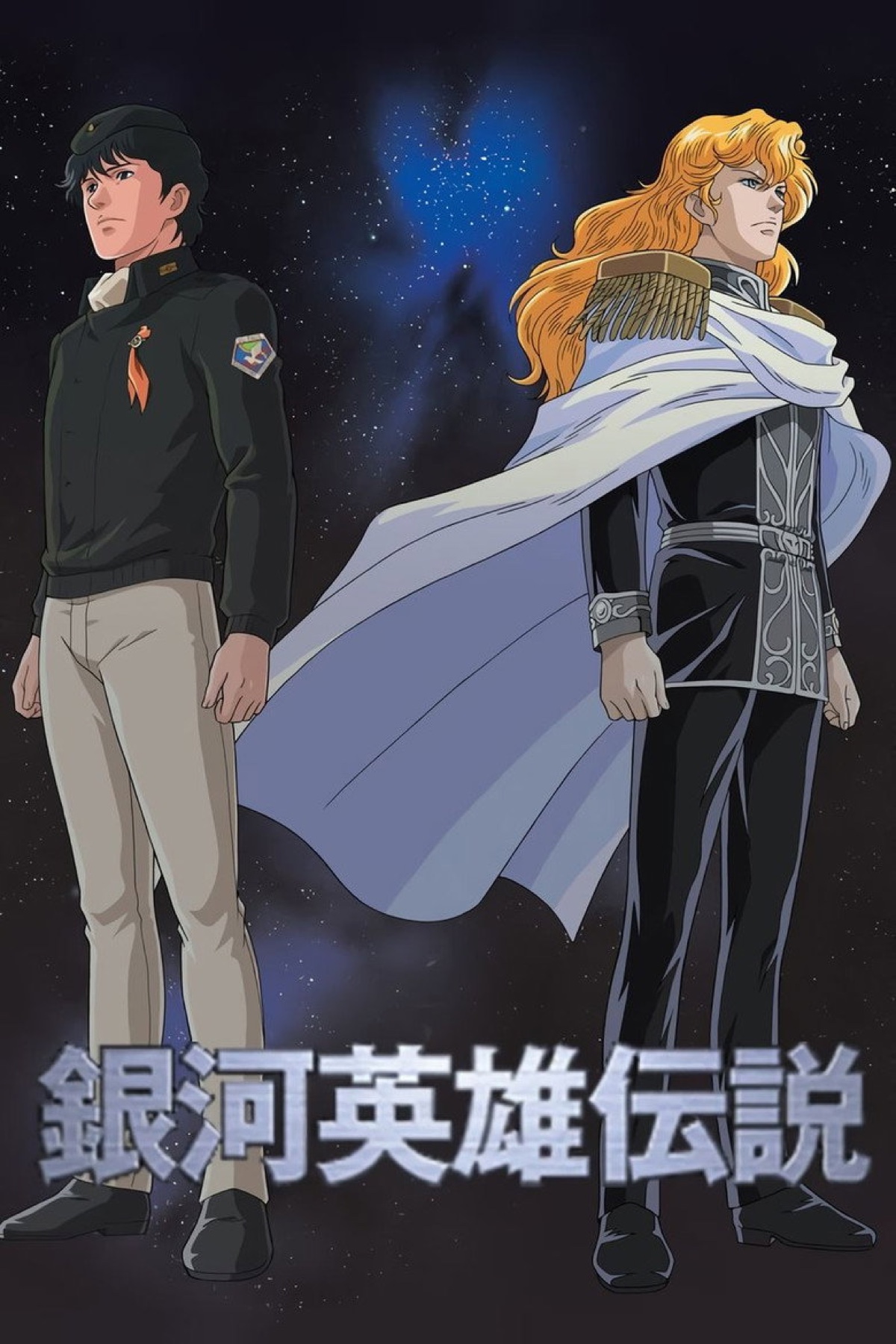
Humanity has been in space for thousands of years, and the galaxy has settled into two blocs. The Galactic Empire is an absolute monarchy built along Prussian lines. The Free Planets Alliance is a democracy. They have been at war for a century and a half, and the war has long since stopped moving. Then two young commanders arrive, one on each side, and the map starts changing again.
Reinhard von Lohengramm is an Imperial officer whose sister was taken by the Emperor, and who intends to climb high enough to tear down the aristocracy that allowed it. Yang Wen-li is an Alliance officer who wanted to be a historian, dislikes the war, and keeps winning it anyway, which is how he ends up promoted into a job he never asked for. Across 110 episodes these two meet face to face exactly once. The rest of the time they measure each other across a battle line.
✨ What Makes It Special
Why It Is Exceptional
- A war between two versions of right, with no villain provided
- Two opposite geniuses who share the screen exactly once
- Conversation, not combat, is where the series actually lives
- 110 episodes that hold their shape from first to last
It never tells you which side is right
Most political fiction sets up a fair fight and then quietly puts its thumb on one side of the scale. This one does not. The democracy is real, and it is rotten. The Free Planets Alliance has elections, courts, a free press, and a governing class that keeps the war going because the war is profitable and because peace would require someone to admit a century of dead was for nothing. Watching its politicians work is unpleasant in a way anime rarely attempts.
The autocracy is also real, and under Reinhard it governs well. He breaks the hereditary nobility, promotes on ability, cleans up the courts, and lowers the tax burden on people who had no say in any of it. If you scored the two systems on outcomes for an ordinary citizen during the years this story covers, the Empire under Reinhard wins, and the series knows exactly how uncomfortable that is.
So the show hands the counterargument to Yang and then refuses to let him win it cheaply. His position is not that democracy performs better. His position is that a system where the public can throw the leadership out is worth keeping even when it performs worse, because good autocrats are not inheritable and the bill for a bad one has no ceiling. He argues this while serving a government he openly despises, which costs him something in every single season.
Praising a story for refusing to answer its own question probably reads, from the outside, like giving cowardice a nicer name. The test I would apply is simple. Both cases are put by people who hold them at personal cost, and neither is ever handed a cheap win. Indecisive writing cannot manage that, because indecisive writing has nobody willing to pay.
That is the engine. Not good against evil, but one defensible answer against another defensible answer, held in tension for 110 episodes without resolution. A show written in the late eighties has no business landing this squarely on 2026, and it does.
Two geniuses, one conversation
Reinhard burns. He is young, beautiful, furious, and completely certain, and the series lets him be magnificent without ever quite letting him off the hook. Yang slouches. He drinks tea, avoids paperwork, treats his own reputation as a running joke, and has the tactical mind of the century attached to a man who would rather be reading.
The pairing works because neither is a foil for the other. They are two complete people who happen to be pointed in opposite directions, and the strangest thing about the series is how obviously they would like each other. Each is the only person alive operating at the other’s level, and the war means they get one meeting to notice it. Restraint on that scale is rare. A lesser version of this story would have engineered a rematch every season.
The real spectacle is people talking, scored by Mahler
I went back through the OVA expecting the fleet battles to be what held up. They are not. What held up was the density of the conversation scenes. Two admirals work through where their country is heading over a bottle of wine. Yang picks apart the contradictions of the state he serves while pouring tea. Oberstein lays out the coldest possible reading of a situation and turns out to be right, again. These are the quiet stretches, and they carry the thinking.
Then the fleets meet and the show puts Mahler or Bruckner over it. Tens of thousands of ships, hundreds of thousands of deaths, and a symphony playing straight through, no sound effects fighting it for attention. The effect is not excitement. It is scale, and a kind of formality, as though the series is insisting you look at the arithmetic of what is happening rather than enjoy it.
One thing subtitles cannot carry. In Japan this show has a nickname, Ginga Seiyu Densetsu, Legend of the Galactic Voice Actors, and it is not a joke about volume. It is a roster. Kei Tomiyama played Yang, and Tomiyama died in 1995 with the series still in production. His Yang is dry, tired, faintly amused, and it is not a performance anyone can go back and redo. For a Japanese viewer of a certain age, half the cast list now reads as a memorial, and that changes what the quiet scenes feel like.
Deeper Themes
The question underneath all 110 episodes is what a citizen owes a state that does not deserve them. Yang keeps fighting for a government he finds contemptible because the alternative is deciding on his own that the public forfeited its right to choose badly. That is a heavier idea than most war fiction is willing to hold.
The other thread is about competence and its limits. The series repeatedly shows brilliance losing to institutions, and it does not treat that as a tragedy to be corrected. It treats it as the price of having institutions at all.
🎭 Memorable Scenes
There are two currents of thought in human society. One says there are things worth more than a life. The other says nothing outweighs a life. People use the first as their excuse for starting wars, and the second as their reason for stopping them, and they have been doing it for thousands of years.
That is my own rendering of Yang’s line rather than the official subtitle wording. I heard it and sat up straighter, which is not a reaction I usually have to episode one of anything. It also tells you within minutes that this is not a series about fleets.
My other pick is the Battle of Vermilion at the end of the second season. Yang has Reinhard beaten. The tactical problem is solved, the war is effectively over, and then his own government orders him to stop, and he stops. Winning the battle and losing the war in the same hour is the cleanest statement this series ever makes: no commander is better than the politics above him. There is also a loss late in the first season that I will not describe, except to say that Japanese fans have a standing joke about how fast this show kills the character you like most. It is not really a joke.
💭 How It Made Me Feel
Mostly it made me argue with myself. I finished a stretch of episodes convinced Reinhard had the better case, then spent the next few being talked out of it by a man drinking tea, then got talked back. The show is built to keep you unsettled, and the discomfort is the point rather than a side effect of ambiguity.
I should say plainly that I am not a neutral party here. I have gone back to this series more than once, and each pass turns up something the previous one walked past, usually in a scene where nothing happens except two people disagreeing. There is a small number of works I would call a permanent reference point, and this is on that list.
I have now spent several sections telling you it is a masterwork, so let me spend one telling you where it will annoy you, because it will.
Who Should Watch This?
- Readers of political and military history who have never found an anime that takes governance seriously
- Anyone who watched Dune or Foundation and wanted five times more of the committee rooms
- Viewers who want a large ensemble they can live with for months rather than binge in a weekend
- Anyone tired of stories that decide for you who deserves to win
😅 Where It Falls Short
It is a 1988 OVA and it looks like one
Now the drawbacks. The animation is of its decade and there is no arguing it away. Character art shifts between episodes, the budget is visibly unequal across 110 installments, and the fleet battles reuse footage often enough that you will start recognizing individual explosions. If your baseline for space combat is a modern production, the first few episodes will feel like homework.
The tactics invite a specific complaint too. These fleets maneuver in three-dimensional space using formations borrowed from Napoleonic line warfare, holding flat battle lines and worrying about being flanked as though space had edges. It is a deliberate stylistic choice rather than an oversight, but if that sort of thing breaks your immersion, it will break it here.
The middle also sags. Somewhere in the third season the series settles into administration and internal politics for a long stretch, and the pace drops well below what a modern show would risk. I watched through it happily. I also would not pretend to a first-time viewer that it never drags.
And then there is the practical problem, which is worse than any of the above: getting hold of it legally in the US currently means buying an out-of-print disc set at resale prices. That is a real barrier, and it is not the show’s fault, but it is the reason most people reading this will end up with the remake.
The Weak Points
- 1988 animation, with visible quality swings across the run
- Age-of-sail formations applied to three-dimensional space
- A long administrative stretch in the back half where the pace drops
- No legal US stream, so the entry cost is an out-of-print disc set
Who Might Not Enjoy This?
- Viewers for whom dated animation is a dealbreaker on its own
- Viewers who want the action foregrounded, since most episodes are conversation
- Anyone looking for a self-contained cour, because the commitment here is measured in months
📺 Streaming Guide by Service
So should you just watch Die Neue These instead?
This is the real question for a US reader, since the remake is on Crunchyroll right now and the original is not. My answer, as someone who came up on the original: watch Die Neue These if that is what you can get, and know what the trade is.
Director Shunsuke Tada has described the remake’s approach as pointing the camera at individual characters rather than surveying the war from above, while keeping the source material’s themes intact. That is a coherent decision and it produces a show that moves faster and looks far better. It is a legitimate way in.
What thinned out for me is the political sediment. The original spends real screen time on the parts that are tedious by design: committee meetings, procurement, press management, the machinery that turns a war into a career. Those stretches are what make Yang’s argument land, because you have watched exactly how bad the institution is and you still have to sit with him choosing it. Cut the tedium and the choice gets easier, which means it gets smaller.
So the ranking is not complicated. If the original is reachable for you, start there, and the remake will still be waiting afterwards. If it is not, start with the remake rather than not starting, and treat the 1988 run as the version to hunt down later. What I would not do is watch the remake and conclude you have taken the measure of this story.
There is a third route worth knowing about. The 60-minute film My Conquest Is the Sea of Stars was built as an entry point, and it compresses the setup into one sitting. 👉 Read our review of Legend of the Galactic Heroes: My Conquest Is the Sea of Stars if you want to test the water before committing to 110 episodes.
Your Options in the US
- Crunchyroll: the 2018 remake Die Neue These, subtitled and dubbed. The only subscription route to this story today
- Amazon: Sentai Filmworks released the 1988 OVA on Blu-ray in 2018 as a 26-disc set covering all 110 episodes plus the Gaiden series and the three films. It is out of print and resale prices are steep
- HIDIVE: worth checking now and then, since it held the series from 2017 to mid-2024
Soundtrack
There is no conventional score album to queue up, because the series does not have a conventional score. It uses existing classical recordings, drawing on Mahler, Beethoven, Bruckner and Dvorak among others, which is also why the music rights on this title have always been complicated.
The practical move is to build the playlist yourself from those composers. Queue the Mahler symphonies in particular and a good deal of the show comes back with them.
📚 The Source Novels
Yoshiki Tanaka’s novels ran to ten volumes in the main sequence, and the first one took the Seiun Award, Japan’s equivalent of the Hugo, in 1987. The OVA follows them closely enough that the books are a genuine alternative rather than a supplement.
They are available in English from VIZ Media’s Haikasoru imprint, starting with Legend of the Galactic Heroes, Vol. 1: Dawn. Given the state of US streaming, this is currently the cheapest legal way to meet the original version of this story, and an audiobook edition exists as well.
🎬 If You Loved Legend of the Galactic Heroes, Watch These 3 Next
Attack on Titan: The Final Season
The closest modern relative. It takes the same problem, two peoples each with a defensible case, and rebuilds it in a completely different register. By the final season the moral floor has dropped out entirely and the audience is left doing the sorting, which is the position this show puts you in for 110 episodes.
👉 Read our review of Attack on Titan: The Final Season
PLUTO
Naoki Urasawa working at full stretch on war, grief and who gets counted as a person. Eight episodes against 110, so the shape could not be more different, but it shares the habit of giving every side a case you cannot dismiss. If you were going to reach for Urasawa after this, start here.
Jin-Roh: The Wolf Brigade
Two hours instead of fifty, and the same interest in what the machine does to the people inside it. Rival security agencies maneuver against each other while a single officer is ground between them. If Oberstein’s chapters were the ones that held you, this is the film to take next.
👉 Read our review of Jin-Roh: The Wolf Brigade
📝 Final Thoughts
110 episodes is a serious ask, and none of them is one click away. You can read the novels, hunt the discs, or start with the remake knowing what it trims. The remake is the version on our list of best war anime, for the plain reason that a US reader can press play on it tonight. This page is the case for going back to the original afterwards.
The reason it is worth the trouble is the thing I opened with. Rotten democracy against effective autocracy, argued to a standstill and left there, by a series from 1988 that had no way of knowing how current that would sound. A show that refuses to resolve its own central question is a show you can keep returning to, because the argument is still live every time you come back.
⭐ Series at a Glance
| Category | Rating | Comment |
|---|---|---|
| Writing | ★★★★★ | 110 episodes without a structural collapse |
| Characters | ★★★★★ | An enormous cast, and the minor players hold up |
| Animation | ★★★☆☆ | Fair for 1988, dated in 2026 |
| Music | ★★★★★ | Classical repertoire used with real nerve |
| Themes | ★★★★★ | The central question is left open on purpose |
Usagi’s Recommendation Score
⭐⭐⭐⭐⭐⭐⭐⭐⭐⭐
10 / 10
Every rewatch turns up something the last one missed. A permanent reference point.

 has no legal US stream right now. The watch order for the 110 e)