*This page contains affiliate links. We may earn a commission if you make a purchase through these links.
Would you rather be kept, or be used up? Toy Story 2 puts that question to a toy and then refuses to make the answer obvious, which is more than the middle chapter of a kids’ franchise is usually asked to do. It is also the entry in this series nobody quotes. The first film invented the format and the third one closed the story, and everything in between gets compressed into a single line: the one where Woody gets stolen. Ask someone to describe it and watch how quickly they run out of sentences.
It lands harder from Japan. The buyer on the other end of Al’s phone calls is a museum in Tokyo. The Konishi Toy Museum is this film’s picture of forever, and it is in my country. Watching from Japan, the fate Woody has to choose against has a local address, and it is not a villain’s lair. It is a glass case, in a place that is obsessively good at keeping old objects safe.
📺 Where to Watch Toy Story 2 (October 2026)
| Service | Status | Notes |
|---|---|---|
| Disney+ | Streaming | The first four films in one place |
| Hulu | Streaming | Carries the 1995 original too |
| Amazon Video | Rent / Buy | A Prime membership does not cover it |
| Apple TV | Rent / Buy | Also on Fandango at Home, Google Play, YouTube |
| Netflix | Not available | Disney keeps its own catalog elsewhere |
| Crunchyroll | Not available | A Pixar film, never an anime service title |
Two subscriptions carry Toy Story 2 in the US: Disney+ and Hulu. They part ways once you go past this film, though. Hulu has the first two Toy Story films and stops there, while Disney+ holds the first four, so if this is the start of a series rewatch rather than a one-off, Disney+ is the one that will not strand you halfway. Without either, the storefronts rent it for a few dollars.
👉 If you have not read it yet, the Toy Story review covers where the “what am I actually for” question got introduced. This film is what happens when the series decides to answer it.
👉 And the argument finally gets settled in Toy Story 3, where the choice stops belonging to the toys and passes to Andy.
⏱ How Long Is Toy Story 2, and Are the Bloopers Still in It?
Toy Story 2 runs 92 minutes, end credits included. That puts it in the middle of the first four: 81 minutes for the original, 103 for Toy Story 3, 100 for Toy Story 4. The one place I would ask you not to reach for the remote is the moment the credits start.
The reason is the outtakes. Partway into the credits the film runs a reel of staged flubs, shot as if the toys were actors who keep blowing their takes. It was not there on opening day. Disney added it on December 25, 1999, about a month into the American run, and it has stayed attached ever since.
One gag from that reel is missing if you stream it. A bit with Stinky Pete and two Barbie dolls was cut for the 2019 home video release, and the Disney+ version follows that cut. It is a fitting coda for a film about whether a toy is better kept behind glass or played with: the last thing it shows you is the whole cast at work, fluffing their lines.
🎬 Trailer
Work Info
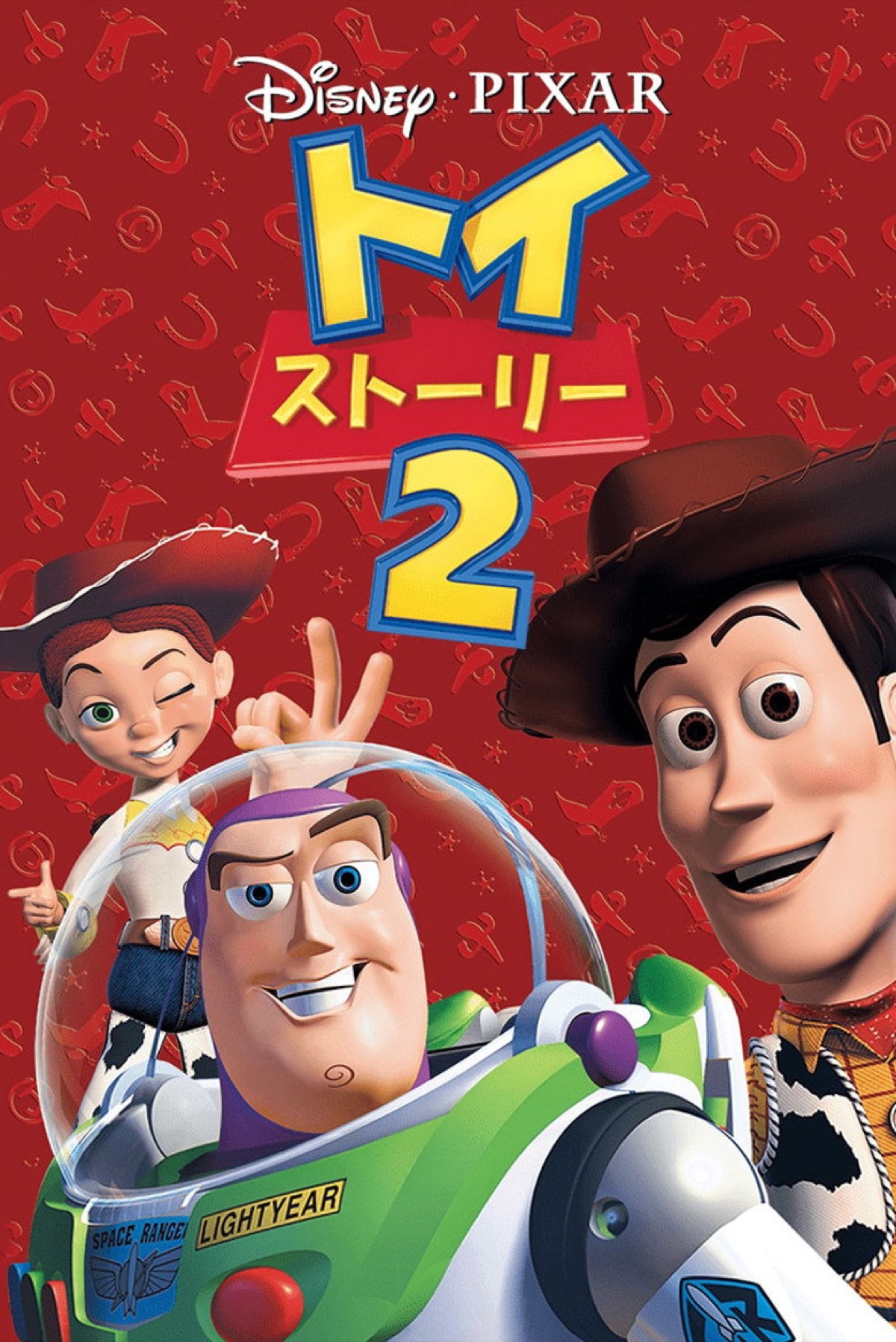
- Title: Toy Story 2 (1999)
- Director: John Lasseter (co-directed by Ash Brannon and Lee Unkrich)
- Runtime: 92 minutes
- US release: November 24, 1999
- Studio: Pixar Animation Studios / Distributed by Disney
- Music: Randy Newman (“When She Loved Me,” performed by Sarah McLachlan)
- Japanese theatrical release: March 11, 2000
📖 Synopsis – No Spoilers
On the morning Andy leaves for cowboy camp, Woody’s arm tears. He gets left behind, and while trying to rescue another toy from the yard sale out front, he is spotted and stolen by Al McWhiggin, a toy collector who owns a chain of toy stores and knows exactly what Woody is.
In the apartment Al takes him to, Woody learns that he was once the lead character of a popular television show. Three other toys from that show are waiting there: Jessie the cowgirl, Bullseye the horse, and the Prospector. Complete the set of four and the collection is finished, at which point it can be sold to a toy museum in Tokyo and displayed behind glass, undamaged, indefinitely. Meanwhile Buzz and the rest of Andy’s toys have left the house on foot to get Woody back.
✨ What Makes It Special
Why It’s Exceptional
- A choice between being preserved forever and being loved until it ends, put to a character who has to actually pick
- The fear the first film could only imagine is handed to somebody it already happened to
- Two minutes of screen time with no dialogue in them at all
- Every supporting toy from the first film gets something to do
The glass case, or the room that ends
What Woody gets offered is a choice where both options cost him something. Take the museum and he is repaired by hand, shipped to Tokyo, and put in a case where generations of children will look at him through glass. Nothing chips him. Nothing breaks. Nobody forgets he existed. He is also never held by anyone again.
The other road goes back to Andy’s room, where he gets handled roughly, has a kid’s name written on the sole of his boot, tears at the arm, and then, at a date the film treats as fixed rather than possible, stops being wanted the moment his owner grows up. Permanence, or a present tense with an expiry date on it. I cannot think of another children’s film that makes a toy sit down and plan its retirement.
I know how that sounds for a movie whose second act is a slapstick chase through a toy superstore. Stay with it, because the structure is doing something careful. Woody and Jessie arrive at the same question from opposite ends. Woody can say “I am going back” without much hesitation, and he can afford that because he is still in the middle of being loved. Jessie has already been through the ending once. For her, choosing a child’s bedroom means signing up to be left a second time. Same two doors, wildly different weight.
Underneath everything, this is a film about what a made thing is for, and the adventure is a coat it puts on. The moment Woody finds out about his own origins as a merchandising character, the story slides quietly off the rescue rails and onto “what am I here to do,” and it never really comes back. Children’s sequels are not supposed to attempt that.
The question then runs down the whole series. It is asked here, sharpened into something much harsher in the third film, and answered differently again in the fourth. This is the film that threw the switch.
Deeper Themes
Loved and worn out, or intact and untouched. That question works on anything that belongs to somebody, which is why it hits adults harder than the film’s rating suggests it should. Kept in storage after your job is done, or used until you wear through. Pixar put that on the table in 1999 and had a plastic cowboy argue it.
One more angle, and this one is mine rather than the film’s. Japanese folklore has a category called tsukumogami: a tool that survives long enough acquires a spirit and wakes up. An old object here is not a dead object, it is an object that has been around long enough to become someone. With the glass case sitting in Tokyo, a Japanese viewer does not automatically read it as a coffin. I suspect that scene plays a little differently depending on which country’s idea of an old thing you grew up inside.
The first film guessed. This one brings a survivor
Being discarded was already in the 1995 film. A better toy shows up, and Woody stops being the one who gets picked. That panic drove the entire first movie. But it was a thing that had not happened yet, a projection, and the threat stayed comfortably in the conditional.
The sequel puts an actual case in the room. Jessie was loved completely by a girl named Emily, and then outgrown and let go. Once the hypothesis has a body attached, the fear changes species. Not “this could happen to me” but “the person it happened to is standing right here, talking.”
That single move drags the series’ central anxiety out of the abstract. Adding a character with the standing to talk about being left builds a straight road from here to the incinerator and the college box in film three. Jessie is less a new toy than a witness the series needed.
Two minutes, no dialogue: “When She Loved Me”
Jessie’s history is not explained. It is sung. Sarah McLachlan performs Randy Newman’s “When She Loved Me” over a montage with no lines in it: being held, being carried in a car, being pushed under a bed. Nothing else happens in it.
The production tried the obvious version first. John Lasseter has said they made several attempts at having Jessie tell the story out loud, and that “every time she would tell the story, it lost some emotion.” So they threw the dialogue away and let a song do it. The most effective two minutes in the film are the ones where they stopped trying to explain.
A footnote for anyone comparing notes with a Japanese friend: the dub does not use the McLachlan recording. The Japanese release has its own vocal of the song, sung by Risa Ohki, which means people who grew up with this scene in Japan are carrying a different voice for it than you are. Same images, same two minutes, different singer in the memory. It is a strange thing to discover in a conversation.
🎭 Memorable Scenes
A door closing, seen from under the bed.
1. Jessie’s flashback, shot from the floor
The camera in that montage stays low the entire time. Picked up, swung around, put down and left. All of it happens at doll height, which pins the audience to the height of the one who gets left behind. The happier the early part of the memory looks, the worse the space under the bed gets later.
2. The repair
An elderly restorer lays out his tools, stitches the torn arm, repaints the worn spots, and finally dusts Woody off with a brush. There is almost no dialogue. Minutes go by on the sound of a needle through fabric. What that sequence really does is make the museum offer credible, because it shows you exactly what being treasured would feel like. A nice piece of Pixar bookkeeping: the restorer is Geri from the 1997 short Geri’s Game, and one drawer of his toolkit is full of chess pieces.
3. Buzz meets Zurg
The reveal about what Zurg is to Buzz replays a famous science fiction scene almost beat for beat, and it got a straight laugh out of me. A film carrying a question this heavy has room for a gag that stupid. That balance is the actual Pixar skill, and it is easier to admire than to copy.
💭 How It Made Me Feel
What is left afterwards has less to do with being moved than with a low-grade guilt about your own belongings. Almost nobody gets through this film without thinking of something specific left in a closet or at a parent’s house. Start wondering what condition it is in now and the evening gets slightly uncomfortable.
Picture the toy shelf in a second-hand shop after closing and the premise turns unpleasant. Every item there had an owner. Every one of them was chosen at least once. The film never goes there. Your head fills it in unprompted on the walk home.
👉 Watch it on Disney+, where the first four films are waiting under one subscription.
Who Should Watch This?
- Anyone whose memory of this series goes blank between the first film and the third
- Anyone revisiting a childhood film with an adult’s set of worries
- Anyone hunting for the Pixar film that gets people. The two minutes you are looking for arrive at the midpoint
😅 Where It Falls Short
I have been building this up for a while, so here is the column that keeps it off the top shelf. None of what follows is fatal. All of it is why the score below is not higher.
It lands exactly where you can see it landing
The real problem is how safe the ending is. After stacking up a choice that really does have two sides, the film lets you see which one Woody takes from a very long way off, because a Pixar sequel aimed at families was only ever going to end one way and everyone in the audience knows it.
The question and the resolution are not the same weight. To make the dilemma real, the museum needed to be sold harder. The restoration sequence proves the film knew how to do that. It just does not do enough of it.
The skeleton is a standard rescue plot
Strip out the theme and what is left is “friends go and get their kidnapped friend back.” The first film was built on something no one had really done: two rivals in a room, working out how to coexist. Next to that, the structural invention here is thin. Good filling, off-the-shelf pastry.
The 1995 shock cannot be reissued
Not this film’s fault, but unavoidable, so it goes in. Nobody gets to see a fully computer-animated feature for the first time twice. The craft here is measurably better than the original, because cloth, hair and crowd scenes are on a different level. The surprise still belongs to the other movie. That was the least fair handicap a 1999 sequel could have been given.
The Downsides
- Heavy question, safe landing. You can see the resolution coming
- A kidnap-and-rescue frame, structurally much plainer than the first film
- Better rendering, none of the novelty that made 1995 an event
Who Might Not Enjoy This?
- Anyone who needs an ending they could not have predicted
- Anyone who has not seen the first film. This one runs on relationships it does not re-explain
📺 Streaming Guide by Service
The bind Woody is handed in this film gets rewritten in the third, and the two play best back to back, which is the reason to pick Disney+ over Hulu if you have the choice.
Where to Stream
- Disney+: Streaming (films one through four)
- Hulu: Streaming (films one and two only)
- Amazon Video: Rent / Buy
- Apple TV: Rent / Buy
- 4K UHD / Blu-ray: The flashback lives in its shadows, which is the first thing a stream gives up
Soundtrack
Randy Newman’s score, plus “Woody’s Roundup” and the song everyone actually comes back for. Without the images to lean on, “When She Loved Me” is somehow less merciful, not more.
- Apple Music (US): Available
- Spotify (Japanese edition): Carries the Japanese vocals alongside the originals, if you want to hear the version this country grew up with
🎬 If You Loved Toy Story 2, Watch These 3 Next
This site is written from Japan, so the three below are Japanese titles rather than Pixar ones. That is not a dodge. The specific thing this film is about, whether being kept forever beats being used up, has been standard material in Japanese animation for decades, and these three take it further than a 92-minute family film is allowed to.
Frieren: Beyond Journey’s End
Woody’s dilemma with the toys taken out and an elf put in. An immortal outlives the people she traveled with and has to work out what a finite lifetime was worth to her, having declined to notice at the time. Preserved forever versus loved briefly, argued out across a whole series instead of one song. If the museum question stayed with you, this is where it goes next.
👉 Read the Frieren: Beyond Journey’s End review
Violet Evergarden
A girl built and used as a weapon, called a doll by the job she takes afterwards, trying to find out what she is for once the person who defined her is gone. Jessie’s problem given a body and a full series. Fair warning: the first episode is not the one that gets you, and the episode that does is a long way in.
👉 Read the Violet Evergarden review
Tokyo Godfathers
Satoshi Kon’s Christmas film, in which three homeless people find an abandoned baby in the trash and set out to return her. Everyone in it, the baby included, was discarded by somebody who had once wanted them. Same subject as Jessie’s flashback, with the toys swapped for people and none of the softening.
👉 Read the Tokyo Godfathers review
📝 Final Thoughts
Toy Story 2 is the entry in this series that gets talked about least. It keeps a straightforward rescue plot up front like a shop sign, and stands there quietly while the films on either side take the attention.
It is also the one that first said out loud what the whole series is about, which is what happiness could possibly mean for a toy. The predictability is a real weakness, and I would not argue with anyone who marks it down harder for that. It still put the choice on the table properly and built Jessie to carry it, and neither of those has aged in twenty-six years.
A small Japanese footnote to leave you with. When this film opened here on March 11, 2000, it was the first movie in Japan shown by digital projection, with no print in the building. A story about whether a thing is better preserved or better used turned out to be the one that retired the reel here. Nobody planned that, and I have never been able to unsee it.
I am giving it a 7.1, and it is an odd 7.1, because the reasons it is not an 8 have almost nothing to do with the reasons it is worth your evening. Honestly, the person most likely to rewatch this after writing it up is me.
⭐ Series at a Glance
| Category | Rating | Note |
|---|---|---|
| Story | ★★★★☆ | Sharp question, obedient ending |
| Characters | ★★★★★ | Jessie rewires the whole series |
| Music | ★★★★★ | Those two minutes in the middle |
| Visuals | ★★★★☆ | Clearly past 1995. The shock is not transferable |
| Pacing | ★★★★★ | 92 minutes with nothing parked in them |
Usagi’s Recommendation Score
⭐⭐⭐⭐⭐⭐⭐☆☆☆
7.1 / 10
The forgotten one is where the series lit the fuse.

