*This page contains affiliate links. We may earn a commission if you make a purchase through these links.
In Japan, Woody has spoken with the same voice for thirty years. Toshiaki Karasawa took the role when the film opened here in March 1996 and never gave it up, and neither did George Tokoro as Buzz. This past March, Disney Japan put the two of them in front of a camera to mark the thirtieth anniversary of that release. If you grew up watching this film in this country, Tom Hanks is the other version.
I'm glad the first fully computer-animated feature was this one. Jurassic Park had put CG in front of a mass audience two years earlier, and the obvious next move was a technical showcase. What arrived instead got nominated for Best Original Screenplay. Eighty-one minutes. The humans look stiff now, and I'll get to that. But the order in which this film was judged is the reason the whole medium turned out the way it did.
📺 Where to Watch Toy Story (August 2026)
| Service | Status | Notes |
|---|---|---|
| Disney+ | Streaming | All the films in the series, at no extra cost |
| Hulu | Streaming | US only. Not an option in Japan |
| Amazon Prime Video | Rent or buy | Not included with a Prime membership |
| Apple TV | Rent or buy | Also on Fandango at Home and YouTube |
| Netflix | Not available | Disney pulled its catalogue years ago |
As of August 11, 2026, Toy Story streams on both Disney+ and Hulu in the US, which makes the US the easier place to watch it. In Japan it is Disney+ and nowhere else. Everything else on the list is a per-title rental. Availability shifts, so check the service's own page before you subscribe for one movie.
👉 If the idea of an object worrying about what it is for lands with you, PLUTO asks the same question with robots, and does not soften the answer.
🎬 Trailer
Work Info
- Title: Toy Story (1995)
- Director: John Lasseter
- Runtime: 81 minutes
- Studio: Pixar Animation Studios / Distributed by Disney
- Music: Randy Newman ("You've Got a Friend in Me")
- Japanese theatrical release: March 23, 1996
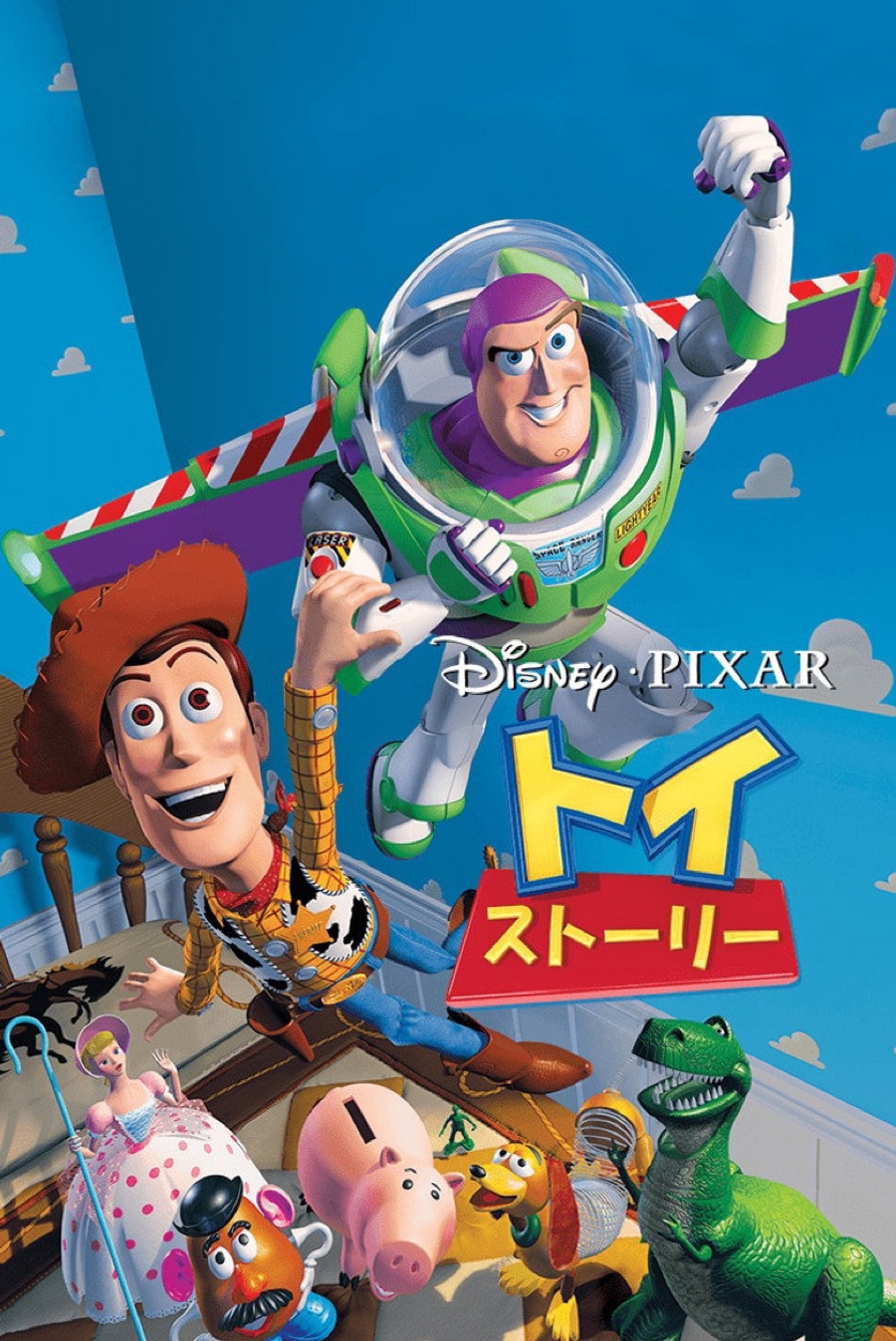
📖 Synopsis – No Spoilers
A boy named Andy owns a pull-string cowboy doll called Woody. Woody is the favorite, and he is also the one who runs the room: when no human is looking, the toys move, talk, and hold meetings, and Woody chairs them. Their whole society is organized around a single fact, which is that a toy exists to be played with.
Then a birthday present arrives. Buzz Lightyear is new, expensive, full of features, and does not believe he is a toy at all. Within a day the room has reorganized itself around him, and Woody's position quietly collapses. The two of them end up outside the house, and from there in the bedroom of Sid, the neighbor kid who takes toys apart for fun.
✨ What Makes It Special
Why It's Exceptional
- The hero starts out as the one doing the damage
- A question about purpose, translated into terms a child can follow
- Eighty-one minutes with nothing parked in them
- Supporting toys who are all specific, not filler
The hero is, at first, kind of a jerk
Early on, Woody tries to shove Buzz behind a desk to get him out of the way, misjudges it, and knocks him out of a second-floor window. The film stages it so that he can just barely tell himself it was an accident, which is worse than if he had meant it. When the other toys confront him, he lies.
Watch this as a kid and the takeaway is "Woody is kind of mean." Watch it again with a job and the scene changes underneath you. What Woody is doing is the exact reaction of someone who has always been first when somebody obviously better walks in, and who has to keep being gracious about it. The newcomer has no idea he is taking anything. Whether I have personal experience of this, I will keep to myself.
What makes it hold up is that Woody never gets replaced with a nicer character. He stays a little conniving to the end, and simply becomes someone who will not abandon a rival while remaining that person. Doing that in the first film of a franchise, with the character you need audiences to love for the next three decades, was a real bet.
It also sets up the back half. Both of them get stripped of their status at roughly the same time, and because neither one is standing on a pedestal, the drop is real. As a story about two characters growing up, this one film is already complete.
"What am I here for" — asked by a toy
In this world a toy's purpose is settled: be played with. So the worst thing that can happen to one is not being broken or thrown away, it is being outgrown. Even the rule that toys freeze when a human enters is less a gag than a law protecting that purpose.
Buzz arrives carrying a completely different answer. He has a mission, a rank, and an enemy. By the standards of Woody's world he is simply wrong about everything, and yet the audience can see that his version of a purpose is not obviously worse. The film's actual subject is on the table the moment those two answers meet.
None of it is ever said in adult language. A child can ride the whole thing on "the new guy doesn't know he's a toy, that's funny." An adult watches the same footage and hears a question about the role someone else assigned them. The same frames do two jobs.
Deeper Themes
What is left of you when you can no longer do the thing you were made for? The series spends four more films working on that, but the door is already open here. Choosing toys as the protagonists is what keeps the question from turning into a lecture, because a toy is a thing that was literally manufactured for someone else's benefit.
The first CG feature did not end up being about CG
This was the first fully computer-animated theatrical feature, and John Lasseter received a Special Achievement Award at the 68th Academy Awards for leading the team that made it. It was his first feature, grown out of his own short film Tin Toy, which had already tried looking at the world from a toy's height.
The detail worth holding onto is that the same ceremony also nominated it for Best Original Screenplay. The technical achievement got its award, and the writing got measured on its own terms in the same year. Had the first one been a demo reel, computer animation might have spent a decade filed under spectacle. Thirty years on, the order of those two judgments looks more important than it did at the time.
🎭 Memorable Scenes
1. Andy's room turns into Buzz's room
After the birthday party, the posters come down, the drawings on the wall change, the pillow and the bedspread change. Woody does not say a word through any of it. He watches. No dialogue explains how he feels; a redecoration does the whole job. The look on his face plays differently once you know how the story ends.
2. One line of fine print
A single line of disclaimer text appears on screen: "NOT A FLYING TOY." It reads like a joke, a legal footnote nobody was supposed to feel anything about. Seconds later it takes a character's entire understanding of himself apart. The cruelest thing in this movie is not the villain or the mutilated toys next door. It is a piece of packaging copy. I won't say more than that.
3. "I have been chosen"
Inside the claw machine at the pizza place, the little green aliens worship the crane as a god and treat being grabbed as salvation. It is the stupidest thing in the film and the hardest to forget. Putting the most deranged possible faith in the background of a story about purpose, and playing it purely as a gag, is a very good instinct.
💭 How It Made Me Feel
What I was left holding afterwards was less the theme than an attachment to the toys themselves. Once you have spent eighty-one minutes inside their anxieties and their small satisfactions, the things on your own shelf sit differently. That is clearly the design, and the film never once states it out loud.
The residue also splits by age. A kid comes out of it wanting to take care of their toys. An adult comes out of it wondering who they are currently useful to. One film hands two people in the same room completely different homework.
👉 Watch it on Disney+, where the rest of the series is waiting in the same subscription.
Who Should Watch This?
- Anyone who saw it as a child and is thinking about going back to it
- Anyone who cannot remember when they got rid of their own toys
- Parents watching it with a kid for the first time (strongly recommended — it is built to land on the adult in the room too)
😅 Where It Falls Short
I've been praising this thing for a while, so here is the other column. All three of these come with the same caveat: for a film made in 1995, and the first of its kind, none of them were really avoidable.
The humans are creepier than the toys
Andy, his mother, and Sid all have stiff faces and stiffer movement. Skin and soft organic surfaces were exactly what the technology could not do yet. The irony is that the plastic and cloth of the toys is rendered so well that the humans look worse by comparison. Building the story around toys was partly a technical decision, and it was the correct one.
The first act is uncomfortable to sit through
The flip side of the film's best idea is that you spend a long stretch watching the protagonist bully somebody. If you came to root for a hero, the entry point is narrow. People who bounce off it here are not wrong to. It is the run-up the second half needs, and it is still awkward the first time.
The sequels have lapped it visually
Coming to the original after the later films, the drop in visual density is stark. Hair, water, and light are on another level by the fourth entry, and the first one is never going to win that comparison. So do not grade this one on its images. Treated as a script-and-character film, it holds its ground completely.
The Downsides
- Human characters look stiff and faintly unsettling by modern standards
- The protagonist is unpleasant for most of the first act
- Visually outclassed by every sequel
Who Might Not Enjoy This?
- Anyone expecting the visual standard of current CG animation
- Anyone who wants a protagonist who is decent from the first frame
📺 Streaming Guide by Service
US readers have it easier than we do here. Toy Story sits on Disney+ and Hulu at the same time, so if you already pay for either one, the film is included. In Japan the only subscription that carries it is Disney+, which is also the only place the four films live together. If you are outside a Disney+ or Hulu subscription and only want this one movie, renting is cheaper than a month of either.
Where to Stream
- Disney+: Streaming (the whole series)
- Hulu: Streaming (US only)
- Amazon Prime Video: Rent or buy
- 4K UHD / Blu-ray: For the 1995 renders at a modern resolution
Soundtrack
Randy Newman's score, including "You've Got a Friend in Me," which the series has never let go of since.
- Spotify: Available
- Apple Music: Available
🎬 If You Loved Toy Story, Watch These 5 Next
This site is written from Japan, so the five below are Japanese titles that pick up what Toy Story starts. Objects with interior lives, assigned roles, and the day someone better walks in are subjects Japanese animation has worked on for decades.
Ghost in the Shell (1995)
Released the same year, on the other side of the world, asking a version of the same question with none of the softness. A manufactured body wondering whether anything inside it is actually hers. Buzz's problem, taken completely seriously and given to an adult.
👉 Read the Ghost in the Shell review
PLUTO
Robots built for a function, living with the function after the world has moved on. Urasawa's rebuild of a Tezuka story, and one of the few things that takes "what happens to a made thing when it develops preferences" as far as it goes. Streaming on Netflix.
Ping Pong the Animation
The Woody problem with the toys removed. Someone more gifted turns up, and you have to decide what you are once you are no longer the best in the room. Masaaki Yuasa's art style scares people off for about eleven minutes, and then it stops mattering.
👉 Read the Ping Pong the Animation review
A Letter to Momo
Presents as a family film with three funny monsters in it, and is actually about a child negotiating a death. Same trick as Toy Story: two audiences, one set of frames, and the adult one is not being handled gently.
👉 Read the A Letter to Momo review
Castle in the Sky
If the "watch it with your kid and get ambushed yourself" part is what you want more of, Miyazaki's 1986 adventure is the one. A robot soldier built as a weapon spends the film deciding to be a gardener instead, which is very much this conversation.
👉 Read the Castle in the Sky review
Toy Story 2 had to be rebuilt almost from scratch in roughly nine months, and it somehow came out the better film. 👉 Read the Toy Story 2 review
Toy Story 3 is where the question stops being hypothetical, because Andy actually leaves. 👉 Read the Toy Story 3 review
How to Train Your Dragon is the DreamWorks film that answered Pixar instead of imitating it. 👉 Read the How to Train Your Dragon review
📝 Final Thoughts
The humans look wrong and the sequels out-render it. I still think Toy Story is a great film, because it produced a great script and a set of great characters at the same time, on the first attempt, in a format nobody had finished before. Because computer animation started here, everything that followed had to start from the assumption that you would be judged on the story. That was not guaranteed.
There is also a reason to do this now. Toy Story 5 opened in Japan on July 3, 2026 and is still playing, with Karasawa and Tokoro back in the booth for the fifth time. Eighty-one minutes is a very small price for knowing what Woody and Buzz were to each other on day one.
⭐ Series at a Glance
| Category | Rating |
|---|---|
| Story | ★★★★★ |
| Characters | ★★★★★ |
| Pacing | ★★★★★ |
| Music | ★★★★☆ |
| Visuals | ★★★☆☆ |
| Rewatch Value | ★★★★★ |
Usagi's Recommendation Score
⭐⭐⭐⭐⭐⭐⭐☆☆☆
7.4 / 10
The first one set the grading criteria for CG animation, and it chose story.

