*This page contains affiliate links. We may earn a commission if you make a purchase through these links.
I started this one expecting Groundhog Day with a body count. Wrong show. Shinpei Ajiro does die, repeatedly, and every death drops him back a few days with his memories intact. What he never does is try to get out. He treats the loop as equipment. Something he runs and logs and spends on a problem far bigger than himself, which gives you the shortest honest description of this series: a time loop played as a walkthrough, and the walkthrough gets passed around.
I have a documented weakness for stories that open the board one square at a time and then close it completely, so I was always going to be an easy mark here. Twenty-five episodes: a funeral on a small island off Wakayama, a local superstition that says anyone who sees their own double dies, and a reveal schedule that keeps paying out until the final episode. The show also changes shape somewhere around the halfway mark, and plenty of viewers got off the ride right there. I will get to that part honestly.
📺 Where to Watch Summer Time Rendering (October 2026)
| Service | Status | Notes |
|---|---|---|
| Hulu | Streaming | All 25 episodes, subtitled, plus a full English dub |
| Crunchyroll | Not available | Disney holds the global rights |
| Netflix | Not available | Not carried in the US |
| Disney+ | Not available | Not in the US catalog. The UK service carries it |
| Amazon Prime Video | Not available | Unavailable in any form |
Hulu is the only place in the United States where you can watch Summer Time Rendering, and it carries the entire 25-episode run in Japanese with subtitles as well as a complete English dub. That single-service situation is unusual for a 2022 anime, and it is worth knowing why: Disney holds the global streaming rights, which kept it off Crunchyroll, where most 2022 anime ended up. Hulu titles also show up inside the Disney+ app for bundle subscribers, so you may end up pressing play there rather than in a separate Hulu app.
Here is the part that still bothers me as someone who watched it from Japan. The series ran on Japanese television every week from April to September 2022, and it was a genuine talking point here all summer. American viewers did not get a legal option until January 11, 2023, roughly nine months after the premiere, and it arrived with almost no promotion attached. If you have never heard of this show despite it being one of the best-constructed mysteries of its year, that gap is the reason, not the show.
🔢 How Many Episodes Does Summer Time Rendering Have?
Twenty-five, in a single season, and the series is finished. Most episodes run 23 minutes, with a slightly longer premiere and two 24-minute episodes near the end, which adds up to about nine hours and forty minutes. That figure is the whole story from the funeral to the last scene.
The count makes more sense once you know how it aired. In Japan it went out every week from April 15 to September 30, 2022, twenty-five weeks in a row with no mid-season break. Plenty of shows that long get split into two labeled seasons with a gap of a year between them. This one never did, so there is no “Season 2” to go looking for afterwards.
Can you stop halfway? I would not plan on it. The midpoint is roughly where the show swaps island horror for a battle story, which I get into further down, and stopping there leaves you with the half people here liked best and none of the answers. My own rule for a 25-episode commitment is to decide by episode five: if by then you are keeping track of the loop rules in your head without being asked to, the remaining twenty will go quickly.
🎬 Trailer
That is the official Japanese trailer from Shueisha’s Jump Channel, and I am embedding it deliberately. Every English-language “official trailer” for this series that turns up on YouTube sits on a fan re-upload account, and I could not locate one on any official English-language channel. That tells you something about how this release was handled. The visuals do the work regardless, and you will notice how much blue sky is in a trailer for a horror story.
Work Info
- Title: Summer Time Rendering
- Broadcast: April to September 2022, 25 episodes
- Director: Ayumu Watanabe
- Original manga: Yasuki Tanaka, serialized on Shonen Jump+
- Animation: OLM
- Music: Keiichi Okabe, Ryuichi Takada, Keigo Hoashi of MONACA
- Runtime: about 24 minutes per episode
📖 Synopsis, No Spoilers
Shinpei Ajiro returns to Hitogashima, the island where he grew up, for the first time in two years. He is there for a funeral. His childhood friend Ushio Kofune has died in an accident at sea, which is the version of events the island has settled on. At the service, his best friend Sou Hishigata says something that does not fit that version: he thinks there may be more to Ushio’s death, and that somebody else on the island could be next.
The following day an entire family living next door vanishes. Meanwhile Ushio’s younger sister Mio insists her sister was killed, and mentions that three days before the death she saw a “shadow” of Ushio. That word carries weight on this island, because Hitogashima has an old belief attached to it: see a double of yourself, and you die. Shinpei learns what the belief actually means the hard way, after his own first death.
✨ What Makes It Special
Why It’s Exceptional
- A time loop used for solving the problem rather than escaping it
- The save point keeps sliding forward, so the margin for error shrinks as the stakes rise
- The opening stretch is straight folk horror, staged in bright summer daylight
- Twenty-five episodes of setup that actually closes in the finale
The loop points the opposite way from every other time loop you have seen
Ninety percent of what makes this show worth your time lives in this one design choice. Shinpei dies and wakes up a few days earlier. Standard. What is not standard is what he does with the rewind: he spends it entirely on testing the next attempt. Who is hostile, what happens where, in which order he has to move so that everyone survives. Information bought with a failed run becomes the starting assumption of the next one. The loop stops being a curse and becomes a lab.
And critically, the results do not stay locked inside his head. Every time he rewinds, he briefs the other survivors and restarts from a position of shared knowledge. That one decision fixes the structural problem that sinks most loop stories. We are not made to sit through the same scene eight times while the protagonist catches up. The plot keeps moving forward even as the calendar moves backward, because the party level rises even when the clock resets.
Then the show starts confiscating his advantages one at a time, which is where the tension actually comes from. First, the point he rewinds to keeps sliding forward. Early on he can recover several days. Later he gets back a matter of minutes. The recoverable distance shrinks, so the cost of a single wrong call changes completely. Second, and much worse, the other side starts looping too. His only structural privilege evaporates. Everything he knows, they know. The episode where it lands that his side was never the only one passing notes around is genuinely rough to sit through.
Saying the show is good at despair undersells the mechanism. Each new low is assembled out of the previous high. A sequence that almost worked stops working, and the reason it stops working is often something Shinpei himself did the last time around. Somewhere in the second half you catch yourself doing his job for him, planning the next attempt during the ending credits. That is a rare thing for a mystery to pull off, and it happens because the rules are laid out fairly enough for you to reason inside them.
I am aware I have just spent four paragraphs describing a plot device as though it were a piece of machinery. That is the effect this show has on people, and I would rather admit it than pretend I watched it for the sunsets.
The first few episodes are shot like folk horror, at noon
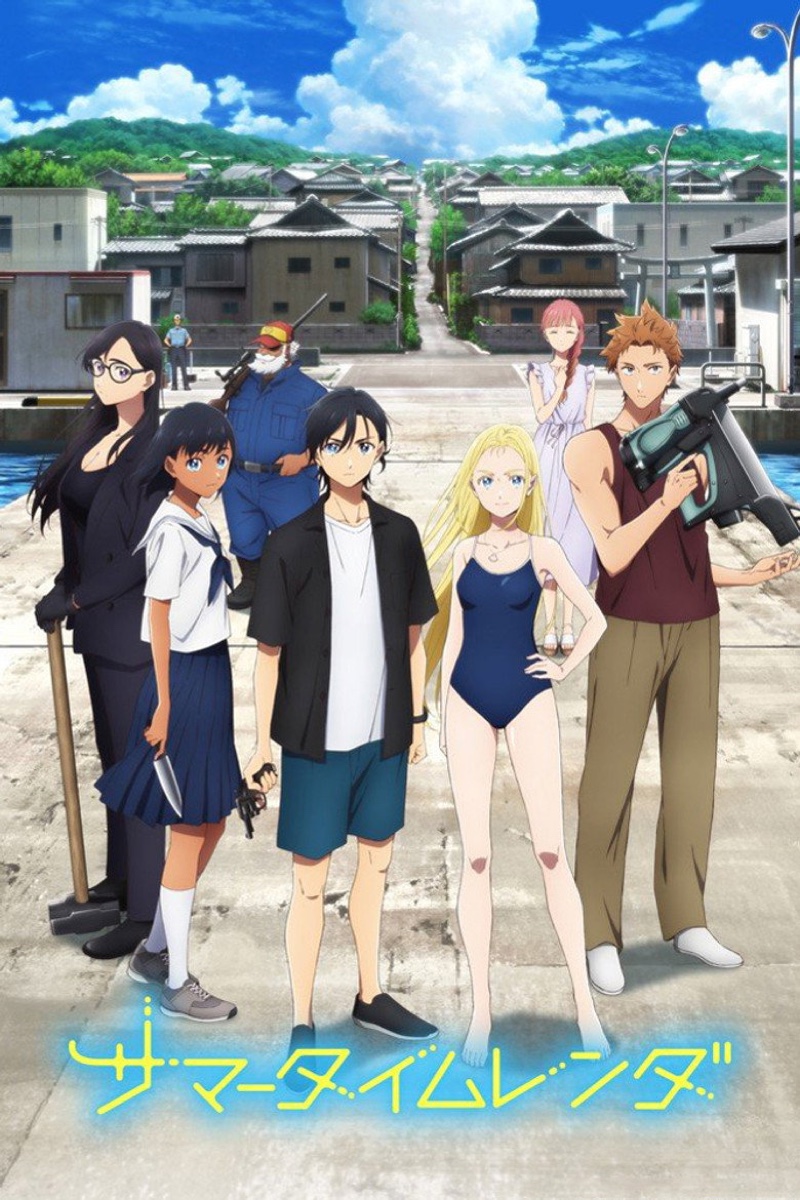
Look at the key art and you get blue ocean, towering summer clouds, a girl in a swimsuit. What you actually get in episode one is a funeral. Episodes one through three on Hitogashima are bright, sunlit, and constantly uncomfortable. Conversations with the islanders land slightly out of true. Somebody is watching from the treeline. The daytime scenes are more unsettling than the night ones, which is a difficult trick, and the horror alone is enough to justify the opening stretch even if you knew nothing about the loop.
Growing up in Japan gives you one extra layer here that subtitles have no way to carry, and it is the dialect. The cast speaks Wakayama-ben. In standard Japanese, half of these scenes would read as exposition delivered by suspicious characters. In dialect, the same lines sound like ordinary neighborhood gossip, so the wrongness of what is being said hits you a beat late, after your guard is already down. Natsuki Hanae and the rest are audibly working at the intonation in the early episodes, and by the later ones it has settled into something that sounds lived-in.
The island is not invented from nothing either. Hitogashima is modeled on Tomogashima, a cluster of four uninhabited islands in the Kitan Strait off Wakayama City, about twenty minutes by ferry from Kada Port. Yasuki Tanaka is from Wakayama City himself, and he has described building the setting by imagining what those islands would be like if people actually lived there. Ahead of the broadcast, Wakayama City appointed Ushio Kofune as its first ever “Wakayama City Anime Tourism Ambassador,” a title the city created specifically for her. Anime pilgrimage, or seichi junrei, is a real economy here, and this show is one of the more literal examples of it.
MONACA scored it, and it sounds like the inside of a summer
The score is by Keiichi Okabe, Ryuichi Takada, and Keigo Hoashi, the team behind the NieR games. Their specialty is holding dread and nostalgia inside a single cue without letting either win, which turns out to be exactly the right instrument for an island where the prettiest shot is usually the worst news. All four theme songs land as well, and the switch to the second opening at the cour break functions as a tonal gear change: the show tells you it has stopped investigating and started fighting.
Deeper Themes
Underneath the mechanics, the series keeps asking what a person owes the place that raised them. Shinpei left the island. Everyone who stayed is now paying for something he was not around for. Every loop he runs is an attempt to buy back time he already spent elsewhere, which is a very specific ache for anyone from a small Japanese town who moved to the city and only comes home for funerals.
The other thread is about copies. The show is not shy about asking whether something that remembers your life, loves what you loved, and grieves what you grieved is meaningfully less real than you are. It refuses to answer that cheaply, and the finale is built on the refusal.
🎭 Memorable Scenes
It isn’t how long you lived. It’s whether you used your life all the way up.
That is my own rendering of the Japanese line rather than the official subtitle wording, since I watched this in Japanese. It belongs to Hizuru Minakata, a novelist who comes back to the island after fourteen years away for reasons of her own. She is the one character chasing the shadows for a motive entirely separate from Shinpei’s, and she is not a fighter, nor does she conveniently hold the answers. What she has is a resolve that was already settled before she arrived. The line lands late in the run, and by then the show has spent twenty-plus episodes earning the right to say it out loud. That is the craft: nobody here gets a big statement they have not paid for.
My other pick is takoyaki. It shows up early as nothing more than food people on this island eat. Watch the finale, think back, and it turns into proof that the story was pointing at one fixed spot the entire time. I am not going to say how. What I will say is that I suspect a lot of viewers open episode one again the moment the credits roll, because I did.
💭 How It Made Me Feel
The first thing that hit when the finale ended was the click of everything fitting. Twenty-five episodes of questions, the island’s superstition, the small odd details in the early episodes that I had flagged and half forgotten. Nothing is left lying on the floor. I love that feeling more than almost anything else a mystery can give me. It is the sound of the puzzle box closing. Somewhere in the last stretch I noticed I had been gripping the remote for twenty minutes without pressing anything on it.
And then the finale goes one step past the mechanics and answers who all that solving was actually for. That is the part I did not expect. Half a year of dying, restarting, failing, and restarting again gets an ending that pays it back rather than just explaining it. The longer you have been grinding through the grim stretch, the harder those last few minutes work on you.
Look, I know I sound like I am gushing. Hear me out for one more section, because there is a real problem with this show and it is the thing most people who bounce off it are reacting to.
Who Should Watch This?
- Anyone who needs every thread tied off by the last episode
- Fans of Erased or Steins;Gate looking for the next serious time loop
- Viewers who love rural folk horror in the Midsommar or Wicker Man vein, strongly recommended
😅 Where It Falls Short
The show changes faces halfway through
But here is where I have to be honest. Somewhere in the back half, the island horror show becomes a superpower battle show. The threat scales up, the combat rules multiply, and confrontations increasingly get settled with fists instead of deduction. Some people’s interest drops out at exactly that transition, and “the first half was so much better” is the complaint I ran into most often from Japanese viewers.
I enjoyed it through to the end, so treat this as a fan’s complaint rather than a dismissal. Even so, the late-run fighting could have been tightened. There is a long stretch of trading blows with the same opponent, and more than once I registered the feeling of having watched this exact standoff already. Twenty-five episodes to adapt the manga to its ending is a hard constraint, and cutting would have produced its own set of complaints. Knowing how tight the early episodes are, though, the slack in the later ones is impossible not to notice. It genuinely bothered me. I still love this show.
The Weak Points
- If you came for the horror of the first cour, the combat focus of the second is a jolt
- The late-series fights run long, and the pacing sags in places
- Fan service, the heroine’s outfit above all, keeps cutting against the tension of the scene it lands in
Who Might Not Enjoy This?
- Anyone who wants quiet psychological horror the whole way through, because the back half is firmly an action series
- Viewers who prefer a tidy twelve-episode single cour, since this one runs twenty-five
📺 Streaming Guide by Service
How should you actually watch Summer Time Rendering?
In the US there is no comparison shopping to do. Hulu carries it, nobody else does, so the only real decision left is subtitles or dub. Hulu has both, which is more than the show got in a lot of territories. My recommendation is the Japanese audio for one specific reason: the Wakayama dialect described earlier is a real part of how the early episodes work on you, and no dub can reproduce a regional accent from another country without inventing something that means something different.
On scheduling, treat this as a binge rather than a weekly. Twenty-five episodes at 24 minutes is roughly ten hours, so a committed weekend covers it. The show assumes you are holding a lot of detail in your head at once, and stretching it over six months is the surest way to lose the thread. That was certainly how it felt watching it weekly in Japan, where the people I talked to about it kept losing track between episodes.
Watch It Here
- Hulu, subtitled version: all 25 episodes
- Hulu, English dub: all 25 episodes
Soundtrack
The official soundtrack album collects 59 cues, about two hours and fourteen minutes of MONACA at work. It streams, so you can take the island atmosphere home without buying anything.
- Spotify: available
- Apple Music: available
📚 The Source Manga
Yasuki Tanaka’s manga ran weekly on Shonen Jump+ from October 2017 to February 2021 and finished at 13 volumes, 139 chapters, with the final volume published in Japan on April 2, 2021. The anime adapts it all the way to that ending, so there is no continuation waiting for you in print. Read it anyway for a different reason: the loop diagrams and page layouts are far easier to parse on paper. Being able to stop and check who currently knows what, at your own speed, makes the manga an excellent second pass on the story.
In English it is published by UDON Entertainment as Summertime Rendering Volume 1, a six-volume omnibus edition that repackages the original 13 Japanese volumes. Note the spelling difference: the manga is officially “Summertime Rendering” in English while the anime is “Summer Time Rendering,” which is why searching either one gives you half the results.
🎬 If You Loved Summer Time Rendering, Watch These 3 Next
The Summer Hikaru Died
Same skeleton: rural Japanese summer, somebody close to you replaced by something that is not them. The difference is that here there is no rewind. It is about a boy who knows the thing wearing his best friend’s face is a fake, and chooses to keep it around anyway, which is a worse trap than dying repeatedly. It also does the same trick of using bright afternoon light as the scariest setting available. Streaming on Netflix in the US.
👉 Read our review of The Summer Hikaru Died
Erased
Twelve episodes about a man thrown back into his own childhood to stop an abduction he failed to prevent the first time. The purpose of the time travel matches Summer Time Rendering exactly, time spent to save specific people, and the closed snowbound town works on the mystery the same way the island does. If twenty-five episodes sounded like a lot, this is the same idea at a much higher concentration. Also on Hulu, so your existing subscription covers it.
Re:ZERO, Starting Life in Another World
Identical premise, dying resets the clock. The inversion is that Subaru physically cannot tell anyone what is happening to him, which produces the precise opposite of the shared-walkthrough structure I spent this whole review praising. Yes, it is isekai, and no, that does not mean what you are assuming: underneath the fantasy packaging it is a study of what repeated death does to a person’s mind. Watching both is the fastest way to see how much a single rule change can rewrite a premise. Also on Hulu.
The reveal schedule is the reason this show stayed with me, and if that is what you came for too, I ranked more series built around the same kind of turn in our anime plot twists list.
📝 Final Thoughts
The recoverable distance keeps shrinking, the enemy gets the same power he has, and he keeps counting his remaining cards and playing the next one anyway. Twenty-five episodes of that is why the ending carries the weight it does. There is a real temperature gap between the folk horror of the first half and the fighting of the second, and even with that on the scale, the quality of the mystery construction comes out ahead. I am giving this an 8.2, and it is a lopsided 8.2: the opening cour is a nine, the closing battles pull the average down, the ending shoves it back up.
Remember how I opened by saying I expected Groundhog Day? What I got instead was ten hours of summer that I ran through in a few days, then immediately reopened episode one to check how early the answers had actually been sitting in plain sight. Two days after finishing it I found myself reading ferry timetables for Kada Port, which is the most honest review I can give you. Fair warning about the takoyaki, though.
⭐ Series at a Glance
| Category | Rating | Comment |
|---|---|---|
| Writing | ★★★★★ | Nothing is left unresolved |
| Originality | ★★★★★ | A loop built on shared knowledge |
| Animation | ★★★★☆ | Island scenery, summer light |
| Music | ★★★★★ | MONACA score, four strong themes |
| Pacing | ★★★☆☆ | Late fights run long |
Usagi’s Recommendation Score
⭐⭐⭐⭐⭐⭐⭐⭐☆☆
8.2 / 10
A time loop run as a shared walkthrough. Watch it for the sound of the puzzle box closing.

