*This page contains affiliate links. We may earn a commission if you make a purchase through these links.
Think of the first half hour of WALL-E as a silent film that got made eighty years late, by a studio with an unlimited budget and no obligation to be silent at all. Pixar had sound, dialogue, voice actors and a marketing department, and chose to build the opening act out of a rusted box on treads, a cockroach, and the noise of wind moving through a dead city.
It works so completely that the film has a reputation problem. People remember it as the beautiful quiet one and forget that it is also a hard piece of science fiction about a species that outsourced its own legs. Below is where to watch it in 2026, what the silence is actually doing, and one thing about its reception that you can only really see from Japan.
📺 Where to Watch WALL-E (August 2026)
| Service | Status | Notes |
|---|---|---|
| Disney+ | Streaming | The only subscription home, and it will stay that way |
| fuboTV | Streaming | Available through its Disney content |
| Amazon Video | Rent or buy | 4K available |
| Apple TV | Rent or buy | Also on Google Play, YouTube and Fandango at Home |
| Netflix | Not available | Disney pulled its library years ago |
As of August 18, 2026, Disney+ is the subscription answer and there is no realistic chance of that changing. Disney owns Pixar, so the catalog is not going to circulate the way licensed anime does. If you want it without a subscription, every major storefront rents it, and the 4K transfer is worth the extra couple of dollars on a film this densely designed.
It is the same story in Japan, where I am writing this. Disney+ and nothing else, and the rental storefronts underneath. For once the two markets look identical, which almost never happens with the titles I usually cover here.
🎬 Trailer
Watch how hard the trailer works to reassure you that things happen. Spaceships, chases, a big score. The film it is selling opens with twenty minutes of a robot tidying up, and is much better than the trailer is willing to admit.
Work Info
- Title: WALL-E
- Released: 2008, 98 minutes
- Director: Andrew Stanton
- Studio: Pixar Animation Studios
- Sound design: Ben Burtt, who also built the voices
- Awards: Academy Award and Golden Globe for Best Animated Feature
- Japanese release: December 5, 2008
📖 Synopsis, No Spoilers
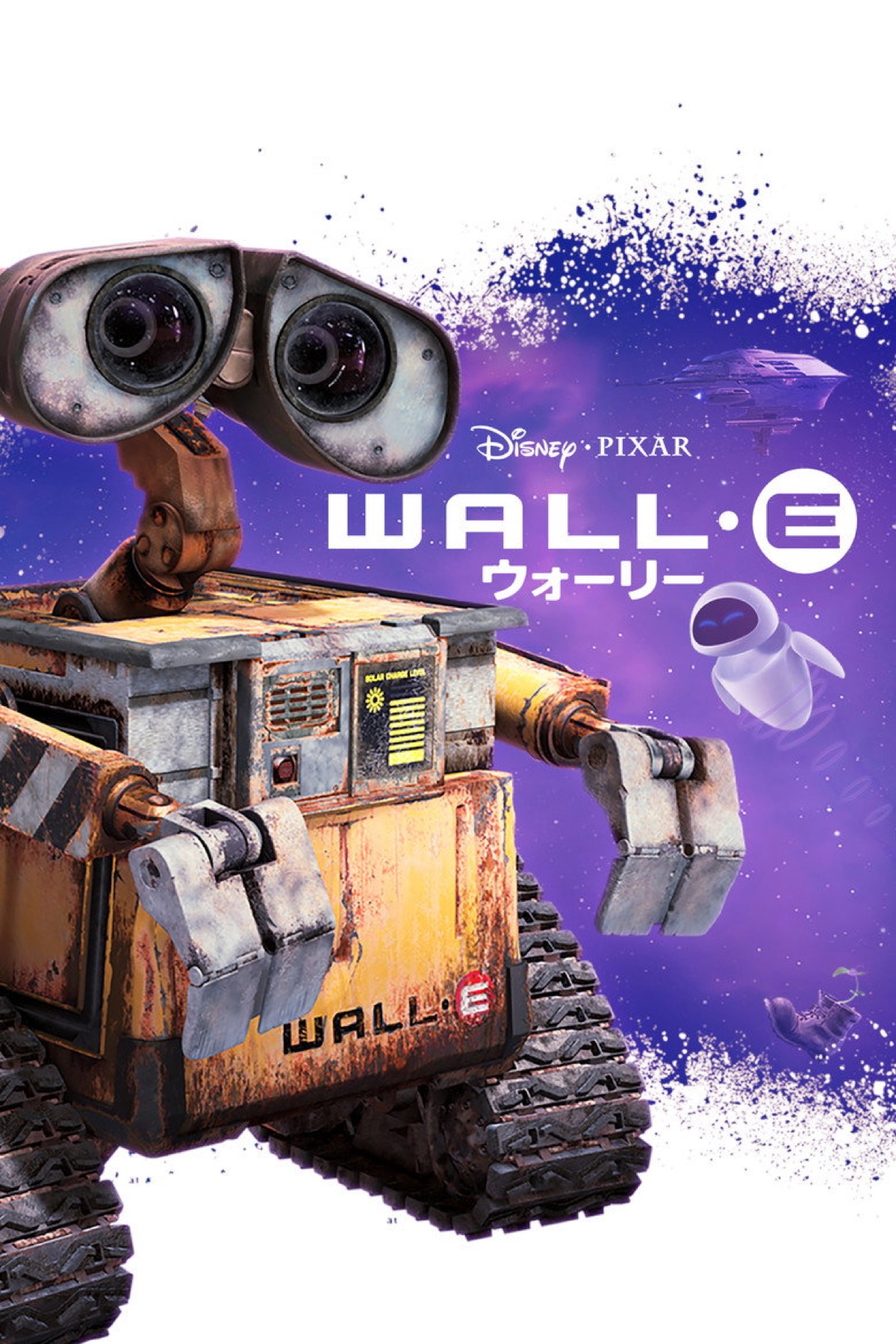
It is the year 2805. Earth is buried under its own garbage and the human race left centuries ago on a fleet of corporate cruise ships. One waste compactor was never switched off. WALL-E has spent seven hundred years crushing trash into cubes and stacking them into towers, and somewhere in those centuries he started keeping things instead of crushing them.
His collection includes a worn videotape of the musical Hello, Dolly!, which he replays for one image: two people holding hands. Then a probe named EVE lands, sent to look for evidence that Earth can support life again. WALL-E has been alone for seven centuries and falls for her within about a minute. When EVE finds what she was sent for, she shuts down, and WALL-E does the only thing that makes sense to him, which is to grab hold of the ship that comes to collect her.
✨ What Makes It Special
Why It Is Exceptional
- Roughly thirty opening minutes with almost no dialogue, and no dead air in them
- A character built from two binocular lenses who out-acts most live-action leads
- A 2008 film that called the screen-shaped future a year after the first iPhone
- Sound design doing the work dialogue normally does
Thirty minutes without dialogue, and nothing is missing
The opening act has a cast of one robot, one cockroach and a ruined planet, and it never once feels like an experiment being conducted at the audience’s expense. Everything you need arrives through movement. The way WALL-E’s lenses tilt inward when something goes wrong. The way he pulls his own head into his body when a sandstorm hits, a gesture the film never explains because it does not need to. Seven hundred years of solitude, small daily pleasures, and a crush, delivered without a line of exposition.
This is worth dwelling on if your usual viewing is anime, because the contrast is instructive. Japanese television animation leans hard on spoken language: internal monologue, narration, characters announcing their own emotional states so a weekly audience never loses the thread. There are magnificent exceptions, and Ghibli is full of them, but the default is verbal. WALL-E throws out the entire toolkit and still lands every beat, which is a useful reminder of how much of animation’s actual expressive power sits in the drawing rather than the script.
Credit where it belongs. Ben Burtt, the man who made a lightsaber sound like a lightsaber, built WALL-E’s entire vocabulary out of motors, servos and treated recordings. The result is a character who never says a word you could transcribe and is never once ambiguous about what he means.
Praising a film for withholding dialogue can easily turn into praising it for being difficult, so let me be clear about what I am claiming. The silence is not a test of the audience’s patience. It is a delivery method, and it is faster than dialogue would have been, because a gesture reads in half a second and a sentence takes four.
The most expressive thing in the film is a pair of binoculars
WALL-E’s design is a box, treads, and two lenses on a stalk. No mouth, no eyebrows, none of the equipment animation normally relies on. The lenses do all of it. Tilt them together and he is worried. Spread them apart and he is delighted. Drop the whole stalk a few degrees and he is heartbroken, and you will read it correctly on first viewing without being taught.
EVE is the harder trick, and less often praised. She is a smooth white shell with a floating visor, designed to look like an Apple product that could kill you, and the animators had even fewer degrees of freedom to work with. She is still legibly a person, and the shift in her over the middle of the film is carried almost entirely in how she holds her body.
It saw the screen-shaped future coming
The humans on the Axiom float in reclining chairs, each with a screen a few inches from their face. They have forgotten how to walk. They speak to the person next to them through the screen rather than turning their heads. Told that blue is in fashion, the entire ship switches to blue at once.
The first iPhone had been on sale for about a year when this came out. The satire was read in 2008 as broad and a bit obvious, and it has aged into something closer to documentary. A Tokyo train carriage at rush hour is a row of people angled toward screens, silent, physically adjacent and socially elsewhere. The Axiom is not a warning about the future any more. It is a warning about last Tuesday.
Deeper Themes
The environmental story is the one everybody names, and it is the shallower of the two. The film is not really arguing that garbage is bad. It is arguing that comfort, applied without limit, removes the capacity to want anything, and that the way back is physical rather than intellectual. The captain does not out-argue the ship’s autopilot. He stands up.
Underneath that sits a quieter idea about what a machine built for one job does with seven hundred years of spare time. WALL-E was manufactured to compact trash. He developed taste, sentiment and curiosity because nobody came back to switch him off, which is a strange and rather generous theory of where a personality comes from.
🎭 Memorable Scenes
I do not want to survive. I want to live.
The captain, refusing the autopilot and getting onto his own two feet for the first time in his life, with Richard Strauss playing underneath. Borrowing Also sprach Zarathustra from 2001: A Space Odyssey for a scene about a soft man standing up is a joke and a thesis at the same time, and the film means both.
The other one is the fire extinguisher. Two robots outside a ship, no gravity, no dialogue, one of them steering by spraying foam, circling and drifting apart and coming back together. It is a dance sequence, it is a date, and it is the single most romantic thing in the Pixar catalog. Nobody says anything, and nobody needs to.
💭 How It Made Me Feel
The credits started and I did not move for a while. Seven hundred years alone is a phrase that does the damage on its own, before you have even factored in the hoarded junk, the tape he keeps rewinding, or the fact that his response to meeting one other being was to follow her into space without a plan.
Then the ending, and the hands. A robot who has lost what he was reaches for a hand and comes back. There is no line of dialogue attached to it, and there did not need to be, and that is the whole argument of the film delivered in about four seconds.
Who Should Watch This?
- Adults who file Pixar under children’s entertainment and have never tested the assumption
- Anyone drawn to silent film, or curious how far animation gets without a script
- Science fiction readers who want the ideas taken seriously rather than decorated with
- Anyone who has caught themselves scrolling in company and disliked the feeling
😅 Where It Falls Short
The spaceship half cannot follow the Earth half
Time to be honest about this one. The problem is not that the second half is weak. The problem is that the first half is extraordinary. Everything on Earth, the dead city, the courtship, the small domestic rituals, is patient and strange and unlike anything else in the studio’s output. Once the story reaches the Axiom it becomes a chase, competently made and much more ordinary.
The human characters are the weakest thing in the film. They exist to make a point about atrophy, and the design never gets past that point into anything resembling a person. Set them beside WALL-E, EVE and M-O the cleaning robot, all of whom are vivid without faces, and the gap is hard to ignore.
The environmental message is also delivered with a firm hand. It did not bother me, and the complaint comes up often enough that it is clearly not a fringe reaction. All of this belongs in the category of wanting a great film to be flawless rather than in the category of real objections. The Earth section alone would justify the running time.
The Weak Points
- The Axiom section trades the opening’s stillness for conventional chase comedy
- The human designs stop at the satire and never become characters
- The ecological argument is delivered with very little subtlety
Who Might Not Enjoy This?
- Viewers who want talk, and plenty of it, from their leads
- Anyone allergic to a film that states its politics outright
- Younger children, who tend to get restless during the wordless opening
📺 Streaming Guide by Service
What Japan did with this film, and why it is odd
Here is the part I can offer that a US review cannot. Japan got WALL-E on December 5, 2008, six months after the American release, and it took about 4.0 billion yen at the domestic box office. That is a respectable number in isolation. Put it next to the studio’s other releases here and it is not: Finding Nemo did 11.0 billion, Toy Story 3 did 10.8 billion, Monsters, Inc. did 9.37 billion. Even Up, released the following December, cleared 5.0 billion. Japanese audiences turned out for this one least of all.
And then the industry here gave it prizes. It took the theatrical feature award at Animation Kobe, and an Excellence Prize in the foreign theatrical category at the Tokyo Anime Awards in 2010. The country that skipped the tickets sent it home with trophies from its own animation establishment, which is a split I find genuinely interesting rather than contradictory. A wordless first act about loneliness is a difficult sell to families in December. It is an easy sell to people who animate for a living.
The title did the film no favors either. In Japanese it is written Woorii, which is exactly how this country writes Wally, of Where’s Wally? fame, a picture book series that has been a fixture in Japanese households for decades. A parent seeing the poster in 2008 had a reasonable chance of assuming it was connected to the striped hat and the crowds.
One last local detail, and it is my favorite. The Japanese dub assembled a proper cast, with Masao Kusakari as the captain and Masashi Ebara as AUTO, for a film in which almost nobody speaks. Among anime fans the subtitles-versus-dub argument is close to a religious war. WALL-E is the rare case where it simply evaporates, because for the first half hour there is nothing to translate. Watch whichever version loads first. You are seeing the same film.
Watch It Here
- Disney+: included with a subscription, in 4K
- fuboTV: included, through its Disney content
- Amazon Video: rent or buy, no subscription needed
- Apple TV: rent or buy, as do Google Play, YouTube and Fandango at Home
Soundtrack
Thomas Newman’s score is on Spotify and Apple Music, and it does an unusual amount of narrative work given how much of the film has no one talking over it.
The other half of the soundtrack is borrowed. Put On Your Sunday Clothes and It Only Takes a Moment come from the 1969 film of Hello, Dolly!, and Richard Strauss turns up for the captain. The Jerry Herman songs are worth queueing separately, because knowing what WALL-E has been watching on loop for seven centuries changes how the last scene reads.
📀 On Disc
This is a film that rewards pausing. The Earth section is packed with detail that goes past too quickly on a first viewing, and the 4K transfer holds up on a large screen in a way streaming compression sometimes does not.
If you want a copy, the 4K UHD release is on Amazon, and the extras include Andrew Stanton walking through how the sound was assembled.
🎬 If You Loved WALL-E, Watch These 3 Next
Nausicaa of the Valley of the Wind
The obvious Japanese companion piece, made twenty-four years earlier. A poisoned Earth, a displaced human remnant, and a protagonist whose relationship to a single growing plant carries the film’s whole argument. Miyazaki is angrier about it than Pixar is, and he gives you no robot to soften the landing.
👉 Read our review of Nausicaa of the Valley of the Wind
Dr. STONE Season 1
The same ruined world, approached from the opposite direction. Civilization is gone and one very loud teenager sets about rebuilding it from first principles, cheerfully and out loud. If WALL-E’s patience is the mood you liked, this is the tonal inverse, and it scratches the identical itch about starting over with nothing.
👉 Read our review of Dr. STONE Season 1
Up (2009)
Pixar’s other great argument for shutting up. The opening montage compresses an entire marriage into a few silent minutes and is routinely cited as the studio’s finest sequence. Watch the two films together and you can see a house style being tested: how much can be cut before the audience stops following?
👉 Read our review of Up (2009)
📝 Final Thoughts
What Pixar did here was take away the tool every animation studio depends on and prove the medium works without it. Movement, timing and sound design carry ninety-eight minutes, and the emotional peak of the film is a hand closing around another hand. That connects back past CG, past cel animation, to Chaplin, and it holds up as well as anything in the catalog.
What has changed since 2008 is the other half. The reclining chairs and the inches-away screens read as satire once and read as reportage now, which is not a comfortable thing for a family film to have achieved. The film does not leave you there, though. It ends on the least sophisticated idea available, that paying attention to one specific other being is enough to start over with, and after seven hundred years of garbage it earns the right to say so.
⭐ Film at a Glance
| Category | Rating | Comment |
|---|---|---|
| Writing | ★★★★★ | Almost no dialogue, nothing unclear |
| Visuals | ★★★★★ | The dead-Earth section is the studio’s best work |
| Characters | ★★★★★ | The robots, at least, and they are the film |
| Music | ★★★★☆ | Newman plus a borrowed musical, used precisely |
| Themes | ★★★★★ | Landed harder in 2026 than it did in 2008 |
| Second half | ★★★☆☆ | Competent chase comedy after an extraordinary opening |
Usagi’s Recommendation Score
⭐⭐⭐⭐⭐⭐⭐⭐⭐☆
9.2 / 10
Take away the dialogue and what is left says more. Pixar’s high point.

