*This page contains affiliate links. We may earn a commission if you make a purchase through these links.
For the first half of Inside Out, Sadness got on my nerves. I saw it in a theater, subtitled. Joy is guarding Riley’s happiest memories with everything she has, and Sadness keeps reaching out to touch them. Every memory she touches turns blue. Joy tells her to stop. A minute later she does it again. Watching from Joy’s side, I just wanted Sadness to leave things alone.
By the end, that irritation turned out to be part of the design. The film takes its Emotions’ clumsy behavior, and the discomfort it stirs up in you, and uses both to say one thing: there is no feeling you can do without. Below: where it streams in the US, who the five Emotions are (with their Japanese names), why Sadness has to be there, why Riley’s broccoli turned into green peppers in Japan, and whether to watch it before Inside Out 2.
📺 Where to Watch Inside Out (October 2026)
| Service | Status | Notes |
|---|---|---|
| Disney+ | Streaming | The only US subscription with it. Inside Out 2 is there too |
| Amazon Prime Video | Rent / Buy | Not included with Prime |
| Apple TV | Rent / Buy | Also on YouTube, Google Play, Fandango at Home |
| Hulu | Not available | Not in Hulu’s own library |
| Netflix | Not available | Not licensed to Netflix in the US |
As of October 7, 2026, Inside Out streams on exactly one US subscription, Disney+. Inside Out 2 is on Disney+ as well, so you can watch the two back to back on a single service. Everywhere else, the first film is pay-per-title. Streaming deals shift, so check Disney+ itself before you pay for a rental.
👉 Pete Docter, who directed Inside Out, also directed Monsters, Inc. (2001). Both films build an entire working world out of something every child feels: screams in one, memories in the other.
🎬 Trailer
Work Info
- Title: Inside Out (2015), released in Japan as Inside Head
- Director: Pete Docter (co-directed by Ronnie del Carmen)
- Screenplay: Meg LeFauve, Josh Cooley, Pete Docter
- Music: Michael Giacchino
- Voices: Amy Poehler (Joy), Phyllis Smith (Sadness), Richard Kind (Bing Bong), Kaitlyn Dias (Riley)
- Japanese dub: Yuko Takeuchi (Joy), Shinobu Otake (Sadness), Jiro Sato (Bing Bong)
- Runtime: 95 minutes, rated PG
- Released: June 19, 2015 in the US, July 18, 2015 in Japan
- Awards: Best Animated Feature at the 88th Academy Awards
- Studio: Pixar Animation Studios / Distributed by Disney
- Source: TMDB
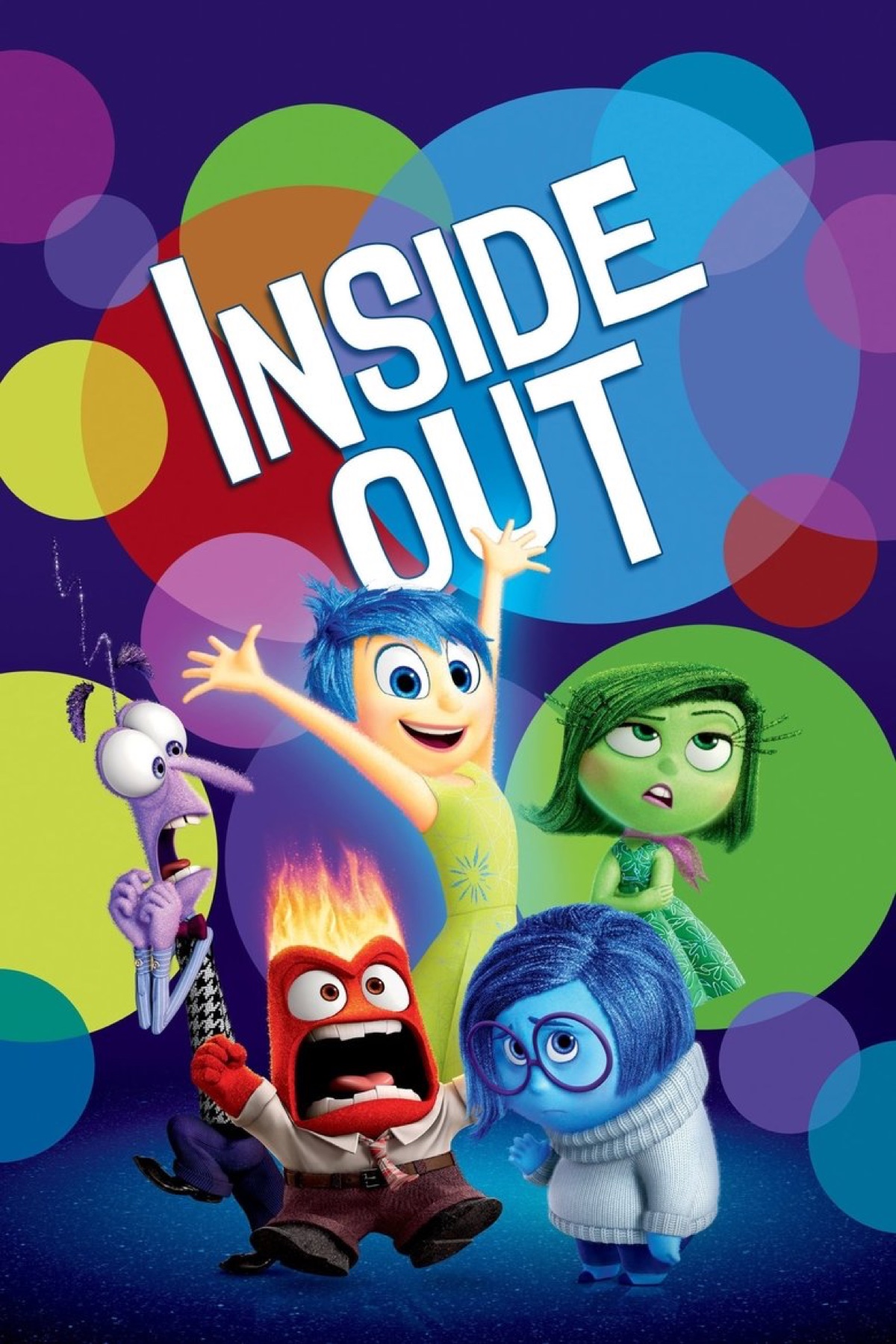
📖 Synopsis – No Spoilers
Eleven-year-old Riley grew up in Minnesota and loves hockey, her friends and her parents. Inside her head is Headquarters, where five Emotions (Joy, Sadness, Anger, Fear and Disgust) take turns at the console. Every moment of her day becomes a glowing memory orb, colored by the feeling attached to it, and the most important ones power her Islands of Personality: Family Island, Goofball Island, Hockey Island and the rest.
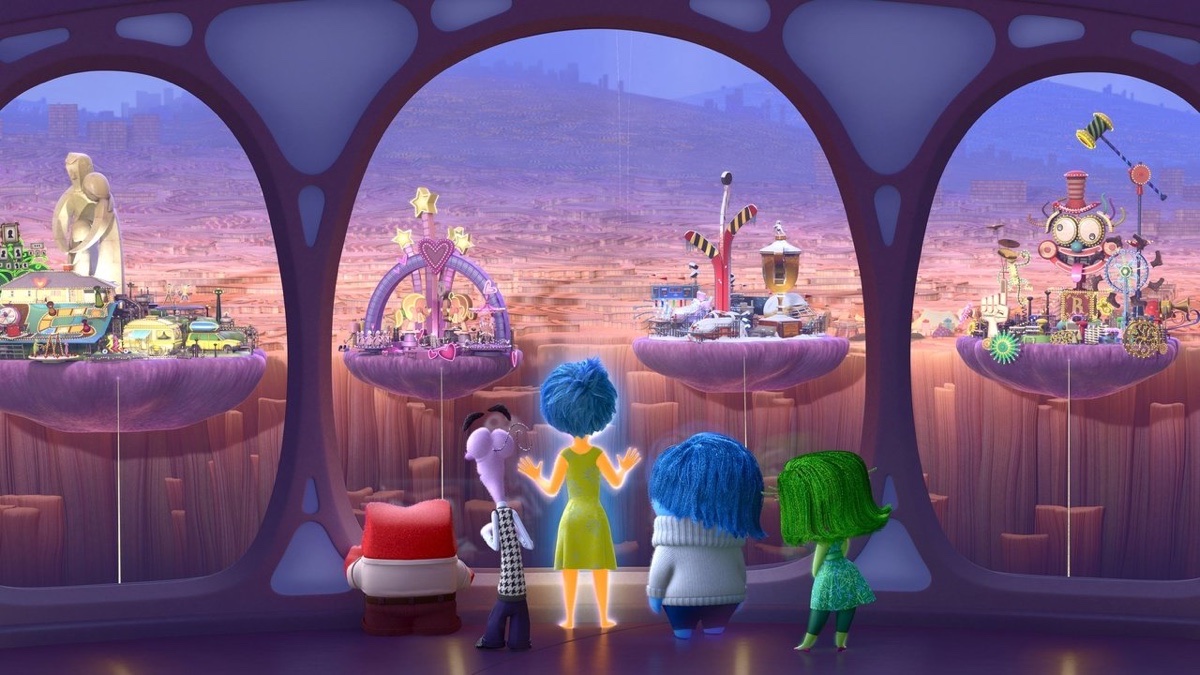
Then her dad’s new job moves the family to San Francisco. The new house is old and cramped, the moving van has not shown up, and school is full of strangers. Joy fights to keep Riley smiling, while Sadness, for reasons she cannot explain, keeps touching memories and turning them blue. In the scuffle, Joy and Sadness are sucked out of Headquarters along with Riley’s most important memories. Only Anger, Fear and Disgust are left at the controls, while Joy and Sadness have to find their way back across the vast landscape of Riley’s mind.
🧠 Inside Out Characters: the Five Emotions, Their Voices and Their Japanese Names
Here is who lives in Riley’s head, with the original voice cast and the Japanese dub. Japan did not keep the English names. Each Emotion was renamed with an everyday Japanese word for the feeling, and a couple of them say more than the originals do.
| Character | Japanese name | Original voice | Japanese dub |
|---|---|---|---|
| Joy | Yorokobi (joy) | Amy Poehler | Yuko Takeuchi |
| Sadness | Kanashimi (sadness) | Phyllis Smith | Shinobu Otake |
| Anger | Ikari (anger) | Lewis Black | Jin Urayama |
| Fear | Bibiri (a scaredy-cat) | Bill Hader | Koji Ochiai |
| Disgust | Mukamuka (a queasy, fed-up feeling) | Mindy Kaling | Yuka Komatsu |
| Bing Bong | Bing Bong | Richard Kind | Jiro Sato |
| Riley | Riley | Kaitlyn Dias | Mai Ijuin |
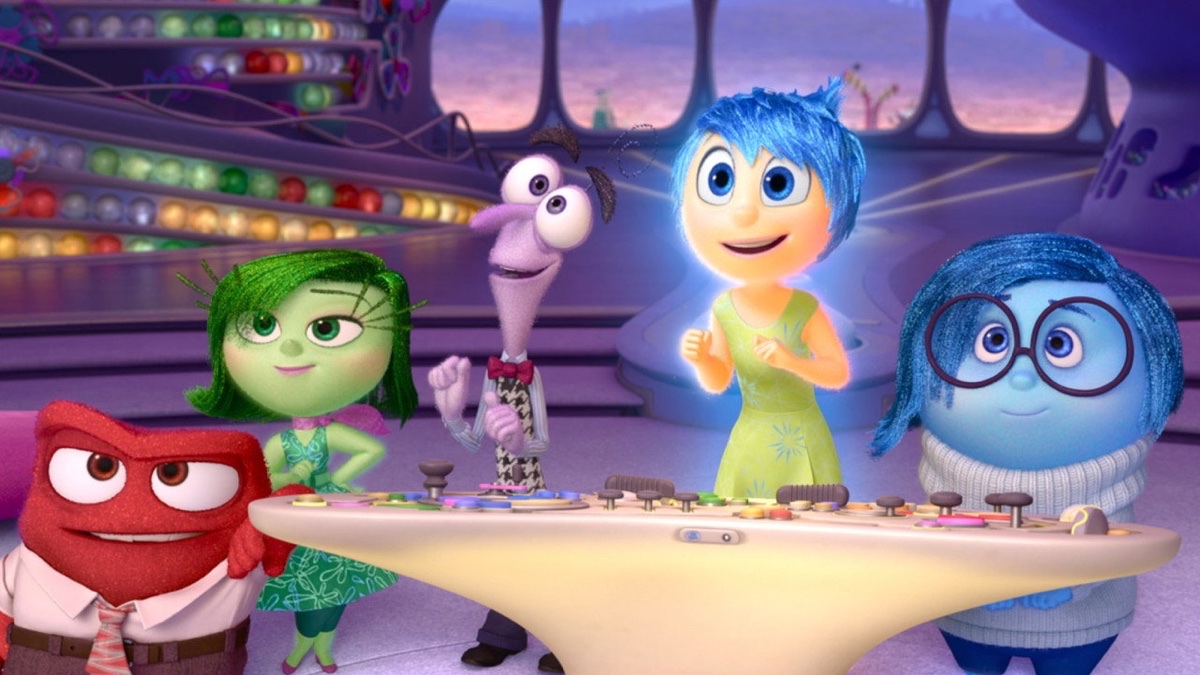
Mukamuka is the most telling of these. It is the word for a stomach turning over, and also for being so fed up you could scream, which covers both halves of Disgust’s job: she keeps Riley from being poisoned, physically and socially. Bibiri is not quite “fear,” either. It is closer to calling someone a scaredy-cat, a little affectionate and a little mocking at once.
Joy’s Japanese voice was the actress Yuko Takeuchi, who passed away in 2020. I watched the film subtitled, so the Joy I heard was Amy Poehler. Japanese TV, though, airs the dub, and when Nippon TV’s Friday Road Show broadcasts Inside Out on October 9, 2026, Japanese viewers will hear Takeuchi as Joy once more. In Inside Out 2, Ami Koshimizu took over the role, and Shinobu Otake came back as Sadness.
In the Japanese dub, Riley’s broccoli is green peppers
Early on, Dad tries to get little Riley to eat her broccoli, and Disgust and Anger grab the console one after the other. It is the quickest way to see how those two differ. Anger pushes back at something unfair. Disgust pushes away whatever does not agree with her. In Japan’s dubbed version, though, there is no broccoli. Pete Docter has explained that the team learned Japanese kids do not find broccoli gross at all. When Pixar asked what they did hate, the answer was green bell peppers, piman in Japanese, so the studio remodeled and reanimated three scenes to swap the vegetable. For the dub, Pixar also redrew Anger’s newspaper and the on-screen signs in Japanese.
Japanese film press reported the swap as dub-only, so the Riley in the subtitled version I saw in the theater hated broccoli. It is a small change, and it tells you how seriously Pixar took the idea that every kid should recognize this kid. In Japan, the green pepper really is the classic vegetable that kids refuse to eat.
✨ What Makes It Special
Why It’s Exceptional
- The belief that nobody needs Sadness gets turned over while you watch
- Bing Bong, an imaginary friend, carries all the ache of growing up
- A memory world detailed enough to explain why a jingle gets stuck in your head
Why does Inside Out need Sadness? The more she annoys you, the later the answer lands
In the first half, Sadness is dead weight. Joy draws a circle on the floor and tells her to stay inside it; a moment later she is out again, touching memories. Further on she lies down and announces she is too sad to walk, and Joy has to drag her along by the leg. If you are on Joy’s side, and the film puts you there, the irritation builds on its own. I was on that side too. Over a small blue character in a family cartoon, of all things.
What the film does so well is keep you standing where Joy stands. Joy believes, right up to the end, that Riley ought to be smiling, and you believe it with her. So when a certain scene late in the film arrives, Joy is not the only one being questioned. The verdict you reached on Sadness an hour earlier is on trial too.
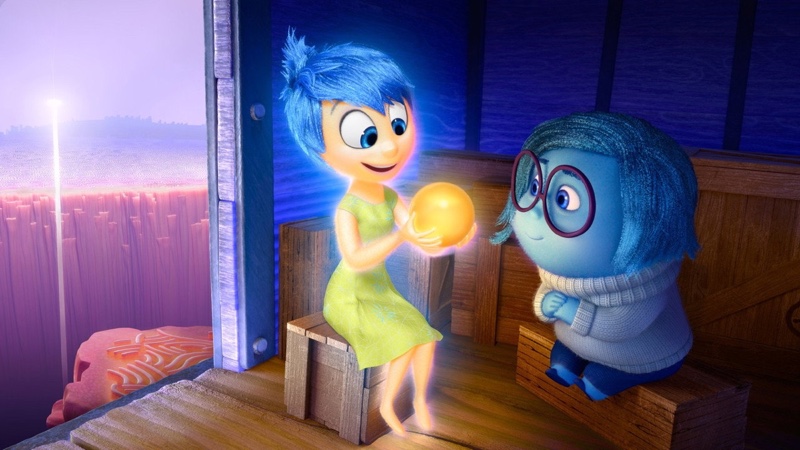
So what is Sadness for? The film’s answer: sadness is the feeling that lets a person ask for help. If you cannot be sad when you are sad, you cannot reach out to anyone around you. A memory bank made only of happy moments is just a lid pressed down on everything else, and sooner or later it rings false. The sad times hurt because good times came before them; run from the sadness and you erase those good times too. None of this arrives as a speech. The film lets you get annoyed on your own, and then lets you take it back on your own.
Look, I know a talking cartoon about feelings can sound childish. Hear me out. The look is for kids, but the story lands harder on adults. Anyone who has spent years being told to stay positive will find Joy’s frantic cheer uncomfortably familiar. (Joy is the hero here, which is exactly what makes her blind spot hard to watch.)
Deeper Themes
With Joy and Sadness gone, Headquarters is run by Anger, Fear and Disgust alone. That state is a fair picture of the start of adolescence: irritable for no reason, jumpy, unable to stand a single thing a parent says. From the outside it reads as a kid who has suddenly turned difficult. Inside, joy and sadness have gone missing. For adults, a move is a change of address. For an eleven-year-old, the whole world gets swapped out. Parents who have started to lose track of what their own kid is feeling may see Riley’s sulking very differently after this.
Bing Bong is the thing every kid had once and let go
Out in the memory world, Joy and Sadness run into Bing Bong, the imaginary friend Riley invented when she was small. His body is cotton candy, he has an elephant’s trunk, and when he cries, candy falls instead of tears. He and Riley had a plan to fly to the moon, and he still treasures the homemade rocket they built for the trip. The eleven-year-old Riley, though, no longer thinks of him.
Bing Bong is the shape of whatever each of us had as a child and let go of without noticing. An imaginary friend, a stuffed animal, a game with no point to it. Outgrowing it is sad, and it is also proof that Riley does not need him anymore. Sadness and joy sit inside the same event. This is where Bing Bong’s story and Sadness’s story meet.
One Bing Bong scene is the main reason so many people call Inside Out a movie that made them cry. I will not say what happens. Only that Bing Bong, who spends nearly all his screen time clowning, shows a face there that he shows nowhere else.
Why a jingle gets stuck in your head: the memory world has an answer
The world inside Riley’s head is a lot of fun in its own right. Memories sit on endless shelves as orbs whose color tells you the feeling, and the ones nobody uses fade to gray, get sorted by workers and are sent down to the Memory Dump. Dreams are films shot every night at a studio called Dream Productions, and Imagination Land even has a machine that turns out the ideal boyfriend. Two bored workers fire a chewing-gum jingle up to Headquarters, and it starts playing in Riley’s head out of nowhere. It is one of the funniest gags in the film.
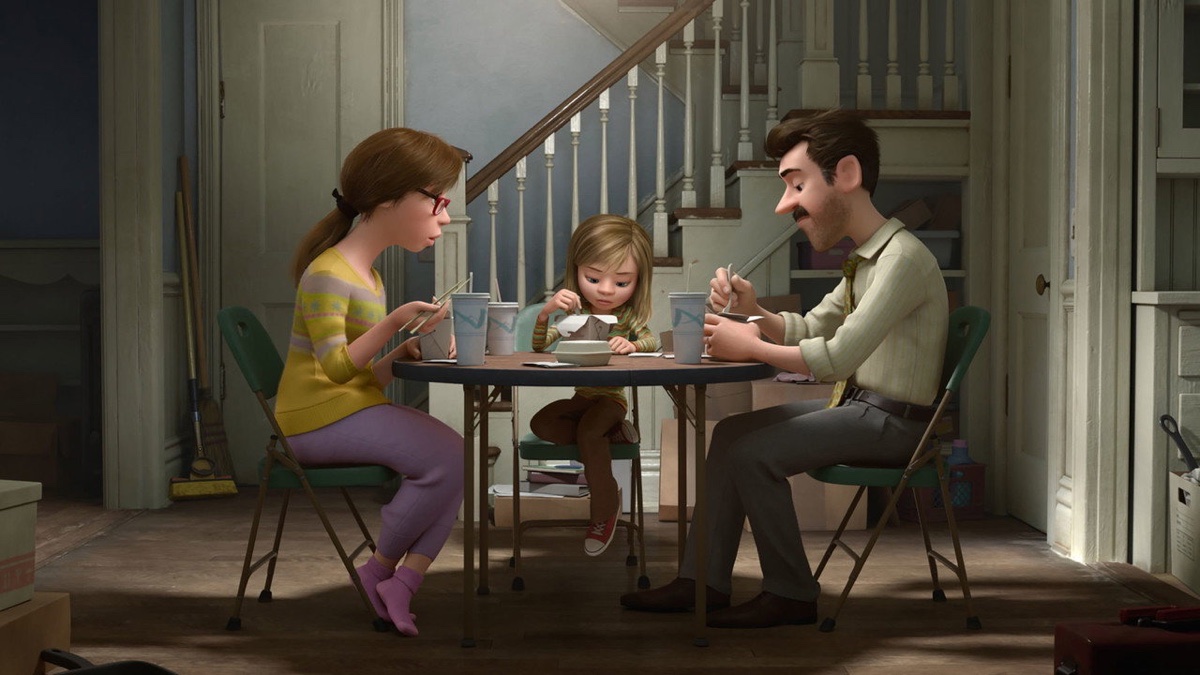
Each piece makes you think, oh, so that is why an old memory pops up for no reason. The whole thing invites you to picture your own Headquarters: which Emotion holds your console, which of your islands is biggest. The dinner scene also cuts inside Mom’s and Dad’s heads, and getting a peek at how a grown-up Headquarters runs is a treat of its own.
🎭 Memorable Scenes
Crying helps me slow down and obsess over the weight of life’s problems.
Sadness says it with a perfectly straight face, and the first time through, it is a punchline. By the end of the film it reads a little differently.
1. The face Bing Bong shows only once
It works because you know how he usually clowns around. What happens there stays out of this review; it is a short moment, and it does not need to be any longer.
2. Riley going numb
With neither Joy nor Sadness in Headquarters, her Islands of Personality crumble one by one each time she is pushed, and the console stops responding to what she feels. You rarely see an eleven-year-old shutting down shown this concretely.
3. One exhale near the end
Near the end, Riley has a short conversation. Who it is with and what she says, see for yourself. When it is over, her face loosens a little and she lets out a breath. Everything the film wanted to say is in that one moment.
💭 How It Made Me Feel
When it ended, the irritation from the first half had somewhere new to go. The Sadness who had seemed so in the way was standing exactly where she was needed most. Remember how badly I wanted her to leave those memories alone? Yeah.
After that I went on to Inside Out 2, in order: one first, then two. Which one to start with is covered further down.
👉 In the US you can start it right now on Disney+.
😅 Where It Falls Short
I’ve been making the case for Sadness this whole time, but two things nagged at me. In Japan, a few hundred people a month search the film’s title together with the word hidoi, “awful.” Look into it and you find people who could not stand Sadness, or who were bored in the middle. I understand both. My answer: it is less an awful film than one that moves flawed Emotions clumsily on purpose and gets its message across through the discomfort that causes. That method has a cost, though.
For some viewers, the irritation with Sadness, and with Joy, never fades
Even if annoying you is the plan, you have no way of knowing that while you watch. Sadness keeps touching memories however often she is stopped, Joy keeps pushing her relentless cheer on everyone, and someone in Headquarters is always yelling. Once Sadness’s role becomes clear near the end, the irritation pays off. If you have checked out before then, what remains is ninety-five minutes of being dragged around by loud characters. I think this one point is nearly the whole reason opinions on the film split so sharply.
The trip back to Headquarters runs long
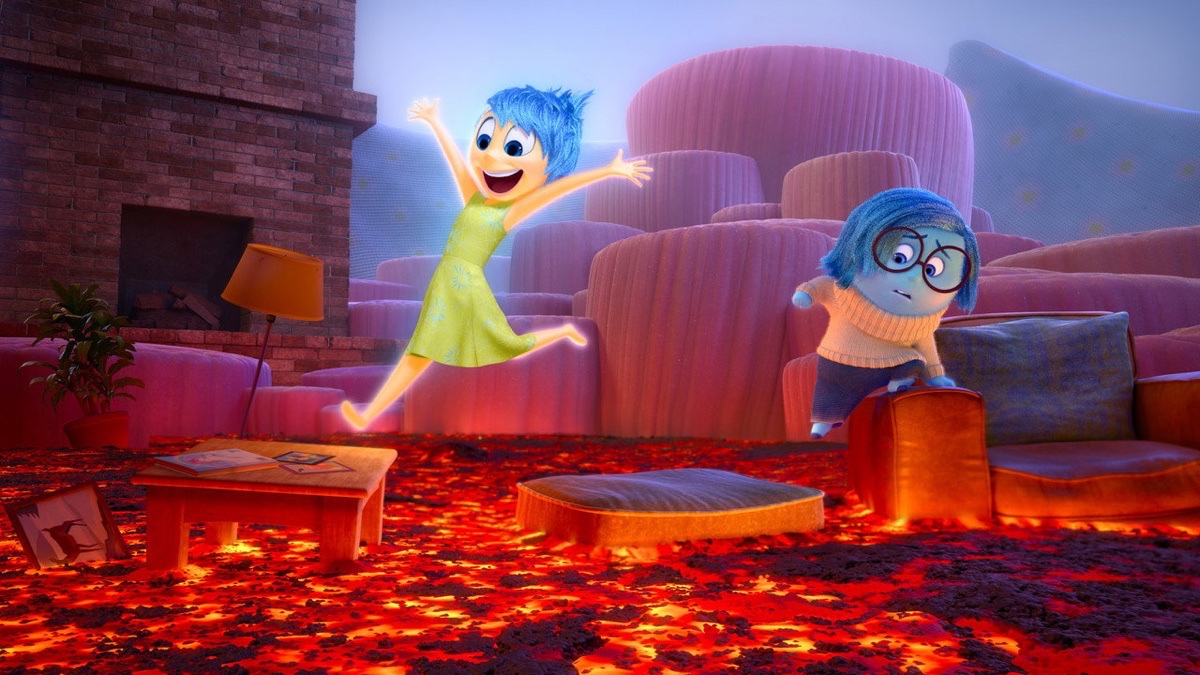
The middle stretch, with Joy and Sadness crossing Riley’s mind to get back to Headquarters, settles into a loop: they nearly make it, then they fail. The places they pass through, Dream Productions and Imagination Land among them, are packed with fun ideas. Still, the film coasts on invention for a long while as the story itself barely moves. You also have to sit through the mechanics of how memory works, so the stretch ends up a bit too complicated for kids and a bit too slow for adults, and satisfies neither completely.
The Downsides
- For some viewers, the first-half irritation with Sadness (and Joy) lasts to the very end
- The journey back to Headquarters runs long, and the story stalls in the middle
Who Should Watch This?
- Anyone about to start Inside Out 2 who wants the first film under their belt, and anyone who saw 2 first and is coming back
- Adults who have been skipping it because it is a kids’ cartoon
- Parents who are starting to lose track of what their almost-teenager is feeling. This one is especially for you
Who Might Not Enjoy This?
- Anyone who tires quickly of noisy characters, or of characters who will not listen
- Viewers who would rather have a plot that keeps rolling than a world being explained
- Anyone expecting a deep psychological drama for adults. The tone stays bright enough for the whole family, and the emotions are simplified quite a bit
🎬 Inside Out or Inside Out 2 First? Start With the First Film
If you are torn on which to watch first, start with the first one. Inside Out 2 (2024) jumps ahead to Riley at thirteen, when a crew of new Emotions led by Anxiety (Shinpai, “worry,” in the Japanese version) moves into Headquarters. Headquarters, memory orbs, the Islands of Personality: all of that machinery is built in the first film, and the sequel assumes you already know it.
More than that, knowing what the five Emotions learned the first time changes the weight of the scenes in 2 where the newcomers shove them aside. If you saw 2 first, going back to 1 shows you where it all started. Both films stream on Disney+ in the US, so you can go straight from one into the other.
Japanese TV is running them in exactly that order this month. Friday Road Show airs Inside Out on October 9, 2026, and Inside Out 2 on October 16, the sequel’s first broadcast on free-to-air TV in Japan.
📺 Streaming Guide by Service
Is Inside Out on Netflix or Hulu? No. Disney+ is the only subscription with it
Neither US Netflix nor Hulu’s own catalog carries Inside Out. Of the US subscriptions, Disney+ alone has it. Inside Out 2 is there, and so are Pete Docter’s other features, Monsters, Inc., Up and Soul. If the first film sends you straight on to the second, one service covers the whole run.
Only want to see the first film once? Rent it on Amazon Prime Video or Apple TV. A Prime membership will not get you in for free; the rental is charged on top.
Where to Stream
- Disney+: Streaming, the only US subscription with it (Inside Out 2 too)
- Amazon Prime Video: rent / buy, not included with Prime
- Apple TV: rent / buy, also offered on YouTube, Google Play, Fandango at Home
- Hulu / Netflix: not available in the US
Soundtrack
- Apple Music: available
- Spotify: available
The score is by Michael Giacchino. A simple piano theme carries both the chaos at the Headquarters console and the long trek through Riley’s mind.
📀 On Disc
Inside Out is a Pixar original with no book behind it, so a disc is how you keep it. With your own copy, Bing Bong’s scenes and the shouting matches in Headquarters are yours to replay whenever you want, whatever the streaming deals do.
🎬 If You Loved Inside Out, Watch These 3 Next
A Letter to Momo
Hiroyuki Okiura’s 2012 Japanese animated film. After her father dies, a girl named Momo moves with her mother to a small island in the Seto Inland Sea. A girl in a new place who cannot tell her parent what she really feels: Momo is stuck at exactly the spot where Riley gets stuck. Inside Out shows you everything going on in Riley’s head. A Letter to Momo shows none of what is in Momo’s; instead, three lovable yokai (spirits from Japanese folklore) hover around the feelings she cannot put into words. As two stories about a child carrying sadness while believing she has to stay cheerful, they answer each other.
👉 Read the A Letter to Momo review
Soul
The second pick comes with a confession: I have not seen this one yet. Pete Docter followed Inside Out with Soul, made for Pixar in 2020. Joe Gardner, a middle-school music teacher who dreams of playing jazz piano, ends up in a realm of souls that have not yet been born and meets 22, a soul who has refused for ages to go to Earth. Having put emotions inside a head, the same director turned to souls before birth, and to where a personality comes from. If the Islands of Personality caught your interest, it is the natural next step. Since I have not watched it, I will not rate it. It streams on Disney+ in the US.
WALL-E
Pixar’s 2008 film. On an Earth everyone has abandoned, the trash-compacting robot WALL-E keeps working alone. If Inside Out gives every feeling a character and lets them all talk, WALL-E is its opposite. Its two leads say little more than each other’s names and a handful of words, and no feeling is ever explained. Even so, the tilt of those binocular eyes carries boredom, panic and falling in love. Watch a film that sorts emotions into words, then one that barely uses words at all, and you see how wide a range one studio has.
📝 Final Thoughts
Inside Out is the story of Joy and Sadness getting lost inside an eleven-year-old’s head. Sadness grates in the first half, and the middle journey runs a little long. She genuinely bothered me, and I still came out of it on her side. On top of that, the ache of growing up that the film hands to Bing Bong is something I have rarely found in any other animated film.
If Sadness gets on your nerves, do not force the feeling down. Keep watching. That irritation is your ticket to the answer the film gives you at the end. And when it is over, go on to Inside Out 2.
⭐ The Film at a Glance
| Category | Rating | Note |
|---|---|---|
| Story | ★★★★☆ | Sadness’s role repays the irritation |
| Animation | ★★★★★ | Memory orbs, the Islands of Personality |
| Characters | ★★★★★ | Five Emotions plus Bing Bong |
| Music | ★★★★☆ | Giacchino’s piano theme |
| Pacing | ★★★☆☆ | The trip back to Headquarters drags |
| Family Viewing | ★★★★★ | Rated PG, bright throughout |
Usagi’s Recommendation Score
⭐⭐⭐⭐⭐⭐⭐⭐☆☆
8.5 / 10
The more Sadness annoys you, the more you take away at the end.

