*This page contains affiliate links. We may earn a commission if you make a purchase through these links.
How long should it take to get an army ready for the war that ends the story? Demon Slayer answers eight episodes, and for seven of them almost nobody swings a blade in anger. Tanjiro works his way around the Hashira one at a time, doing their drills, eating their food, losing to them. That is the season. I have watched all five of these arcs and this is the one I rate lowest, so treat this review as coming from somebody who was arguing with it the whole way through.
What waits at the end of this road is the Infinity Castle, and once the story goes down there nobody is coming back up. Stopping to build strength and settle feelings before that point is a reasonable thing for a story to do, and this franchise has always earned its power-ups by showing the work, not by handing out talent. The case for this arc existing is solid. The case for it running eight episodes never arrived. Then the finale showed up and I stopped caring about the argument for about forty minutes.
📺 Where to Watch Demon Slayer: Hashira Training Arc (October 2026)
| Service | Status | Notes |
|---|---|---|
| Crunchyroll | Streaming | Where it simulcast weekly from May 2024. Subtitled plus the English dub |
| Netflix | Streaming | All eight episodes. Carried on the cheaper ad-supported plan too |
| Hulu | Streaming | Listed on its own arc page, subtitled plus dubbed |
| Disney+ | Add-on | The same Hulu entry showing through on bundled plans |
| Amazon Prime Video | Add-on | Outside Prime itself. Only through a paid Crunchyroll channel subscription bolted onto Amazon |
No two apps agree on whether this is season four or season five of Demon Slayer, so searching by number tends to fail. Type Hashira Training instead.
👉 One thing to sort out before you press play: this arc opens on the immediate aftermath of the previous one, with two Hashira carrying marks they did not have before and a demon lord who has changed his priorities because of it. Our Swordsmith Village Arc review covers the night that put everyone in the position they start this season in.
🔢 Hashira Training Arc Episodes: How Many, and How Long
Eight episodes, about four hours in all. The count undersells the time, because the episodes are not a standard length: the premiere runs close to fifty minutes, the finale about forty, episode 7 a little over half an hour, and only episodes 2 to 6 are the usual twenty-four.
Those lengths also tell you where to cut it. Episode 1 stands on its own, since it was made for theaters first. Episodes 2 to 6 are the drills, roughly two hours, and the block I would watch on a weeknight without much ceremony. Episodes 7 and 8 belong together and come to a little over an hour: one is Gyomei’s past, the other is where the war begins. Watch those two in one sitting.
On sub versus dub, Hulu puts the choice in the episode list itself. The arc appears there as sixteen entries: eight labeled Sub, eight labeled Dub, instead of one set of episodes with an audio menu.
The Japanese title is Hashira Geiko-hen, and keiko is not the everyday word for training. It is the word for practice in martial arts, sumo and the traditional performing arts: the same movement, repeated under somebody senior, until it no longer registers as an exercise. Seen as keiko, the repetition is at least deliberate.
🎬 Trailer
One long parade of Hashira, posed like the season is a tournament bracket. For once the marketing is telling the truth about the shape of the thing: they really do come at you one per stage. What the trailer cannot show you is how much of the running time is spent on stretching, running, lifting rocks.
Work Info
- Title: Demon Slayer: Kimetsu no Yaiba Hashira Training Arc
- Broadcast: May 12 to June 30, 2024 on Fuji TV and affiliates, Sunday nights
- Episodes: 8. The premiere runs about 48 minutes, the finale about 40, and episode 7 about 31
- Director: Haruo Sotozaki
- Animation production: ufotable
- Original manga: Koyoharu Gotouge. The back half of volume 15 through the middle of volume 16, chapters 128 to 139
- Music: Yuki Kajiura and Go Shiina
- Theme songs: Mugen by MY FIRST STORY x HYDE for the opening, Eikyu -Tokoshie- by HYDE x MY FIRST STORY for the ending. Same two acts, credit order reversed
- English release: Crunchyroll simulcast from May 12, 2024, subtitled and dubbed. Manga from VIZ Media
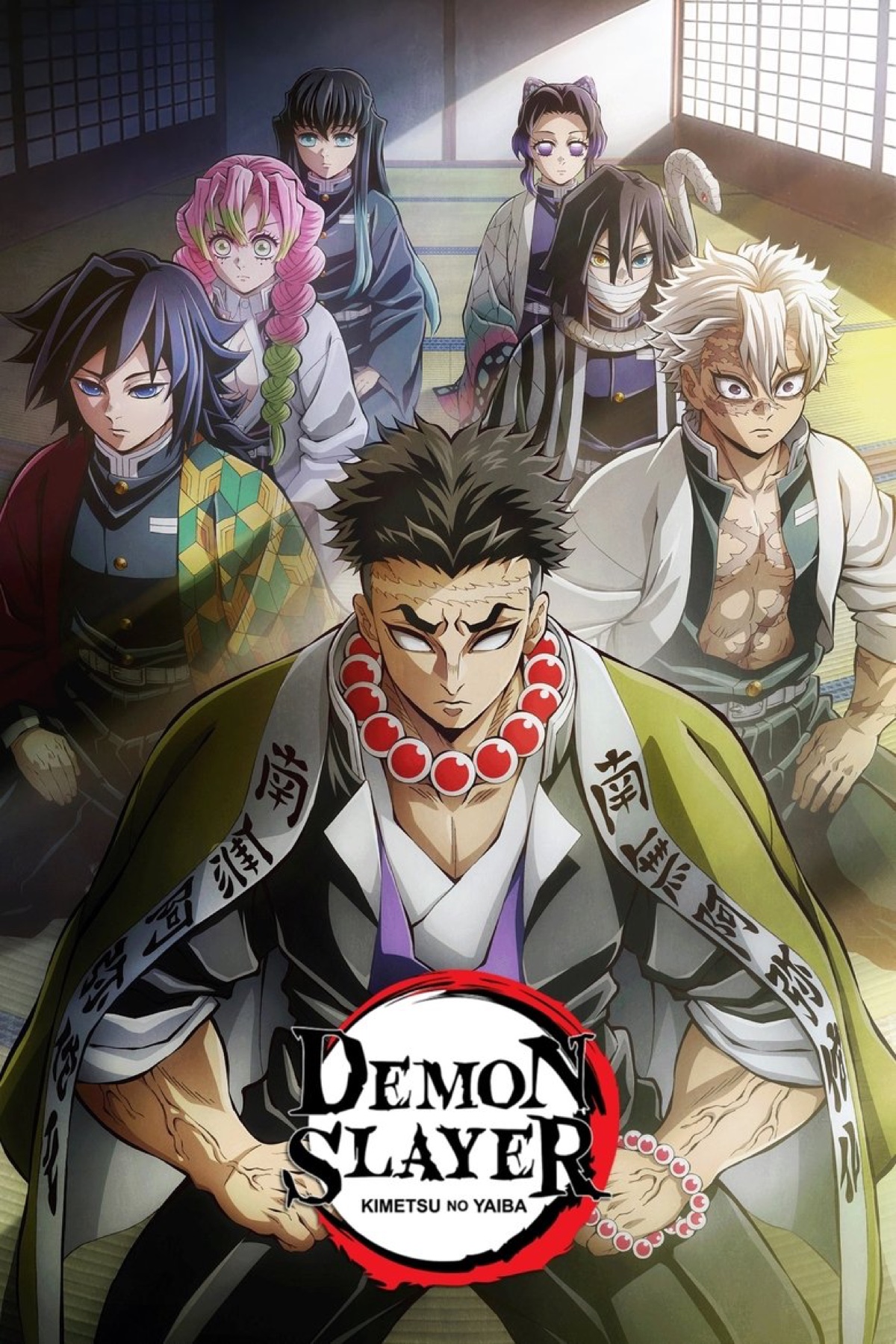
📖 Synopsis, No Spoilers
Nezuko has come through something that no demon has survived before, and the news reorganizes the enemy. Muzan wants her, which means the Demon Slayer Corps now has a target painted on it and very little time. The answer the leadership lands on is Hashira Training: every one of the top swordsmen takes a turn running the rank and file through a stage of conditioning, and the rank and file rotate through all of them. Tanjiro, still healing from the last fight, joins the rotation once he is cleared.
What follows is a circuit. Tengen Uzui, retired from the Hashira but dragged back to run the fitness stage, then Muichiro Tokito on speed, Mitsuri Kanroji on flexibility, Obanai Iguro on swordsmanship, Sanemi Shinazugawa on endurance, Gyomei Himejima on raw lower-body strength. Between the drills, Tanjiro keeps learning what each of these people carried before they got the title. Seven episodes of that, and then the eighth episode arrives and the war starts without warning.
✨ What Makes It Special
Why It’s Exceptional
- Episode 8 is drawn, scored and paced at a level the series has hit maybe twice before
- With the fighting switched off, the running time goes entirely into what the Hashira are like
- The funniest stretch in the whole franchise sits in the middle of it
- Inheritance gets handled head-on for once, with no battle attached to it
The Finale Changes the Color of the Show
Seven episodes of sweat, jokes and more sweat. The tempo is loose, the lighting is bright, and the worst thing that happens to anybody is a pulled muscle. Then episode 8 opens and the show you are watching is not the same show. The palette narrows, the score pulls back, and people stop raising their voices. Nothing has been explained to you yet. You already know something has gone permanently wrong.
The part that impressed me most is what the episode does with quiet. There is a long conversation in it, two figures sitting down, no shouting, no impact frames, and I noticed halfway through that I had stopped breathing normally. I will not say who or about what. What I will say is that the tensest scene in an arc about combat training is one where nobody stands up. ufotable owns every loud trick in the medium and it holds all of them back until the last possible moment, which takes more discipline than the spectacle does.
And then, late on, the picture finally moves. The mansion, and the place that opens underneath it, are built to a density that television schedules are not supposed to allow. Watching that stretch, the feeling I got was closer to a starting gun than to an ending. There is a version of the last ten minutes I would happily have paid theater prices for, and that turns out to have been the point: the Infinity Castle film trilogy was announced at the end of this very broadcast in Japan, on June 30, 2024.
This gap is not purely a compliment. Episode 8 being that strong drags episodes 2 through 7 down with it instead of lifting them. If a team can put that on screen at the end, the two and a half hours of drills in front of it start to look like a choice somebody made rather than a shape the story required.
Nobody Fights, So the Hashira Finally Open Up
Up to now these people have mostly been seen mid-battle. Strong, well dressed, occasionally unhinged. Plenty of viewers know the seven active Hashira as a color scheme and a rank and nothing else. Take the swords away for eight episodes and something else becomes visible.
Gyomei Himejima gains the most. He is billed as the strongest man in the Corps and he weeps constantly, and until now the show never told you why. Episode 7 hands over the night that did it: a blind monk protecting orphans, a fight held off until dawn, and then a misunderstanding that put him in a cell instead of a temple. His strength turns out to be built on injustice rather than honor, and he stops reading as an intimidating slab the moment you know that.
Giyu Tomioka gets the other half. Tanjiro decides the way to reach a man who refuses to speak to anyone is to walk into his house and refuse to leave, which is an extremely rude plan and very funny to watch fail repeatedly. What finally cracks him open is a soba speed-eating contest the boy talks him into, and a painful history comes out somewhere in the middle of the bowls. That swing, from slapstick to grief inside the same scene, is the best thing this arc does.
What Gets Passed Down Is Not Technique
Call it training and it sounds like a skills course. Watch what actually changes hands and it is nothing that could be written in a manual. In episode 6, stuck under a boulder he cannot shift, Tanjiro gets it moving only by holding on to his family and to something Kyojuro Rengoku said to him before he died. The technique is not what unlocks it. The words are. A man who has been dead since the film is still issuing equipment.
Then the arc runs the same idea downward. Whatever Tanjiro picks up spreads outward into recruits the story never bothers to name, and by the finale it has traveled further than anyone on screen can see. Eight episodes to show a thousand-year-old organization doing the only thing that has kept it alive.
Deeper Themes
The bodies on screen most often in this arc do not belong to anyone you can name. They are ordinary Corps members, and none of them will ever be a Hashira or a Tanjiro. They know it. They line up for the drills anyway, and the ones who wash out say they will move to support work instead of going home. Spending eight episodes on training is not only about how somebody gets stronger. It is about what the people who will not decide the war do with the last stretch of time before it. Read the slow middle as a look at the bottom of an organization instead of a delay, and those hours change shape a little.
🎭 Memorable Scenes
I’m not like you guys.
Giyu has been saying a version of that line since the Hashira Meeting, and everyone in the room, viewers included, has been filing it under arrogance. This arc turns it over without altering a word of it. The sentence was never about ranking himself above anybody. Same line, opposite meaning, and it only works because the series has had four arcs to let you misread it first.
The second one I keep going back to is the quiet conversation in the finale. No raised voices, no music doing the heavy lifting, two people talking calmly while the sound design tells you the floor is gone. Braced, on my side of the screen, at a scene where nobody so much as reaches for a weapon. That is not a thing television usually manages.
Third, and this one is a Japanese-broadcast quirk worth explaining. Nearly every episode ends with a short comedy skit called a Taisho Secret, where Tanjiro turns to camera and shares a piece of trivia. It is normally a palate cleanser. Here it gets used for information that matters: the segment after the final episode reveals that Mitsuri Kanroji trained directly under Rengoku, and his voice comes in over it. The bonus corner did more emotional damage than most of the actual episodes.
💭 How It Made Me Feel
Unconvinced, and I still am. Nothing since has talked me round on the length. What episode 8 produced was different in kind: an abnormal, jittery kind of anticipation, the sound of a story finally getting up off the floor after seven episodes of sitting quietly. Seven episodes of waiting, then a noise that says the thing you have been waiting for has started. That gap is the experience of this arc, and there is no separating the two halves of it.
😅 Where It Falls Short
This section is why it ranks at the bottom of my Demon Slayer list, not the middle.
The Middle of the Season Keeps Running the Same Shape
Arrive at a Hashira. Struggle. Improve. Move on. Tengen, then Muichiro, then Mitsuri, then Obanai, then Sanemi, then Gyomei. The drills themselves vary, and one or two of them are inventive, but the carriage underneath is identical every time. By the fourth round the only question still alive is who comes next, and that is not a question worth two and a half hours.
The source is much shorter than this. Gotouge covers the training in a stretch of chapters you can read in a sitting, and the anime inflates it with material of its own. That material is made with care, as you would expect from a production this well funded, and I will not pretend the added scenes look cheap. They are simply optional. Nothing in them is necessary, and the story would stand without a single one. The timing is what made me suspicious: the Infinity Castle trilogy was announced inside the finale itself. Work backwards from a theatrical release and the television side needs to fill a certain amount of runway. I found myself thinking about the schedule instead of the story, which is never where you want a viewer’s attention.
It Is Called Hashira Training and the Training Never Completes
Put that title on a season and a reasonable viewer expects a full set. You do not get one. Shinobu Kocho never runs a stage at all. Giyu Tomioka refuses outright, takes a whole episode of Tanjiro wearing him down before he agrees in episode 3, and then the stage he is supposed to be running never appears on screen. Sanemi’s gets suspended part-way through after things go badly with his brother, and Mitsuri’s is over almost before it starts. This is faithful to the manga, so the anime is not inventing the gap. In eight episodes, though, the missing pieces are exactly what you are left holding.
Which points at where the padding should have gone. If you are going to add scenes that are not in the book, add them to the Hashira whose sessions we never see. The season is designed as a full parade of its cast, and it finishes with two slots empty and a third abandoned in the middle. That is a strange thing to be short of in a season named after it.
The Downsides
- Six stages, one template. The middle of the season repeats itself
- Only six trainers get a session on screen, one of them a Hashira who already retired
- The finale works as an opening for the next story, not an ending for this one
Who Should Watch This?
- Anyone heading into the Infinity Castle films who wants to know these people before the fighting starts
- Anyone who learned the Hashira as names on a chart without ever learning what any of them want
- Anyone who watches ufotable for the drawing. Episodes 1 and 8 on their own repay the subscription
Who Might Not Enjoy This?
- Viewers who came to this franchise for the duels. There is barely any fighting across the eight episodes
- Viewers who want a season that resolves. All eight episodes are preparation for something else
- Newcomers. Episode 1 assumes you have seen four arcs plus the film, and explains none of it
📺 Streaming Guide by Service
Three Licenses, One Decision, Already Made for You
Crunchyroll is where the arc simulcast in 2024. If you are catching up, not dipping in, Netflix is the one to prefer, because in the US it carries all five television arcs, so no earlier arc sends you to a second service.
Some context from this side of the Pacific that changes how the premiere reads. Episode 1 did not start life on television. It went into Japanese theaters on February 2, 2024 as part of a compilation called To the Hashira Training, paired with the last episode of the previous arc, and Aniplex, Crunchyroll and Sony took the same program to North American screens on February 23. Television did not get it until May 12. Which means the 48-minute premiere was built for a theater screen and only afterward cut into a Sunday night slot, and it shows in every frame of it.
The Sunday night slot is worth a sentence of its own, because Demon Slayer occupies a place in Japan that no anime holds in the United States. This ran at 23:15 on Fuji TV, a national commercial network, and pulled household ratings in the Kanto region between 5.5 and 6.9 percent for a season in which people mostly stretch and lift things. It is closer to a network drama than to a niche subscription title, and that scale is part of why the anime-original padding got made with such expensive care.
Where to Stream
- Crunchyroll: Streaming, subtitled and dubbed, where it simulcast in 2024
- Netflix: Streaming, all eight episodes plus every earlier arc, included on the ad-supported tier
- Hulu: Streaming, on its own arc page, not under a season number
- Disney+: shows the Hulu listing to subscribers on a Disney+ and Hulu bundle
- Amazon Prime Video: not in Prime itself, reachable through the Crunchyroll add-on channel
Soundtrack
Yuki Kajiura and Go Shiina score it as usual, but the curiosity this season is the theme songs. The opening, Mugen, is credited to MY FIRST STORY x HYDE. The ending, Eikyu -Tokoshie-, is credited to HYDE x MY FIRST STORY. Same two acts, billing reversed, one pair of songs written as a set, with Kajiura handling words and music on the ending. The ending does not turn up until episode 2, because the premiere was a theatrical piece that ran without one. Play the two back to back and the design is obvious in about thirty seconds.
- Spotify: the score, plus Mugen and Eikyu -Tokoshie-
📚 Read the Manga
Gotouge’s original ran to 23 volumes and finished in 2020, all of it available in English from VIZ. This is the arc where the gap between book and screen is widest: the whole season comes out of the back half of volume 15 and stops in the middle of volume 16, roughly twelve chapters, and reads in one sitting. Do that and my main complaint evaporates, because on paper the training is a brisk montage, not a six-episode circuit. Volume 16 is the one to pick up, since the season stops part-way inside it and the pages after that point are where the story goes next.
- Demon Slayer, Vol. 16: Undying: contains the end of this arc plus the chapters the season did not reach
- Hashira Training Arc on Blu-ray: the one copy of episode 8 that does not depend on a license
🎬 If You Loved the Hashira Training Arc, Watch These 3 Next
Medalist
This is the pick I would push hardest, because it does weekly what the Hashira Training Arc could not sustain for six episodes. Figure skating, a coach nobody takes seriously, an eleven-year-old starting years behind everyone in her age group. Almost all of it is practice. Nothing but practice, in fact, and it is gripping from episode 1.
The difference is where the camera points. Demon Slayer films training as an obstacle between the viewer and the next fight, something to be cleared. Medalist films the same jump attempted for the fortieth time as the event itself, so a landing that goes wrong carries more weight than most anime death scenes. Repetition is the drama, not the runway to it, and once you have seen that done properly you can name precisely what the middle of this arc was missing. It is also the gentler watch of the two by a wide margin, which after eight episodes of people being thrown into walls is not nothing.
Attack on Titan Season 2
Twelve episodes, and for years the standard advice about it was that you could skim. Same accusation, different franchise. What actually happens is that the season quietly loads every gun the rest of the story fires, and skipping it means the later payoffs land on somebody who does not know what they are looking at. If you are currently deciding whether the Hashira Training Arc is optional, this is the same decision with the results already in. Nobody who skipped it is glad they did.
👉 Read the Attack on Titan Season 2 review
Dr. Stone Season 1
A show with no shortcuts in it at all. Civilization is gone, so everything has to be rebuilt one prerequisite at a time, which means the entire series is run-up and never once feels like it. The lesson for this arc is that the problem was never the amount of preparation. It was the order things were shown in, and whether each step visibly bought you the next one.
👉 Read the Dr. Stone Season 1 review
📝 Final Thoughts
Skip it? No. Skipping it means arriving at the Infinity Castle with a group of people you can identify by hair color and nothing else. The plot does not advance, the title promises a full set of training sessions it does not deliver, and both of those are real. What only exists here is who these people are underneath the rank, and what got handed to them by the ones who are already dead. None of that is available anywhere else in the series.
What surprised me is how the memory has settled. The drills have gone. The last episode has not, and it has been getting bigger, not smaller, which is the opposite of what usually happens. Those seven episodes turn out to have been measured out as run-up distance for one flight, and it is a lot of run-up. Having seen what is at the end of it, though, I am glad I complained my way through all of it instead of jumping ahead. The arc I am least convinced by is the one holding the single episode I am least likely to forget. That is why this one is hard to talk about, and why the score below is going to annoy people in both directions.
⭐ Series at a Glance
| Category | Rating | Note |
|---|---|---|
| Animation | ★★★★★ | Episodes 1 plus 8 are among the best the studio has drawn |
| Music | ★★★★☆ | Kajiura with Shiina again, plus a matched pair of theme songs |
| Characters | ★★★★☆ | Gyomei explained at last, Giyu turned inside out |
| Setup for what follows | ★★★★★ | The final ten minutes function as a starting gun |
| Story | ★★☆☆☆ | Eight episodes, almost no forward movement |
| Pacing | ★☆☆☆☆ | Six training stages built to one template |
Usagi’s Recommendation Score
⭐⭐⭐⭐⭐⭐⭐☆☆☆
6.5 / 10
Seven episodes of run-up. One episode that makes them count.

