*This page contains affiliate links. We may earn a commission if you make a purchase through these links.
“Not this again.” I said that out loud at least four times across these eleven episodes, always at the same moment: a fight has finally tightened, somebody is about to land or fail to land a hit, and the picture drops into a childhood. This arc keeps reaching back into the past, and it keeps doing it at the least convenient second available. That is the honest first impression, and it is why the word filler keeps turning up whenever I read about this one in English.
Then I finished it and tried to write down what had actually happened. The list came out almost empty. A sword gets repaired, a village survives the night, the war with the demons is exactly where it was in episode 1. Everything with any weight in it had happened inside the flashbacks I kept resenting. The plot stands still for eleven episodes. Three people do not. This review takes both halves of that seriously, because the arc’s defenders and its critics are, as far as I can tell, describing the same eleven episodes correctly.
📺 Where to Watch Demon Slayer: Swordsmith Village Arc (August 2026)
| Service | Status | Notes |
|---|---|---|
| Netflix | Streaming | Complete arc. The cheaper ad-supported plan carries it as well |
| Crunchyroll | Streaming | Weekly simulcast home in 2023. Subs plus the English dub |
| Hulu | Streaming | Filed under its own arc page since September 2023 |
| Disney+ | Add-on | Same entry as Hulu, on the plans that bundle the two |
| Amazon Prime Video | Add-on | Not part of Prime. Reachable through the Crunchyroll channel you attach to your account |
You are very likely already paying for one of these. As of August 20, 2026 four US services carry the arc, and the Disney+ entry is simply the Hulu one showing through a bundled plan, which is unusually wide coverage for a single season of anime. In practice that means nobody reading this has to sign up for anything new. A tip for finding it: no two sites agree on what season number this is, and none of the apps care, so put the words Swordsmith Village into the search box and the arc comes straight up. Licences do change hands without notice, so confirm on the service page itself before you hand over a card.
👉 Order does matter here, though not for the reason people assume. Tanjiro is not sword-less and stranded. His blade got chipped in the previous arc, the chip angered the craftsman who forged it, and the whole journey exists so that he can sort that out with the man in person. Our Entertainment District Arc review covers the fight that ruined the sword and, more importantly, the state everyone is in when this one opens.
🎬 Trailer
Sixty-five seconds, and almost all of them are swords. The arc’s best asset, advertised accurately. Its actual shape, not advertised at all. Watch for the two Hashira the season is really about, who go past at roughly a second each.
Work Info
- Title: Demon Slayer: Kimetsu no Yaiba Swordsmith Village Arc
- Broadcast: April 9 to June 18, 2023 on Fuji TV and affiliates
- Episodes: 11. The premiere runs about 49 minutes and the finale about 52, with everything in between at the usual 24
- Director: Haruo Sotozaki
- Animation production: ufotable
- Original manga: Koyoharu Gotouge, volumes 12 through 15 of 23 (chapters 98 to 127)
- Music: Yuki Kajiura and Go Shiina
- Theme songs: Kizuna no Kiseki by MAN WITH A MISSION and milet (opening), Koi Kogare by milet and MAN WITH A MISSION (ending). Insert song: Kamado Nezuko no Uta
- English release: Crunchyroll simulcast from April 9, 2023, subtitled and later dubbed. Manga from VIZ Media
📖 Synopsis, No Spoilers
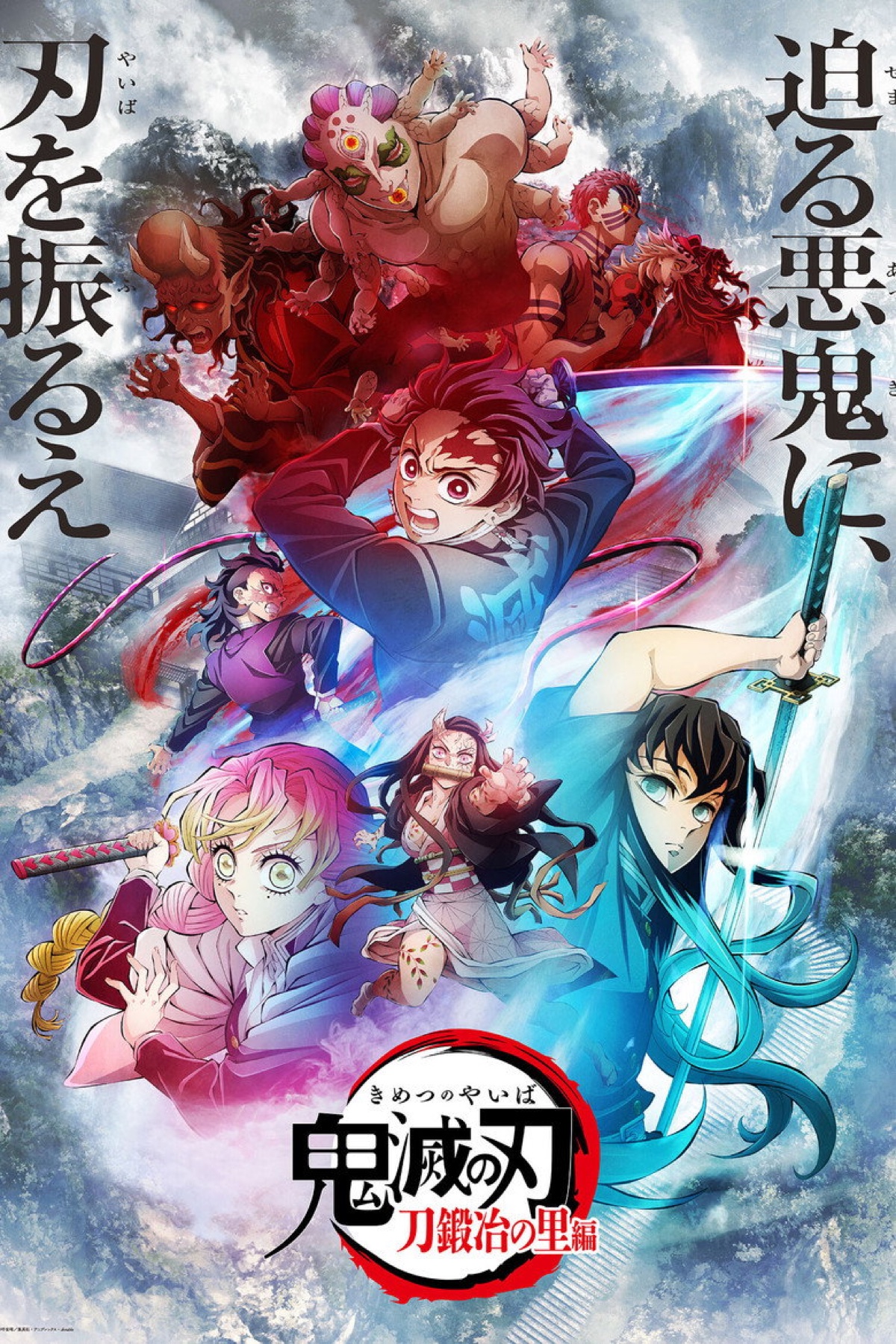
Tanjiro’s blade came out of the last fight chipped, and that chip was enough to anger Hotaru Haganezuka, the smith who forged it. So Tanjiro travels to the swordsmith village to settle it with him face to face. The village is where every weapon the Demon Slayer Corps carries gets made, which is why its location is hidden even from most of the Corps. Waiting there, for reasons of their own, are two Hashira he has barely met: Muichiro Tokito, the Mist Hashira, and Mitsuri Kanroji, the Love Hashira. Also present is Genya Shinazugawa, a fellow recruit who cannot use breathing techniques at all and has found other ways to stay alive.
Then the hidden village stops being hidden. Two demons of the Upper Ranks arrive, Hantengu and Gyokko, on the straightforward logic that an army with no blacksmiths is an army with no weapons. Defending the place are two Hashira, three teenagers, and a few dozen craftsmen who do not fight. The senior demon cannot be killed by decapitation. Cut his head off and he splits into more of himself, so the count on his side climbs while the count on yours drops. From the back half of episode 3 onward the arc runs as one unbroken night, and it ends at daybreak.
✨ What Makes It Special
Why It’s Exceptional
- Two Hashira fighting in two completely unlike ways, drawn so you can tell them apart with the sound off
- Episode 8, the best twenty-four minutes in the arc by a wide margin
- The sword work never dips. Not once across eleven episodes
- The flashbacks everyone complains about are, structurally, the actual story
Two Hashira, Two Unrelated Pleasures
Whatever else is wrong with the pacing, the screen never gets boring, and the reason is simple enough to state: the combat animation holds at the top of its range for all eleven episodes without a single soft patch. ufotable had already made that abnormal in the previous arc, which means the bar we are grading against was one they set themselves. They cleared it again anyway.
Mitsuri Kanroji is the clearest example. Her weapon is a ribbon-thin blade that flexes along its whole length, handled closer to a whip than a sword, and on the printed page it is genuinely hard to parse. I read this arc in print years before it was animated and never once worked out what that sword was actually doing. Animated, it travels in long ribbons like rhythmic gymnastics, and when it takes an arm off in four places you can see the order the four cuts happened in. She is the character who gains most from being adapted.
Muichiro Tokito is built as her opposite. Mist Breathing is fast, but the animation refuses to show you the speed directly. The cut registers as a white haze that arrives a beat late and then disperses. Mitsuri fights at a speed you can watch. Muichiro fights at a speed you only see the receipt for. Putting two Hashira in the same eleven episodes and giving their swordplay no overlap at all is a level of care that most action shows do not bother with.
Tanjiro is not left out. There is a stretch where his blade changes colour, and the way the colour arrives is worth pausing on by itself. What follows it, a slash that leaves a dragon running across the frame for about three seconds, would be a poster in any other series. Here it goes past and something else starts. I caught myself rewinding twice in one episode, which I do not normally do.
The Plot Is Parked. The People Are Not.
I have been writing as though the craft settles the argument. It does not, and this is the part that took me a second viewing to see. Nothing about the war changes here. The Corps and the demons stand in the same relation at the end as at the start, no secret gets opened, no alliance shifts. What the season leaves you holding has nothing to do with the situation. Three people arrive unable to accept something about themselves, and leave able to.
Everything this series has done up to now has been about bonds between people. Brother and sister, master and student, one recruit and another. The Swordsmith Village Arc quietly switches the subject to how each character handles their own self. A boy with no memory of who he used to be. A girl who has spent her life apologising for a body and a hair colour that other people found strange. A young man who cannot do the one thing his profession is built on. None of the three is short of allies. All three are short of a way to be at peace with what they are.
And that job cannot be done in the present tense. To make peace with what you are, you have to go back and look at where it came from, which is precisely why this arc is stuffed with flashbacks. They are not padding around the story. They are the story, and the demon fight is closer to the venue it happens in. Once I read it that way the eleven episodes stopped feeling badly rationed, and the satisfaction at the end stopped being confusing. The relief on offer is not that a battle got won. It is that nobody had to finish the night still ashamed of themselves.
Episode 8 Is on Another Level
I have spent several paragraphs calling the flashbacks excessive. Episode 8 is where I take that back. It hands most of an episode to a single question: why does this fourteen-year-old speak with so little in his voice, and why does he not care what his own name means?
The load is carried by his twin brother, who is sour, sharp-tongued and cruel to him in a way that reads as straightforward nastiness while you are watching. That reading gets turned completely inside out before the episode ends. What causes the reversal stays out of this review. What I will say is that when this arc comes up in Japan, episode 8 is the part I hear named first, and that a lot of its total goodwill is resting on those twenty-four minutes.
Deeper Themes
Once you accept that every human being in this arc is fighting about how to hold their own self, the choice of villain starts to look deliberate. Hantengu spends the entire season insisting that he is weak, that he is the injured party, and that whatever went wrong was done to him by somebody else. Corner him and he weeps. Confront him and the blame goes out the window. He is written as the one character who never once does the work the others are doing. Muichiro, Mitsuri and Genya each pick up the part of themselves they had been refusing to hold, and carry it forward. Hantengu refuses permanently, and multiplies instead, which is a neat way of saying that a self you will not look at just keeps producing more of itself. As a piece of design it is coherent. Coherent and enjoyable to watch are separate questions, though, and that is where the next section comes in.
🎭 Memorable Scenes
The “mu” in Muichiro is the “in” in “infinity.”
That is how the official English translation gets around it, and it is a smart save, but the original does something English cannot. The brothers are Yuichiro and Muichiro, and their names open with the two characters for “there is” and “there is not.” Muichiro has been told his whole life that his half means nothing, useless, void. The Japanese word for infinity is mugen, and it begins with the same character. The line reinterprets nothing. It points out that the better reading had been sitting there all along and nobody had bothered to use it. Note who says it, too: not Muichiro. His brother.
The second one has no fighting in it at all. Haganezuka, the swordsmith, sits and sharpens a blade while demons tear through the village around him and does not lift his head. Minutes of a man who cannot fight wearing the exact expression of the people who can. It is the one sequence in the arc that could only happen in this particular location, and it holds the screen with nothing but a whetstone.
The third is in the finale, at dawn, and involves a choice made by somebody who should never have been asked to make it. I am not going into it. I will only note that even reading this arc as a pure connector, I would not try to argue that the scene leaves the rest of the series where it found it.
💭 How It Made Me Feel
Honestly? Not much, while it was on. My attention drifted every time the Hantengu fight restarted and I sighed audibly at the arrival of each new flashback. It landed the next morning instead, in the shower, when it occurred to me that I could not name a single plot development but could describe all three character arcs in detail. The swordplay is the part I would defend to anyone. The part that stayed is the other one. Since finishing I have gone back to episode 8 twice and to nothing else in the arc, which tells you roughly how the eleven episodes are distributed for me.
😅 Where It Falls Short
Here is where I have to give some of that back. The case against this arc is strong, and I do not think its critics are being unfair.
The Villain Spends the Season Running Away
This is my biggest complaint by a distance. The Hantengu fight eats most of the season and generates almost no tension while doing it. The cause is not hard to identify. The real Hantengu spends the whole thing hiding. His gimmick, that cutting his head off produces more of him, is a genuinely nasty idea and I liked it on paper. In practice it means the copies do the fighting while the original cowers somewhere off screen, screaming, waiting to be found.
What this franchise has always done better than its peers is make you regret the kill. The demon gets a history, the history is a life somebody lost, and you finish up grieving for whatever you were cheering the death of two minutes earlier. Hantengu is handed that same slot. But when the flashback comes, the man inside it turns out to have been rotten before he was ever a demon. There is nothing to mourn, and there was nothing satisfying about the fight either, so the moment he goes down lands with a quietness the earlier arcs never had. Gyokko, the other one, at least has a hideous design and an artist’s ego to keep him interesting. On the strength of its antagonists this is the weakest stretch of Demon Slayer so far.
It Keeps Stopping the Fight to Run a Biography
I argued above that the trips into the past are the substance of the arc, and I stand by it. My objection is to where they are dropped. Almost every one of them begins at the precise moment a fight has finished building, blade in the air, and by the time you come back the pressure has gone flat. Do that once and it is a technique. Keep doing it and the viewer starts bracing for it instead of watching.
Episode 8 proves the fix was available. Hand a past its own episode and the thing works completely. What does not work is chopping the same material into slices and inserting them into combat. Finish the fight and then go back, or go back before it starts. Either would have been better than this. Eleven episodes is not a long season, and yet the felt length is considerably more than the real one.
Eleven Episodes That End Where They Began
A boy goes to get his sword fixed, the place gets attacked, the people there fight it off. That is the complete plot and the season never gets out of it. Seeds are planted for what comes next, and they matter later, but taken on its own this arc leaves you with no sense of forward travel.
There is one substantial event in the finale. Even that reads less like a payoff for these eleven episodes and more like material being placed for the ones after. Japanese viewers have a word for this kind of season, tsunagi, meaning the connective bit that holds two better things together. It is not usually a compliment, and applied here it is difficult to argue with. Anyone starting the series at this point gets very little.
The Downsides
- The main demon hides for most of the season, so the central fight never grips
- His backstory gives you nobody to pity, which is the one trick this series is best at
- Trips into the past keep landing on the tensest beat and letting the air out
- The situation at the end of episode 11 is the situation at the start of episode 1
Who Should Watch This?
- Anyone who watches action for the choreography and will forgive a season everything else
- Anyone drawn to stories about making peace with the thing you were ashamed of
- Anyone who wants to know who Mitsuri and Muichiro are before the later seasons assume you do
Who Might Not Enjoy This?
- Viewers who need a plot to advance and will not accept character movement instead
- Viewers who lose patience when a fight halts for somebody’s childhood
- Newcomers picking a starting point. This arc assumes you have seen everything before it, the film included
📺 Streaming Guide by Service
Four Services Carry It. Only One Difference Matters.
Netflix, Crunchyroll, Hulu and the Hulu shelf inside Disney+ all hold the complete arc, which makes this a decision your existing bills have already taken for you. The one thing worth checking before you pick is the audio: Crunchyroll definitely carries the English dub, and what the others offer varies. Watching subtitled? Then whichever app is already signed in on your TV is the correct answer, and it is not worth a second thought.
One piece of context that is easy to miss from outside Japan. Episode 1 did not premiere on television. It went into cinemas first, packaged with the last two episodes of the previous arc as a feature called To the Swordsmith Village, opening in 418 Japanese theatres on February 3, 2023 and taking about 1.16 billion yen in three days. North America got the same programme on March 3. That is why the premiere runs 49 minutes and is built like a film: a large number of people, in Japan and the US alike, watched the first episode of this season on a cinema screen before it ever reached television.
On watching with children, one honest note. The setting causes fewer awkward questions than the previous arc did, since nobody has to explain a red-light district this time. The dismemberment and the blood are unchanged, though, and Mitsuri is drawn with a degree of fan service that is worth knowing about in advance rather than discovering next to a nine-year-old.
Where to Stream
- Netflix: Streaming, complete arc, included on the ad-supported plan
- Crunchyroll: Streaming, subtitled, and the surest place to find the English dub
- Hulu: Streaming, listed under its own arc title
- Disney+: Streaming for bundled plans, pointing at the Hulu entry
- Amazon Prime Video: outside Prime, but the Crunchyroll add-on channel brings it in
Soundtrack
Yuki Kajiura and Go Shiina return, and the album carries both theme songs in their broadcast lengths. The track to look for is neither of them. It is Kamado Nezuko no Uta, the insert song, which arrives late in the arc over a stretch with hardly any dialogue in it. The finale is the place this season actually got me, and the song is doing only half of that work. The other half is how much silence the episodes bank beforehand so that one voice can spend it.
- Spotify: the score, plus Kizuna no Kiseki and Koi Kogare
📚 Read the Manga
Koyoharu Gotouge’s original finished serialisation in 2020 and runs to 23 volumes, every one of them available in English from VIZ, so nothing here leaves you waiting on anything. The arc opens in volume 12 and the finale stops three chapters into volume 15, which means the book to pick up next is the one the season ends inside. The manga is also the fairest test of my main complaint, and it fails to reproduce it: in print the trips into the past stop being interruptions, because print has no tempo of its own for them to interrupt. What print cannot deliver is Mitsuri’s sword, which needs motion before it is legible at all. Worth owning both.
- Demon Slayer, Vol. 15: holds the finale plus the six chapters the anime has not reached
- Swordsmith Village Arc on Blu-ray: the version that will still play when the licences move
🎬 If You Loved the Swordsmith Village Arc, Watch These 3 Next
Cyberpunk: Edgerunners
Ten episodes against this season’s eleven, and in those ten a whole life starts and finishes. If the standing-still bothered you, the comparison is brutal and instructive. Studio Trigger is pushing just as hard on the visuals, and the neon has the same lurid confidence ufotable brings to fire. Run the two in the same week and what a comparable number of episodes can be made to carry becomes impossible to unsee.
👉 Read the Cyberpunk: Edgerunners review
Frieren: Beyond Journey’s End
Take the thing I spent a whole section grumbling about and turn it the right way up. Frieren is built almost entirely out of the past, and not one minute of it slows the present down. A line goes by, then a memory arrives and changes what the line meant, so the old material drives the show rather than braking it. Identical tool. Opposite result. It makes the exact spot where the Swordsmith Village Arc was losing money very easy to find.
👉 Read the Frieren: Beyond Journey’s End review
Bocchi the Rock!
An odd pick until you look at what it is about. If this arc is a story about carrying the part of yourself you were embarrassed by, Bocchi is that story with no demons and no swords anywhere in it. Anyone who felt something at Mitsuri’s memories of being laughed at for her hair and her appetite will find the same shape in a teenager shaking behind an amplifier. Nothing gets decapitated, and the moment of self-acceptance still detonates.
👉 Read the Bocchi the Rock! review
📝 Final Thoughts
This is a season for people already inside the series. On its own it does not hold up, the antagonist is the weakest the show has produced, and the trips into the past are placed about as badly as they could be. The reason to keep going anyway is that the swordwork has gone up another step from an already unreasonable starting point.
What is odd is what survives the week after. Not the fights, which I would have bet on. What I still have is three people who walked in unable to look straight at themselves and walked out able to. By the end I could not tell you who killed whom, and I could tell you exactly who stopped apologising for existing. Call it a connector if you like, because it is one. It is also the season that finished the people the rest of the war needs. I have landed on the same score I gave the previous arc, which surprised me, since almost nothing about how the two get there is the same.
⭐ Series at a Glance
| Category | Rating | Note |
|---|---|---|
| Animation | ★★★★★ | Eleven episodes with no soft patch anywhere |
| Music | ★★★★☆ | Kajiura plus Shiina again, with one insert song that earns its place |
| Characters | ★★★★☆ | Three arcs of self-acceptance, all of them finished properly |
| Villains | ★★☆☆☆ | Hantengu hides, then his past gives you nobody to mourn |
| Story | ★★☆☆☆ | Ends the night in the position it started |
| Pacing | ★★☆☆☆ | The past interrupts the present at the worst beat available |
Usagi’s Recommendation Score
⭐⭐⭐⭐⭐⭐⭐☆☆☆
7.0 / 10
A bad villain, a stalled plot, and swordwork good enough to cover both.

