*This page contains affiliate links. We may earn a commission if you make a purchase through these links.
Episode eight. Everything before it is a well-made comedy about an anxious teenager with a guitar, and everything after it is you at one in the morning scrubbing back the same thirty seconds for the fifth time. I have watched a lot of anime change gear. I have not seen one change gear that hard inside a single scene.
I put it on as background noise, which is the correct amount of respect to give a four-panel comedy adaptation about a shy girl in a band. That plan survived about four episodes. By the end of the season I had a browser tab open on the real Tokyo venue the fictional one is based on, which is not the behavior of somebody watching something in the background.
📺 Where to Watch Bocchi the Rock! (October 2026)
| Service | Status | Notes |
|---|---|---|
| Crunchyroll | Streaming | Twelve episodes, Japanese audio with English subtitles |
| Amazon Prime Video | Add-on | Through Crunchyroll’s paid channel on Prime Video; Prime alone is not enough |
| Amazon Video | Rent / Buy | Season purchase |
| Apple TV | Rent / Buy | Purchase only, no rental |
| Netflix (US) | Not available | Japan has it on four services at once |
Crunchyroll is the answer in the United States, with all twelve episodes in Japanese with English subtitles. Buying it outright only makes sense if you collect discs.
The Japanese situation is the opposite kind of problem. Here the series sits on Netflix, Prime Video, Hulu, U-NEXT, and a couple of anime-specific channels simultaneously, which is what happens when a late-night show becomes a real cultural event rather than a hit. Guitar sales in Japan rose after this aired, and music shops put up displays.
🎸 Is There a Bocchi the Rock! Season 2, and an English Dub?
Season 2 is confirmed but still has no premiere date. It was announced on February 15, 2025, with a short teaser, and no broadcast season, month, or year has been attached to it since.
What is known is the staff, and it is a bigger change than most second seasons get. CloverWorks continues, but Keiichiro Saito, who directed the first season, hands over to Yūsuke Yamamoto, and the character designs move to Keito Oda and Kerorira. Whether the performance scenes keep the level of season 1 is the question I will be watching season 2 for, more than where the story goes.
The dub question has a shorter answer. As of early October 2026 I could not find an official English dub; Crunchyroll lists the series with English subtitles only, and the compilation film it screened in North America in October 2024 (both parts as one double feature) was subtitled only as well. I am not sorry about it, for reasons I get into in the streaming guide below.
🎬 Trailer
The English-subtitled main promo. It sells the comedy, which is fair, since that is most of the running time. What it cannot show you without spoiling is the other thing this series does roughly twice a season.
Work Info
- Title: Bocchi the Rock!
- Broadcast: October to December 2022, twelve episodes
- Director: Keiichiro Saito
- Animation: CloverWorks
- Source manga: Aki Hamazi, serialized in Manga Time Kirara Max
- Music: Tomoki Kikuya. Songs performed as Kessoku Band
- Season two announced February 2025, no broadcast date yet
📖 Synopsis, No Spoilers
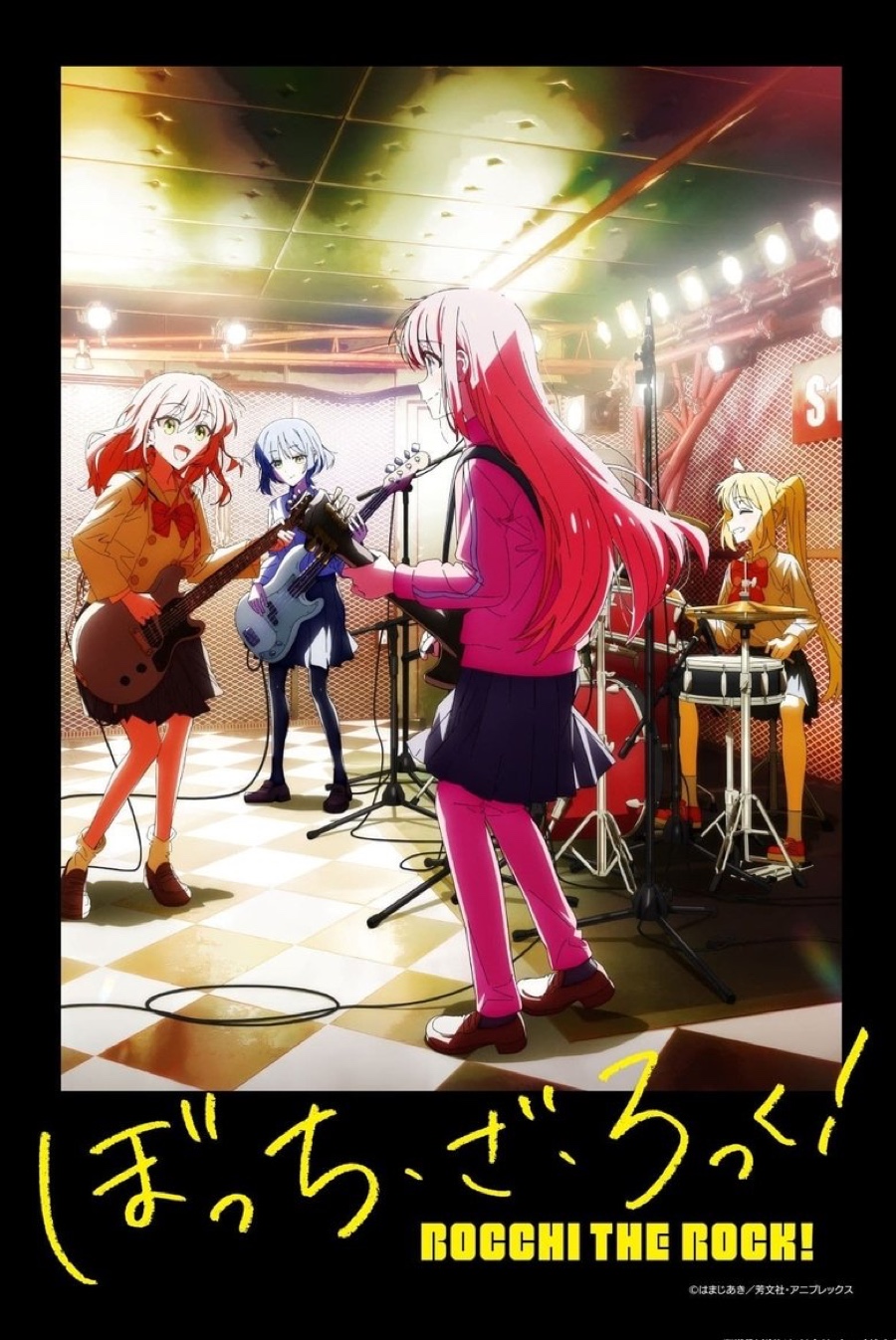
Hitori Goto saw a band interview on television at thirteen, concluded that being in a band was the one route by which a person like her could be admired, and started learning guitar. She then practiced six hours a day through middle school, about three years, alone, because she had nobody to practice with. Her playing is excellent. She posts videos under a handle and has an audience of tens of thousands who have no idea who she is.
In real life she cannot make eye contact, cannot start a conversation, and enters high school with the same zero friends she had in middle school. Then a drummer called Nijika finds her sitting outside with a guitar case and needs a session player that evening. What follows is twelve episodes of a girl being dragged, by increments and against considerable resistance, into a band, a job, a venue, and eventually a stage.
✨ What Makes It Special
Why It Is Exceptional
- Social anxiety written with a precision that stops being funny halfway through
- Performance sequences animated at a completely different level from the rest
- Music as the only available exit, rather than as a nice hobby
- Songs good enough to survive outside the show
Hitori is written without mercy
Japanese has a word this series is built on top of, and it does not survive translation cleanly. Inkya means roughly the gloomy type, the one with no social gravity, and it exists in opposition to youkya, the bright type, the one everybody orbits. It is a taxonomy Japanese teenagers apply to themselves out loud and without much cruelty intended, which is somehow worse than if they meant it.
Plenty of anime have done the socially anxious protagonist. What is unusual here is how far the writing is willing to go into the unflattering parts. Her phone notifications are her mother and a supermarket coupon. She is respected online by strangers and unable to look at anyone in her classroom. She retreats into a cupboard to record. The fantasies of being admired are elaborate, extremely detailed, and clearly load-bearing for her sense of self.
All of that is played as comedy, and it works as comedy, and then about twenty minutes later you find yourself thinking about something you did at sixteen. The balance is the achievement: the show laughs at her constantly without ever once inviting you to look down on her.
I should admit my angle here. I am the sort of person who over-prepares for anything involving speaking to a room, on the theory that if the material is perfect nobody will notice the delivery. Hitori’s arrangement, in which she is extraordinary at one thing and hopeless at everything surrounding it, is a bargain a lot of people have quietly made with themselves. Watching a show notice that out loud is uncomfortable in a way I did not sign up for on a Tuesday evening.
It is also worth knowing where this came from. Manga Time Kirara Max is a magazine that publishes four-panel comedy strips about groups of cute girls doing a hobby, and it is a pipeline with a house style. K-On! came out of the same magazine. Bocchi the Rock arrives with all the packaging of that genre and then spends its running time doing something the format was not built for.
Episode eight, and what happens when the music starts
Take the daily-life material on its own and this is a competent Kirara adaptation. Then a performance begins and the production budget visibly relocates. Characters move on roughly twice the drawing count. The camera goes places a camera cannot go, sighting down the neck of a guitar, sitting behind the strings.
The detail that convinced me is small. Kita, on vocals and rhythm guitar, glances down at her own hands mid-song for a fraction of a second. Anyone who has played in a band knows that glance. It is the check you make when you are not yet confident in a chord change, and nobody animates it because nobody notices it. CloverWorks noticed it.
Which brings us to episode eight. A typhoon has emptied the venue, the band is playing badly, the room is dying, and Hitori decides she is not going to let it finish like this. The second song starts. The camera pulls back from the headstock into a wide shot and the entire series arrives at once. I cannot tell you how many times I replayed it, because I stopped counting.
Why K-On! is the wrong comparison
Everybody reaches for K-On!, and the two shows share a magazine, a format, and four girls with instruments. The difference is what the music is for. For the K-On! club, music decorates an already reasonably happy adolescence. It is the thing they do together, and the show is right that this is enough.
Hitori has nothing else. No friends, no classroom standing, no other channel through which another human being might be persuaded to look at her. The guitar is not an enrichment activity. It is the only door in the building. That is where the heat in the performance scenes comes from, and it is why a motivation as childish as wanting to be admired plays as something closer to a survival instinct.
One detail for readers who came up on Japanese rock. All four band members are named after Asian Kung-Fu Generation: Gotoh, Ijichi, Yamada, Kita, matched to the same instruments as the real players. If you know the band from a Naruto opening two decades ago, that is the lineage this show is claiming, and it is claiming it on purpose.
Deeper Themes
The series is quietly interested in the difference between being good at something and being able to use it. Hitori arrives fully formed as a guitarist and completely unable to convert that into a life. Everything she learns over twelve episodes is social rather than musical, which is an unusual shape for a story about a musician.
The other thread belongs to Kita, who is the opposite case and gets less credit than she deserves. She is charming, popular, and mediocre on her instrument, and she has to sit with that in a room where the least socially functional person present is the best player. The show never makes a speech about it. It just keeps putting them next to each other.
🎭 Memorable Scenes
Let me hear your rock.
Nijika says it under a vending machine at night, and it is the moment the title stops being a joke about a lonely girl. The series has been running on comic energy for hours by then, and it simply goes quiet for a minute. The change in air pressure is the best directing in the show that does not involve a guitar.
Episode twelve pays off something planted in the first five minutes of episode one. A string breaks mid-performance, Kita improvises to cover the gap, and Hitori produces a bottleneck technique that nobody attempts unless they have spent an unreasonable amount of time alone with an instrument. Three years in a bedroom, cashed in over about four seconds.
Then the song. There is a line in one of the band’s tracks about wanting to be joined up into a constellation with someone. A constellation is a set of unrelated stars at wildly different distances that somebody on the ground decided to connect. The lyric does not claim it has happened. It says if we could. That conditional is the whole character.
💭 How It Made Me Feel
I wanted to play guitar afterwards, which is inconvenient, because I cannot. That reaction is apparently extremely common here and is the reason Japanese music shops had a good quarter in early 2023.
The lasting bit was smaller and more embarrassing. On the train the following week, with the band’s music in my ears, one particular chorus caught me completely unprepared and I had to look out of the window for a while. Twelve episodes of jokes about a girl hiding in a cupboard, and that is where it lands.
Who Should Watch This?
- Anyone who has ever been the best in the room at something nobody could see
- Viewers who loved K-On! and want the same shape with teeth in it
- Japanese rock listeners, particularly Asian Kung-Fu Generation fans
- People who want to see what a modern studio does with a performance scene
😅 Where It Falls Short
Two real complaints
Look, I have been enthusiastic, so here is the other side. The gap between the performance sequences and everything else is so wide that the everything else starts to feel like waiting. There is a beach episode. There is a long stretch of festival preparation. Both are pleasant, both have good jokes, and both had me checking how many minutes were left before the band would be on a stage again. A show should not make you impatient for its own best material this often.
The second complaint is bigger and I have not seen it answered. For a series about a band, there is almost no music in it. Not songs, which are excellent, but the process: writing, arguing about arrangements, the part where four people with different taste have to agree on what they sound like. The stated motivations stay at wanting to be admired or wanting a good adolescence, and nobody ever fights about the music itself. The Kessoku Band songs are strong enough that their absence from the story is conspicuous.
Neither of these stops me recommending it, and both are the kind of thing a second season could fix. The first one is a pacing decision. The second is a whole missing dimension.
The Weak Points
- The everyday episodes sag against the performance episodes
- Almost nothing about how the music actually gets made
- Twelve episodes covers barely two volumes of the manga
Who Might Not Enjoy This?
- Anyone expecting serious drama about musical direction
- Viewers with no patience for slow slice-of-life stretches
- People who find rapid-fire visual gags exhausting
📺 Streaming Guide by Service
Sub, dub, the recap films, and season two
Crunchyroll, twelve episodes, done. There is no competing option worth considering in the United States, and, as far as I can find, no English audio track to choose either. That suits this show. A lot of the humor is in vocal register rather than wording, and Yoshino Aoyama’s performance moves between a whisper and a shriek in ways a dub would have to smooth out.
Two compilation films exist, released in Japan in June and August 2024, and Crunchyroll screened them in North America that October as a combined event. They are recaps with some new animation attached. Watch the series first. The films are for people who already know what episode eight is.
Season two has its own section near the top of this page. Until it has a date, the manga is the answer rather than the calendar.
Watch It Here
- Crunchyroll: all twelve episodes, Japanese audio with English subtitles
- Amazon Video: purchase, plus the Crunchyroll add-on channel
- More in this vein in our best music anime list
Soundtrack
The songs are credited to Kessoku Band, the fictional group, with real session musicians behind them, and the album is on every streaming service. It is the rare anime soundtrack that works as a rock record with no context attached.
Start with the track about constellations if you want the one that follows people around. Start with the opening if you want the one that made a generation of Japanese teenagers ask their parents about guitars.
📚 The Source Manga
Aki Hamazi’s four-panel manga is fully licensed in English by Yen Press, which began publishing in October 2023 and reached its seventh volume in November 2025. The Japanese edition is up to eight.
The anime covers a little under two volumes. If you have finished the series, start at volume three, which is where the story goes past everything you have seen. The four-panel format reads fast, and there are characters here the anime never reached.
🎬 If You Loved Bocchi the Rock!, Watch These 3 Next
Blue Giant
The same engine with the comedy stripped out. A boy decides jazz saxophone is the only thing his life is going to be about and proceeds accordingly, and the film keeps its budget in reserve for the performances exactly the way this series does. If the stage scenes were the reason you stayed, go here immediately.
👉 Read our review of Blue Giant
Hi Score Girl
A kid with one competence and no social skills, using that competence as his only channel to another person. Arcade cabinets instead of a guitar, 1990s Japan instead of 2022, same fundamental bargain. Funnier than it needs to be and quietly sad underneath.
👉 Read our review of Hi Score Girl
Ping Pong the Animation
Another series that changes its entire visual approach the second the performance starts. Masaaki Yuasa abandons pretty drawing at exactly the moments Bocchi doubles its frame count, aiming at one target from opposite directions. Also, underneath, about people whose only social currency is being good at one thing.
👉 Read our review of Ping Pong the Animation
Under the comedy, Bocchi the Rock! is one of the more honest portraits of social anxiety in anime, which is why it also appears on my list of anime about depression and mental health.
📝 Final Thoughts
Bocchi the Rock is a comedy about a girl who cannot speak to people, and it is also a fairly serious argument that clinging to the one thing you are good at is a legitimate way to build a life. The pacing wobbles and the band never argues about music, and those are real complaints I would make again. Neither of them survives contact with episode eight.
The venue in the show is based on a real live house in Shimokitazawa, which is the Tokyo neighborhood where small bands go to be small bands. Fans have been turning up there since 2022. The clearest sign of what this series did is that it sent a large number of people to a basement in west Tokyo to stand in a room where somebody they have never heard of is playing very loudly. There are worse things for a television show to accomplish.
⭐ Series at a Glance
| Category | Rating | Comment |
|---|---|---|
| Writing | ★★★☆☆ | Standard growth arc, uneven pacing |
| Characters | ★★★★★ | Hitori is written with unusual precision |
| Animation | ★★★★☆ | Performance scenes on another tier entirely |
| Songs | ★★★★★ | Kessoku Band works as a real record |
| Comedy | ★★★★☆ | Visual gag range with almost no repetition |
| Music as subject | ★★☆☆☆ | The band never argues about the band |
Usagi’s Recommendation Score
⭐⭐⭐⭐⭐⭐⭐☆☆☆
7.2 / 10
Worth it for the performance scenes alone. What actually gets you is the girl in the cupboard.

