*This page contains affiliate links. We may earn a commission if you make a purchase through these links.
The man who designed Serial Experiments Lain, working at the studio that made Serial Experiments Lain, immediately afterwards, produced a thirteen-episode comedy about a broke exam student and the alien squatting in her attic. It is called NieA_7, almost nobody outside Japan has seen it, and it is the strangest turn in a career built on strange turns.
I put it on expecting the Yoshitoshi ABe I knew. Dread. Ambiguity. People quietly failing to understand their own existence. What I got was an alien failing to build a UFO out of scrap while her landlady worries about the electricity bill. It took me three episodes to stop waiting for the other shoe. The shoe does fall, eventually, but not in the way I had braced for.
📺 Where to Watch NieA_7 (October 2026)
| Service | Status | Notes |
|---|---|---|
| Discotek DVD/Blu-ray | Rent / Buy | Disc only: the 2018 combo set, with the 2001 English dub |
| Crunchyroll | Not available | Absent from the catalog |
| Netflix (US) | Not available | Not in the Japanese catalog either |
| Amazon Video | Not available | No digital rental, no digital purchase |
| HIDIVE | Not available | Outside its library |
No service streams this series legally in the United States, and there is no digital copy to buy either. The Japanese catalogs are no better. I checked both. It is one of a shrinking number of shows that simply fell through the licensing floor, then stayed there.
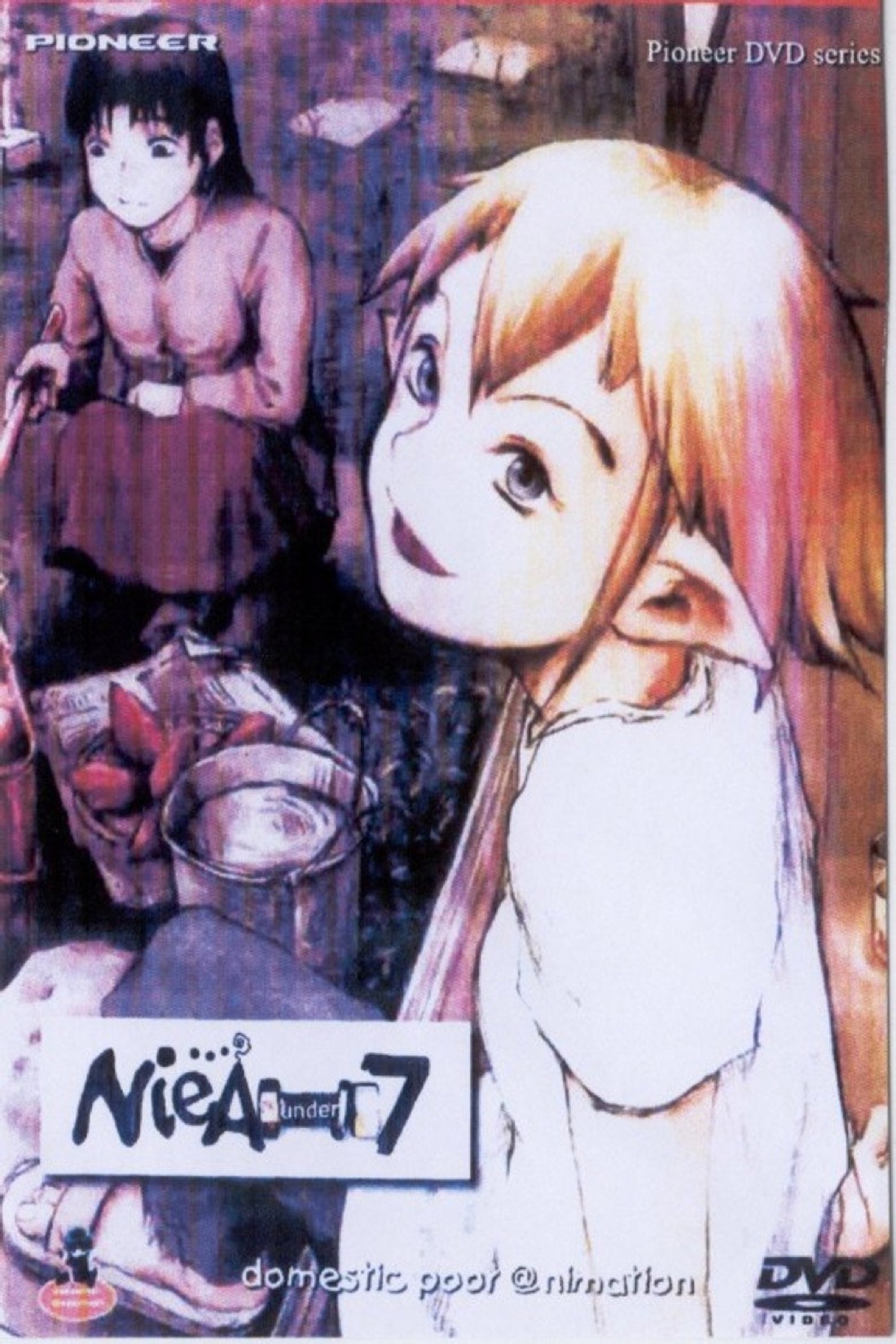
What exists instead is a disc, and the history behind it is a small piece of anime distribution archaeology. Pioneer put the series out in North America in 2001 with a full English dub. Those DVDs went out of print, and when Funimation later swept up most of the Pioneer and Geneon catalog, this was the one Yoshitoshi ABe title left on the floor. Discotek Media rescued it in February 2018 as a DVD and Blu-ray combo, sourced from the Japanese upscale. That release is still the answer.
👽 Is NieA_7 the Same Show as NieA Under 7?
Yes. NieA_7 and NieA Under 7 are the same thirteen-episode series, broadcast in Japan from April 26 to July 19, 2000; the underscore is simply read as “under.” Episodes run about 24 minutes, so the full set runs just over five hours. The Discotek set is sold as NieA_7 while many retail listings spell the title out, so search both names when you go looking for the disc.
I read the underscore as the series’ first joke. Niea is an Under Seven, the bottom rung of the alien hierarchy, the ones with damaged or missing antennae, and her name is typeset exactly where society files her: under the seven. By the last episode the joke is still in the title, but it has stopped being only a joke.
🎬 Trailer
A 2000 television series with no overseas campaign has no English trailer. What you get instead is the opening sequence, posted by the Japanese rights holder. Ninety seconds of summer light over a shabby neighborhood. The song underneath belongs to SION, who sounds like somebody sighing in a good mood.
Work Info
- Title: NieA_7, read as Niea Under Seven
- Broadcast: 2000, thirteen episodes
- Director: Takuya Sato
- Original concept and character design: Yoshitoshi ABe
- Animation: Triangle Staff
- Voices: Ayako Kawasumi, Yuko Miyamura
- Source manga: Yoshitoshi ABe with gK
📖 Synopsis, No Spoilers
A spaceship crash-landed on Earth about a decade ago. The survivors did not conquer anything. They settled, took jobs, and reproduced their own social hierarchy on the ground, ranked by the antennae on their heads, from the respectable Sevens at the top down to the ones with damaged or missing antennae at the bottom. Those are the Under Sevens, and society treats them roughly the way you would expect.
Mayuko Chigasaki came to Tokyo from the provinces to retake her university entrance exams, and lives in the loft above a struggling public bathhouse, working part-time jobs to stay there. At some point an Under Seven called Niea moved in with her. Niea eats Mayuko’s food, wrecks the room, salvages junk to build a flying saucer that never flies, and has no papers, no income, and no plans. The whole show is thirteen episodes of a summer in which nothing much occurs.
✨ What Makes It Special
Why It Is Exceptional
- An immigration allegory built into a slacker comedy, nine years before District 9
- Yoshitoshi ABe with the dread turned down and the melancholy left in
- The best argument in anime for a bathhouse as a setting
- Thirteen episodes with no plot, which is the format rather than a fault
The caste system is the joke, and then it is not
For most of its running time the alien hierarchy is played for laughs. Niea is an Under Seven, which means she is at the bottom of a ranking system nobody can explain, and she is also lazy, greedy, loud, and impossible to insult. The show gets a lot of comedy out of a character whose social position is hopeless and who has decided not to notice.
Then you start to see what is underneath. The aliens have no legal status. They live in the parts of town nobody else wants, do the work nobody else will do, and are surveilled. There is a restricted zone they are not permitted to enter. Some of them have adopted flamboyant surface identities, one obsessed with China, one with India, one with Hawaii, and the joke there is not on them. It is a satire of how a host country flattens foreigners into a costume, delivered by a country that was, in 2000, in the middle of exactly that argument with itself.
Some of this will not be legible from outside Japan without a footnote, so here it is. Around the turn of the century Japan was absorbing a large wave of foreign labor while insisting to itself that it was not an immigration country, and the domestic press was preoccupied with people living without proper household registration, a status that in this country makes you close to administratively nonexistent. Niea has no registration, no records, and no way into the system. That is not an invented science fiction problem. It is a thing that happens here.
The comparison every Japanese viewer eventually reaches for is District 9, which took the same premise, aliens as an underclass in a country with a specific history of segregation, and made a much angrier film out of it. That was 2009. This was 2000, on a late-night television budget, disguised as a sitcom. Getting there first while pretending not to be trying is a properly impressive trick.
Look, I know I have made this sound like homework. It is not. Ninety percent of the running time is two broke housemates bickering about food, and the political material arrives the way it does in life, sideways, in an episode that started out being about something else.
The other Yoshitoshi ABe
If you know ABe at all in English, you know him for Lain, or possibly for Texhnolyze, and the mental image is a pale figure in an empty room while something goes wrong with reality. He drew this too, at the same studio, in the same years, and the visual signature is unmistakable: the same soft grubby palette, the same faces that look slightly unwell in a beautiful way.
What is missing is the dread. What survives is the melancholy, which turns out to be the part that was doing the work all along. This is worth understanding if you are coming to Haibane Renmei from either direction, because Haibane sits precisely between the two modes, and NieA_7 is the evidence that ABe could always have written warmth if he had felt like it.
Fair warning that ABe fans are divided on this show. A portion of the audience wanted the sadness undiluted and finds the comedy a waste of him. I think that gets it backwards, but I understand where it comes from.
The bathhouse, and the case for nothing happening
Mayuko lives above a sento, a neighborhood public bath, and the choice is more loaded than it looks. Sento were once how ordinary Japanese people washed, and they have been closing steadily for fifty years as flats acquired their own bathrooms. A struggling bathhouse in 2000 is shorthand for a whole disappearing texture of working-class city life, and a room in the roof of one is the cheapest accommodation a student could plausibly find.
The series uses it for the thing it is best at, which is evening. Sunset over low rooftops, the specific exhaustion of a Japanese summer, a conversation about nothing, then hot water. If you have watched Yokohama Kaidashi Kikou or anything in that lineage, you already know this register. The claim being made is that the empty parts of a day are not the gaps between the content. They are the content.
Deeper Themes
Mayuko and Niea are the same problem in two bodies. One is a student who has failed her exams and is running out of money and time, tolerated by society but not yet admitted to it. The other is legally invisible and always will be. The show never states the parallel, and it does not need to, because they are sharing one room.
Underneath is a question about whether poverty is a stage you pass through or a place you live. Mayuko believes she is passing through. Niea is not going anywhere, has stopped expecting to, and is measurably happier about it. Which of them the series thinks is right is left completely open, and that ambiguity is the ABe fingerprint on an otherwise gentle show.
🎭 Memorable Scenes
Under Seven. That is what they call me.
The episode where Niea gets into the restricted area is the one that stays. It is the only time the show drops the comic register for a sustained stretch, and it works precisely because eleven episodes of stupidity have earned it. A character you have been laughing at walks into the machinery that decides what she is allowed to be, and the machinery does not find her funny.
Against that, the bathhouse. Steam, tiled walls, a painted mural, and two people who have nothing left to say to each other saying it anyway. There is no scene I could point to and call remarkable. Collectively they are why anybody remembers this series, and why I put it back on when the weather turns.
And the UFO. Niea keeps building one out of scrap, and it keeps failing, and the show never once treats this as a metaphor even though it obviously is. Restraint like that is rarer than it sounds.
💭 How It Made Me Feel
Like the end of August. Not sad exactly, more the specific flatness of a season closing while you were not paying attention. Thirteen episodes of nothing happening should not leave a residue and this one does.
The lasting effect is seasonal, which is a strange thing to say about a television show. It has become something I reach for in late summer, the way other people reread a particular book. Last year I noticed I had started walking past my local bathhouse deliberately rather than by accident, which I am choosing not to examine too closely.
Who Should Watch This?
- Anyone who has finished Lain and Haibane Renmei and wants the missing third
- Viewers who like slice of life but want something underneath it
- People curious about how Japan talked about immigration in 2000
- Collectors who accept that some shows now only exist as objects
😅 Where It Falls Short
Three honest problems
The world building is a backdrop and never becomes anything more. A crashed ship, a caste system, a decade of coexistence, and the series has no intention of investigating any of it. If the premise is what pulled you in, the show will keep declining to deliver on it for thirteen episodes and then stop. That is a design decision rather than a failure, and it will still irritate you.
Second, and this one bothers me more, the social critique has no follow-through. The series is sharp about how the hierarchy works and vague about what anybody should do, and what it offers instead is roughly a change of attitude. Asking a gentle thirteen-episode comedy for structural analysis is unreasonable, and yet it gets close enough to the real thing that the retreat is noticeable.
Third, and unavoidably, the availability. Recommending a series that requires importing a Blu-ray is a hard sell in 2026, and I am aware of how that reads. The disc is good, the dub from 2001 is on it, and the alternative is not watching it at all.
The Weak Points
- The science fiction premise is scenery, never subject
- Sharp on the problem, evasive about any answer
- No streaming route anywhere, so a disc is the only option
Who Might Not Enjoy This?
- Anyone hoping for the dark ABe of Lain or Texhnolyze
- Viewers who want a science fiction setting actually explored
- People who need a story to escalate
📺 Streaming Guide by Service
There is no streaming guide, so here is a buying guide
The Discotek combo release from February 2018 is the only version worth your money. It carries the complete thirteen episodes, the Pioneer English dub from 2001, and the extras from the original American discs. The picture is an upscale of a standard definition master rather than a true high definition remaster, so calibrate your expectations: this will look like good 2000 television, because that is what it is.
On sub against dub I have no strong opinion here, which is unusual for me. The dub is a period piece in its own right, recorded when American anime dubbing was still finding its register, and it has a scrappiness that suits a show about being broke. Ayako Kawasumi and Yuko Miyamura in the original are the better performances. Either is fine.
One piece of viewing advice. Do not attempt this as a binge. It was made for one episode a week in summer, it has no momentum by design, and four in a row will flatten it into wallpaper. Two evenings a week for two weeks is the correct dose.
How to Watch It
- Discotek DVD and Blu-ray combo: complete series, subtitled plus dubbed
- Discotek Media: the label’s own catalog, worth browsing if this is your era
- Out of print Pioneer discs from 2001 still circulate secondhand. The Discotek release supersedes them
Soundtrack
Yoshio Owa scored it, and the approach is minimal to the point of near absence. Acoustic guitar, a little piano, long stretches with nothing but cicadas. For a series this quiet the sound design does more work than the music, and both know it.
The opening song belongs to SION, a blues-inflected singer-songwriter who has been a fixture of the Japanese underground since the eighties and who is almost entirely unknown abroad. His voice on a comedy about aliens is the single oddest production choice here, and the reason the opening sticks.
📚 The Source Manga
Yoshitoshi ABe drew the manga with a collaborator credited as gK, running alongside the series rather than ahead of it, so the two versions share a premise and diverge on episodes. It was collected in 2012 as a single complete volume under the title NieA_7 Recycle.
There has never been an English edition, and I would not hold out much hope of one. If you read Japanese it is the best way to see ABe writing comedy in his own hand, and it is short.
🎬 If You Loved NieA_7, Watch These 3 Next
A Letter to Momo
Almost the same household arrangement, drawn with a much bigger budget. A girl relocated somewhere she did not choose, three non-human freeloaders who eat everything in the house, and one long humid summer. Warmer than NieA_7 and considerably easier to obtain.
👉 Read our review of A Letter to Momo
Mushishi
The same faith that atmosphere can carry a series without a plot to push it, executed at a much higher level. Self-contained episodes, strange creatures treated as ordinary weather, and an enormous amount of quiet. If the empty stretches of NieA_7 were the appeal, this is the masterwork of that idea.
Hi Score Girl
Comedy with a class gap running underneath it, rendered with the same obsessive fidelity to a specific vanished decade. One kid has money and the other does not, the show finds that funny, and it also never lets you forget it. Different era, same instinct.
👉 Read our review of Hi Score Girl
📝 Final Thoughts
NieA_7 is the ABe title nobody talks about, and the reasons are structural rather than qualitative. It came out in the wrong register for his reputation, on a late-night slot, and then fell out of every catalog that would have kept it in front of people. A show about characters society forgot to file has been treated by the market exactly the same way.
What it does, nothing else quite does. Sunset on a cheap neighborhood, a conversation with no purpose, an alien with no papers building a spacecraft that will not fly, and a country in 2000 arguing with itself about who is allowed to stay. If any of that appeals, buy the disc. It is the only way in, and I have not regretted the shelf space.
⭐ Series at a Glance
| Category | Rating | Comment |
|---|---|---|
| Writing | ★★★☆☆ | Deliberately plotless, occasionally too much so |
| Characters | ★★★★☆ | Two housemates who earn thirteen episodes |
| Visuals | ★★★★☆ | ABe’s palette on a television budget |
| Music | ★★★★☆ | Minimal score, an opening by SION |
| World | ★★★★☆ | Rich premise, deliberately unexplored |
| Themes | ★★★★☆ | Immigration, class, smuggled in sideways |
Usagi’s Recommendation Score
⭐⭐⭐⭐⭐⭐⭐☆☆☆
7.2 / 10
The one you remember at the end of summer. Buy the Discotek disc, because nothing streams it.

