*This page contains affiliate links. We may earn a commission if you make a purchase through these links.
In the oldest surviving Japanese poetry anthology, the word we now write as love was written with two characters meaning solitude and sorrow. Not affection. Not desire. The specific ache of wanting somebody while you are on your own. Makoto Shinkai built a forty-six minute film on that single piece of etymology, and it is the most focused thing he has ever made.
I watched it for the first time in the middle of winter, nowhere near a rainy season, and about ten minutes in I had the distinct physical sense of sitting in a wet garden pavilion in June. That is what the film does. Whether it earns its ending is a separate question, and I am going to be honest about that part further down.
📺 Where to Watch The Garden of Words (October 2026)
| Service | Status | Notes |
|---|---|---|
| Kanopy | Streaming | Free with a participating US library card |
| HIDIVE | Streaming | Included with a subscription |
| Blu-ray (Amazon US) | Rent / Buy | Sentai Filmworks disc. No US store rents or sells it digitally |
| The Criterion Channel | Not available | Not in its US catalog |
| Netflix | Not available | Not in the US catalog |
| Crunchyroll | Not available | Sentai Filmworks holds the North American license |
Two services stream The Garden of Words in the US: Kanopy, which works through participating public libraries, and HIDIVE, with a subscription. No US store rents or sells it digitally, so the disc is the only way to own it. Listings checked October 3, 2026.
📖 Is There a Garden of Words Novel?
Yes. Shinkai wrote it himself, and it goes well past the film. It ran as a serial in the Japanese magazine Da Vinci from 2013 into 2014, came out as a complete book from Kadokawa in April 2014 with scenes that are in neither the film nor the serial, and Yen Press published it in English in August 2020.
Read it after the film, not before. The 46 minutes depend on not knowing who Yukino is until Takao finds out, and a book that fills in her life is the last thing you want spoiling that. Afterwards it does the opposite job: if the stairwell scene felt sudden to you, the extra chapters give both of them more room than 46 minutes could.
🎬 Trailer
Posted by CoMix Wave Films, the studio itself. The dialogue is Japanese, which matters less here than in almost any other trailer, because roughly eighty percent of what this film has to say arrives as water hitting things.
Work Info
- Title: The Garden of Words (Kotonoha no Niwa)
- Released: 2013, 46 minutes
- Written, directed, edited by: Makoto Shinkai
- Animation: CoMix Wave Films
- Voices: Miyu Irino, Kana Hanazawa
- Music: Daisuke Kashiwa
- Theme song: Rain, performed by Motohiro Hata, written by Senri Oe
📖 Synopsis, No Spoilers
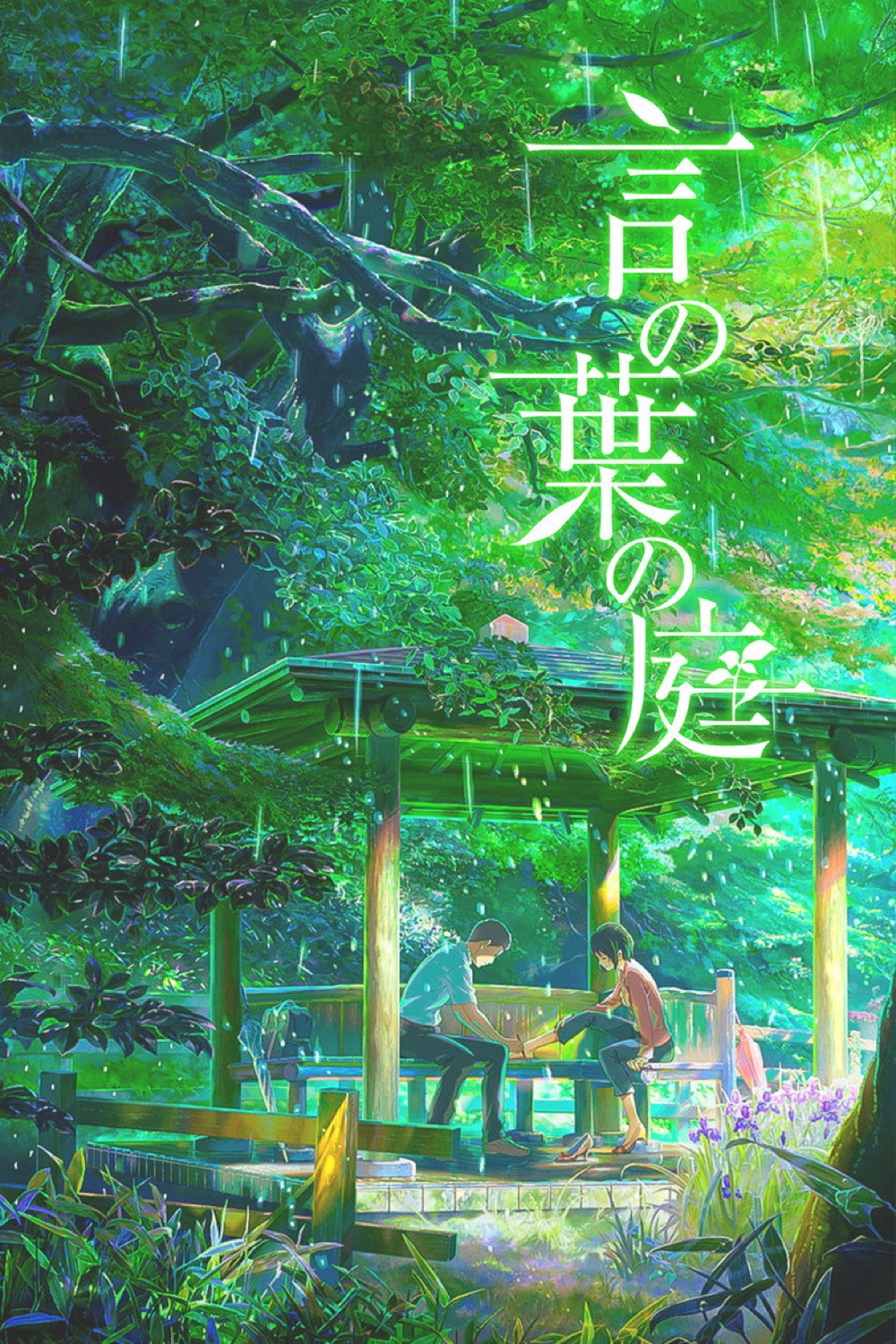
Takao Akizuki is fifteen and intends to make shoes for a living, which is an unusual ambition for a Japanese high school student and is treated by everyone around him as slightly embarrassing. On mornings when it rains he skips his first period, goes to Shinjuku Gyoen, sits in a pavilion, and sketches.
One June morning somebody is already there: a woman of twenty-seven in office clothes, drinking beer and eating chocolate at nine in the morning on a weekday. She leaves by reciting a poem at him, which he does not understand. They keep meeting, without arrangement, only when it rains. He decides to make her a pair of shoes. Then the rainy season ends, the reason to be in the garden disappears, and he finds out who she is.
✨ What Makes It Special
Why It Is Exceptional
- Rain animated as a dozen different substances
- A thousand-year-old poem used as structure rather than decoration
- Characters colored to dissolve into the backgrounds around them
- Forty-six minutes, with an end-credits song that collects the whole debt
Rain, animated as about twelve different things
Around four fifths of this film takes place in rain, and the achievement is that no two instances of it behave the same way. Fast water in a channel. Water running down the underside of a leaf. Heavier water falling out of a gutter. A single bead landing on a pond with blossom on it, and the specific way that surface answers back.
The greens are just as differentiated. Shinjuku Gyoen in the rainy season is properly oppressive, humidity you can lean on, and the film gets that across without a word about weather. Branches touching the water. Water striking a puddle and coming back up. The attention to detail is at a level where the picture acquires a smell: wet asphalt, and that warm vegetable air that comes off soaked trees.
There is a technical decision underneath this that mostly goes unmentioned. Shinkai had the characters colored to merge with the backgrounds rather than sit on top of them, with the shadow lines carrying background color so that light appears to refract through the figures the way it does through everything else in the frame. The effect is that Takao and Yukino belong to the garden instead of being placed in it, which is a large part of why their meetings feel private rather than staged.
I would go further than the film’s reputation does. This is the high-water mark of Shinkai as an image maker. Your Name is a better film, and Weathering with You has more ambitious weather, but neither has this density, because neither has the luxury of forty-six minutes and one location.
The poem is the blueprint
Shinkai has said the theme is loneliness, and the source he went to is the Man’yoshu, Japan’s oldest poetry collection, compiled in the eighth century. What gives the film its title and its engine is a detail of spelling. In that era, the word for love was written with characters meaning solitary and grieving. Love, in writing, was a compound of being alone.
The poem Yukino recites at their first meeting is from that collection, and translated roughly it says: a faint roll of thunder, clouded skies, and perhaps rain will come and keep you here. She is not making conversation. She is telling a fifteen-year-old stranger, in a code he cannot read, that she would like him not to leave, and the film waits until much later to let anyone say so directly.
You do not need the classical background to follow the story, and that is the mark of it being done well. If you do have it, the poem stops being atmosphere and starts being a plot device that discloses her identity and her state of mind before the script does. Japanese schoolchildren learn these poems and then forget them, and the film is counting on that half-memory.
The song, and where it lands
Rain is a Senri Oe song from 1988, covered here by Motohiro Hata, and it starts the instant the emotional peak subsides. Shinkai has been doing this since Five Centimeters per Second, where a Masayoshi Yamazaki song performed the same function, and it remains the most reliable tool in his kit.
Whether it is a trick is a fair question. It is at least an honest one, in that the film has actually built the forty-six minutes the song then collects on. I have been ambushed by it twice now, knowing exactly what was coming both times.
Deeper Themes
Read it as a romance and the age gap dominates everything. Read it as a film about two people who have both stopped being able to walk, in the ordinary daily sense of getting to the place they are supposed to be, and it opens up. He skips class. She cannot go to work. They meet in a garden because a garden is where you go when the building you belong in has become impossible.
The shoes are the argument, and they are not subtle once you see them. He is learning to make the object that lets a person move. She has told him she has forgotten how to walk. Everything the film wants is contained in a teenager measuring an adult’s foot with a piece of string, and it never explains the metaphor out loud, which is the best decision in the script.
🎭 Memorable Scenes
A faint clap of thunder, clouded skies. Perhaps rain will come. If so, will you stay here with me?
The opening, and the best introduction of a character I can think of in a short film. A woman in office clothes at nine in the morning with a can of beer, pale ankles under a business skirt, chocolate for breakfast, who leaves by quoting eighth-century poetry at a schoolboy. Every element of that is wrong in an interesting direction, and it buys the film its entire first act of curiosity.
The one that stayed with me is smaller and has no dialogue. Takao wakes, checks the forecast on his phone, sees rain, and makes lunch. Cracking the eggs. Setting his shoes down in the entryway. This is the kind of thing Japanese animation is quietly the best in the world at, and the entire content of the scene is that a boy is hoping for weather so he can see somebody. Nobody says it. I watched it and remembered checking a forecast for reasons that had nothing to do with weather.
And then the stairwell, where the film stops being quiet. Takao finally says the thing, loudly, and Yukino runs down concrete steps in bare feet. Opinions vary on that scene and I have some of my own further down. What is not in doubt is that both of them are moving again when it ends.
💭 How It Made Me Feel
I sat looking out of the window for a while afterwards and felt obscurely let down that it was dry outside. Forty-six minutes, and what it leaves is not the punch of a big film. It is warmer and lower than that, and if you have ever spent a period of your life with no particular place you were expected to be, you will recognize the temperature.
The measurable after-effect turned up the next morning, when I saw rain in the forecast and was pleased about it. I do not like rain. I have never liked rain. A film that can reverse that for a week has done something to you, and I have been slightly wary of it ever since.
Who Should Watch This?
- Anyone who has had a stretch of life with nowhere they were expected to be
- Viewers who only know Shinkai from Your Name
- People who want a complete film in under an hour
- Animation people who want to study one studio drawing water
😅 Where It Falls Short
Three complaints, written honestly
The stairwell scene arrives without enough run-up. Forty minutes of restraint, quiet voices, weather, and then Takao is shouting. I understand what the outburst is for, I understand that Yukino’s barefoot descent needs it to exist, and on rewatching I find more groundwork than I did the first time. On a first viewing it still reads as a sudden change of register, and I do not think the relationship has been built high enough in the running time to carry it.
Second, and I would rather say it than skirt it: he is fifteen, she is twenty-seven, and she is a teacher at his school. The film handles it with more care than that summary suggests, and animation grants a kind of license that live action would not. It is still a setup where the adult initiates the pattern, recites the poem, and lets the meetings continue. Some viewers will find that reading unavoidable, and I do not think they are being unfair.
Third, the people are less convincing than the weather. Two strangers do not start talking like that. A fifteen-year-old with a settled vocational plan to make handmade shoes is a construction. A woman drinking beer in a public garden on a Tuesday morning is a construction. Shinkai has always paired photographic realism in the environment with characters who are a degree or two more idealized than real people, and how much that bothers you determines your score more than anything else in the film.
The Weak Points
- The climax shifts register faster than the setup supports
- A fifteen year old, a twenty-seven year old, one school between them
- Photoreal settings, characters a degree more idealized than people
Who Might Not Enjoy This?
- Anyone with a firm objection to teacher and student romance
- Viewers who want plot rather than a visual poem
- People who find Shinkai’s sincerity hard to take
📺 Streaming Guide by Service
Free first, and the case for headphones
Try Kanopy before anything else, because a library card makes this free and the film is short enough to fit inside a monthly borrow limit without thinking about it. If Kanopy is not an option, HIDIVE is the standard subscription route.
An English dub exists on the Sentai release. I lean subtitled for one specific reason, which is the poem. Yukino’s recitation is in classical Japanese, a register that sounds noticeably archaic to a modern ear here, and the strangeness of it is doing work that no English line reading can reproduce. The dub is otherwise fine.
Two practical notes. Use headphones or decent speakers, since a large fraction of this film is rain and the sound design separates a dozen kinds of it. And watch it in one sitting, which at forty-six minutes should not be difficult.
Watch It Here
Soundtrack
Daisuke Kashiwa’s score is almost entirely solo piano, deliberately understated, sitting under the rain rather than competing with it. On its own it is a pleasant, unremarkable record. Inside the film it is exactly right, which is a harder thing to write than a memorable theme.
The song is the reason to look this up. Motohiro Hata’s version of Rain is on every service, and Senri Oe’s 1988 original is worth a listen straight afterwards for how differently the same lyric behaves at a slower tempo with more reverb on it.
📚 In Print
Shinkai wrote his own novel version, which fills in most of what forty-six minutes had to cut: Yukino’s history, Takao’s home situation, the supporting characters given chapters from their own point of view. There is also a manga adaptation drawn by Midori Motohashi, published in English by Vertical.
If the ending felt underfed to you, the book is the answer rather than a rewatch. Check current editions on Amazon, and read the language field carefully, since Japanese printings share the shelf.
🎬 If You Loved The Garden of Words, Watch These 3 Next
Weathering with You
Shinkai returning to rain six years later with a blockbuster budget and a much bigger argument attached. Same city, same obsession with water, entirely different scale. Watching them in order shows you exactly what he learned in between, and what he traded away for it. Its rain-soaked Shinjuku is the one we picked for our list of anime set in Tokyo, if the city is what pulled you in here.
👉 Read our review of Weathering with You
Violet Evergarden
A series about somebody whose job is finding words for feelings other people cannot articulate, which is the same subject as this film approached from the far side. If the idea of an eighth-century poem doing the work a confession could not appeals to you, this is twelve hours of that idea.
👉 Read our review of Violet Evergarden
Your Name
The one that made him a household name three years later, and the reason most people abroad have heard of him at all. Everything he worked out in the garden is here at feature length with a plot engine bolted on. Watch this film first if you want to see the craft before the phenomenon.
👉 Read our review of Your Name
📝 Final Thoughts
This is Shinkai at his least commercial and most legible as an artist. It came before the run of enormous films, it is quiet and slightly awkward, and the script is doing something clever with a poem nobody outside Japan has read. It is also imperfect in ways I would not pretend away: the ending changes gear too fast, the central relationship is a problem for some viewers, and the people are less real than the trees.
What it has instead is a specific claim, made over forty-six minutes and mostly without dialogue, that it is permissible to stop for a while. To sit somewhere you are not supposed to be, in weather that gives you an excuse, until you can walk again. Not many films will tell you that. Watch it on a wet evening, on your own.
⭐ Film at a Glance
| Category | Rating | Comment |
|---|---|---|
| Visuals | ★★★★★ | Shinkai’s peak. Twelve kinds of rain |
| Writing | ★★★☆☆ | Clever structure, undercooked in 46 minutes |
| Characters | ★★★☆☆ | Delicately felt, not quite believable |
| Music | ★★★★☆ | Sparse piano, then Hata collects the debt |
| Sound design | ★★★★★ | Worth headphones on its own |
| Pacing | ★★★☆☆ | Lovely, then abruptly loud |
Usagi’s Recommendation Score
⭐⭐⭐⭐⭐⭐⭐☆☆☆
7.2 / 10
Forty-six minutes, on a wet evening, alone. Headphones are not optional.

