*This page contains affiliate links. We may earn a commission if you make a purchase through these links.
Japan’s national media arts festival hands out a grand prize for animation every year. The year before this film came out, it went jointly to Spirited Away and Millennium Actress. Then it went to a Crayon Shin-chan movie. Nobody was being funny.
I want to be clear about my starting position, because it was wrong. I knew this franchise as thirty years of a five-year-old pulling his trousers down, and I put this on expecting a competent kids’ film with a sentimental third act. What I got was a period war picture with siege tactics, correct sixteenth-century military vocabulary, and a love story that never once gets said out loud.
📺 Where to Watch The Battle of the Warring States (August 2026)
| Service | Status | Notes |
|---|---|---|
| Crunchyroll | Not available | No Shin-chan features in the catalog |
| Netflix (US) | Not available | Netflix Japan streams it |
| Amazon Video (US) | Not available | No rental, no purchase |
| HIDIVE | Not available | Outside its library |
| Japanese Blu-ray | Region free, no subtitles | 2023 anniversary edition. See below |
As of August 18, 2026, no service in the United States carries this film in any form. Not streaming, not rental, not purchase. That is the same situation the previous Keiichi Hara film is in, and it is the single most frustrating gap in Japanese animation availability abroad.
The contrast with Japan is total. Here it sits on Prime Video, Netflix, and Hulu simultaneously, and a 2023 anniversary Blu-ray put it back on shelves. There was an English-subtitled disc release once, from a Southeast Asian label rather than a US one, and it is long out of print. What that means practically is covered further down, and I would rather set the expectation now than let you read a thousand words about a film you cannot reach.
🎬 Trailer
The original TV Asahi trailer, in Japanese, because a film with no Western release never had an English one cut for it. Watch the battlefield shots. That is hand-drawn animation of massed infantry, made for a franchise about a preschooler.
Work Info
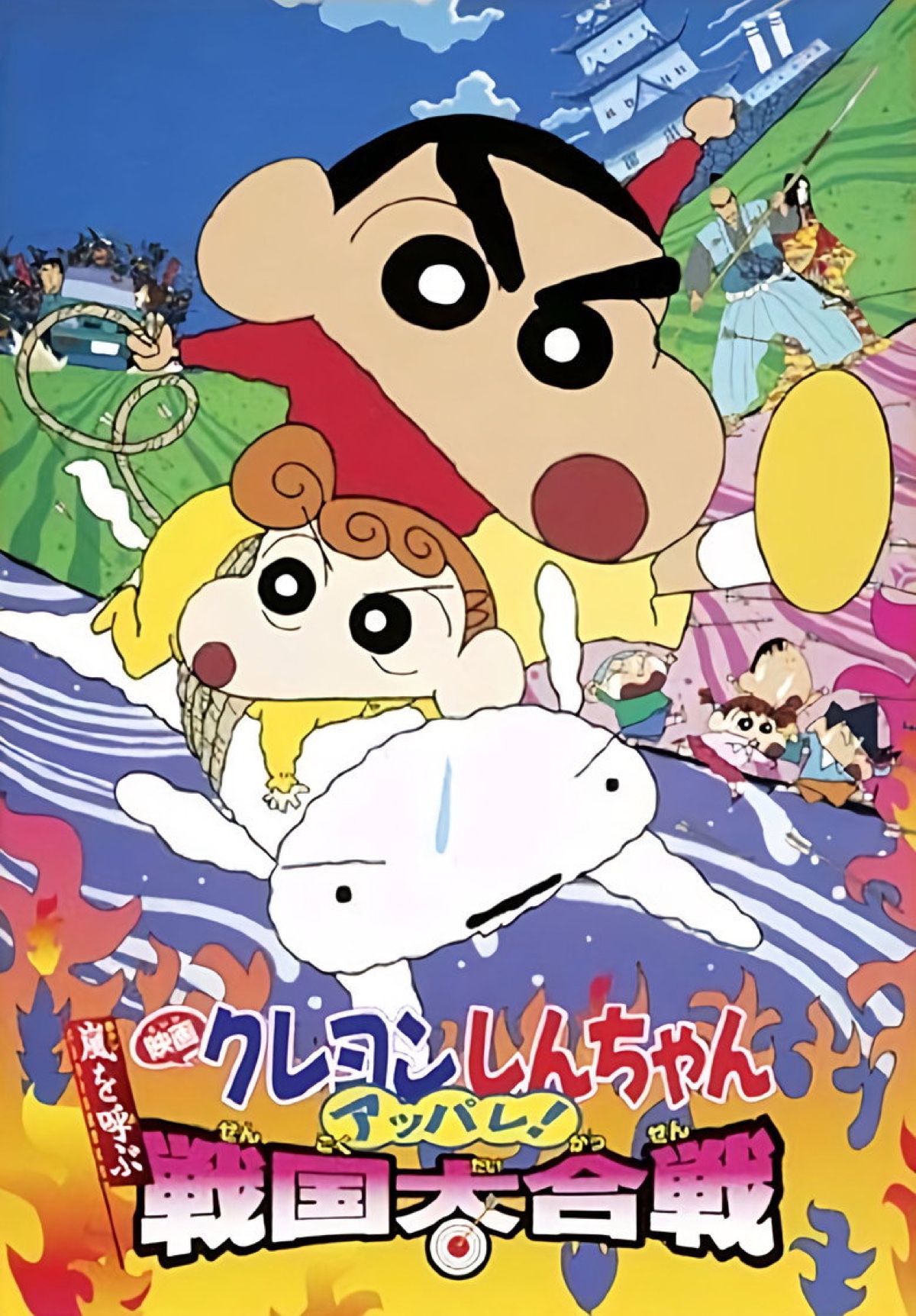
- Title: Crayon Shin-chan: Fierceness That Invites Storm! The Battle of the Warring States
- Released: April 2002, 95 minutes. Tenth film in the series
- Written and directed by: Keiichi Hara
- Animation: Shin-Ei Animation. Distributed by Toho
- Original manga: Yoshito Usui
- Music: Toshiyuki Arakawa, Shiro Hamaguchi
- Awards: Japan Media Arts Festival Grand Prize, Mainichi Film Award for Best Animation
📖 Synopsis, No Spoilers
The Nohara family all have the same dream on the same night: a woman in a kimono standing beside a pond. The next day Shinnosuke digs up a letter buried in the garden and finds himself in his own town in the spring of 1574, in the middle of the Warring States period.
He is taken in by Matabei Ijiri, a retainer of the local castle, a stiff and inarticulate man who takes being a samurai extremely seriously. Shinnosuke also befriends Ren, the lord’s only daughter, who has known Matabei since they were children and who is about to be married off to secure an alliance. The neighbouring province is preparing to attack. Then the rest of the Nohara family drives a small family car into the sixteenth century to collect their son.
✨ What Makes It Special
Why It Is Exceptional
- A love story across five hundred years of class, never once spoken
- Battle scenes researched harder than most live-action period films manage
- The emotional climax staged with the character’s face out of frame
- A children’s franchise treating death as permanent
The thing neither of them says
The centre of this film is not the battle. It is Matabei and Ren, who grew up together, who both know exactly how the other feels, and who will go to their graves without either of them saying it.
The reason needs stating for readers outside Japan, because the film assumes it. In 1574 a retainer and a lord’s daughter did not marry. Marriage was not a thing you did because of feeling. It was an instrument of alliance, and a daughter was the instrument. Ren’s engagement is not an obstacle placed in the plot’s way, it is simply how the world worked, and everyone in the film understands that including her.
Which is what makes a five-year-old’s throwaway line detonate. Shinnosuke, who has no idea what he is walking into, tells Matabei that in the twenty-first century you just have to like each other and that is enough. Five centuries of received wisdom taken apart by a preschooler who was not even trying. Matabei goes red, gets flustered, retreats behind being a samurai, and the scene is funny and awful at the same time. A man who cannot say it, in front of a child who cannot see why not.
Late in the film Ren is driven away in the family car and Matabei rides after her on horseback. He cannot keep up. Five hundred years of engineering rendered as the exact distance between two people. He works out that he will never close it, stops, and she looks back. There is no dialogue in the sequence and there does not need to be.
I will admit to wanting to shake him. Say something. Then I remember I am applying twenty-first century assumptions to a man who would not have understood the suggestion, which is precisely the gap the film is built on.
Research nobody asked for
I did not come to a Crayon Shin-chan film expecting accurate military terminology, and this is where it stopped being a comedy for me. The commands are period-correct rather than modern: the archaic verb for loose rather than the modern one for fire, the order to push forward rather than to advance. Spearmen shout the specific short syllables that Japanese foot soldiers used to keep formation. Live-action period drama frequently does not go this far.
The fighting is also built as collective tactics rather than individual heroics, which is rarer than it should be. Torches ringing a castle at night to intimidate. A dawn raid. Incendiary arrows. The particular airlessness of being besieged. All hand-drawn, in a film whose target audience was six years old.
Think about the working conditions that implies. Keiichi Hara spent months reading primary material so that a gag franchise could get its siege right, on the reasonable theory that children deserve not to be lied to. That instinct is the whole difference between this film and every other licensed animated feature of its era.
The face he refuses to show you
At the emotional peak of the film, Hara keeps his protagonist’s face out of the frame. Something is handed to Shinnosuke, and tears land on it, and you never see him. You are given the evidence and asked to construct the expression yourself.
It is subtraction rather than expression, and it works far better than a close-up would have. Film people in Japan have connected the choice to Kurosawa’s Ran, which withholds a face at its own worst moment. Smuggling Kurosawa’s grammar into a franchise about a boy who moons people is not a thing most directors would attempt.
Deeper Themes
The question the film keeps circling is what a borrowed stretch of time is worth. Matabei gets a season he would not otherwise have had, because a child fell out of the future into his life, and he spends it seriously. Whether that makes the season more valuable or crueller is left entirely to you.
Underneath that is a franchise decision with real weight. Crayon Shin-chan is a comedy where nothing has consequences. This film introduces a world where death is administrative, ordinary, and does not negotiate, and then refuses to protect its characters from it. Japanese audiences who grew up with the television series felt that floor give way, and it is why people still talk about the film two decades on.
🎭 Memorable Scenes
What is there to keep me in a world without Shinnosuke?
Hiroshi, the father, says it in a library, after finding his son’s name in a sixteenth-century record. Hiroshi is the series’ running joke about salarymen: tired, underpaid, with famously bad feet. He is also a man who will point a family car at the Warring States period without discussing it first. The entire character is in that one line.
Then there is a piece of samurai practice the film taught me, which is a vow sealed by striking the guards of two swords together. Matabei and Shinnosuke make one. Late in the film a five-year-old keeps it, at real cost, in silence. It is the most adult thing that character has done in thirty years of the franchise.
And Ren, crying, telling Shinnosuke to stop. He is about to relay what Matabei feels, and she will not let him finish. Whether she already knew or could not bear to hear it confirmed, the film does not say. Shinnosuke swallows the sentence and reseals the vow instead. Everything this film is doing is in that decision.
💭 How It Made Me Feel
Unable to start anything else for about an hour. Not tearful, though. What I actually felt was closer to unease, a question about whether it had to end the way it did that I have not resolved and do not particularly want to.
The residue showed up as an appetite. For weeks afterwards I found myself watching period drama I would normally skip, chasing whatever it was those siege sequences did to me. A film aimed at six-year-olds gave me a taste for chanbara at forty, which I am choosing to find funny rather than embarrassing.
Who Should Watch This?
- Anyone who dismissed this franchise without watching a Keiichi Hara entry
- Period drama viewers who care whether the tactics are right
- People who like a romance that never resolves into a confession
- Anyone tracking what Japanese animation was doing outside Ghibli in 2002
😅 Where It Falls Short
Three things I would take back
Look, I have spent a lot of words praising this, so here is the other column. The largest problem is that you can see the machinery in the final act. Victory arrives, the audience relaxes, and the film immediately overturns everything. Using a reversal to generate feeling is standard practice, and the execution here is clean. It is so clean that I caught myself admiring the construction while I was supposed to be inside it, which is not where a film wants you.
Second, the fair question of whether this material belonged in this franchise at all. Class-forbidden love, a political marriage, death on a battlefield. The tone is pitched at adults from about the twenty-minute mark. The criticism that it is a different film wearing a Shin-chan costume is not stupid, and the previous Hara entry balanced comedy against weight considerably better.
Third and related, there is simply not enough of the joke. The gags are thinner here than in any other film in the series, and Shinnosuke’s specific brand of idiocy is what makes his line about the twenty-first century land at all. A little more stupidity would have made the serious parts hit harder rather than softer. And I say all that as somebody who thinks the mismatch is half the reason the film works.
The Weak Points
- The late reversal is visible as engineering
- Adult material inside a franchise built for six-year-olds
- Thinner comedy than any other entry in the series
Who Might Not Enjoy This?
- Viewers who came to this franchise strictly for the comedy
- Anyone who finds period drama heavy going
- People who want an ending that leaves them feeling fine
📺 Streaming Guide by Service
What you can actually do about this
Being honest about the options is the useful thing I can offer here, so here they are in order of realism. If you visit Japan, it streams on services you may already pay for, and a Japanese account will show it to you. If you have a friend here, the same applies. Neither of those is a recommendation so much as an observation.
The 2023 Japanese Blu-ray, released for the film series’ thirtieth anniversary, is region free in the sense that Japan and North America share a Blu-ray region. It carries no English subtitles. For a film with this much dialogue about feudal obligation, that is a real barrier rather than a minor one, and I am not going to pretend otherwise.
The realistic answer is to make noise. Every Keiichi Hara film in this series is in the same position, and the licensing gap exists because distributors assume the franchise is unsellable to Western adults. If a label ever tests that assumption, this is the title to test it with.
The Available Routes
- Japanese streaming services, if you are here or have an account here
- Import disc listings: 2023 Japanese Blu-ray, no English subtitles
- Read our Adult Empire Strikes Back piece for the companion film in the same predicament
Soundtrack
Toshiyuki Arakawa and Shiro Hamaguchi wrote the score, and it is far more orchestral than the franchise usually permits. Hamaguchi is a name Western listeners may know from arrangement work on much larger productions, and the battle cues here are period drama scoring played straight.
Finding it outside Japan is difficult, which by now will not surprise you. If you can reach it, the cue that plays over the horseback pursuit is the one that does the damage.
📀 The Live-Action Version
There is a curiosity worth knowing about. In 2009 this story was remade as a live-action film called Ballad, with the Shin-chan characters removed and replaced by an ordinary modern boy. It is a strange object: the same plot, the same doomed pair, none of the tonal collision that made the original work.
Watching it is instructive rather than enjoyable. Strip out the five-year-old and the line about the twenty-first century has nobody left to say it, which tells you where the power was sitting all along.
🎬 If You Loved The Battle of the Warring States, Watch These 3 Next
Crayon Shin-chan: The Adult Empire Strikes Back
Hara’s film from the year before, and the better balanced of the pair. Where this one takes on death and class, that one takes on nostalgia and what being an adult costs, and it keeps far more of the comedy intact while doing it. If you only get to reach one Shin-chan film, reach that one.
👉 Read our review of The Adult Empire Strikes Back
Princess Mononoke
The same conviction that an animated film for a general audience should not soften its history. Miyazaki’s Muromachi period and Hara’s Warring States are both researched hard and both refuse to make killing weightless. Anyone who sat up during the siege sequences should go straight here.
👉 Read our review of Princess Mononoke
Merry Christmas Mr. Lawrence
Live action, forty years old, and about the identical impossibility: two people who cannot name what is between them because the roles they occupy forbid it. Oshima sets it in a prisoner of war camp instead of a castle. Same silence, same ending, considerably less mercy.
👉 Read our review of Merry Christmas Mr. Lawrence
📝 Final Thoughts
This is a film that took a licensed comedy franchise as far as the format would stretch and then leaned on it. Class-forbidden love, warfare researched to the level of the verb forms, a climax staged by hiding a face. Keiichi Hara made a genuine period drama inside a franchise about a boy who moons people, and the national arts festival gave him its top prize for it.
The mismatch is real and I would not argue with anyone who finds it awkward. What has kept it alive for over twenty years is not the crying, it is the question it leaves sitting on the table about a stretch of borrowed time and what a person does with it. The frustrating part is that I cannot tell American readers where to watch it. The film is worth the inconvenience anyway, and I would rather you knew it existed.
⭐ Film at a Glance
| Category | Rating | Comment |
|---|---|---|
| Writing | ★★★★☆ | Superb until the reversal shows its seams |
| Animation | ★★★★☆ | Hand-drawn siege warfare, done properly |
| Direction | ★★★★★ | The withheld face is the best shot of 2002 |
| Music | ★★★☆☆ | Orchestral, effective, not memorable alone |
| Themes | ★★★★★ | Borrowed time, taken seriously |
| Comedy | ★★★☆☆ | The thinnest in the series |
Usagi’s Recommendation Score
⭐⭐⭐⭐⭐⭐⭐☆☆☆
7.2 / 10
A real samurai film wearing a cartoon costume. Unreachable in the US, and worth knowing about anyway.

