*This page contains affiliate links. We may earn a commission if you make a purchase through these links.
A Crayon Shin-chan movie is not where anyone would expect to find the best Japanese film about middle age. The franchise is thirty-plus years of a five-year-old dropping his trousers, and the American exposure to it was a heavily rewritten Adult Swim dub that treated the whole thing as a gag delivery system. Nothing about that prepares you for this one.
In Japan, The Adult Empire Strikes Back is something close to a national text about being an ordinary father. Grown men will tell you which scene undid them. It is also, as of 2026, completely unavailable in the United States, which is the part I want to deal with first.
📺 Where to Watch Crayon Shin-chan: The Adult Empire Strikes Back (August 2026)
| Service | Status | Notes |
|---|---|---|
| Netflix (US) | Not available | Carries it in Japan and Korea, not in America |
| Crunchyroll | Not available | The films have never been licensed for the US |
| Prime Video (US) | Not available | On the Japanese catalog only |
| Hulu (US) | Not available | Same split as Netflix |
| Amazon (US) | Manga only | The old English manga volumes, out of print |
⚠️ Availability as of September 2026. Please verify before subscribing.
Checked on August 18, 2026: no legal way exists to watch this film in the United States. No subscription, no rental, no US disc. TMDB lists no American provider and JustWatch reports the same, with availability confined to Japan and South Korea. Toho holds the worldwide rights to the film series and has never placed them here.
The Netflix situation is the detail that says the most. The film is on Netflix right now, in Japan and in Korea, on the same service under the same brand. It is a licensing boundary rather than a technical one, and it is the reason a movie that any Japanese thirty-something can quote is effectively invisible to an English-speaking audience.
For the sake of being useful rather than just accurate: the Japanese Blu-ray is Region A, the same region as the United States, so it will play on an American machine. It carries no English subtitles. That is the honest state of the options, and if the film ever does get licensed here it is worth hearing about.
🎬 Trailer
That is TV Asahi, the broadcaster, and it is in Japanese with no subtitles. There is no English trailer to offer instead, for the same reason there is no English release. Watch it anyway for the tone, which swings from slapstick to something much heavier inside ninety seconds and does the same thing across the film.
Work Info
- Title: Crayon Shin-chan: The Storm Called: The Adult Empire Strikes Back
- Released: April 2001, 89 minutes
- Director: Keiichi Hara
- Original manga: Yoshito Usui
- Cast: Akiko Yajima, Keiji Fujiwara, Miki Narahashi, Masane Tsukayama, Ai Kobayashi
- Series position: the ninth Crayon Shin-chan feature
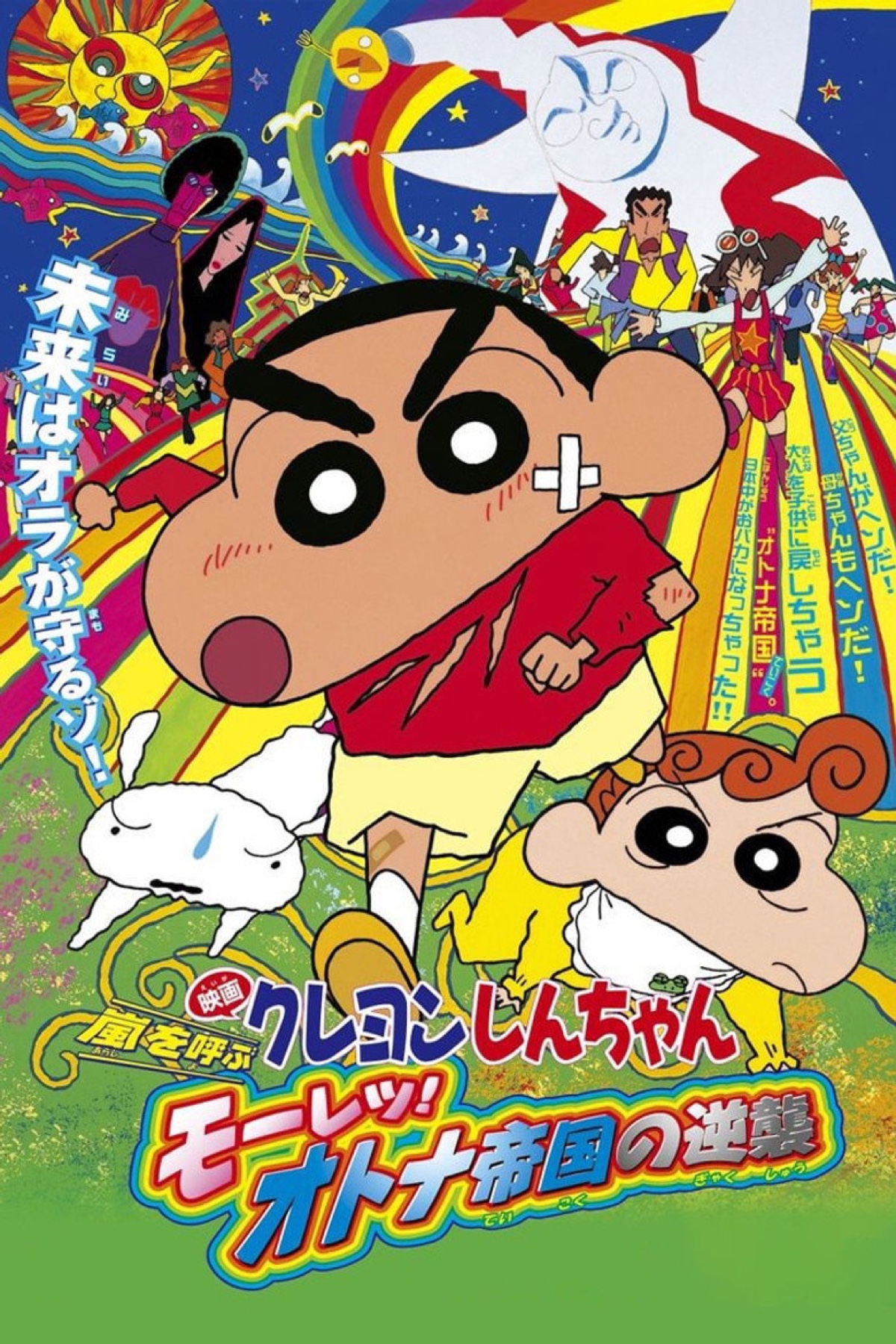
📖 Synopsis, No Spoilers
A theme park called Twentieth Century Expo opens in Kasukabe, the ordinary Saitama commuter town where the Nohara family lives. It reconstructs Japan around 1970 in exhaustive detail: the streets, the shopfronts, the television, and above all the smell of the period. Adults walk in and something in them lets go.
Hiroshi and Misae go back day after day. Then the adults of Japan begin abandoning their households wholesale to live inside the reconstruction, and the country is left to its children. Shinnosuke and his friends set out to retrieve their parents from the organization running the park, a pair called Ken and Chako who operate under the name Yesterday Once More. What the film is actually asking is whether an ordinary adult life is worth choosing over a perfect childhood, and it does not treat the answer as obvious.
✨ What Makes It Special
Why It Is Exceptional
- A wordless montage of one unremarkable man’s life, and it is devastating
- It interrogates nostalgia four years before Japan’s nostalgia boom began
- Villains who never threaten anybody and are frightening anyway
- Slapstick and dread sharing scenes without either one collapsing
Hiroshi’s flashback, which has no dialogue at all
Hiroshi has been regressed to childhood along with everyone else. What brings him back is his son shoving a shoe under his nose, because Hiroshi’s feet smell, and the smell is the one thing in his adult life that nobody could mistake for anyone else’s. It is a fart joke, structurally. It is also the hinge of the film.
What follows is several minutes of his life with no spoken words: riding behind his father on a bicycle, a first crush, the move to Tokyo, the job, the disappointments, meeting Misae, the wedding, a baby. Music and image only. Japanese audiences have been calling this the best sequence in the franchise for twenty-five years and it is not a sentimental overrating. The montage works because it refuses to select for highlights. Most of what it shows is unremarkable, which is the argument.
There is a layer here that only lands from inside Japan now. Keiji Fujiwara, who voiced Hiroshi from the beginning, died in 2020 at fifty-five. For a Japanese viewer of my generation his voice is simply what a father sounds like, and rewatching this scene after 2020 is a different experience than it was before. That is not something a subtitle can hand over.
I am conscious that I have just spent three paragraphs on a scene triggered by foot odor, and that this is a hard sell. The film knows it too, and does it anyway, and the collision of the stupid and the enormous is exactly why it works rather than a flaw it survives.
It saw the nostalgia industry coming
The park is built around the Japan of the 1970 Osaka Expo, the moment this country decided the future had arrived. Ken’s explanation of the design is the sharpest line in the film: sunset makes people look backward, so the town is kept at permanent dusk. That is a complete account of how nostalgia is manufactured, delivered by a villain, in a cartoon aimed at six-year-olds.
Timing matters here. Always: Sunset on Third Street, the film that kicked off Japan’s commercial Showa-nostalgia boom, arrived in 2005. This came out in 2001 and had already worked out what the appeal was and where it goes wrong. And the wheel turned again last year: Osaka hosted another World Expo in 2025, sold in part on memories of 1970. The thing the film warns about is currently for sale.
The position it takes is not that looking back is contemptible. Ken and Chako are treated with real sympathy, and the film concedes that what they are offering is genuinely better than what the adults are choosing to return to. The claim is narrower and harder: the past is safe because it is finished, and a finished thing cannot be lived in.
The villains never threaten anyone
Ken and Chako do not coerce. They ask whether you remember, and whether things were not better then, and the adults walk into the park on their own legs. Masane Tsukayama and Ai Kobayashi play them quietly and a little sadly, as people who lost an argument with the twenty-first century rather than as antagonists.
The early stretch where parents drift away from their own children is genuinely unpleasant to watch, closer to horror than to family animation, and the film gets there without a single raised voice. Keiichi Hara directs the register changes so precisely that a school-bus car chase and a scene of a child realizing his mother is gone can sit ten minutes apart.
Deeper Themes
Hiroshi’s defense of his own life is specific rather than abstract, and the specifics are Japanese: a thirty-five-year mortgage, a packed commuter train twice a day, bowing to a superior he does not respect. That is the life he is asked to trade away, and it is not obviously the better offer.
What the film puts opposite it is not achievement but obligation. He has people who need him tomorrow, and the past does not. It is a modest argument for staying, and the reason it holds is that the film never pretends the alternative is worthless.
🎭 Memorable Scenes
My life is not boring! I have got a family, and I would hand you some of that if I could!
Loosely translated by me, since there is no official English version to quote from. Ken has just told Hiroshi that his life amounted to nothing much, and this is the answer, shouted by a salaryman with a mortgage and no accomplishments to point at. It is the line Japanese fathers bring up, and the reason this film has the standing it does here.
The other one belongs to the five-year-old. Dragging himself up an endless staircase, Shinnosuke yells that he wants to grow up so he can go out with lots of pretty women. It is crude and it is the whole counterargument: the future is worth having because you want things from it. Coming from anyone older it would be unbearable. Coming from him it lands.
💭 How It Made Me Feel
It made me want to phone my parents, which is not a reaction I get from animation often. The mechanism is straightforward once you notice it. The montage forces you to apply the same treatment to the adults you grew up with, who were also once children with plans, and who also ended up somewhere ordinary and stayed.
The line I came away with is that beautiful memories of the past exist because there is a present to look back from. Both halves of that matter, and the film gets there without asking anyone to renounce anything.
Who Should Watch This?
- Parents, who will find themselves handled with unusual respect
- Anyone in their thirties who has started saying that things used to be better
- Viewers who want to see how far a comedy franchise can be pushed
- Anyone standing at a decision between what was and what is next
😅 Where It Falls Short
How much of this survives the border
The honest problem for a foreign viewer is that the nostalgia is not generic. It is aimed at Japanese adults who were children around 1970, and the specific objects doing the work, the shopfronts and the television and the Expo, will read to an American as period detail rather than as memory. The scaffolding is universal and the emotional payload is local, so expect to understand a portion of it from the outside rather than feel it.
Ken and Chako are also underwritten. The film establishes what they want and gives them dignity, and it never explains what broke them, which leaves the most interesting pair on screen thinner than they should be. The opening is slow too. The transformation of the adults is drawn out further than a young audience will sit through, which is a strange miscalculation in a film for children.
None of that changes the standing of the thing. These are the complaints you make about a film you rate at the top, and I would rather list them than pretend the crossing is frictionless.
The Weak Points
- The nostalgia is specifically Japanese and travels only partway
- Ken and Chako are given motive but no history
- The first act takes too long over the adults changing
Who Might Not Enjoy This?
- Anyone who cannot get past the deliberately crude character art
- Viewers expecting spectacle, since the animation is television-scale
- People with no interest in mid-century Japan at all
📺 Streaming Guide by Service
What an American viewer can actually do
Not much, and I would rather say that than pad this section. There is no US licence, so there is no service to sign up for and no disc to order that comes with subtitles. Anyone telling you otherwise is describing a fan copy.
Two things are worth doing. The first is to watch the rest of Keiichi Hara’s work, which did travel: Miss Hokusai came out in the US through GKIDS, and Colorful has circulated in the West as well. Both show the same director putting adult weight into a form nobody expects to find it in. The second is to keep an eye on Netflix, since the film already sits in that catalog in two countries and the only thing between it and an American audience is a signature.
If you do end up seeing it somehow, watch it with a parent if you can. It is built for that and it changes the film considerably.
The State of Play
- United States: nothing. No subscription, rental, purchase or subtitled disc
- Japan: Netflix, Prime Video, Hulu and U-NEXT, all flat-rate
- Discs: the Japanese Blu-ray is Region A and will play in the US, without English subtitles
Soundtrack
The official score has never been put on streaming and exists on CD only, which is normal for Japanese films of this vintage and this budget tier.
The cue from the flashback sequence is the one people look for, and cover versions of it are on Spotify and Apple Music if you want to hear what the scene sounds like without the pictures.
📚 The Source Manga
Yoshito Usui’s manga ran from 1990 until his death in 2009. The films are original stories rather than adaptations, so the manga is background rather than the source of this plot.
English volumes were published years ago and are only available secondhand now. Worth knowing that the manga is much broader and cruder than this film, so it is a poor guide to what you would be getting here.
🎬 If You Loved The Adult Empire Strikes Back, Watch These 3 Next
Up (2009)
The closest thing in Western animation, and the resemblance is structural rather than tonal. Both open a family film with a silent montage of an entire life, and both are about an adult who would rather stay with what is gone. Released eight years later, and reachable from anywhere, which this film is not.
👉 Read our review of Up (2009)
My Neighbor Totoro
The other side of the same coin. Miyazaki built a loving reconstruction of rural Japan in roughly the era this film is nostalgic about, and it is precisely the kind of object Twentieth Century Expo is selling. Watch them together and the second one complicates the first in a useful way.
👉 Read our review of My Neighbor Totoro
A Letter to Momo
Family animation from Japan that takes a child’s grief seriously and refuses to resolve it cheaply. Broad comedy sits next to real loss here in the same way, and it makes a good next step if what you valued was a children’s film declining to talk down.
👉 Read our review of A Letter to Momo
The Warring States film is the other Keiichi Hara entry that adults cry at, and it does it inside a period drama. 👉 Read the The Battle of the Warring States review
📝 Final Thoughts
A children’s cartoon about a boy who moons people contains the most persuasive defense of an unremarkable adult life that Japanese animation has produced. That sentence sounds like a bit, and it is simply what the film is. Keiichi Hara took a franchise nobody was watching for meaning and put a whole argument inside it, and the argument holds up twenty-five years later.
The frustrating part is the one I opened with. This is the most exportable idea in the franchise, and it is the film English speakers cannot reach. If a licensor is reading, the property is sitting on Netflix in two countries already. In the meantime, the sensible thing is to know it exists, because eventually somebody will pick it up.
⭐ Film at a Glance
| Category | Rating | Comment |
|---|---|---|
| Writing | ★★★★★ | An argument disguised as a school holiday movie |
| Direction | ★★★★☆ | Register changes handled without a seam |
| Music | ★★★★★ | Carries the flashback on its own |
| Characters | ★★★★★ | Hiroshi is the best father in Japanese animation |
| Emotional impact | ★★★★★ | Reliably takes out grown adults |
| Travels abroad | ★★☆☆☆ | Locally aimed, and legally unavailable in the US |
Usagi’s Recommendation Score
⭐⭐⭐⭐⭐⭐⭐⭐⭐☆
8.6 / 10
Watch this the next time you catch yourself saying things used to be better.

