*This page contains affiliate links. We may earn a commission if you make a purchase through these links.
Somewhere in the second half of this film, a man says quietly that he has spent his entire life being careful never to fail, and that being careful has left him with nothing. He is not the villain of the picture. He is the older brother, he runs the family gas station, and he is the most ordinary person on screen.
The younger brother is a photographer in Tokyo who comes home for a memorial service and finds the whole arrangement faintly beneath him. I think Sway is one of the finest Japanese films of its decade. I also have no appetite for watching it a second time. By the end of this piece I hope both of those statements will make sense together, because they are the same statement.
📺 Where to Watch Sway (August 2026)
| Service | Status | Notes |
|---|---|---|
| Netflix | Not available | Absent from the US catalog |
| Amazon Prime Video | Not available | No US rental, no US purchase |
| Hulu | Not available | No US listing |
| The Criterion Channel | Not available | Cannes pedigree, still no listing |
| Kanopy / Hoopla | Unconfirmed | Library catalogs vary by system |
| KimStim DVD, 2008 | The one English route | English subtitles, out of print |
As of August 21, 2026, no US service streams, rents, or sells this film. I pulled the US provider list on the day of writing and it came back completely empty, which is rarer than it sounds. Most obscure Japanese titles at least turn up as a digital purchase somewhere. This one does not.
What does exist is a disc. KimStim put out an English-subtitled NTSC DVD for the US market on October 28, 2008, and as far as I can establish it is the only English-subtitled edition ever released in America. It has been out of print for years, so the practical route is a used copy. The alternative is the Japanese DVD, which also carries English subtitles and is easy to order from the import shops. Details on both are further down.
One honest caveat on the table above. Kanopy and Hoopla build their catalogs library by library, so I cannot rule either of them out for your particular card the way I can rule out Netflix. If you have access to either, it costs nothing to search. Everything else on that list I checked directly.
🎬 Trailer
A word about what you are watching. The film is from 2006 and the original theatrical trailer never made it onto an official channel that still exists, so there is no English trailer to show you. The clip above is from Bandai Namco Filmworks, the company that released the Blu-ray, and it pairs footage with newly recorded comments from Joe Odagiri and director Miwa Nishikawa. It is in Japanese with no subtitles. This site will not embed a fan re-upload just to have something with English text on it, and the English-subtitled trailers floating around YouTube are all exactly that.
Work Info
- Title: Sway, released in Japan as Yureru
- Released: July 8, 2006. 119 minutes
- Original story, screenplay, direction: Miwa Nishikawa
- Starring: Joe Odagiri, Teruyuki Kagawa, Yoko Maki, Masato Ibu, Keizo Kanie
- Music: Cauliflowers. Theme song: Uchi ni Kaerou
- Official selection, Directors’ Fortnight, 59th Cannes Film Festival. The only Japanese film in it that year
- Nishikawa’s second feature, after her debut Wild Berries
📖 Synopsis, No Spoilers
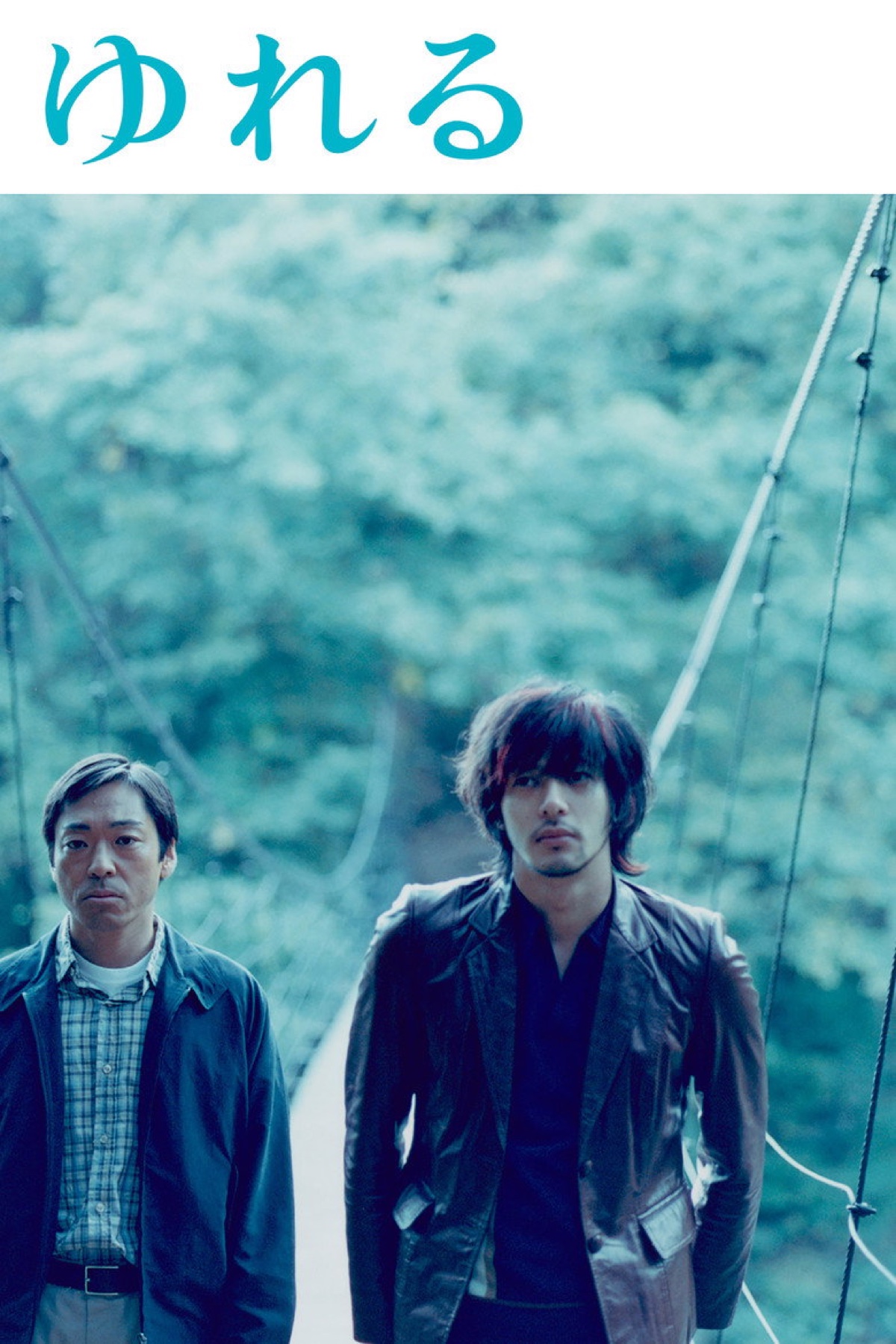
Takeru Hayakawa is a successful photographer in Tokyo. He comes back to his rural hometown for the first anniversary of his mother’s death, arrives late, and irritates his father within about ninety seconds. His older brother Minoru has stayed put and taken over the family gas station. Working alongside Minoru is Chieko, a woman Takeru used to know well.
The three of them drive out to a gorge the next day. Takeru wanders off to take photographs. While he is gone, Chieko falls from the suspension bridge that crosses the ravine, and the only person near her is Minoru. Was it an accident. Was it something else. A trial begins, and Takeru finds himself in a courtroom looking at a version of his brother he has never met.
Some context that the film assumes and Western viewers may not. The event that drags Takeru home is a hoji, a Buddhist memorial service held on the anniversary of a death. The first-anniversary one is close to mandatory. Scattered families come back to the house, sit through a priest’s sermon, and eat together, whether or not anybody wants to. It is the single most reliable engine in Japanese domestic drama, because it puts people who have arranged their lives to avoid each other in the same room by obligation.
✨ What Makes It Special
Why It Is Exceptional
- Teruyuki Kagawa playing a man failing to keep something down
- A mystery that never tells you what happened on the bridge
- Joe Odagiri taking the least likeable part in the film
- Rivers, rope bridges, a swing set. Everything in frame is moving
Kagawa, and the acting of things that get out
Minoru is introduced as a plain, decent, slightly dull man. He works the pumps at the station his father handed him. He is unmarried, he lives in the family house, he does not raise his voice. On the surface there is nothing else to him, and the film is content to let you believe that for a good while.
What Kagawa is actually doing underneath is much harder than it looks. Something the character is working to keep down keeps getting out anyway, against his will. His smile when his brother arrives lands about half a second late. His agreement noises turn very slightly careless. The speed at which he walks away from a conversation changes. None of these are performances of an emotion. They are performances of a man losing a small, continuous argument with himself, and Kagawa sustains that for the entire running time without once signposting it.
That groundwork is why the middle of the film works. When a different person stands up in the courtroom, it does not read as a twist or a switch. It reads as somebody who was there the whole time finally stepping forward. Every unremarkable moment in the first forty minutes was load-bearing. Watch it once and the early scenes are texture. Think about it afterwards and they are all evidence.
Malice would be far easier to sit with. What surfaces here is something more awkward and more ordinary: the sediment that collects between two people who are stuck with each other. What the one who stayed has been carrying. What the one who left has been declining to notice. One accident lifts the lid on all of it. This is the layer of the film that has nothing to do with the mystery plot at all.
For a sense of how this landed at home: Kagawa took essentially every supporting actor prize going that season. Hochi, Blue Ribbon, Kinema Junpo, an Academy Prize nomination in Japan, and Best Actor outright at the Yokohama Film Festival. Awards sweeps are usually noise. This one was the industry agreeing on the same thing at once.
The film never says what happened on the bridge
Structurally this is a mystery. Was the fall an accident, or was there intent behind it. A trial convenes, testimony accumulates, and Takeru goes back over his own memory of that day again and again looking for the frame he missed.
The verdict arrives. The answer does not. The film hands the judgment to you instead, and it is not gracious about it. Your sympathies get flipped repeatedly on the way there. There are long stretches where the older brother is plainly the wronged party, and then long stretches where the younger one is, and the two readings do not reconcile. Which brother you decide to believe changes what film you just watched.
The final scene is where this pays off, and it is the single most argued-over thing about the picture in Japan. Interpretations split cleanly, and what makes it work is that more than one of them holds up under pressure. If you need a film to confirm which reading was correct before the credits, this will annoy you enormously. I think it is close to a perfect closing move, and that is all I intend to say about it.
One more thing worth flagging, because it is easy to miss on a first pass. The film keeps putting things that move into the frame. The river running through the gorge. The rope bridge underfoot. A swing set. Individually each is just a location detail placed without comment. Cumulatively you start noticing that almost nothing in this movie is standing still. The bridge itself is real, by the way. It is Mikura Bridge in Tsunan, Niigata Prefecture, and you can walk across it. Most of the rest of the film was shot in Fujiyoshida, Yamanashi.
Odagiri, playing the man you want to slap
Takeru wears the leather jacket, drives the vintage American car, and sells photographs in Tokyo. Back at the house he is mildly bored by the family, by the town, and by his brother’s life, and he does not work very hard to hide any of it. He looks tremendous and behaves badly for most of the film.
What stops this from being a simple portrait of a jerk is that the charm and the selfishness are running on the same face, so you never get to write him off. You settle in on the brother’s side, and then twenty minutes later you have quietly started agreeing with Takeru, and then the film pulls you back. In 2006 Odagiri was already a star who could have taken the sympathetic part in this script. He took the other one.
Deeper Themes
The subject underneath the trial is what a sibling actually is. Friendships end. Marriages end. A brother is a permanent condition, which means the two of you can damage each other badly without the relationship being over, and then carry on in that damaged state for another forty years. The film treats that permanence as weight rather than comfort, and it is unusual for a film to be that unsentimental about family without turning cruel.
There is also the town itself. One brother left, one stayed. Japanese cinema has been working that seam for decades, and Sway is unusually even-handed about it: neither leaving nor staying is presented as the correct answer, and both men are carrying a bill for the choice they made.
🎭 Memorable Scenes
Nishikawa wrote an essay about making this film, and Words Without Borders published Linda Hoaglund’s English translation of it in 2011. It is free to read, and this line from it explains the whole architecture of the picture:
By binding these characters with the chains of brotherhood, I made it so they could never flee from each other, no matter how great their anguish.
Miwa Nishikawa, Director’s Notes on Sway, translated by Linda Hoaglund
The same essay reveals where the film came from. She dreamed that a friend of hers might have killed someone, and what horrified her on waking was not the crime but her own reaction to it, which was to worry about what the association would do to her future. She threw out a year of work on a different screenplay and spent nearly two years writing this one instead.
As for scenes: two carry more than their share. The first is the priest’s sermon at the memorial service, near the top of the film, before the plot has started. People weep over things they only imagined they saw, he says, and weep again over the things in front of them that they failed to see, and they do this their whole lives. It sounds like filler on a first viewing. Everything that happens in the following 119 minutes is contained in that passage. The answer is handed over before the question is asked.
The other is the one I opened with, the older brother’s admission that a lifetime of not failing has produced nothing worth having. Cinema is full of people wrecked by their mistakes. It has very little to say about the person who made no mistakes at all and finds the account empty anyway. That confession cuts deeper than any tale of ruin, and it is delivered almost as an aside.
💭 How It Made Me Feel
Shaken is an overused word for this kind of film, but here it is the literal description of the effect. The feeling does not travel in one direction and settle. It gets pushed left, then right, then left again, and the film ends while it is still moving. The older brother is at fault. No, the younger one is. No, neither of them is. No, one of them definitely is. None of those land, and then Cauliflowers’ theme song starts over the credits.
Which is, I have come to think, the actual meaning of the title. The thing swaying is not only the bridge, or the brothers. It is the person in the chair.
The blood tie cannot be cut. This film declines to treat that as reassurance and treats it as load instead. You cannot get free, so hurting each other does not conclude anything, and the relationship simply continues in its damaged condition. If you have a brother or a sister, the film has a lever on you that it does not have on everybody, and it uses it.
Who Should Watch This?
- Anybody with a brother or a sister. This one is aimed straight at you
- People who left the town they grew up in, plus the people who stayed
- Viewers who prefer a film that refuses to resolve itself
- Anyone who came to Japanese cinema through Kore-eda’s family dramas
😅 Where It Falls Short
Too effective to go back to
I have been calling this a masterpiece for a while now, so here is the thing that stops me short of handing it to everybody. This is not a film to put on when you are tired.
Look for craft faults and you will come up short. I cannot point at a bad scene, a slack stretch, or a performance that misses. The problem is entirely on the other side of the screen. Nearly two hours of people envying each other, covering for each other, betraying each other, and being unable to walk away from each other takes something out of you. The aftertaste is heavy enough that you are not going to queue up a second film that evening.
So the honest verdict is awkward. It is not that the film is too weak to revisit. It is that it works too well to revisit. That reads as praise, and it is, but anybody recommending this to you owes you the warning as well. This is not a film for all comers, and I am not going to pretend otherwise to make the score look tidier.
The second caveat is smaller. Nishikawa herself apparently felt the weight while writing it. In that same essay she describes scolding herself mid-process, remembering that she had set out to make a gentle, happy film this time. She did not.
The Weak Points
- One viewing is enough to keep you away from a second for a long time
- The truth is never confirmed, which will frustrate puzzle-solvers
- No US streaming route exists, so getting hold of it is work
Who Might Not Enjoy This?
- Anybody who needs a clean, settled ending
- Viewers looking to unwind after a hard day
- People who want a courtroom film to deliver a courtroom verdict
📺 Streaming Guide by Service
How to actually get hold of this film
There is no subscription answer here, so this section is a shopping guide rather than a streaming one. Two routes work, and one of them is better than the other.
The KimStim DVD from October 2008 is the American release. English subtitles, NTSC, widescreen, one disc, no rating. It is out of print, so you are looking at the used market, where copies surface regularly enough. The second route is the Japanese DVD, which also carries English subtitles and is stocked by the usual import retailers. Japanese Blu-ray discs are Region A, the same region as the United States, so a Japanese disc will play on an American player. Do check the subtitle listing before you buy, because the Japanese Blu-ray edition is sold primarily to a domestic audience.
If you want to sample Nishikawa before committing money to a disc, her later film Under the Open Sky reached international audiences far more widely than this one ever did, so it is the likelier of her titles to turn up somewhere you can reach.
The Available Routes
- DVD listings on Amazon US: the 2008 KimStim disc, English subtitles, used copies only
- Import shops such as CDJapan carry the Japanese DVD, also English-subtitled
- No US subscription service carries the film, so there is nothing to link here
- Free to read in English: Nishikawa’s own essay about the film
Soundtrack
The score is by Cauliflowers, and the theme song Uchi ni Kaerou, which translates roughly as Let’s Go Home, was written for the closing sequence. A ten-track soundtrack album including two solo piano pieces came out in Japan in July 2006.
Worth noting how restrained the music is. For most of the film there is barely any, which is what makes the theme song landing over the final images do as much work as it does. A decent slice of the aftertaste this film leaves is that song’s doing.
📀 The Novel, and How Japan Rated This
Nishikawa wrote a novel version of Sway herself, published by Poplar in 2006, and it was shortlisted for the Mishima Yukio Prize the following year. Separately, her screenplay won the Yomiuri Prize for Literature in the drama and screenplay category. Film scripts do not normally get taken seriously as literature in Japan, and this one did, twice. There is no English edition of the novel.
The Japanese Blu-ray, issued in January 2021, adds a newly filmed conversation between Odagiri and Nishikawa looking back at the film. Given how much of the discussion around this picture is argument about what the ending means, hearing the two of them revisit it is genuinely worth having. That extra is Japan-only.
🎬 If You Loved Sway, Watch These 3 Next
Cure
Kiyoshi Kurosawa, 1997. Sway withholds one fact, the one about the bridge. Cure shows you who the killer is almost immediately and then withholds every reason, so you finish it with nothing settled at all. The specific unease afterwards is the same species. If the appeal here was a Japanese film that will not close the loop for you, this is the harder version of that.
Bright Future
Kurosawa again, 2003, three years before Sway, with Joe Odagiri as an unreadable young man drifting through Tokyo. The blueprint for Takeru’s selfishness is here in a rawer, less decorated form. Where Sway examines the wreckage after an incident, this one stretches out the discomfort of a long stretch where something feels about to happen and keeps not happening. No trailer is embedded above because every English-subtitled version online is a personal upload, which this site does not use.
👉 Read our review of Bright Future
Harmful Insect
Akihiko Shiota, 2002, with Aoi Miyazaki as a thirteen-year-old who stops attending school after her mother attempts suicide. She explains almost nothing about her own situation, and with the dialogue stripped that far back, the edges of an ordinary life come away in a face walking through a town in a school uniform. There is no villain anywhere in its 92 minutes. Things get worse regardless, which is also true of Sway.
👉 Read our review of Harmful Insect
One more, if you want a companion piece rather than a follow-up. Shinji Aoyama’s EUREKA also films only the people left standing after an incident, and takes three hours and thirty-seven minutes to do it. Sway looks brisk beside it. The hands are similar.
📝 Final Thoughts
Nishikawa shot this without protecting anybody in it. She does not take the older brother’s side, she does not take the younger one’s, and she keeps both accounts on the table for the full 119 minutes. The job of judging was assigned to the audience from the start, and the evidence handed over is deliberately insufficient. That she did this on her second feature is the part that still looks alarming twenty years on.
Some context for how far that reached. Every film company Nishikawa applied to out of university turned her down. The one person who saw something in the interview was Hirokazu Kore-eda, then at TV Man Union, who brought her onto the crew of After Life as freelance staff, and she worked her way up through other people’s sets from there. With Sway she became the first woman in Japan to take Best Film and Best Director at awards of this rank, which is a sentence that should have been written decades earlier than 2006.
Remember the two claims I opened with, the masterpiece and the no-second-viewing. They were never in tension. This film chooses its day and it chooses its viewer, and I am not going to hand it to everybody. But if the question is which Japanese films of the 2000s were genuinely great, this one is on the list without argument. The closer you are to a sibling, the more it costs. That cost is also why the last scene stays with you as long as it does.
American readers get the short end here, and I am aware of the irony of writing several thousand words about a film I cannot point you at. Hunt down the KimStim disc if you are serious. In the meantime, Nishikawa’s essay is free, it is four pages, and it tells you exactly what she was trying to build.
⭐ Film at a Glance
| Category | Rating | Comment |
|---|---|---|
| Story | ★★★★★ | Two brothers, one fall, no exit |
| Performances | ★★★★★ | Kagawa swept every supporting prize that year |
| Direction | ★★★★☆ | Withholds the answer on purpose |
| Screenplay | ★★★★★ | Won a literary prize, unusually for a script |
| Music | ★★★★☆ | Sparse, then the theme song lands |
| Rewatch value | ★★☆☆☆ | Effective enough to be exhausting |
| Broad appeal | ★★☆☆☆ | Wrong film for a tired evening |
Usagi’s Recommendation Score
⭐⭐⭐⭐⭐⭐⭐⭐☆☆
8.6 / 10
119 minutes that cost more the closer you are to a sibling. Go in ready for the ending to be argued about.

 streams nowhere in the US. Here is the only English-subtitled route, plus why Mi)