*This page contains affiliate links. We may earn a commission if you make a purchase through these links.
“O-genki desu ka. Watashi wa genki desu.” How are you? I am fine. In Japan, plenty of people know that line before they ever see the film, as a woman shouting it into a field of snow. It comes from Love Letter (1995), the first feature film by Shunji Iwai, and both of the women at the center of the story are played by the same actress, Miho Nakayama.
I will say my position up front, because the whole review leans on it. What stayed with me most was the white of the snow in Otaru and Nakayama standing in the middle of it. I think this film became a classic because of Miho Nakayama. Below: where US viewers can (and cannot) watch it right now, a who’s who chart for the two women with one face and the two characters named Itsuki Fujii, whether to see Last Letter first, and why the film is still finding new viewers thirty years on.
📺 Where to Watch Love Letter (October 2026)
| Service | Status | Notes |
|---|---|---|
| Netflix (US) | Not available | No listing |
| Amazon Prime Video (US) | Not available | No stream, no rental |
| Hulu | Not available | No listing |
| HBO Max | Not available | No listing |
| Apple TV | Not available | A US page exists, with nothing to buy yet |
| Crunchyroll | Not available | Not in its catalog |
| Film Movement home release | Not available | Dated December 11, 2026 |
| Japanese services | Japan only | U-NEXT streams the 4K version; Prime Video Japan streams it too |
As of October 20, 2026, Love Letter is not available from any American service, not even as a rental. I checked both TMDB and JustWatch for the US on that date, and neither listed a single offer. That should change soon. The US distributor Film Movement opened its new 4K restoration in a limited North American theatrical run on June 5, 2026, and Film Movement’s page for the film gives a “Watch at Home” date of December 11, 2026. It does not yet say which services will carry it. Apple TV already has a US page for the film, but it had nothing on sale when I looked. Availability changes, so check the services yourself before you plan a viewing.
In Japan it is easy to see: U-NEXT streams the 4K remaster made for the 30th anniversary in 2025, and Prime Video Japan includes it with Prime. Neither reaches a US account. If you want something from the same director to watch tonight, All About Lily Chou-Chou, which Iwai made six years later, streams free in the US. Instead of white snow, the screen fills with green rice fields and the pain of being fourteen.
🎬 Trailer
The 4K Restoration Trailer from Film Movement’s official channel, made for the 2026 North American release.
Work Info
- Title: Love Letter (the Japanese title is also Love Letter)
- Released: March 25, 1995 (Japan). 4K remaster: April 4, 2025 (Japan), June 5, 2026 (North America, Film Movement Classics)
- Director and screenplay: Shunji Iwai (his first feature film)
- Cast: Miho Nakayama (dual role), Etsushi Toyokawa, Miki Sakai, Takashi Kashiwabara, Bunjaku Han, Katsuyuki Shinohara, Mariko Kaga
- Cinematography: Noboru Shinoda
- Music: REMEDIOS (the name singer-songwriter Reimy uses for her film work)
- Runtime: 117 minutes
- Source: TMDB
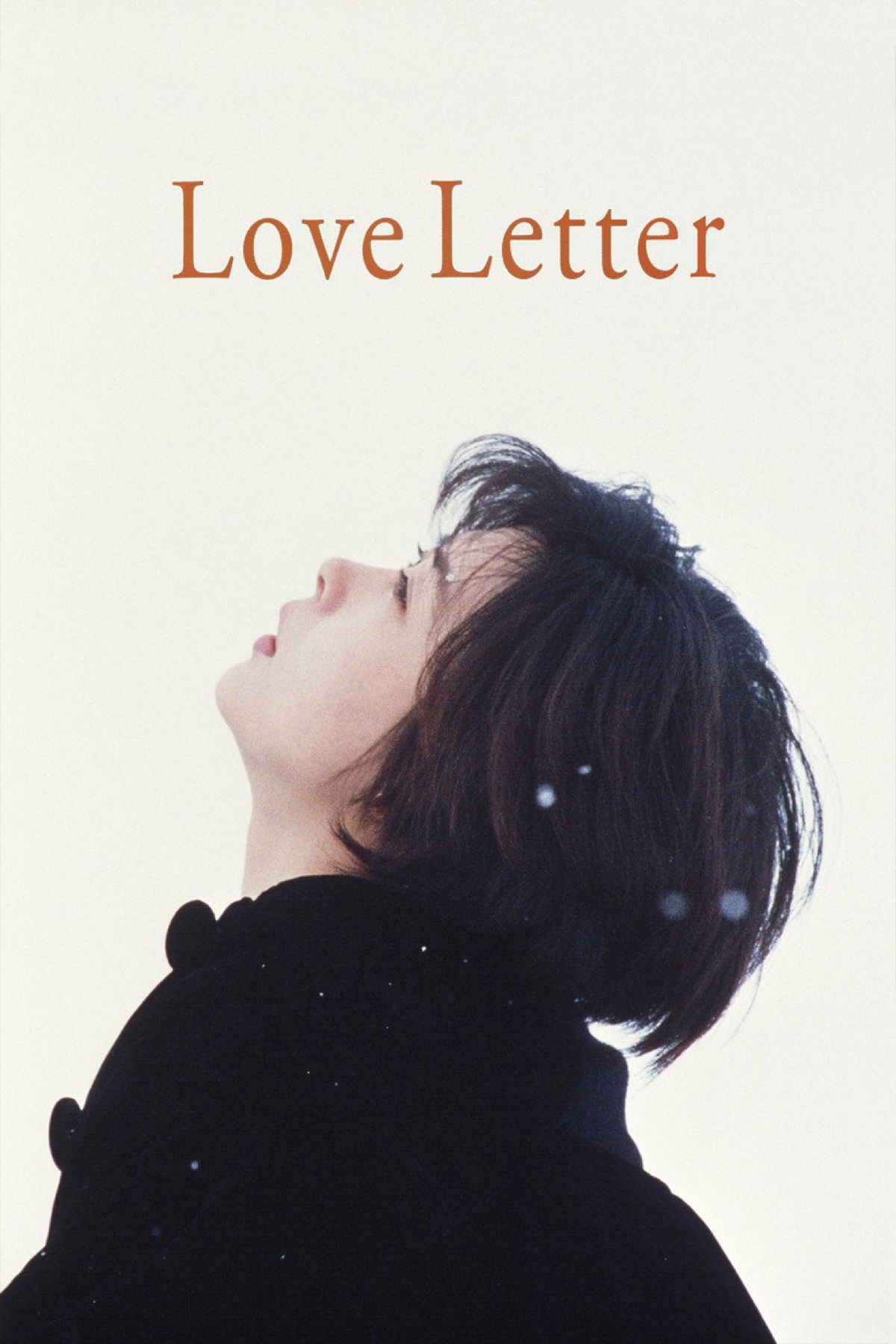
📖 Synopsis – No Spoilers
Hiroko Watanabe (Miho Nakayama) lives in Kobe. Two years ago, her fiancé, Itsuki Fujii, died in a mountain-climbing accident. After the memorial service, she stops by his family’s home, and his mother shows her his junior high school yearbook. In it is the address where he lived as a boy in Otaru, a snowy port town in Hokkaido. She is told the house is gone and the spot is a road now. She writes to him anyway: “How are you? I am fine.”
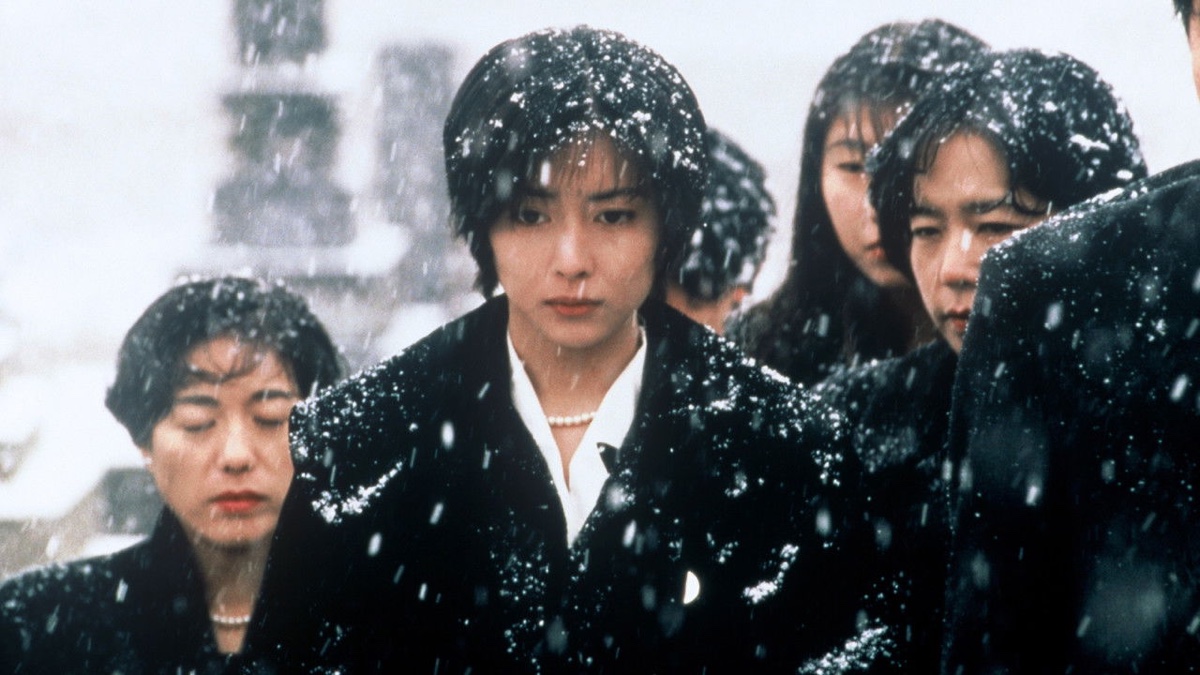
A letter that should go nowhere gets an answer. It comes from Otaru, from someone named Itsuki Fujii. But this Itsuki is a woman who works at the town library (also Miho Nakayama). She shared his name and was his classmate in junior high. As the letters go back and forth, the two women start piecing together the memory of one boy.
🗺️ Love Letter Who’s Who: Two Miho Nakayamas and the Itsuki Who Is Gone
The relationships are not complicated. The trouble is that two characters share one name, and two share one face, so the first half hour can get confusing. Here is everyone as they stand when the story begins.
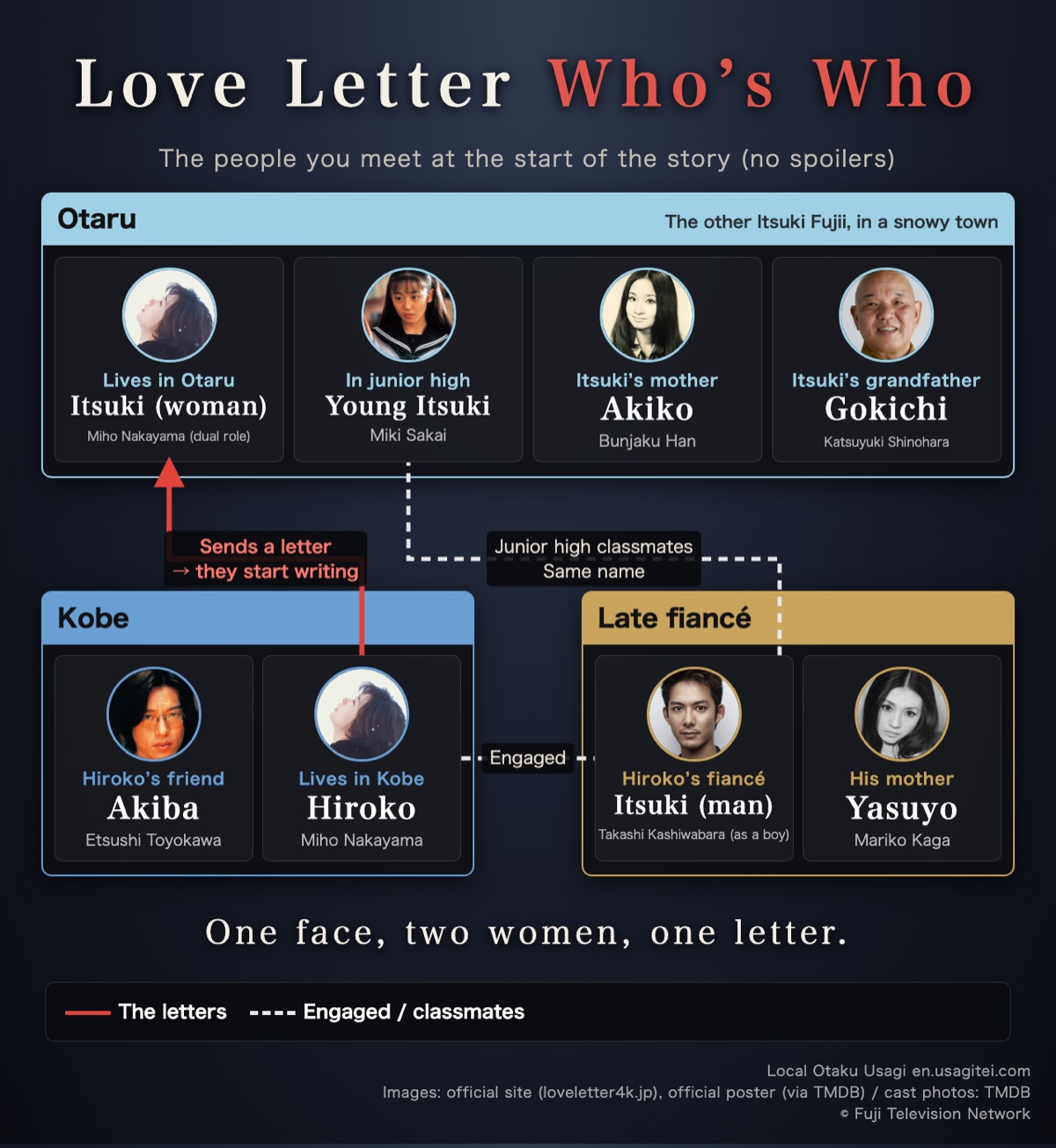
| Character | Cast | Who they are |
|---|---|---|
| Hiroko Watanabe | Miho Nakayama | Lives in Kobe. Cannot let go of her fiancé, Itsuki Fujii, who died in the mountains |
| Itsuki Fujii (the woman) | Miho Nakayama | Lives in Otaru, works at the library. Receives Hiroko’s letter |
| Itsuki Fujii (the man) | Takashi Kashiwabara (as a boy) | Hiroko’s late fiancé. The woman Itsuki’s classmate in junior high |
| Young Itsuki (the woman) | Miki Sakai | The woman Itsuki in junior high, stuck in a class with a boy who has her name |
| Shigeru Akiba | Etsushi Toyokawa | Hiroko’s friend, the late Itsuki’s climbing partner. Works at a glass workshop |
| Akiko Fujii | Bunjaku Han | The woman Itsuki’s mother |
| Gokichi Fujii | Katsuyuki Shinohara | The woman Itsuki’s grandfather |
| Yasuyo Fujii | Mariko Kaga | The late Itsuki’s mother. Shows Hiroko the yearbook |
The one thing to hold on to: the Itsuki at the center of the story is already dead. You only ever see him through Hiroko’s memories and the junior high scenes the other Itsuki digs up. The people he left behind rebuild him, a letter at a time. That is what this film is about.
✨ What Makes It Special
Why It’s Exceptional
- When it ends, you want to read the title again
- The mystery of the letters is solved early, and then the real story starts
- Soft white light on a snowbound Otaru
- Miho Nakayama’s dual role turns into the story’s pain
Hiroko’s letter was a long detour
Anyone starting the film will assume the “love letter” of the title is the one Hiroko writes. Most of the story does run on her letters. Then, at the end, a completely different letter arrives. It isn’t written on stationery. It is a single library card from the junior high school library. What is on the back of it, I am not going to tell you.
Looking back, the first letter Hiroko mailed turns out to have been a long detour toward delivering that one card. She never knows it, and she finishes carrying something other than her own letter. Read the title again after the credits and it points at something else. The 117 minutes exist to make that switch.
That is also why the film turns into a different film once you know the ending. Things you never noticed the first time start showing up all over the junior high scenes: an exchange in the classroom, the window seat in the library, an idle doodle. The better you know the ending, the more the quiet early scenes stop you.
The mystery ends early, and the two women’s story begins
Why would a letter to a dead man get a reply? The film doesn’t milk it. The answer (a classmate with the same name) comes fairly early.
The real subject starts there. Hiroko wants to know the boyhood her fiancé never showed her. The woman Itsuki, who had forgotten most of junior high, has to dig it back up to answer the letters. It wears the face of a mystery only at the door; inside, it is two women each facing their own memories.
Soft white light on a snowbound Otaru
The cinematographer is Noboru Shinoda. A handheld camera follows people slowly, and the winter light wraps softly around their faces. The film is already beautiful in its long opening shot, where Hiroko, lying on a snowy slope, gets up and walks back toward town. Frozen streets, white breath, the library curtain filling with wind. What stayed with me, before any of the plot, was that whiteness.
Deeper Themes
Everyone in this film traces the past through old paper. Letters you wait days to hear back from, yearbooks that print every student’s home address: none of that is coming back. Proust’s In Search of Lost Time turns up at an important moment, too. Hiroko and Itsuki are both tracing lost time through old paper, so the Proust title is not decoration. And don’t forget that the film opens on a memorial service. It is a love story, and it is also a film about mourning.
🎭 Memorable Scenes
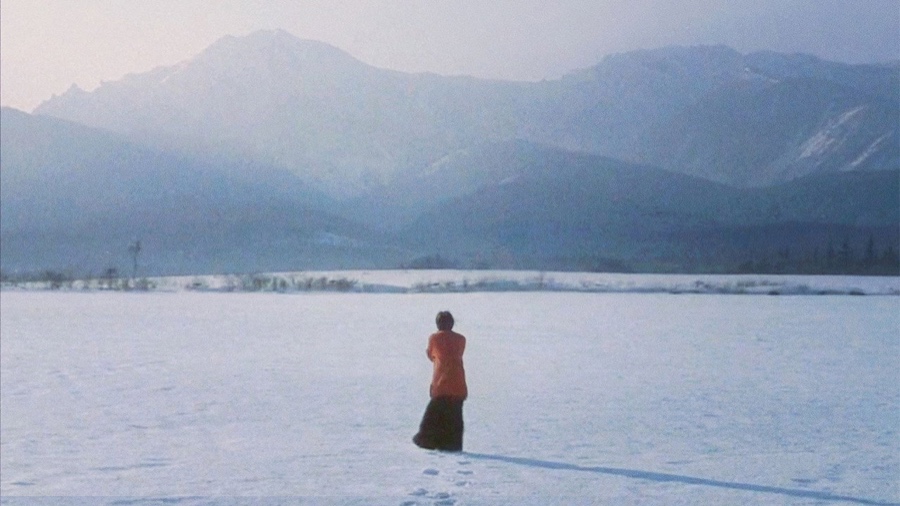
Hiroko calling out to the mountains. Facing a wide field of snow, Hiroko shouts “O-genki desu ka” again and again, a greeting she knows will never be answered. Crying, repeating it, she turns it into a farewell. That was the voice of someone finally managing to say goodbye. In Japan, this is the scene people quote.
The library card. Near the end, something unexpected reaches Itsuki. Her face as she holds it stands in for the most important line in the film: a small smile, confusion, then laughing through tears. What actually happens in that moment is barely put into words.
A girl sliding down an icy slope. In junior high, Itsuki (Miki Sakai) skids down a frozen hill in her ordinary shoes. Nothing in the plot depends on it. But the lightness of being a teenager is burned straight into the frame.
💭 How It Made Me Feel
After the credits finish, what comes back is the white of the snow and Miho Nakayama’s face. I can’t say right away whether it is Hiroko’s face or Itsuki’s. That blur, the not-quite-knowing which, is the aftertaste of this film. (I’ll admit the same blur is also my first complaint. More on that below.)
Who Should Watch This?
- Anyone who saw Last Letter and got curious about the film behind it (my strongest recommendation)
- People who only know the title from 18×2 Beyond Youthful Days on Netflix
- Anyone about to watch a Shunji Iwai film for the first time
👤 Miho Nakayama Is Why It Became a Classic: One Actress, Two Women
This is the part of the review I care about most. Love Letter became a classic because Miho Nakayama is in it.
For readers outside Japan, some context. By 1995 Nakayama was already one of Japan’s biggest stars. She broke out in 1985 in a TV drama, debuted as a singer the same year, and in 1992 had a million-selling hit with “Sekaijū no Dare yori Kitto.” Here, that star plays two quiet, ordinary women in a small winter film.
Hiroko keeps to herself. Itsuki is bright and blunt. Same face; only the way they stand and the temperature of their voices differ. And as the story goes on, the dual role gets tied to a certain doubt Hiroko carries. I won’t say what it is. But if two actresses had played them, the film would have had to spell it out in dialogue. With one actress, you check it with your own eyes. The casting trick becomes the pain of the story.
Iwai reportedly asked her to separate the two women from the inside, not by appearance, and when she asked whether she should change her hair for one of them, he told her to leave it as it was. The difficulty of telling them apart was built in from the start. That year Nakayama won Best Actress at the Blue Ribbon Awards and the Hochi Film Awards for this performance.
Reading other viewers’ reactions in Japan, I noticed something odd. Even people who dislike Iwai’s films, even people unhappy with the dual role, land on the same word for her: tōmeikan, a kind of transparency. Standing in all that white, Nakayama never sticks out. She melts into it and is still unmistakably there. And at the end, Itsuki holding the library card: the film doesn’t explain that moment with a single line of dialogue. It leaves it all to her face.
Miho Nakayama died in December 2024. Watching the film now, Hiroko’s longing for the fiancé she lost quietly overlaps with the viewer’s own feelings for Nakayama. That doesn’t turn it into a sad film. She is still there, laughing in the snow, writing letters, and in the last scene, smiling through tears.
💌 Love Letter vs Last Letter: Which Should You Watch First?
My answer: watch Love Letter first. I have seen both, and that is the order I recommend.
Last Letter (2020) is another Iwai film built on letters. (It is the Japanese one, not his 2018 Chinese-language film that shares the English title.) The stories are not directly connected, so either one stands on its own. Still, the two films mirror each other.
| Love Letter | Last Letter | |
|---|---|---|
| Released | 1995 | 2020 |
| Season, setting | Winter, Otaru with Kobe | Summer, Miyagi |
| The one who died | Hiroko’s fiancé (a man) | The heroine’s older sister (a woman) |
| Who retraces the memories | Two women in their twenties | Grown adults, plus their teenage daughters |
| How the letters start | A letter reaches the wrong person | She is mistaken for her sister at a class reunion |
| Dual roles | Miho Nakayama plays two women of the same age | Suzu Hirose, Nana Mori play a mother in the past, a daughter now |
Three reasons to start with Love Letter.
First, Last Letter has something set up for people who know Love Letter. Partway through, there is a scene whose meaning changes only if you have seen the 1995 film. If you know it, the scene plays almost as a reply sent back from the older film. If you don’t, it passes as just another scene. So go into Last Letter without even looking up the cast.
Second, as the table shows, the season, the person who died and the direction of the letters are all reversed. See the original first and you get to enjoy Last Letter for what it changed.
Third, Love Letter loses nothing if you watch them the other way around. Last Letter, though, is made to reward people who know the original. In the Japanese reactions I read, viewers who had seen Love Letter first also tended to rate Last Letter higher. US viewers can start it now: according to TMDB’s US listings it streams on Rakuten Viki, and it is free with ads on Prime Video. My advice is still to hold it until Love Letter’s US home release in December.
⏳ Why Love Letter Is Still Loved 30 Years Later
I didn’t want to answer this one lightly, so I read as many Japanese viewers’ reactions as I could before writing it. “The images are beautiful” doesn’t explain it. Iwai’s own Last Letter gets praised for its images just as much. Four reasons came out of that reading.
1. The longer it exists, the more the film itself becomes “lost time.” Letters, a yearbook with home addresses printed in it, a library card, and Miho Nakayama in 1995. Over thirty years, the parts the film is made of have turned into things that will not come back for the people watching it. To tell a story in letters in 2020, Last Letter needed a device to put a smartphone out of action. Love Letter was shot near the end of the years when letters needed no excuse at all. Nobody could make the same story fresh today.
2. It is a film about mourning dressed as a romance. It opens at a memorial, and its high point is a goodbye shouted at a mountain. Watch it young and it reaches you as a love story. Watch it after you have lost someone and it reaches you as a farewell. “How are you? I am fine.” holds a greeting to the dead and a promise to keep living, in one line. The more goodbyes there are in your own life, the more that line holds.
3. Knowing the ending makes it a different film. As I said above, the ending changes how the junior high scenes look. A film you cannot use up in one viewing keeps bringing people back every few years.
4. One short line keeps opening new doors. When the film opened in South Korea in 1999, it reportedly drew more than 1.4 million viewers, and “O-genki desu ka” became a catchphrase there. It is often described as the first Japanese film to become a real hit in Korea after the country began lifting its restrictions on Japanese pop culture in 1998, and Korean tourists started visiting Otaru because of it. Since then the doors have kept coming: Last Letter, 18×2 Beyond Youthful Days, the 4K re-release in Japanese theaters in 2025, and the North American theatrical release in 2026. Each new door brings people who are seeing it for the first time.
😅 Where It Falls Short
I’ve been making the case for this film all the way down. I know this has read as one long love letter of its own. So here are two honest reservations before you press play.
Early on, it is hard to tell which Nakayama you are watching
I explained above why the dual role is there. Even so, in the first stretch there are scenes where you can’t quite tell whether you are looking at Hiroko or Itsuki. Go in cold, and it is easy to mix up who wrote which letter. On top of that, you are reading subtitles in which two people share a name. Remember: Kobe is Hiroko, Otaru is Itsuki. That alone makes the first half hour much easier to follow. A quick look at the who’s who chart above helps too.
The coincidences will bother some viewers
A boy and a girl with the same name in the same class; a letter to an address that no longer exists reaching someone else; that someone having Hiroko’s face. Almost everything that moves the story is chance. If that strikes you as too much, it will keep the film’s strengths at arm’s length.
Who Might Not Enjoy This?
- Viewers hoping for a tightly plotted mystery with sharp twists
- Viewers who go cold the moment a plot leans on coincidence
📺 Streaming Guide by Service
The Available Routes
- Netflix, Prime Video, Hulu, HBO Max, Apple TV, Crunchyroll (US): not available as of October 20, 2026
- Coming: Film Movement’s 4K restoration, home release dated December 11, 2026 (Film Movement)
- Japan: streaming on U-NEXT, also included with Prime Video Japan (Japanese accounts only)
For a US viewer the honest answer today is to wait for December. When the home release lands on a service, I will revise the table at the top of this page.
Soundtrack
The score is by REMEDIOS. The original soundtrack has 15 tracks, including “A WINTER STORY” and “SMALL HAPPINESS,” and it is on US streaming music right now, so you can hear the film before you can see it: Spotify / Apple Music.
📚 Source Novel
Iwai also wrote the story as a novel, Love Letter, first published in Japan the same year as the film and now in paperback from Kadokawa. It lets you read Hiroko and Itsuki’s letters in the director’s own prose. As far as I could find, there is no English translation.
🎬 If You Loved Love Letter, Watch These 3 Next
One pick each for three things in Love Letter: the person who is gone, the feelings nobody says out loud, and a memory that stays beautiful.
Millennium Actress (2002)
Satoshi Kon’s animated film. Chiyoko Fujiwara, a retired film star, starts telling her life story to two men who came to interview her. As a girl she met a man once, and she has chased him from role to role ever since. Her longing drives the story far more than the man she is chasing. A life that turns around someone who isn’t there: it has the same shape as Love Letter. In the US it streams on HBO Max and is free with ads on Plex, and the Blu-ray is on Amazon. 👉 Read my Millennium Actress review
The Garden of Words (2013)
The Japanese trailer from CoMix Wave Films, the studio’s official channel.
Makoto Shinkai’s 46-minute animated film. Takao, a high school student who skips class on rainy mornings to sketch shoe designs in a Japanese garden in Tokyo, meets an older woman, Yukino. If Love Letter speaks through snow, this one speaks through rain. The two barely tell each other anything about themselves, and their feelings travel through short poems from the Man’yōshū, Japan’s oldest poetry anthology. Not letters, but the same habit of trusting feelings to a few words. In the US it streams on HIDIVE and free on Kanopy with a participating library card, and the Blu-ray is on Amazon. 👉 Read my Garden of Words review
Josee, the Tiger and the Fish (2003)
Isshin Inudo’s live-action film, not the 2020 anime of the same title. Tsuneo, a college student played by Satoshi Tsumabuki, meets Josee (Chizuru Ikewaki), a young woman whose grandmother wheels her around town in a baby carriage. Love Letter offers a past love as a beautiful memory in the snow. This one refuses to let you pack love away in a memory box. If sweet love stories leave you cold, watch it right after Love Letter. In the US it is free on Kanopy with a participating library card, and it is on RetroCrush and as a Prime Video channel add-on. I could not find an official trailer for the 2003 film online, so there is no video here.
❓ Love Letter (1995) FAQ
Is Love Letter (1995) on Netflix?
No. As of October 20, 2026, it is not on US Netflix, and nothing else in the US has it yet. Film Movement has dated its home release for December 11, 2026.
Is Last Letter a sequel to Love Letter?
No. The stories are separate, though Last Letter has a scene that means more if you have seen Love Letter. That is why I suggest watching Love Letter first.
Does Miho Nakayama play both Hiroko and Itsuki?
Yes. She plays Hiroko in Kobe and the adult Itsuki in Otaru. Itsuki as a junior high student is played by Miki Sakai.
📝 Final Thoughts
The dual role is hard to follow at first, and the stack of coincidences will put some people off. There is still more than enough reason to watch it. Even after the details of the plot fade, her two faces stay with you.
If you are starting from zero, glance at the who’s who chart once, then watch it when Film Movement’s release reaches a service near you. Save Last Letter for after.
⭐ Series at a Glance
| Category | Rating |
|---|---|
| Story | ★★★★☆ |
| Acting | ★★★★☆ |
| Visuals & Direction | ★★★★★ |
| Music | ★★★★☆ |
| Accessibility for newcomers | ★★★☆☆ |
Usagi’s Recommendation Score
⭐⭐⭐⭐⭐⭐⭐☆☆☆
7.5 / 10
“How are you? I am fine.” A single line that grows heavier the older you are when you watch it.

 isn’t streaming in the US yet; Film Movement dates its 4K home release for Dec. 1)