*This page contains affiliate links. We may earn a commission if you make a purchase through these links.
Most long stories run on subtraction. Each episode takes a question off the table, and by the finale the table is clear. Neon Genesis Evangelion runs that operation backwards. Twenty-six episodes, broadcast in 1995, and the pile of unanswered things is taller at the end than it was at the start. You learn what an Angel is. Standing behind that answer is something larger that nobody will name for you.
I watched it going out, Wednesday evenings on TV Tokyo, one episode a week with seven empty days in between. That gap is not something I can hand to you, and it shaped how the show landed on me, so read all of this knowing I am not a neutral party. Thirty years later there are six Evangelion films sitting around the series, and the question I still see most often in English is which one you are supposed to start with. The answer is these twenty-six episodes. The rest of this page is why. First, where they are.
📺 Where to Watch Neon Genesis Evangelion (October 2026)
| Service | Status | Notes |
|---|---|---|
| Netflix | Streaming | All 26 episodes, plus The End of Evangelion and Death (True)² |
| The Criterion Channel | Streaming | The series and both 1997 films. The one place with the classic ADV dub |
| Amazon Video | Rent / Buy | Purchase only, sold by the season |
| Apple TV | Rent / Buy | Purchase by the episode or the season |
| Fandango at Home | Rent / Buy | Purchase only. Google Play sells it on the same terms |
| Blu-ray (US) | Rent / Buy | GKIDS disc set, 2021. Series plus both films |
| Amazon Prime Video | Not available | Included with Prime in Japan, not in the US |
| Crunchyroll | Not available | Has never held the 1995 series |
| Hulu | Not available | Not in the US catalog |
As of October 2, 2026, two US subscriptions carry the 1995 series: Netflix and the Criterion Channel, and both file The End of Evangelion right next to it, so either one covers the original run from the first episode to the last frame of the last film. Netflix had it to itself from June 21, 2019 until Criterion added it on September 1, 2026. Pick Netflix if you already pay for it; pick Criterion if the English voices matter to you, for a reason I get to further down. Everything else on the list sells the show rather than streams it.
It is worth knowing what the same question looks like from Japan. On October 1, 2025, for the series’ thirtieth anniversary, the 26 episodes and both 1997 films were released to Japanese subscription services at once, and the list has only grown since. Today it streams on Prime Video, U-NEXT, Netflix, Hulu, Disney+, DMM TV and d Anime Store. In Japan the answer to “where can I watch Evangelion” is now “whichever service you already pay for.” In the US, until September 1, the answer was Netflix, full stop. If you have been told Evangelion is a Netflix exclusive, that was true worldwide for six years, and in the US it stopped being true that day.
🔢 How Many Episodes Is Neon Genesis Evangelion?
Twenty-six, in one season, and that is the whole 1995 series. There is no season two to go looking for. Most episodes run 23 minutes, and the full set adds up to 615 minutes, a little over ten hours. The End of Evangelion, the film that finishes the story, is another 87 minutes on top.
The number that matters more to me is the split. The first thirteen aired in 1995, weekly from October 4 to December 27, and the other thirteen picked up on January 3, 1996. So the show has a natural halfway seam, and episode 14 sits right on it as a recap. It is titled “Weaving a Story,” and if you are watching over a few weekends, that is the place to stop and breathe rather than the place to push through.
My one bit of pacing advice, from someone who got it at broadcast speed: do not binge the last six in a single night. The series was built to be sat with for a week between episodes, and the back stretch in particular goes down badly in a lump. Two or three a night lets each one settle the way it was meant to.
🧭 Evangelion Watch Order: Why the 26 Episodes Come First
Everything with Evangelion on the cover splits into three blocks. The 1995 television series, 26 episodes. The 1997 to 1998 films that finish it. The four Rebuild films released between 2007 and 2021. These are not one continuous line. The 1997 pair ends the 1995 story. The Rebuild four branch off it partway through and travel somewhere else entirely.
Two things reliably confuse people. The first is the 1997 titles, which are a genuine mess. Death & Rebirth arrived that March in two halves: a recap of episodes 1 through 24, followed by a short stretch of new footage. When the films were re-released in 1998, that recap half was reworked and retitled Evangelion: Death (True)². So these are not two rival films standing side by side. They are one recap, twice. The film that actually moves the story is The End of Evangelion, and on US Netflix it sits directly under the series.
The second is the advice to open with Rebuild 1.11, on the grounds that it covers the same early ground in under two hours. People do try it. A fair number stall and end up at the series anyway. What this show is made of is 26 weeks of accumulation on four people, and no 98-minute film has room for that. Compression is the whole design brief of the Rebuild films, and it reads as compression only once you know what got compressed.
- 1. The TV series, all 26 episodes (Netflix, a little over 10 hours)
- 2. The End of Evangelion (Netflix) — the 1997 ending, in film form
- 3. The Rebuild films, in order (rent or buy): 1.11 → 2.22 → 3.33 → 3.0+1.0
Death (True)² is on Netflix as well. It is a recap. Skip it unless you specifically want the 1995 story a second time in compressed form.
One warning about step three. Until August 2026, all four Rebuild films were bundled into Prime Video worldwide. The license ran five years, reached its term on August 13, 2026, and all four films left that day. No US subscription has them right now; every major storefront rents them. Several listing sites have not caught up and still show them as included with Prime, so trust the storefront over the aggregator.
Ten-plus hours of thirty-year-old television that declines to explain itself at the end. That is the ask.
There is no shortcut, but there is a fair trial. Six episodes is enough to know. If it has not got hold of you by then, it is not going to, and you can walk away without owing anybody a completion.
🎬 Trailer
Work Info
- Title: Neon Genesis Evangelion (1995)
- Japanese title: Shin Seiki Evangelion
- Broadcast: October 4, 1995 to March 27, 1996 on TV Tokyo, 26 episodes
- Director: Hideaki Anno
- Studio: GAINAX with Tatsunoko Production
- Character design: Yoshiyuki Sadamoto / Music: Shiro Sagisu
- Opening theme: A Cruel Angel’s Thesis, sung by Yoko Takahashi
- Runtime: about 23 minutes an episode, a little over 10 hours in total
- US streaming: Netflix from June 21, 2019, the first time the series was legally streamable here
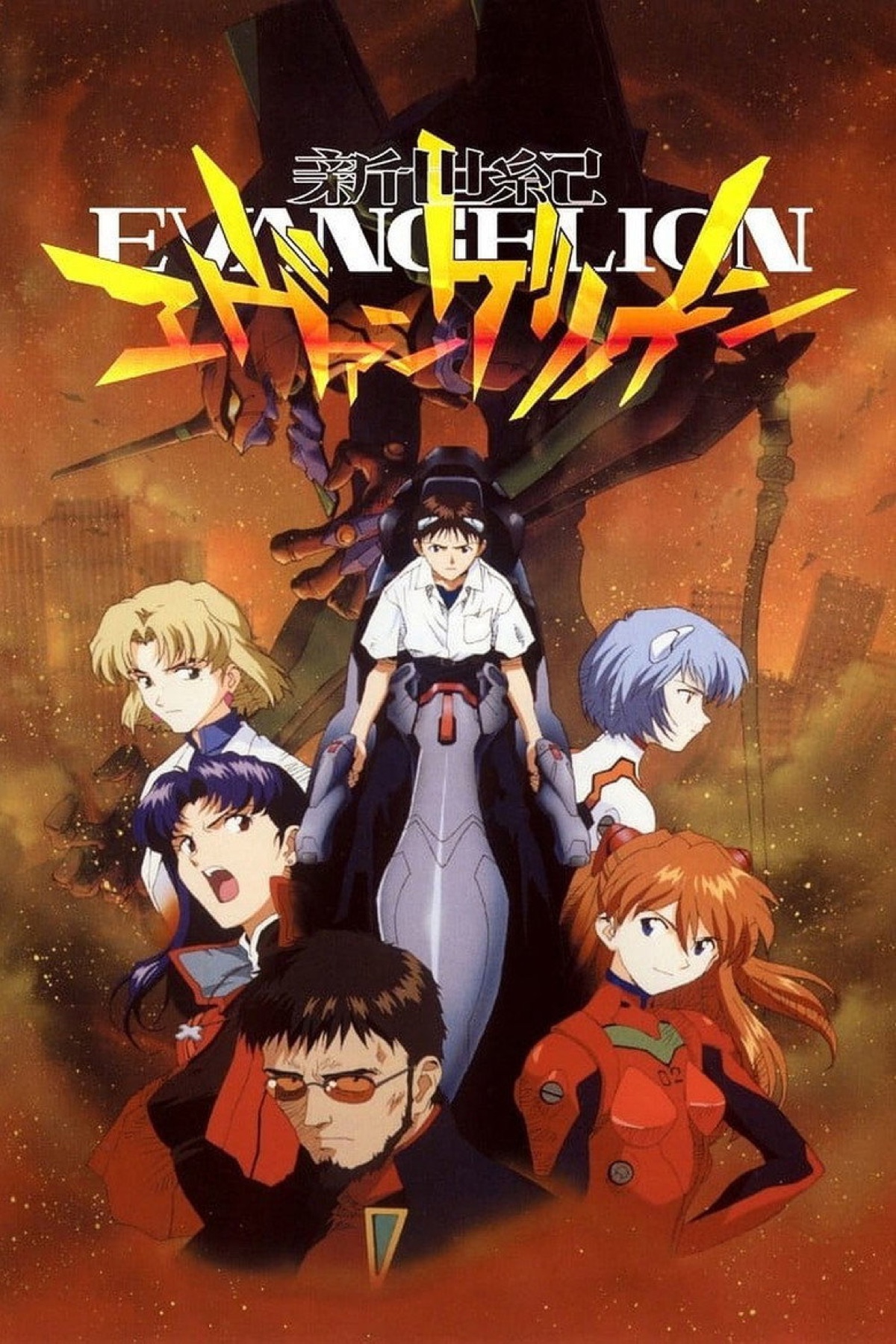
📖 Synopsis – No Spoilers
The year is 2015. Fifteen years have passed since a catastrophe wiped out close to half the world’s population. A fourteen-year-old boy named Shinji Ikari is summoned to Tokyo-3 by the father who handed him off to somebody else three years earlier. There is exactly one item on the agenda. Get into the cockpit of Evangelion Unit-01 and fight the things called Angels.
He has had no training. Nobody explains why the fight is his. He is cornered into it anyway, and he sits down in the seat. The Angels come at irregular intervals, and each time they do, Shinji goes out along with Rei Ayanami, another fourteen-year-old pilot, and later Asuka Langley Soryu. The first stretch is built around those battles. As the episode numbers climb, though, the camera keeps easing inward, away from the fight, toward the people strapped into it.
✨ What Makes It Special
Why It’s Exceptional
- A lead who spends 26 episodes saying he does not want to do this
- The running time goes to the people, not to the robot fights
- Cutting rhythms from 1995 that still read as modern
- Every answer arrives with a bigger question attached to it
The boy who never agrees to be the hero
In 1995 there was a settled shape for stories about a teenager in a giant machine. A reason to pilot is supplied. Something worth protecting is put on screen. The kid accepts the job. He can agonise afterwards all he likes, but the acceptance happens early, because the story needs it to. Almost nothing ran 26 episodes with its lead still refusing.
Shinji is put into Unit-01 in the first episode and then spends the series running, returning, and running again. Praise him and he will pilot. Take away his place to sit and he quits. His motive is not “to save the world” but “to be told I am allowed to be here,” which means his behaviour wobbles every single week. That wobble is infuriating to watch. Then somewhere around the middle you notice it is also the most accurate portrait of a fourteen-year-old you have ever seen animated, and the irritation curdles into something worse.
Look at reactions from people meeting the show now, three decades late, and this is still the first thing they flag. Thirty years on, “I have never seen a protagonist this unwilling” is a sentence being typed fresh. That tells you how few shows have copied the design, and there is a reason for that: it is an extremely uncomfortable thing to build a story on.
The plot refuses the standard shape too. What the Angels are, what NERV is for, what Shinji’s father is hiding. Each of those cracks open one notch, and something bigger and less explicable is standing behind it. Meanwhile the next-episode preview has Misato chirping “Service! Service!” at you like this is a comedy, while the show itself keeps descending. Taking that whiplash weekly, in real time, meant carrying the deeper half of it around for seven days with nowhere to put it. I do not think a binge reproduces that, and I am not sure a binge should try.
Twenty-six episodes of watching four people wear down
Shinji, Gendo, Asuka, Rei. Every one of them is guarding a place they cannot stand having touched. Piloting an Eva is the machine that exposes that place, over and over. This is not the usual arrangement where a strong character is granted one scene of vulnerability. They get worn down by the job itself, so the further into the run you are, the more of each person’s actual grain you can see.
Full disclosure: I am an Asuka partisan. In a cast full of people who fold inward, she is the one who goes at other people head-on. Which is why episode 9, where she and Shinji have to fight in exact sync, is a sequence I have never got tired of. The scene is built so that the shortness of the time those two spend moving to the same rhythm does the damage later, not while you are watching it. (The fact that my memories of 1995 are unaccountably sharper on her episodes is, I realise, its own kind of evidence.)
People who arrive via the Rebuild films often report that the TV cast feels deeper, and the reason is arithmetic. Three films’ worth of running time cannot show you the wearing-down twenty-six separate times. You have to watch the same person stuck in the same place for weeks before the being-stuck becomes the story.
Nineteen ninety-five, and the cuts still land
This is not a show that overwhelms you with drawings. There are a lot of held frames. It survives anyway because the editing swings between absurdly fast and absurdly slow with nothing in the middle. It will sit on a silent shot for a count of five, then cut so quickly you cannot tell what just happened. The first-episode composition looking up at Unit-01 through the mesh of its cage works exactly as well today as it did then.
Shiro Sagisu’s score is doing the same job with sound. Each cue has one assignment and does not stray from it. The tense strategy-room music has its own following, people who put the soundtrack on for that track alone, which is a strange thing to be able to say about background scoring.
Deeper Themes
The engine underneath all of it is a question about the cost of being near other people. Every character wants contact enough to reach for it, then finds the reaching unbearable and withdraws. The show gives this a name in its own vocabulary later on, but you do not need the terminology to feel the shape: getting close means being seen, being seen means being judged, so people build a distance they can survive at and then get lonely inside it.
The mecha framing is what makes the argument possible on television in 1995. A giant robot gives the show a weekly reason to force four people into the exact situation they have organised their lives to avoid.
🎭 Memorable Scenes
Episode 1, the moment Unit-01 moves. A boy who has been in the seat for under a minute cannot possibly be driving it, and the machine moves in a way that no machine should. The texture of the picture changes for those seconds. I was on the floor of my parents’ living room when it happened, and I caught myself leaning in at an angle I would have been mortified to be seen at. If the only question is whether you and this show’s images get along, that stretch settles it.
Episodes 18 into 19. This is where the whole thing changes state. Ask around and this pair is what most people name as the peak, and it works by taking everything the show has patiently built between these characters and putting it to the worst available use. I am not going to describe it. Get to episode 19 and every bit of the heaviness that follows will make sense.
And then the last episode’s one word.
Congratulations.
Something odd happens around that word. In Japan, people who finish the series write it to themselves at the bottom of their own write-ups, addressed to nobody but the person who just got through 26 episodes. I am not going to say what it means inside the story. What I can tell you is that finishing this thing gets treated as an accomplishment in its own right, and I cannot name another show where the audience marks its own completion that way.
💭 How It Made Me Feel
You do not come out of the last episode feeling settled. Too much is unresolved for that. What you do next is the fork in the road: open a theory site, or do not. Going looking for answers has a way of leaving you with less than you had. Leave the not-knowing alone, and something else happens. Three or four days later a specific shot comes back to you, uninvited, in the middle of doing something unrelated.
It did not hit me during the broadcast. It hit me during the weeks after it ended, when I was supposedly done and kept turning it over anyway. What stays is not the memory of having understood something. It is the texture of a thing you carried around without understanding it. Very few pieces of television leave a residue in that particular shape, and I have stopped expecting any given show to manage it.
😅 Where It Falls Short
Past episode 20, the air goes out of the room
The first half has comedy in it. There is a penguin living in the apartment. Two pilots get made to practise a dance routine for an absurd length of time. That lightness is load-bearing, because it is what gives the fights their tension. Somewhere past episode 20 it is simply gone.
Everyone’s situation deteriorates at once, colour drains out of the frame, and conversations stop connecting. I understand completely why people drop it here. “I could not stay with the back half” is a fair report, not a failure of nerve. This is not a show to marathon during a bad week, and I would say that to anybody about to start it on a Sunday with nothing else planned.
The last two episodes hand you the explaining
Here is the part everybody splits on. Episodes 25 and 26 depart, hard, from the way the previous twenty-four were made. Instead of resolving the situation, they put the characters’ interior states directly on screen. You do not finish in a state where you could describe what happened to another person in plain sentences.
There is a serious defence of this, and I want to represent it properly. “Episodes 1 through 24 exist to make those two possible.” “The abstract material took as much work as anything else in the run.” Those arguments are widely held, and the show does support that reading. Plenty of people count these two episodes as the thing being finished rather than abandoned.
I have been talking this show up for a while now, so let me be straight about where I actually land. I am on the against side. What unfolds in there felt hollow to me, and I never shook the sensation of being pulled into the director’s head along with everybody else. Shinji’s mind gets set free, and I can see that it does. I wanted the resolution to happen on the side of the world where the rest of the story took place. Who he talks to, what he says, how he carries himself afterwards, in the same reality where the other twenty-four episodes happened. That is what I did not get.
The genuinely odd part is that the people writing this complaint tend to be the ones rating the show highest. “The ending does not work for me” and “this is one of the great ones” get said by the same person in the same breath. I do it myself, on this page. Both are still true.
The Downsides
- From episode 20 the weight never lifts again
- The final two episodes settle nothing on the side of the world where the story happened
Who Should Watch This?
- Anyone who started with a Rebuild film, lost the thread, quietly stopped
- People who want character writing more than they want mecha combat
- Anyone who has known the name for thirty years without ever pressing play (especially you)
Who Might Not Enjoy This?
- Anyone who needs every thread tied off before the credits
- Viewers who came for robots hitting each other
📺 Streaming Guide by Service
What you are actually pressing play on
Netflix being the door most Americans walk through has a consequence that nobody mentions in the “where to watch” listicles, and it is worth two minutes before you start. The version on Netflix is a 2019 rebuild of the English-language material, not the one older English-speaking fans grew up on. Netflix streams the 2019 Netflix dub, with a new cast, and a new subtitle translation to go with it. The ADV dub from the 1990s VHS run is not on Netflix, and for years it was not on any streaming service anywhere: ADV Films folded in 2009 and the dub went out of print along with the company. That changed on September 1, 2026, when the Criterion Channel put all 26 episodes up with the classic dub attached. If the voices are what you are here for, that is the service to pick, and it is the first time in thirty years that this option has existed outside a second-hand disc.
The change that caused the loudest argument is a single line in episode 24, where Kaworu speaks to Shinji. The line most English-speaking fans carry around is “I love you,” which is how ADV’s later home-video releases rendered it. The Netflix subtitles read “I like you.” Worth noting that ADV’s own earliest release also had it as “I like you,” so the wording being defended is itself a revision, which almost nobody brings up. Here is the bit I can usefully add from this side: the Japanese word is suki, and it sits in between those two English options rather than lining up with either. It is the word a Japanese teenager uses to confess romantic feeling, and it is also the word for liking a sandwich. Context carries the weight, and this context is not ambiguous to a Japanese ear. Both English renderings are defensible as dictionary work. Only one of them tells you how the line actually plays.
And then there is the music, which is the real loss. Every one of the 26 episodes originally closed on a different cover of Bart Howard’s “Fly Me to the Moon,” arranged to match whatever had just happened, sometimes sung by the cast. That song is not on the US Netflix version. Licensing. The GKIDS Blu-ray does not restore it either; it puts Rei’s theme over the end credits instead. So no US release currently gives you the endings as they were broadcast. It is a small thing that turns out not to be small, because those closing minutes were where each week’s episode was allowed to land before you had to go and live your Wednesday night.
Where to Watch
- Netflix: all 26 episodes, subtitled plus the 2019 dub
- The Criterion Channel: from September 1, the only place streaming the original ADV dub
- The End of Evangelion: on the same subscription, watch it after episode 26
- Amazon Video: purchase by the season if you would rather own it
Soundtrack
Shiro Sagisu’s scoring for the series plus the 1997 films is collected across five discs on NEON GENESIS EVANGELION SOUNDTRACK 25th ANNIVERSARY BOX. Catalog availability differs by country, so search rather than assume.
- Spotify: the 25th Anniversary Box, complete
- Apple Music: the box is a Japan listing, so search the US catalog
📀 On Disc
GKIDS put the whole thing on US Blu-ray in 2021: Neon Genesis Evangelion: The Complete Series, 26 episodes with Death (True)² plus The End of Evangelion in the same set. Worth knowing before you buy: the disc carries the same 2019 dub as Netflix, it substitutes Rei’s theme for the original ending song, but it does include the alternate Director’s Cut versions of episodes 21 through 24, which are not on the streaming version at all.
🎬 If You Loved Neon Genesis Evangelion, Watch These 3 Next
Ghost in the Shell (1995)
Same year. Japanese animation put out two works in 1995 asking the same question and answering it from opposite directions. Evangelion goes inward to work out what a self is; Oshii’s film comes at it from the outside, through definitions. In a world where your body is swappable hardware, which part of the arrangement is you? Watching one after the other makes 1995 look like a very strange year to have been in a Japanese cinema. This one is on Prime Video in the US.
👉 Ghost in the Shell (1995) – Why This Cyberpunk Masterpiece Hits Harder Than Ever in the Age of AI
Legend of the Galactic Heroes
If what you want next is more depth, this is depth built the other way round. Evangelion gets there by excavating one person; this gets there by setting two political philosophies against each other for 110 episodes. Democracy and autocracy, each with a real case, each rotting from a different end. Evangelion holds you with what it will not explain. This one is bleak precisely because everything is explained. Fair warning: no US subscription carries it, which is the subject of the piece below.
Made in Abyss
Children put into a brutal place that adults built. On that single point it is continuous with Evangelion. The difference is the art style, which is round and warm and makes the gap between how it looks and what occurs enormous. Evangelion dug into the interior of a fourteen-year-old; this one applies pressure to the body of a twelve-year-old girl without flinching. Do not trust a cute picture, in other words, which is the other thing these two have in common. Streaming on HiDive in the US.
👉 Made in Abyss Review | The Deeper You Go, The Less You Can Return
👉 Why are the pilots 14? Why does an Eva bleed? Why does the story have two endings? The questions that run across the whole series are answered in Why Are Evangelion Pilots 14? The Answer Everyone Repeats Has No Source.
Evangelion closes out my list of anime about depression, and the entry there explains why I placed it last rather than first.
📝 Final Thoughts
It is a peculiar position to argue from, given that I have just spent several paragraphs refusing the ending, but here it is anyway: if you are going anywhere near Evangelion, go in through the 26 television episodes. What is stored in them is the time the films had no choice but to squeeze out. A boy who keeps saying he does not want to do this sits back down in the seat every week and gets a little more worn away each time. Watching that loop run twenty-six times is what earns you an opinion about where it ends up, on either side.
Thirty years old, and a subscription you probably already have puts the entire original run in front of you, series and both films together. Since September 1 there are two such subscriptions, and one of them comes with the voices that went missing for a decade and a half. That arrangement is a license, and licenses expire; the four Rebuild films demonstrated exactly that in August. If you have been carrying this title around as a thing you will get to eventually, the conditions are not going to get better than they are right now. Six episodes tells you whether it is yours. Decide to go that far and see what happens.
⭐ Series at a Glance
| Category | Rating |
|---|---|
| Story | ★★★★☆ |
| Characters | ★★★★★ |
| Visuals & Direction | ★★★★☆ |
| Music | ★★★★★ |
| Accessibility | ★★☆☆☆ |
Usagi’s Recommendation Score
⭐⭐⭐⭐⭐⭐⭐⭐☆☆
7.8 / 10
The questions never close. The door is still here.

