*This page contains affiliate links. We may earn a commission if you make a purchase through these links.
Warm.
Nobody reaches for that word when they talk about Evangelion, and I have watched the lot: the 1995 series, The End of Evangelion, all four Rebuild films. The word fits exactly two of them. One is the final film. The other is this one, the second Rebuild film, which opened here in the summer of 2009, and it is the one I will defend hardest.
What makes it warm is a swap the film performs in the open. The story about saving the world turns into a story about going to collect one person. Everything before that swap is groundwork, and the groundwork is three teenage pilots who, for the first time anywhere in this franchise, try to reach each other. If the first Rebuild film left you filing the whole project as a tidy remake of a show you already knew, this is the one where the road forks. It forks a good deal harder than “they added a new pilot” makes it sound.
📺 Where to Watch Evangelion: 2.22 (August 2026)
| Service | Status | Notes |
|---|---|---|
| Apple TV | Rent or buy | Google Play, YouTube, Fandango at Home price it the same |
| Amazon Video | Rent or buy | A per-title charge since the subscription ended |
| Amazon Prime Video | Streaming | Back on Prime Video as of September 2026, after the 2021 licence lapsed on August 13 |
| Netflix | Not available | Netflix carries the 1995 TV series, not these four films |
| Crunchyroll / Hulu | Not available | Never carried in the US |
As of August 26, 2026, no US subscription carries this film. Amazon held all four Rebuild films worldwide from August 13, 2021, and the five-year license expired on August 13, 2026, which took the whole set off Prime Video on the same day. What is left is a per-title rental, priced the same wherever you go. The Netflix confusion is worth naming, because it catches people every time: Netflix has the 1995 television series and it has never had the Rebuild films. Rights move without notice, so check the service itself before you pay for a month on account of one title.
👉 You can start here and follow the plot without trouble. You will get more out of it knowing where this boy came from, which is what the first film is for: Evangelion: 1.11 You Are (Not) Alone. Ninety-eight minutes, and it makes the temperature change in this one land properly.
🎬 Trailer
Work Info
- Title: Evangelion: 2.22 You Can (Not) Advance (2009), released theatrically as 2.0
- Japanese title: Evangelion Shin Gekijoban: Ha, where ha means the break
- Chief Director: Hideaki Anno, who also wrote the screenplay
- Directors: Masayuki, Kazuya Tsurumaki
- Music: Shiro Sagisu / Theme song: Beautiful World (PLANiTb Acoustica Mix) by Hikaru Utada
- Runtime: 112 minutes for the 2.22 cut, 108 for the 2009 theatrical version
- Studio: Khara
- Released: June 27, 2009 in Japan. GKIDS put it on US disc on October 21, 2025
- Japanese box office: about 4 billion yen, the second highest-grossing anime film in Japan that year
- Sources: TMDB, Japanese theatrical records
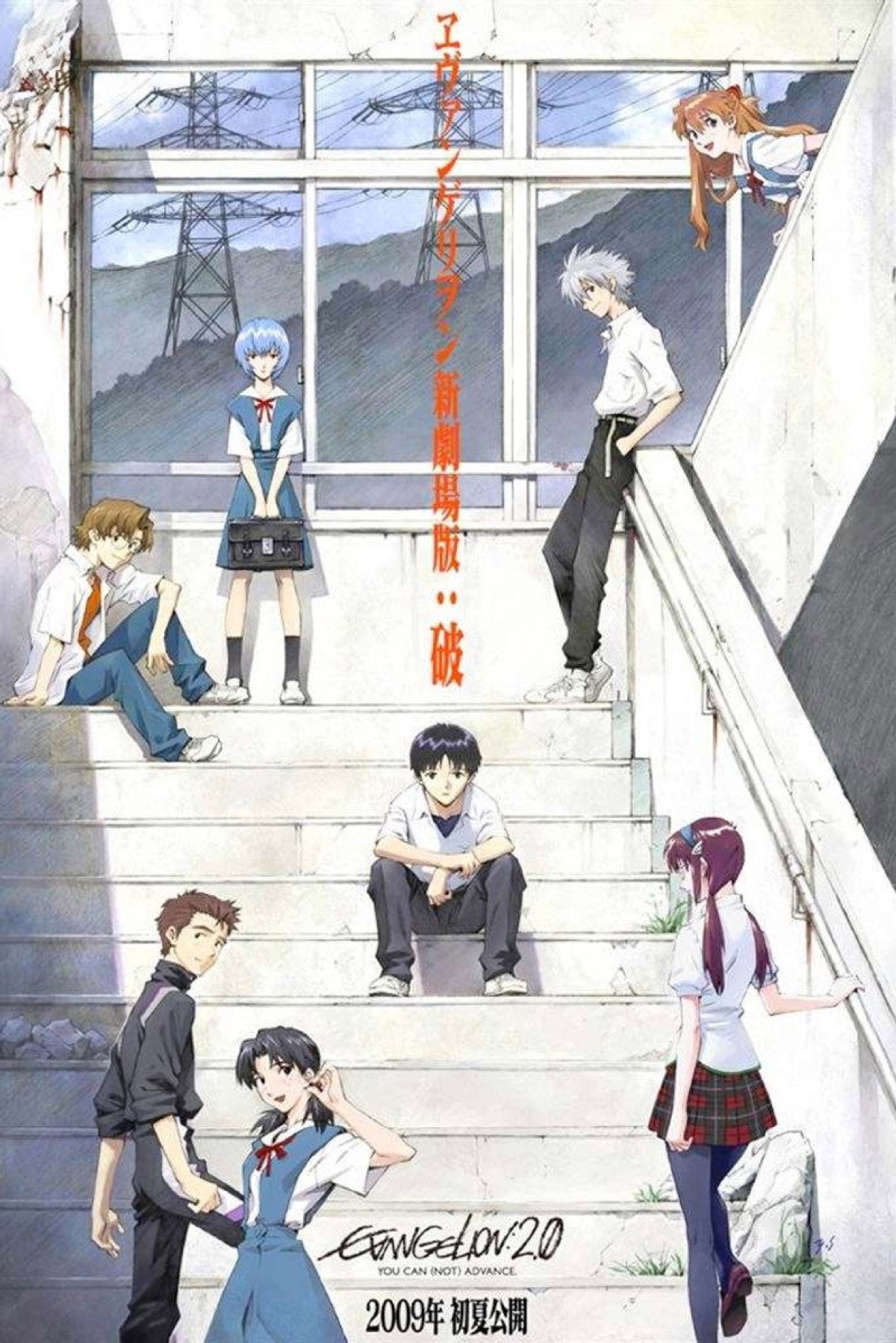
📖 Synopsis – No Spoilers
Tokyo-3 is still being attacked, and Shinji Ikari is still the boy they put in Unit-01 to stop it. Then the roster grows. Asuka Shikinami Langley arrives with Unit-02 and an attitude, and a girl nobody at NERV has papers for, Mari Makinami Illustrious, turns up in the cockpit of something else entirely. Two Evangelions become three, the fights scale up to match, and Tokyo-3 keeps getting flattened.
What the film actually spends its time on is the gaps between those battles. School. A dinner party the whole household prepares for. A boy working out whether he can talk to his father one more time. If you know the television series, that temperature will feel wrong on you for a while, and it is meant to. Then the back half arrives, and the film stops being gentle with astonishing speed.
✨ What Makes It Special
Why It’s Exceptional
- The soft first half is not filler. It is the ammunition for the second half
- Two songs every Japanese schoolchild has sung, deployed as instruments of dread
- Asuka was rewritten from the ground up, and the rewrite has a job to do
- Watchable cold, with a different set of shocks waiting if you know the 1995 show
The gentle half is the weapon
For a long stretch, this film runs at a temperature Evangelion has no business running at. Classrooms. Friends. A kitchen in Misato’s apartment, with people cooking badly in it, for a dinner whose entire purpose is to get a father and a son to sit at the same table. Rei Ayanami, of all people, is the one organising it. She has no idea what she is doing with a kitchen knife and she does it anyway.
There is a word she uses for how the situation feels, and English does not really have it. Pokapoka is what Japanese children say about weak winter sun on the back of your neck, or a bath that has not gone cold yet. It is a small, physical, unglamorous kind of warm. That is the register the whole first half is written in, and for long stretches you can genuinely forget you are watching a war story.
I have been selling this as the gentle Evangelion. Here is the catch. None of that stretch is a breather, and none of it is foreshadowing in the usual sense. It is mass, being loaded. Every scene where somebody gets a little closer to somebody else is one more thing that can be taken away later, and the film knows precisely how much it is stacking. The more comfortable you get, the further you have to fall. I watched it the first time thinking the soft part was the film relaxing. It was the film doing arithmetic.
The drop gets its final push from the music, and this is the part I cannot explain to anybody who did not go to school in Japan. At two separate moments the film reaches for a song that everyone in the audience sang as a child. Not nursery rhymes. Both are proper songs with authors and release dates, and both went into the school system afterwards and stayed there. Tsubasa wo Kudasai, Give Me Wings, was written by Michio Yamagami and Kunihiko Murai and released by the folk group Akai Tori in 1971. It began turning up in music textbooks from 1976, and it has been a chorus-competition standard for so long that most Japanese adults learned it before they learned who recorded it. Kyo no Hi wa Sayonara, Goodbye to This Day, was written by Shoichi Kaneko in 1966 and recorded by Ryoko Moriyama in 1967. It reached a high school music textbook by 1973, it is a scout campfire song, and it is what a Japanese class sings at each other on the last day of term. In 2007 the Agency for Cultural Affairs and the national PTA association put it on their list of a hundred Japanese songs worth keeping.
Both are sung in this film by Megumi Hayashibara, who is also the voice of Rei Ayanami. So the sound arriving over the worst material in the picture is a school-assembly melody in the voice of the girl you have been watching learn to cook.
A softer song under a harder image is an old trick, and normally the softness sands the edges off. Here it does the opposite. The mismatch is so total that the calm melody makes the images worse, not better. You take the medicine and it turns out to be the poison. I sang both of those songs at school, dozens of times, without ever once thinking about them. That is exactly what makes them usable this way, and it is why the effect only fully detonates for a Japanese audience. Films that use music well are common. This is one of the rare ones filed in memory by its soundtrack first, where people describe the scene by naming the song that was playing over it.
Asuka being nicer is not a softening. It is a trap
The Asuka of the television series was Soryu. This one is Shikinami, and the surname is not the only thing that changed. She still comes in hot, but there is markedly less of the deliberate cruelty, and there are scenes, plural, of her trying to get closer to Shinji and to Rei rather than pushing them away. Taken on its own it reads like a studio filing the sharp edges off a difficult character for a wider audience.
That is not what it is for. The rewrite exists so that you will like her before the film needs you to. Prickly and unpleasant, she could be watched from a safe distance, which is roughly how a lot of viewers handled her in 1995. Show her reaching toward people and the distance closes without your consent. Then the story goes where the story was always going.
Rei moves the same direction. Her project across this film is to get her commander and his son back into the same room, which means walking into a group of people and asking for things, and if you know the original character, that sentence should read as science fiction. Asuka, Rei and Shinji all want each other to be all right here, and all three of them do something about it. That is the single largest difference between this film and the show it is built on. The 1995 series was a study of three people failing to make contact. This one lets them succeed, at length, on screen, and the whole back half sends the bill.
Shinji stops making excuses
Thirty years of jokes rest on this boy dithering about whether to get in the robot. Refuse, run, come back, refuse again. The dithering was the engine of the television series and it was not cowardice, it was a fourteen-year-old behaving like a fourteen-year-old.
In this film there is a point where he simply stops. What matters is the reason, because it is not duty and it is not the survival of the species. He moves in order to go and get one specific person. Every large word the film has been stacking up, humanity, the organisation, the scenario, gets set down on the floor, and a boy walks off holding one name. The load-bearing idea of Evangelion changes shape in that moment. Written down it sounds like overstatement. Watch it and it plays exactly that size.
It also settles the question of what all that cooking and school and awkward dinner planning was for. A boy who has only ever been handed his reasons from above finally produces one himself, and the one he produces is the smallest on offer. Not the species. Not the city. One person he happens to have spent the film getting to know. That is why the gentle half had to run as long as it does. Without it the decision is a plot beat. With it, it is the only thing he could possibly have decided.
Deeper Themes
The move from “for the world” to “for one person” did not stop with this film. Through the 2010s, Japanese animation kept handing its protagonists that same fork and kept watching them choose the person, to the point where it became the default shape of the form. Anno planted his flag on that ground in 2009, which puts this film early in the sequence rather than in step with it. Running underneath is a second thread the film keeps returning to, the suspicion that you are replaceable, that somebody else could do your job and the machine would not notice. That is not a private teenage worry. It is a description of how a society organises people when parts and staff are equally swappable, and it is the reason a film from 2009 has not dated.
🎭 Memorable Scenes
A girl who has spent two films being described as a doll decides, unprompted, to cook dinner for other people. Nobody explains why. The film does not need her to.
The dinner party preparations. Rei turns up at Misato’s apartment and cooks, badly, with total concentration. The aim is to get Shinji and his father into the same room. She never states the aim out loud, and no character delivers a speech about how much she has changed. An Eva pilot holding a kitchen knife is, in this particular film, a major plot event.
Ryoji Kaji talking to Shinji. The gist is that people who have been through something painful are the ones who can be kind to others, and that this kind of kindness has nothing to do with weakness. The line is inherited from the television series. It is the most adult thing anybody says in the film, and it is delivered with none of the descending-from-above tone that usually comes with adult advice in anime. It is also placed just before the noise starts, which is not an accident.
The exchange about being replaceable. Somebody works out that there is nothing they can do that another person could not. For a fourteen-year-old that arithmetic is far too heavy to carry, and the film hands it over without softening it. Some viewers let this one go past. Others stop functioning for a minute. I know which group I was in.
💭 How It Made Me Feel
Not moved. Not thrilled. Sore. Everything the first half spent so long building comes due, and the credits do not roll on the clean feeling of having watched a good story about people being decent to each other. It comes with a bruise on it. And there is nothing in the film I can point at and dislike. The warmest Evangelion ever made leaves the most uncomfortable aftertaste, which is an awkward thing for a film to be.
It did not land on me during the film, either. It landed that night, when I went looking for the soundtrack and started one of those two school songs, and could not get to the end of it. Ten seconds in, the image the film had welded to it came back whole. Years on, I still cannot hear either one clean.
One practical note, with no spoiler attached: do not walk out while the credits are running. That is all I will say, and you will want the next film ready.
Who Should Watch This?
- Anyone who watched the first Rebuild film, shrugged, and stopped there (this one is for you)
- Anyone who has never touched Evangelion and cannot work out where to get on
- Viewers who judge a film by what it does with its music
- Anyone who gets a small private thrill out of three giant machines running in formation
😅 Where It Falls Short
The tightest stretch is also the most explained
Look, I am about to complain about a film I am giving a nine to. Late on, with the situation already moving, Ritsuko Akagi starts explaining what is happening. The job is legitimate: the audience needs to grasp the mechanics of the thing. My objection is that at that specific moment the audience needs one piece of information and one only, which is that something has started that cannot be undone. Everything past that is furniture, and the words arrive at the precise instant you least want words.
It grates more than it would elsewhere because Evangelion built its reputation on refusing to do exactly this. The series has always thrown its private vocabulary past you at speed and left you to keep up or not, and the refusal to stop and define things is half of why the atmosphere works. Turning helpful for one scene, and picking that scene to do it in, is out of character for the film around it.
On Mari, I am holding the verdict back
Mari Makinami Illustrious arrives and takes the room immediately. She hums while she pilots. In a world this heavy she registers as a foreign object, and the foreignness works, which I want on the record before the complaint.
The complaint is that at this stage there is nothing inside her. What she wants, who sent her, why any of it: all blank. Standing next to Shinji with his crisis, Rei with her mystery and Asuka with her armour, she reads as a function the film needed rather than a person it wrote. She is one film old and it would be unfair to file a final judgment on a character who has barely started. So I am not filing one. As of this film she is a shrug in a plugsuit, and I say that as somebody who came round to her later.
The Downsides
- Exposition lands in the middle of the tensest sequence and breaks the spell
- Mari gets a function and a personality, but no interior
Who Might Not Enjoy This?
- Viewers who need the vocabulary explained as it lands. SEELE turns up, does things, and is never once introduced
- Viewers who treat school scenes and domestic scenes as a detour from the plot
📺 Streaming Guide by Service
Nothing streams these films in the US any more
The US shelf got simpler and more expensive on the same day. Amazon took the Rebuild films worldwide in 2021, all four sat on Prime Video for five years, and the license ran out on August 13, 2026. Nothing picked them up. Every service that still has them charges per title, so a full run of four films is four rentals. If you expect to come back to these, the discs cost less than renting the set twice.
There is a detail here that matters if you watch dubbed, and it is the kind of thing US viewers get wrong because Netflix muddied it. The 2021 dub commissioned for Prime Video was recorded by Dubbing Brothers USA under Joe Fria, and it brought back the voices from the ADV-era English version: Spike Spencer as Shinji, Tiffany Grant as Asuka, Allison Keith-Shipp as Misato, John Swasey as Gendo, Amanda Winn Lee as Rei. Netflix’s 2019 dub of the 1995 series recast every one of those parts. Those voices belong to this 2021 dub specifically, and they are not what you hear on Netflix’s recast of the 1995 series. Mari, a character with no ADV history to return to, is voiced by Deneen Melody.
Where to Stream
- Apple TV: Rent or buy, matched by Google Play, YouTube, Fandango at Home
- Amazon Video: rent or buy, since the Prime Video subscription ended on August 13, 2026
- Prime Video / Crunchyroll / Netflix / Hulu: not available on subscription in the US
Soundtrack
- Spotify: available
- Apple Music: available
Shiro Sagisu wrote the score, and the album carries the two choral pieces in Megumi Hayashibara’s recordings. Be warned that playing them later brings the scene back attached, whole, without asking.
📀 On Disc
Now that no subscription in the country carries the film, the disc is the version nobody can take off you. GKIDS put 1.11 and 2.22 out on US Blu-ray on October 21, 2025, with bonus material and a booklet. Worth knowing before you buy: the disc version is the 2.22 cut, four minutes longer than what played in Japanese cinemas in 2009.
🎬 If You Loved Evangelion: 2.22, Watch These 3 Next
Weathering with You
The world, or one person. Makoto Shinkai puts a teenager in front of the identical fork ten years after this film did, and comes back with the same answer. His version then keeps the camera running afterwards and makes the boy live in the world his choice produced, which is the part Anno leaves for later films. If the decision at the centre of this one did something to you, the back half of Shinkai’s will do it again with the receipts attached.
👉 Read the Weathering with You review
Cyberpunk: Edgerunners
Ten episodes in which a boy gets power and spends it wrecking himself, not for a cause but for a girl. Trigger builds the good times first, exactly the way this film does, then charges for every one of them. The music is used with the same violence too. Go in knowing that the structure you just watched is about to be run on you again at greater length.
👉 Read the Cyberpunk: Edgerunners review
Jin-Roh: The Wolf Brigade
This one is the flaw above, inverted. Mamoru Oshii’s script explains almost nothing, and it tells you how the film ends by quoting Little Red Riding Hood at you and letting you work it out. Handing the story to a piece of childhood folklore is the same manoeuvre as the school songs here, run for the full length of the picture, and Jin-Roh never once breaks and starts explaining itself. If the exposition problem bothered you, this is the antidote.
👉 Why are the pilots 14? Why does an Eva bleed? Why does the story have two endings? The questions that run across the whole series are answered in Why Are Evangelion Pilots 14? The Answer Everyone Repeats Has No Source.
📝 Final Thoughts
Four billion yen at the Japanese box office and second place among the anime films of 2009 make this sound like a picture that works at scale. What it is actually doing is small-scale bookkeeping. Minutes of comfort in the first half, converted at a fixed rate into damage in the second. There is a reason the Japanese title is the character for the break: jo-ha-kyu is a thousand-year-old idea about pacing that came out of court music and got fixed into Noh theatre by Zeami, and it runs slow opening, rupture, rapid close. Film one is jo. This is ha. The break is in the name.
Remember the word I opened with. Warm still applies to this film and to the last one in the series, and nothing in between. The aftertaste is another matter, and it is not kind. Somebody who has never seen a frame of Evangelion could start here, follow it, and get hit properly, and the only thing I would ask them to accept in advance is that the vocabulary is going to arrive unexplained and they should let it. Nine out of ten. The point I am withholding is for the exposition and the blank where Mari should be, and for nothing at all to do with the ending. The rest is admiration, and none of it is comfort.
⭐ Series at a Glance
| Category | Rating | Note |
|---|---|---|
| Story | ★★★★☆ | Middle chapter of four, and it never pretends otherwise |
| Characters | ★★★★★ | Three pilots who finally reach for one another |
| Music | ★★★★★ | Two school songs, repurposed as instruments of dread |
| Visuals | ★★★★★ | Three Evangelions on screen and the frame still reads clean |
| Emotional drop | ★★★★★ | The gentlest hour in the series, invoiced in full |
| Accessibility for newcomers | ★★★☆☆ | Follow it cold, but the vocabulary is your problem |
Usagi’s Recommendation Score
⭐⭐⭐⭐⭐⭐⭐⭐⭐☆
9.0 / 10
The one to hand anybody who gave up after the first film.

