*This page contains affiliate links. We may earn a commission if you make a purchase through these links.
Thank you. That was the first thing out of my mouth when the lights came up, and it is not a normal thing to say to a film. I have been inside this series since the television broadcast in 1995: the 1997 films, then four more spread across fourteen years. These 155 minutes are the ones that finally let me graduate. That is a bias and not a credential, and you should read everything below knowing I am not a neutral party.
What I am not going to tell you is that it made everything clear. It did not. The film is as hard to follow as the one before it. What changed is that the confusion is now something you are allowed to carry out of the room with you. So there is one question worth putting to this film, and only one: what does it do differently from the ending Evangelion already gave us in 1997?
📺 Where to Watch Evangelion: 3.0+1.0 Thrice Upon a Time (October 2026)
| Service | Status | Notes |
|---|---|---|
| Amazon Video | Rent / Buy | $3.99 to rent, $12.99 to buy. The Japanese and English-language versions are listed separately |
| Apple TV | Rent / Buy | $5.99 to rent, $12.99 to buy |
| Fandango at Home | Rent / Buy | $3.99 to rent, $12.99 to buy |
| Blu-ray (Amazon US) | Rent / Buy | GKIDS disc, released October 17, 2023 |
| Amazon Prime Video | Not available | Left Prime on August 13, 2026. The Amazon page now offers rent or buy only |
| Crunchyroll | Not available | Not in its catalog |
| Netflix | Not available | Netflix US has the 1995 TV series, not the films |
| Hulu | Not available | — |
No US subscription includes this film right now, but the major storefronts rent it. Outside Japan, Prime Video had all four Rebuild films from August 2021; that deal expired on August 13, 2026, and they came off together. Some streaming guides still file this one under Prime, but the Amazon page itself only offers it to rent or buy. GKIDS holds the North American rights, which is why it kept a digital home after the exit. Prices checked October 3.
👉 Watch the previous film first, and do not skip it. This one opens on a frozen clock and restarts it without a word of recap: Evangelion: 3.33 You Can (Not) Redo.
🔢 Is Evangelion 3.0+1.0 the Same as Evangelion 4.0?
Yes. There is no separate film called 4.0; it is the name people reach for because this is the fourth and last Rebuild film. The English title is Evangelion: 3.0+1.0 Thrice Upon a Time. In Japan it is Shin Evangelion Gekijoban, and fans there call the four films Jo, Ha, Q and Shin rather than counting them.
The digits after the decimal point are the other thing that throws people. They mark small re-edits, not different stories, so the Amazon listing reading 3.0+1.01 and the US Blu-ray reading 3.0+1.11 are both this film. The note on versions further down has the details. The one right before it is Evangelion: 3.0 You Can (Not) Redo, which home video sells as 3.33.
My own reading of the odd title, and it is only a fan’s: 3.0 left everything unfinished, and this film is the remainder, 3.0 plus the one part still owed. It plays that way too: the story picks up the threads 3.0 dropped and spends 155 minutes tying them off.
🎬 Trailer
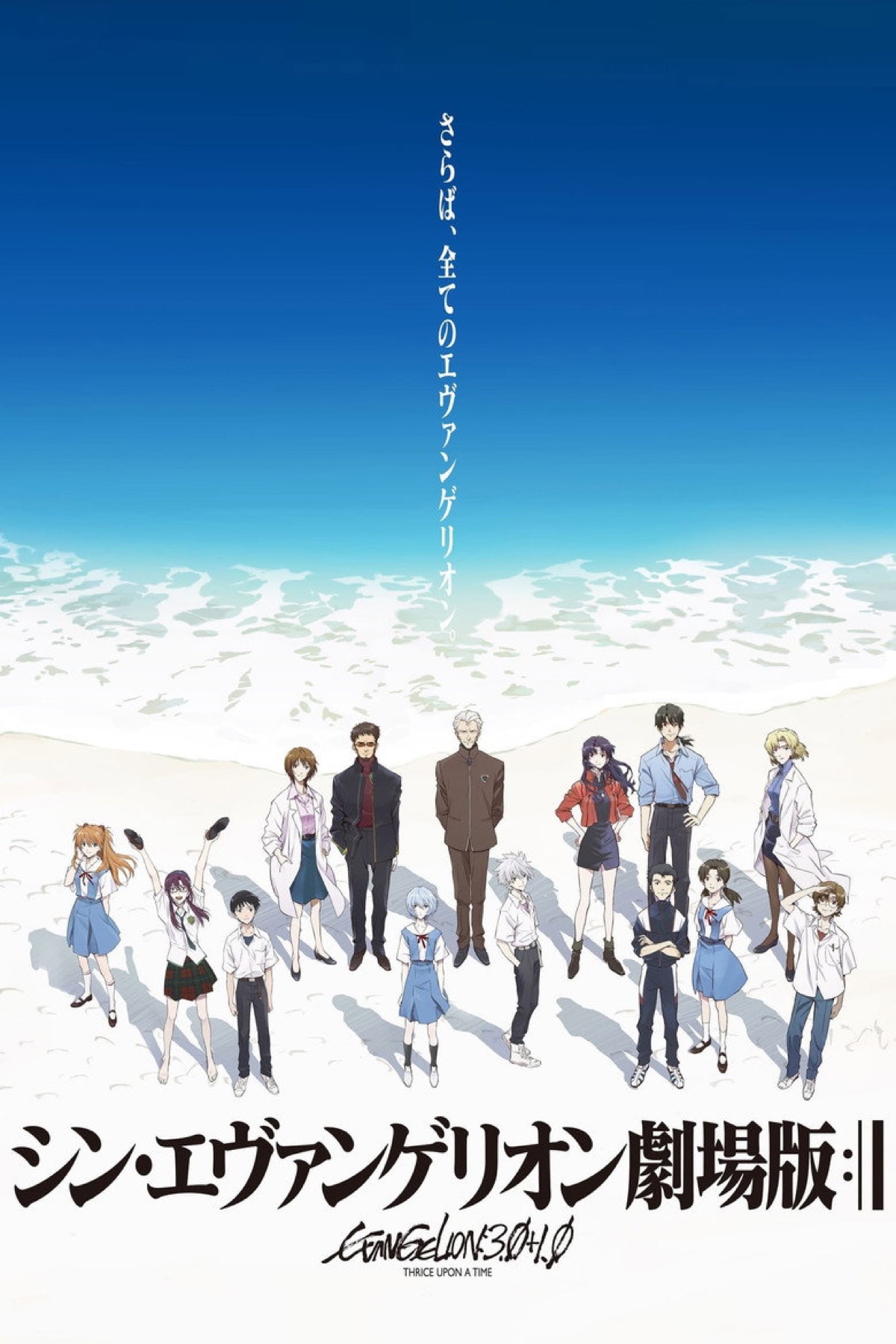
Work Info
- Title: Evangelion: 3.0+1.0 Thrice Upon a Time (2021). The version GKIDS put on US disc is labeled 3.0+1.11
- Japanese title: Shin Evangelion Gekijoban:||. In Japan the four films are called Jo, Ha, Q and Shin, never 1.0 through 4.0
- Chief Director: Hideaki Anno
- Directors: Kazuya Tsurumaki, Katsuichi Nakayama, Mahiro Maeda
- Music: Shiro Sagisu / Theme song: One Last Kiss by Hikaru Utada
- Runtime: 155 minutes, the longest film in the series
- Studio: Khara
- Released: March 8, 2021 in Japan. GKIDS took it to US cinemas from November 30, 2022 and to US disc on October 17, 2023
- Japanese box office: about 10.28 billion yen, the top-grossing release in Japan that year
- Sources: Japanese theatrical records, GKIDS release announcements
📖 Synopsis – No Spoilers
The film opens over Paris, or what a red mineral crust has left of it. Wille, the organization built to bring NERV down, has parked its flagship above the old city so a team can restore a ring of sealing pillars, and the window for the job is 720 seconds. Partway through the clock, NERV’s Evangelions arrive in numbers. The first fifteen minutes carry more animation per second than anything else in the series, and none of it is warm-up.
Elsewhere, three teenagers are walking across a Japan that no longer looks like one. Shinji Ikari has not spoken since the end of the previous film, and the story is in no hurry at all about that. It sits with him. The front half of this film is about living somewhere, and the back half is about finishing something, and the seam between the two is visible from a long way off.
✨ What Makes It Special
Why It’s Exceptional
- Graduates the cast, the people who made it, and the people who waited, in the same 155 minutes
- Hands you the difficulty instead of clearing it away first
- Runs animation and Japanese live-action monster-film grammar through one continuous picture
- The score and the closing song are the one part nobody in Japan argues about
Twenty-five years, and everybody graduates at once
The plainest description of this film is that it is a graduation ceremony. What separates it from every other anime finale is who is standing in the hall.
The characters graduate first, which is the part you can see. A boy who has been fourteen years old for a quarter of a century gets one adult at a time sitting down opposite him, and the film gives each of those conversations room to be uncomfortable. Then the people who made it graduate. Hideaki Anno spent 25 years with an unfinished piece of homework in his desk, and this is him closing the drawer himself rather than letting somebody else do it. And then the audience is graduated too, which is the part that does the damage.
Count the time honestly. The television series started in October 1995. This film opened in March 2021. Fourteen years pass inside the story, but twenty-five passed outside the frame, and in Japan that gap has a very specific shape to it. The kids who watched the original broadcast in middle school were closing in on forty by the time the finale opened. They had jobs by then. Mortgages, in a lot of cases. Children of their own who were the age Shinji is. Plenty of them had quietly stopped waiting somewhere in the middle and only came back because this was the last one.
The film knows all of this, and it is built on top of it. That is why it does not reduce to the question of how Shinji gets rescued. It is running the same conversation with the people in the seats. To anyone who left a version of themselves parked somewhere around 1997 and got older anyway, it says: you can put that down now. Once you notice the second floor under the film, the 155 minutes stop looking like a plot and start looking like a letter.
People who dislike the ending are not wrong to, and I will get to my own complaint later. But something I had been carrying for 25 years got handed back to me in a form I could set down with gratitude instead of a grudge. The loop closed. It closed facing forward. A review that turns into a thank-you note has stopped functioning as a score somewhere along the way, and I am leaving it in anyway.
Not following it is not you failing
Time to admit something. One viewing was not enough for me, and I am the target audience with 25 years of preparation behind me. It took three passes before the second half stopped being a wall of noise, and I would still not claim I have all of it. From the midpoint onward the film produces terminology at a rate no one on screen has any intention of explaining.
Whether you file that under flaw or under design decides your entire verdict on the film. My answer is that Evangelion has run on “I do not understand this and I cannot look away” since 1995. That is the exact sensation of watching the original broadcast at thirteen with no idea what an Angel was and no ability to switch off. What the last stretch of this film delivers is that sensation, reconstructed on purpose, one final time.
So the difficulty is specification, not leftover mess. Anno could have explained all of it and sent everybody home tidy. He had 155 minutes and total authority and he declined. Which means that if the film outruns you the first time, nothing has gone wrong on your end. There is a stretch of screen time where comprehension never arrives and your feelings get carried off regardless, and that experience is the thing you paid for. (Watch it a second time knowing where it lands and even the quiet village half plays differently.)
Animation and tokusatsu sharing one screen
The Paris battle is the whole thesis in fifteen minutes. Somebody takes hold of the Eiffel Tower and swings it. A 720-second counter burns down in the corner of the frame the entire time, which is a cheap trick and works completely.
The part worth stopping on is how the images are constructed. Buildings modeled in CG come apart with a weight hand-drawn animation cannot fake, and the camera is not placed where an animator would place it. It is placed where a tokusatsu crew would: the Japanese live-action tradition of men in suits demolishing miniature cities, which is Sunday-morning television for anyone who grew up here. Looking up at something enormous from too low. Framing pulled back further than the action wants. The subject drifting out of the edge of the shot because a physical camera could not track it that fast. You are watching anime, and every so often your eyes report that you are watching Ultraman. Anno has spent his whole career running this trade in both directions, which is why Shin Godzilla is live-action cut like a cartoon while this is a cartoon shot like live-action.
The last act pushes further than that. There are passages where images that have skipped part of the finishing process go by on screen exactly as they are, which by the ordinary rules of filmmaking is not allowed. It holds together because by that point the film has stopped pretending it is not a made object. The moment you can see the hands that built it, you are being shown 25 years of backstage along with the picture.
The one part nobody in Japan argues about
Japanese opinion on this film splits hard, and the split runs along generational lines. The music is where it stops splitting. In everything I read at the time and everything I have read since, I have yet to find a Japanese viewer with a bad word for Shiro Sagisu’s score. It works hardest in the quiet, and the piano under the village sequences is the only place in 155 minutes where your shoulders come down.
Then there is One Last Kiss. Hikaru Utada wrote Beautiful World for the first Rebuild film in 2007 and has stood at every milestone this series has had since. In the spring of 2021 the new song was unavoidable in Japan: shops, trains, television. Pieces of it had already been in the trailers, so most of the country knew the melody before knowing what it was for. Then you hear it at the end of the film and it is a different song. Handing the last one to anybody else was never an option.
Deeper Themes
The Japanese title ends in :||, which is not decoration. It is the repeat sign from written music, the mark telling a player to go back and perform the passage again. Sitting at the end of a finale, on the film that closes the story, it is doing two jobs that contradict each other. The narrative is over. The thing itself is marked to be played again, in the memory of whoever watched it.
The other three titles are the same joke, and it is the kind of joke you catch without trying if you were schooled in Japan. Jo and Ha are the first two movements of jo-ha-kyu, the classical pacing structure behind noh theater and gagaku court music: a slow opening, a break, a rapid finish. The third film takes the slot where kyu belongs and writes it as the letter Q. Anno named his four films after a six-hundred-year-old set of instructions for how a performance is supposed to be shaped, then ended the sequence on the symbol for do it again. Badly behaved. Completely in character.
🎭 Memorable Scenes
A number in the corner of the frame counts down from 720 while a ruined city is fought over. Nobody in the film mentions it. You watch it anyway, the entire time, and it does most of the work that dialogue would normally do.
The restoration of Paris. Cut it out of the film and it stands on its own as a complete action picture. Before a single thread of the story is picked up, the film simply overwhelms you with volume of craft, and that turns out to be a statement of intent.
The point where the picture changes texture. I am not going to describe what is on screen. There is a stretch late on where the images are not finished ones, and first-time viewers tend to sit up. Read it as a signal aimed at everyone who has ever built an animated film and it settles into place.
The final image. Not describing this one either. It moves the story somewhere the preceding 154 minutes give you no way to anticipate, and the instant it appears you understand where the film has been walking you the whole time. I will say only that it is the most argued-about shot in the entire series, and that it is the reason people came out of that screening quiet.
A short exchange between Asuka and Shinji. Something that has been unresolved between them since 1995 gets an end put to it. I am not saying what passes between them. What I will say is that how it lands on you probably depends on your age. At sixteen I would have missed it entirely.
💭 How It Made Me Feel
The reaction arrived before any opinion did, and the reaction was: that is over. Not good, not bad. Over. What I was responding to was not the quality of the film in front of me but the length of the relationship behind it, and I have never had a film do that to me before.
It did not fully land on the night. It landed about three days later, on a train, when I caught myself doing arithmetic on how old I had been in 1995. What the rewatches eventually made clear is that the film had been talking to the audience the entire time, on exactly the terms it was talking to Shinji. Put the version of yourself you left back there down. For anyone who followed this in real time, no other answer would have been worth the wait.
Having been in Japan for it probably changes what this film is. The opening got pushed back twice by the pandemic, so a country that was already tired of waiting spent one more year waiting on top of 25. When it finally opened, it opened on a Monday, which is not how films normally open in Japan. Whatever your relationship with this film turns out to be, ours was assembled out of a very long stretch of not being told.
Who Should Watch This?
- Anyone thrown off by the third film who never went back (this one is for you specifically)
- Anyone who lived through the 1995 broadcast and the 1997 films as they happened
- Viewers who can enjoy a difficult film without needing to solve it first
- Anyone interested in how animation and live-action camera grammar borrow from each other
😅 Where It Falls Short
Mari never gets an inside
I have been praising this film for well over a thousand words. One thing has never stopped bothering me, and it has a name: Mari Makinami Illustrious.
Mari is positioned a step above the world of this series, watching it from an angle nobody else has access to. Her job is to pull Shinji outward, and without her the film does not reach the place it reaches. All of that is legible and all of it works.
The trouble is that the job is nearly all there is. She is not a total blank: late on, a flashback puts her on screen for a second or two in what looks like her university years. The film stops there, and what she is carrying while she stands next to Shinji is never accounted for. No conflict, no hesitation, nothing lost. Every other character in this story has to put their weakest self on screen before they are allowed to move forward. She is the one exempted from the procedure.
Which leaves her outside the logic of the world she is saving. Not Asuka, not Rei, not Gendo, nobody built by the rules the film runs on: somebody from outside walks in and takes the boy out. I understand why that is the kindest solution available. It also reads as a statement that nobody on the inside could manage it, and that reading is still sitting with me. That bothers me, and I still think this is the right ending for the series.
The back half changes people faster than the front half earned
Even at 155 minutes there is not enough room to clear 25 years of debt. In the closing stretch, several characters who have been locked in position for a very long time swing round inside a handful of scenes. Because the first half was so patient about sitting in silence, the speed of the second half is conspicuous rather than invisible.
Some people also get left behind. A few characters who have been present across the whole series reach the end without being handed a line to close on. Giving every one of them a moment was never possible, but there are two or three faces here that another ten minutes would have covered.
The Downsides
- Mari is written as a function and never given an interior life
- Characters turn around faster at the end than the patient opening prepared for
- Several long-running faces exit without a closing line
Who Might Not Enjoy This?
- Anyone who has seen none of the series, since starting here is not viable
- Viewers who need every question answered by the time the credits roll
- Anyone hoping to be devastated the way the 1997 film devastated people
📺 Streaming Guide by Service
The finale is now the easy one to find
What US viewers have now is uneven, and this film got the good half of the split. GKIDS took North American rights to the finale in 2022, ran it in US cinemas that December, and put it out digitally and on disc the following year, so it is rentable tonight from whichever storefront you already use. The third film is the one with no North American digital rights attached, which currently leaves it with nowhere to go but a disc. If you are working through all four, that is the gap to plan around, not this one.
One note on versions. The disc GKIDS sells is labeled 3.0+1.11, a slightly revised cut rather than the print that opened in Japanese cinemas in March 2021, which was 3.0+1.0. The cut Amazon lists for rent today is a third, 3.0+1.01. The differences across all three are small and nobody watching for the first time will register them.
Where to Watch
- Amazon Video: rent or buy, English dub and subtitled versions both listed
- Apple TV: rent or buy
- Fandango at Home: rent or buy, as do Google Play and YouTube
- Amazon Prime Video: no longer included with a subscription since August 13, 2026
- Crunchyroll, Netflix, Hulu: not carrying this film in the US
Soundtrack
- Spotify: available
- Apple Music: available
The score runs to 54 tracks under Sagisu’s name, the village piano among them, and it holds up as an hour of listening on its own. The closing song sits outside the album. One Last Kiss went to number one in Japan, and spent three straight weeks on top of two separate digital rankings at once, which no solo artist had managed before. Number one, for a piece of music written to end something. Hikaru Utada had also written Beautiful World for the first Rebuild film in 2007, so the same voice opens and closes a set of films made fourteen years apart. Play the two back to back once. The distance between them is the distance the series traveled.
📀 On Disc
There is no manga or novel underneath this one. Evangelion was original work from the start, so the disc is the only physical object the film comes in. GKIDS released it in the US on October 17, 2023, with the English dub and subtitles, plus a collector’s 4K UHD edition carrying the bonus prologue shorts.
The case for owning it is stronger than it looks. A film no US subscription carries, and that specifically rewards a second viewing, is a poor candidate for renting twice. If you expect to watch it more than once, own it, on disc or as a digital purchase.
🎬 If You Loved Thrice Upon a Time, Watch These 3 Next
This is a finale that chose not to explain itself. So rather than chase the same aftertaste, here are two finales that explain everything down to the last bolt, and one film that asks the village question head on. Watching how other stories fold themselves up is the fastest way to see the shape of this one.
Attack on Titan: The Final Chapters
The other long-running series that had to land a decade of accumulated weight, and the other one that split its audience clean down the middle doing it. The difference is method: this ending talks, at length, and leaves nothing unstated. Put the two next to each other and you can see two opposite theories about what an audience is owed at the end.
👉 Where to Watch Attack on Titan: The Final Chapters and THE LAST ATTACK in the US
Summer Time Rendering
Another story about repeating the same stretch of time, run on the opposite settings. Across 25 episodes it lays out the machinery of its loop and then closes it with arithmetic. A loop narrative that finishes with no residue left over is a satisfying thing to watch, and it is the obvious cure for anyone who walks out of Thrice Upon a Time still asking what that was.
👉 Summer Time Rendering Streams Only on Hulu: The Time Loop He Uses as a Walkthrough
Crayon Shin-chan: The Adult Empire Strikes Back
Stay inside the warm past, or walk out of it. Evangelion asks that in its village sequences and this one asks it with an entire city built out of the smell of the twentieth century, occupied by adults who locked themselves in on purpose. The person sent to prise them out is five years old. As a film about putting the past down, it arrives at the same place as a 155-minute graduation, in half the time and with fart jokes. Trust the children’s-cartoon packaging and it will take you apart.
👉 Crayon Shin-chan: The Adult Empire Strikes Back, Japan’s Best Film About Being an Ordinary Father
👉 Why are the pilots 14? Why does an Eva bleed? Why does the story have two endings? The questions that run across the whole series are answered in Why Are Evangelion Pilots 14? The Answer Everyone Repeats Has No Source.
📝 Final Thoughts
The practical advice is fixed and there is no way around it. The order cannot be rearranged. This film is constructed on the assumption that you have the three before it in your head, and skipping the homework means being lost from the opening minutes onward. Budget three more films on top of the 155 minutes. Do that, and the question of whether it is worth watching now has an easy answer: a series that ended in 1997 by leaving its audience in pieces gets to be watched arriving somewhere else, and this is the only film where that happens.
The blank where Mari’s inner life should be still bothers me, because it can be read as an admission that nobody inside this world was capable of getting the boy out. Weigh that against what the film does and it does not come close to balancing. I got to be in the room when that kid finally faced forward and started walking. Eight and a half out of ten, and it is a compromised eight and a half, handed out by somebody who waited 25 years and cannot pretend to be impartial about the wait. Remember what I said at the top about the first thing out of my mouth. Anyone who has carried this series for long enough will end up saying some version of it too.
⭐ Series at a Glance
| Category | Rating | Note |
|---|---|---|
| Story | ★★★★☆ | Settles 25 years of debt. Cannot stand alone for a second |
| Visuals | ★★★★★ | Drawing, CG and tokusatsu camera on one continuous surface |
| Music | ★★★★★ | Sagisu and Utada, the part Japan does not argue about |
| Characters | ★★★★☆ | Nearly everyone gets an ending. Mari gets a role |
| Newcomer accessibility | ★☆☆☆☆ | Three prior films are a practical requirement |
| Rewatch value | ★★★★★ | The village half changes completely on a second pass |
Usagi’s Recommendation Score
⭐⭐⭐⭐⭐⭐⭐⭐⭐☆
8.5 / 10
155 minutes built for the people who waited 25 years. It lets them graduate.

