*This page contains affiliate links. We may earn a commission if you make a purchase through these links.
“Gambling is more fun the crazier you are. So let’s gamble ourselves mad.”
That is the official Japanese tagline, and it makes the show sound like something you need to brace for. Twelve episodes later I can report the opposite. Kakegurui is the least punishing gambling story I have ever sat through, and it gets there by removing the one thing the genre normally runs on. No one at this table is desperate. The girl at the centre of it is having the time of her life whether she wins or loses, and once you understand that, you stop worrying about her. You just sit back and wait to see how she does it.
Which is also the complaint. Every good thing in this show can be lifted out of the praise column and dropped into the problems column without changing a single word. Most reviews keep those two lists apart because it reads more cleanly. For this show that would be a lie, so I am going to leave them tangled together where they belong.
📺 Where to Watch Kakegurui (August 2026)
| Service | Status | Notes |
|---|---|---|
| Netflix | Streaming | All 12 episodes, subtitled plus English dub. Season 2 sits on the same page |
| Crunchyroll | Not available | Netflix holds the licence everywhere outside Japan |
| Hulu | Not available | — |
| Amazon Prime Video | Not available | Nothing to rent. Nothing to buy |
| HBO Max | Not available | — |
As of August 28, 2026, Netflix is the only place a US viewer can watch this, and there is no rental or digital purchase to fall back on. The upside of a single-service title is that the Netflix page carries the whole run: season 1, season 2 as Kakegurui ××, and the English dub Bang Zoom! recorded back in 2018. Licences move, so check the service before you plan an evening around it.
Here is something worth knowing if you have had this show sitting in your Netflix list since college. Netflix has streamed Kakegurui worldwide since 2018 with one country carved out of the deal: Japan. For years the answer to “where can I watch Kakegurui” was easier to give an American than a Japanese person. That only changed on December 1, 2024, when the show finally began rolling out to Japanese services, and U-NEXT added it on January 1, 2025. Eight years is a long time for a country to be locked out of a show it made itself.
👉 This country being last in line for one of its own titles is not unusual. My Neighbor Totoro is the more famous case, and that gap has still not closed.
🎬 Trailer
Work Info
- Title: Kakegurui (Season 1)
- Aired: July 1 to September 23, 2017 (12 episodes, about 24 minutes each)
- Director: Yuichiro Hayashi
- Series Composition: Yasuko Kobayashi
- Character Design: Manabu Akita
- Music: Technoboys Pulcraft Green-Fund
- Animation: MAPPA
- Original manga: Homura Kawamoto and Toru Naomura, serialized in Monthly Gangan Joker
- Opening: “Deal with the Devil” by Tia / Ending: “LAYon-theLINE” by D-Selections
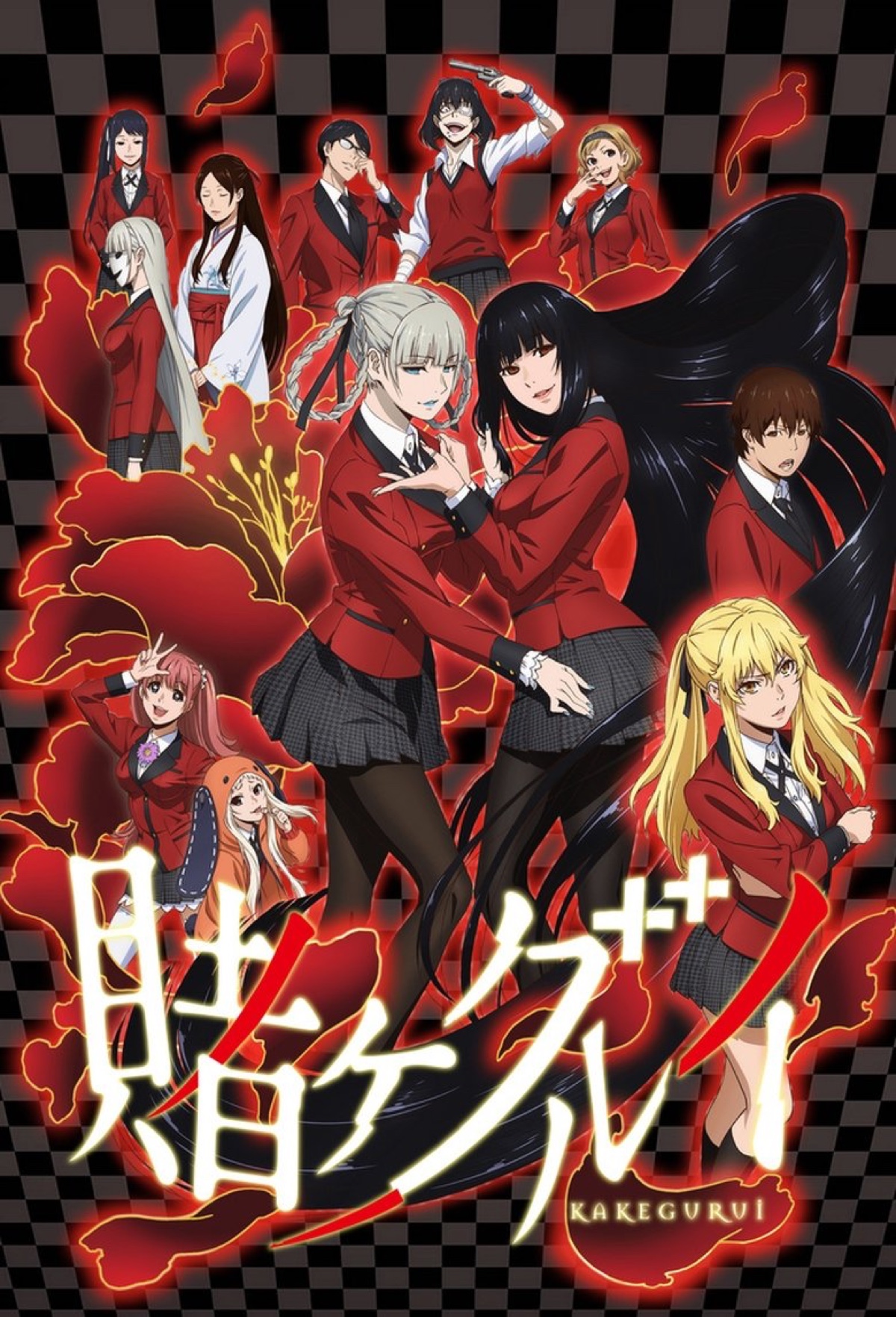
📖 Synopsis – No Spoilers
At Hyakkaou Private Academy, rank has nothing to do with grades or family money. It is decided by how well you gamble. Students who lose enough to fall into debt are demoted to a class called housepets, given animal nicknames, and stop being treated as people by everyone around them. The student council runs the whole apparatus, and the president, Kirari Momobami, sits at the top of it.
Into the classroom of Ryota Suzui, one of those housepets, walks a transfer student named Yumeko Jabami. Every other person in this building uses gambling as a means to something: a higher rank, more money, control over somebody weaker. Yumeko is the exception. For her the betting is the point, and the result barely registers. Drop one person who gambles for its own sake into a room full of people gambling for leverage, and the leverage stops working. That is the entire engine of the show.
✨ What Makes It Special
Why It’s Exceptional
- It swaps the genre’s forced gambler for one who volunteers, and everything follows from that
- The animation budget goes almost entirely into the second somebody’s composure comes apart
- Saori Hayami plays derangement without ever raising her voice, and the supporting cast follows suit
- The cheating always has a mechanism you can follow, so the wins feel earned rather than granted
Nobody had to drag this gambler to the table
Japanese gambling manga has a house rule that almost nobody breaks: the protagonist is made to play. Kaiji is loaded onto a ship because of a debt he did not really choose. Nao Kanzaki in Liar Game opens a package containing 100 million yen and discovers she cannot give it back. These people sit down at the table because there is no other door out of the room, and that is what generates the pressure. You watch them because you are worried about them. Losing ends their life, and the story leans on that the whole way.
Yumeko Jabami arrives with none of that attached. No one is forcing her, nothing is closing in. She gambles because the gambling itself is pleasurable, full stop. By episode 4 she is 310 million yen in the hole, roughly two million dollars, and gets tipped into a mass debt-clearing event that the show frames as a humiliation ritual. She looks delighted. A scene built to be the low point of somebody’s life is filmed as a treat, because that is genuinely what it is for her.
That one substitution changes what your brain does for twelve episodes. Since there is nothing to be anxious about, you stop asking whether she can win and start watching how she wins. Instead of tensing up, you fold your arms and wait for the method. The weight that gambling stories usually strap to your back the moment you press play never gets loaded on. Almost all of this show’s watchability comes from that single decision.
Structure backs it up. Each gamble resolves inside two or three episodes, which caps any single game at about seventy minutes. There is no stretching, no long stall before the reveal. Stalling would not work anyway: the audience already knows Yumeko will be fine either way, so the writers spent their effort on tempo instead. Twelve episodes go past in one sitting without any obvious place to stop.
Here is where I should be honest about myself rather than about the show. I have watched the genre’s heavyweights and I rate them, but the weight is exactly why I space them out. Kaiji is superb and it takes something out of me. This one asks for nothing.
Everything is spent on one frame
The safest seat in this academy is the one you are watching from.
In Japan the shorthand for this series is kaogei anime, which translates roughly as “face acting” and refers to the deliberately grotesque expressions a show pushes its characters into. Accurate, but it undersells what is on screen. What actually gets filmed is not the distorted face itself, it is the exact second the arrogance falls off somebody. Someone who has spent two episodes smiling down at the room loses the upper hand, and the voice climbs, the posture collapses, the eyes roll back. The pleasure lives in the drop, not in the drawing.
What makes it work is what the production gave up to pay for it. Outside the key moments the art is nothing special, and MAPPA clearly knew that going in. Refusing to spend on ordinary shots is what leaves enough in the budget for the collapses to be rendered at a density that borders on unreasonable. The freeze frames follow the same logic, landing at the precise instant a person’s real character has finished surfacing. You can see the labour that went into individual teeth.
Calling this a gambling show undersells it. What you are actually watching is social status evaporating in real time, and the cards are just the delivery system. And the reason it plays as entertainment rather than cruelty is that you have nothing on the table. Show the same footage to someone sitting in that chair and it stops being funny immediately. The show hands you the guilty pleasure of watching people fall from a place where you cannot be reached, and does not pretend otherwise. (Not a flattering thing to enjoy. I am aware.)
Deeper Themes
What the students of Hyakkaou are actually wagering is neither money nor rank. It is the belief that they belong to the category of people who win. That belief is what leaves the body first when a hand goes wrong, which is why the faces go before the chips do. Yumeko never held that self-image to begin with, so there is nothing in her for a loss to take. Her apparent invincibility is not skill. She simply put something different on the table than everyone else did.
Not one raised voice
Saori Hayami never lifts her voice as Yumeko. The delivery stays polite and unhurried from the first episode to the last while the content of the sentences goes somewhere unwell. Screaming would have been the easy route to “unhinged” and the production declined it, which is why the character stays unsettling instead of becoming a cartoon. Mariya Ise as Midari Ikishima and Minami Tanaka as Mary Saotome work the same way, building the gap between composure and collapse with nothing but temperature.
The sound design deserves credit past the score itself. Technoboys Pulcraft Green-Fund wrote the music, but the sharpest trick is where the episode title card lands. It drops in immediately after a game has turned, so it functions as a breath rather than a formality. Tia’s opening and the D-Selections ending are both slicker than a 2017 late-night anime had any obligation to be.
🎭 Memorable Scenes
Episodes 4 and 5, the two-card Indian poker inside the debt exchange
This is the high point of the season and the cleanest thing in it. Yumeko and Mary end up seated with Jun Kiwatari, a student known for how he treats the housepets, and with Nanami Tsubomi, the housepet he owns. Three separate things make it land.
The first is that Kiwatari is written as unredeemable and left there. Shows like this usually pause to explain the loser, to give you a reason to feel conflicted while he goes under. Not here. The absence of that courtesy means you get to watch him disintegrate with nothing complicating the view.
The second is the game. Indian poker takes three seconds to explain: you can see everyone’s card except your own. No brainpower goes into holding the rules in your head, so all of it is free for the strategy, and the payoff of the reveal is proportionally bigger. The season’s more elaborate invented games are impressive, but understanding arrives faster here, and speed is most of the pleasure.
The third is the ending. The result comes to rest in Tsubomi’s hands, and what Yumeko offers her is not a bailout. It is a step forward that costs nothing and changes everything. The episode declines to end on an accounting of who gained and who lost, and instead follows a person one notch further than she was. It is the only stretch of the season where something survives past the final chip.
Episodes 10 and 11, the choice poker, are close behind. A player at a clear financial disadvantage accepts unfavourable terms and sits down anyway, and the resolution runs on arithmetic rather than nerve. Judged purely as a designed game, it may be the best thing in the twelve.
💭 How It Made Me Feel
If you ask whether it stayed with me, the answer is not really.
Nobody’s life is altered here, and nothing about the world outside looked different afterwards. What I will say is that as a show to enjoy without effort, I will recommend it without hedging. Twelve episodes at twenty-four minutes that never once give you a reason to stop are rarer than they sound. Most twelve-episode shows have a dead stretch somewhere in the middle. This one does not, and that alone is worth the evening.
Concretely: it has gone onto the short shelf I reach for when I want television that does not ask me for anything. That is a smaller compliment than a masterpiece gets, and a more useful one.
😅 Where It Falls Short
The academy never behaves like a school
As far as I can recall, a teacher appears exactly once, in episode 1. Lessons are barely shown. The student council holding absolute power is clear enough as a premise, but what this institution actually does as a place of education is never established. The housepet system has the same problem. Students demoted to that class do not look like they are living through anything especially terrible, which is awkward for a show whose plot assumes the system is monstrous. The cruelty is asserted rather than shown.
Let me argue the other side for a moment, because there is a real defence. Cutting the outside world entirely is what makes Hyakkaou feel severed from everything. Skipping ordinary school life is subtraction, not laziness, and it is a legitimate way to build a sealed room. Had we been given commutes and family dinners between the games, the strangeness would have thinned out by half. I think that reading holds up.
The housepet material is where the defence runs out. Without any felt sense that losing here ruins a life, the wagers weigh less than the show needs them to. Cutting the daily routine was the right call. Cutting this was not.
The tension never stacks up
I have been listing strengths for a while now. Every one of them is about to come back as a complaint, in the same words.
Yumeko is the protagonist, so the outcome of any given game is legible before it begins. On top of that, the show gives her no backstory and no visible fear. A character with nothing to lose, who also does not lose, cannot generate suspense no matter how baroque the game around her gets. Life-or-death stakes arrive repeatedly across twelve episodes and my pulse stayed exactly where it was. Watching the method never stops being fun, but the knuckle-whitening feeling simply never turns up.
Refusing to go inside her adds to the lightness. There is a moment with Suzui where something like an unguarded expression appears, and the show declines to follow it. Deranged is the whole characterisation, held from beginning to end. A single instance of Yumeko being afraid of something would have made a result unpredictable, and the season never spends one.
Fixing that would destroy the thing I liked. Add weight and dread and you drift toward Kaiji, and you lose the one asset nothing else in the genre has: twelve episodes you can finish without needing a recovery day. The lightness is a choice, not a defect. It bothered me anyway, and I would still hand this to somebody tonight.
The Downsides
- The housepet system is described as brutal but never shown to be, so the bets weigh less than they should
- The lead cannot lose, so no amount of escalation builds pressure across the season
- Yumeko is never opened up, and finishes the season exactly as thin as she started it
Who Should Watch This?
- Anyone who got through Kaiji or Liar Game and does not want to carry that weight every single time
- Anyone who came in through Bet on Netflix and wants to see what the animated version does with the same premise
- Anyone who already knows they do not mind watching people come apart (this one is for you specifically)
Who Might Not Enjoy This?
- Anyone who wants a protagonist backed into a corner with a real chance of losing
- Anyone with a low tolerance for extreme facial distortion as a visual style
- Anyone expecting airtight rules and a tightly argued battle of wits
🃏 Kakegurui in Order: Every Anime, Drama and Film (and Where Bet Fits)
Search this title and you will land on something other than the anime within about two clicks, because the franchise now covers two animated seasons, a spin-off, Japanese live-action television, two Japanese films, a stage play and an English-language Netflix series. Here it is in order of release.
| Title | Format | Year | US streaming |
|---|---|---|---|
| Kakegurui (Season 1) | Anime | 2017, 12 episodes | Netflix (this review) |
| Kakegurui (live-action drama) | Live action, Japan | 2018 / 2019 | Netflix |
| Kakegurui ×× (Season 2) | Anime | 2019, 12 episodes | Netflix |
| Kakegurui: The Movie | Live action, Japan | May 3, 2019 | Not available |
| Kakegurui Twin (live-action drama) | Live action spin-off | March to April 2021 | Not available |
| Kakegurui 2: Desperate Russian Roulette | Live action, Japan | June 1, 2021 | Not available |
| Kakegurui Twin | Anime spin-off | August 4, 2022 | Netflix |
| Bet | Live action, English | May 15, 2025, 10 episodes | Netflix |
Start with the anime and go in order. Seasons 1 and 2 are continuous, with the second shifting weight onto the student council officers rather than staying with Yumeko. Kakegurui Twin is a prequel following Mary Saotome through the year before Yumeko transfers in, and it plays much better once you already know who Mary becomes.
The Japanese live-action drama can be watched alongside all of it. If you arrive from there, the anime will feel like the more extreme version, and for a mechanical reason: a live actor has a face with physical limits on how far it can be pushed. Drawing has no such ceiling. As for Bet, Netflix’s English-language series from 2025, treat it as a separate object rather than an adaptation to check for accuracy. Setting and characters were rebuilt for it. Plenty of English-speaking viewers met this story through Bet first, and there is nothing wrong with running the order backwards from there.
Against the manga, season 1 takes you to the end of volume 5. One caveat: the final gamble in episode 12 was written for the anime and does not exist in the original. Readers in Japan are split on it, and if you plan to continue in print, volume 6 is the clean place to pick up.
📺 Streaming Guide by Service
Is Kakegurui on Netflix or Crunchyroll in the US?
Netflix, and only Netflix. Crunchyroll does not carry it in the United States and never has, because Netflix took worldwide rights outside Japan back in 2018 and has held them since. Hulu and HBO Max do not have it either, and unusually for a title this well known, there is no rental or purchase option on Prime Video or Apple TV to fall back on. Without a Netflix subscription there is no legal way to watch this show in the US at all.
The consolation is that one subscription gets you almost the entire franchise. Season 1, season 2, the Kakegurui Twin spin-off, the Japanese live-action drama and Bet are all on the same service. At twelve episodes of twenty-four minutes, season 1 runs about five hours, so a single evening and a bit of a second one covers it.
Where to Stream
- Netflix: Streaming, all 12 episodes, subtitled plus English dub, ad-supported plan included
- Crunchyroll: not available in the US
- Hulu, HBO Max, Prime Video, Apple TV: no subscription, no rental, no purchase
Soundtrack
Technoboys Pulcraft Green-Fund’s score runs to 61 tracks and streams in full under the title Kakegurui Original Soundtrack.
- Spotify: the complete 61-track album
- Apple Music: same album, US store
📚 Read the Manga
Homura Kawamoto and Toru Naomura’s original is still running in Monthly Gangan Joker, and reached 21 volumes in Japan with the most recent released on March 21, 2026. Yen Press publishes it in English as Kakegurui: Compulsive Gambler and is past volume 20, so the translation is nearly current. Season 1 stops at the end of volume 5, which makes volume 6 the place to start reading if you would rather continue now than wait for another season. It is also the fastest way to find out what happens next, given how far ahead of the anime the manga has run.
- Kakegurui: Compulsive Gambler, Vol. 6: exactly where the season leaves off
- The full Yen Press run: for anyone starting at volume 1
🎬 If You Liked Kakegurui, Watch These 3 Next
Death Note
The product Kakegurui is actually selling, that instant when composure comes off somebody’s face, was being sold a decade earlier by Death Note. The camera moves the same way: less interested in the reasoning between Light and L than in what happens to the face of whoever thought they had the advantage. The difference is what sits behind the collapse. Death Note has no safe seat for you, so the same shot leaves you breathing shallower.
One-Punch Man Season 1
The exact problem I spent three paragraphs complaining about, a protagonist who cannot lose, is the premise here rather than the flaw. Saitama ends every fight in one hit and you know it from episode 1. One-Punch Man converts that into the joke and builds the emotional weight somewhere else, in a bald man’s total inability to feel anything about winning. Watch it after this and you can see two shows facing an identical structural dead end, one working around it and one walking straight into it.
👉 Read the One-Punch Man Season 1 review
NIPPON SANGOKU
If you want the one thing Kakegurui refuses to give you, this is where to get it. Also twelve episodes, also a series of confrontations, except what settles them is the logic of an argument, built one step at a time until a position turns over. The pressure keeps climbing because nothing is decided by nerve or luck. Western coverage of it is almost nonexistent, which is the main reason I keep pushing it, and it streams on Prime Video in the US with an English dub.
👉 Read the NIPPON SANGOKU review
📝 Final Thoughts
Kakegurui is twelve episodes of a gambling story with the desperation surgically removed. The reason a character sits down at the table changes from “there was no other option” to “this is enjoyable,” and that single move fires the audience from the job of worrying about anybody. What is left is the satisfaction of watching a scam get taken apart, arriving at a rate of one complete game every two or three episodes, with no logical corners cut to get there. Nowhere in it is there a good place to stop.
What was traded away is tension. A character who cannot lose keeps making bets that cost her nothing, so however loud the games get, the stakes never register in the body. The academy’s cruelty is stated more than it is filmed. The show runs on watchability bought with weightlessness, and if you sit down knowing that is the deal, it is about as comfortable as twelve episodes get. Every line of praise up there is also a line of complaint, printed once and counted twice. I warned at the top that pulling them apart would have been a lie. That is the whole review.
⭐ Series at a Glance
| Category | Rating | Note |
|---|---|---|
| Story | ★★★☆☆ | The individual games are built well, the spine holding them is thin |
| Characters | ★★★★★ | Everyone lands, right down to the one-episode opponents |
| Animation | ★★★★☆ | All of it goes into the collapses; ordinary shots pay the price |
| Pacing | ★★★★★ | One gamble per 2–3 episodes; twelve gone in one breath |
| Tension | ★★☆☆☆ | The results are legible, so the pressure never arrives |
| Music / OP / ED | ★★★★☆ | Sharp, down to where the title card drops |
Usagi’s Recommendation Score
⭐⭐⭐⭐⭐⭐⭐☆☆☆
7.3 / 10
Not a show that marks you. Still the one I reach for on a tired night.

