*This page contains affiliate links. We may earn a commission if you make a purchase through these links.
I bought the entire manga after three episodes. Waiting a week at a time stopped being an option, and I don’t usually break that way for a currently-airing show. Knowing what happens past episode 12 didn’t hurt the weekly watch at all.
Here is the thing nobody tells you going in. Japan collapses, splits into three warring states, and technology falls back to roughly the 1870s. It sounds like a setup for enormous battle sequences. Large armies almost never clash on screen. What you get instead is negotiation, procedure, and speeches. This is a war epic that barely shows a war, and it works far better than it has any right to.
📺 Where to Watch NIPPON SANGOKU (August 2026)
| Service | Status | Notes |
|---|---|---|
| Amazon Prime Video | Streaming | All 12 episodes, English dub available. Also on the ad-supported plan |
| Crunchyroll | Not available | Prime Video holds exclusive rights outside Japan |
| Netflix | Not available | — |
| Hulu | Not available | — |
| HBO Max | Not available | — |
As of August 1, 2026, this is a Prime Video exclusive. Amazon MGM Studios co-produced it and took worldwide rights outside Japan, releasing it in over 240 countries and territories. If you have been hunting for it on Crunchyroll, that is why you came up empty. An English dub is available alongside the subtitled version, so this is one of the rare seasonal anime you can hand to a dub-only friend on day one. Availability shifts, so check the service before planning an evening around it.
One more before you go: if stories about people risking everything to defend an idea are your weakness, Orb: On the Movements of the Earth hits the exact same nerve.
🎬 Trailer
Work Info
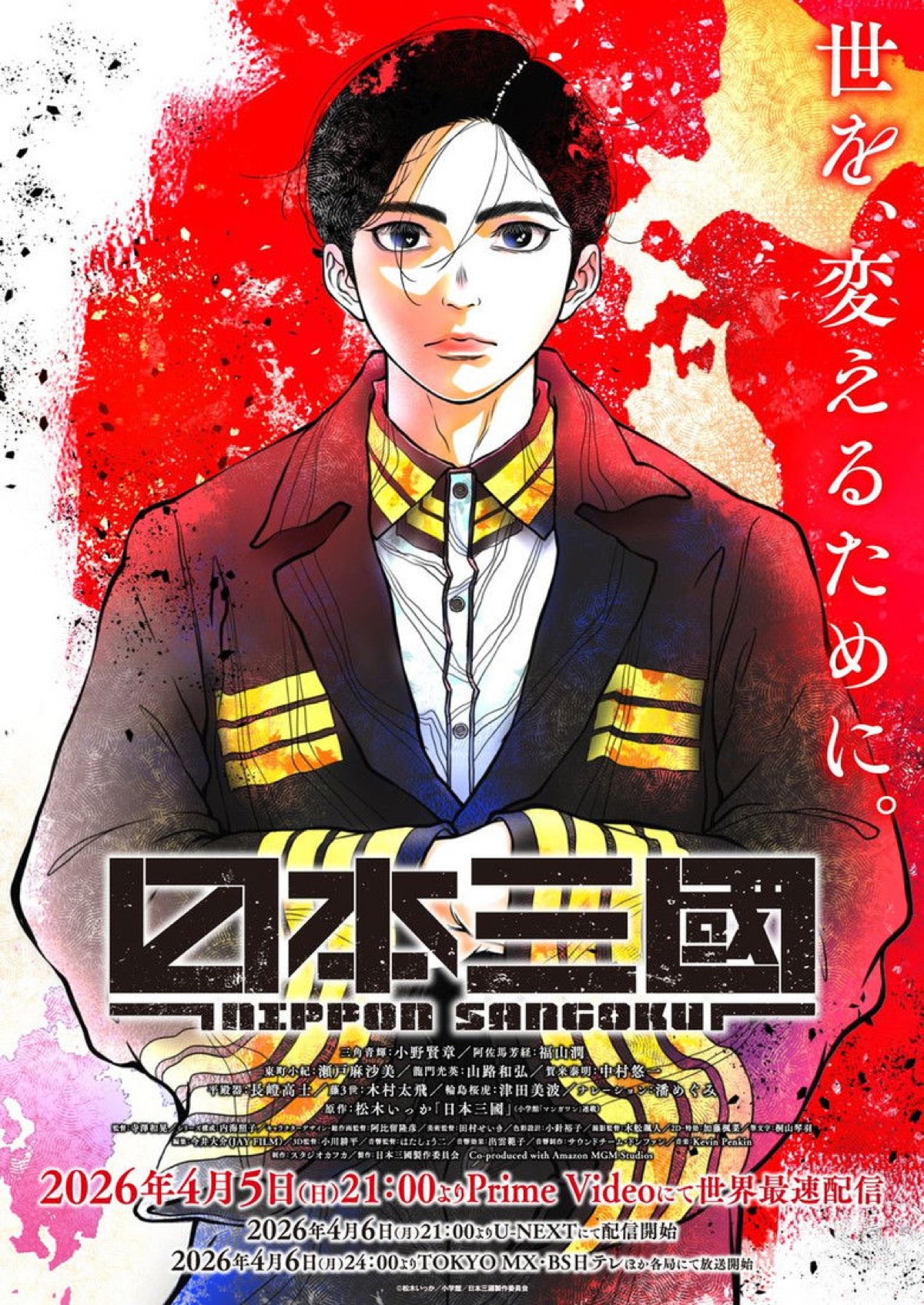
- Title: NIPPON SANGOKU: The Three Nations of the Crimson Sun (日本三國)
- Aired: April–June 2026 (12 episodes)
- Director: Kazuaki Terasawa/Character design: Takahiko Abiru
- Studio: Studio Kafka/Music: Kevin Penkin (Made in Abyss, Tower of God)
- Original manga: Ikka Matsuki, serialized by Shogakukan
- Opening: Tatsuya Kitani “Hidane”/Ending: Leina “Chikai”
📖 Synopsis – No Spoilers
Late in the Reiwa era, Japan loses its economic footing and never recovers. A nuclear war abroad sends refugees and disease across the islands, earthquakes follow, and wealth stays locked in the hands of a few while everyone else starves under crushing taxes. The population revolts. Within a few years the country has lost ninety percent of its people and most of its technology, landing somewhere around the 1870s. Decades later, three nations — Yamato, Buo, and Seii — are carving up what used to be Japan.
Aoteru Misumi is a minor bureaucrat in Yamato, living quietly with his wife. She is executed on the order of the Interior Minister. Misumi decides on revenge, but the weapon he picks up is neither a sword nor a gun: it is the history, law, and administrative knowledge he accumulated as a clerk, plus an unnerving talent for making people agree with him. He sits the civil service exam under a frontier general and starts climbing.
✨ What Makes It Special
Why It’s Exceptional
- The antagonist is the engine of the entire story
- Episode 1 packs the world, the lead, and the inciting disaster into one sitting
- Battles get cut so that negotiations and speeches can be the set pieces
- Kevin Penkin scoring a political drama, which turns out to be a perfect match
The Interior Minister is volunteering to be the villain
More than half of what this show is worth sits with one character.
The Interior Minister holds more real power than the emperor, and he flashes a peace sign and a soft little smile while sentencing people to death. He is the reason the protagonist’s wife dies. He is genuinely infuriating to watch. I have never had a hand gesture ruined for me before.
Then the episodes accumulate and the read changes. The man is frighteningly competent. He reads a room instantly, measures exactly what everyone wants, and never wastes a move. Most stories write corrupt officials as greedy and stupid, because that makes them satisfying to topple. This one refuses that shortcut.
Having finished all twelve, I have a stronger suspicion. He can see his own execution coming, and he is walking toward it on purpose.
Running a state sometimes requires somebody to collect the hatred. Someone has to levy the taxes, sign the death warrants, and be the face people curse. Whoever accepts that job gets removed eventually, in the name of justice, by whoever comes next. Watch how he behaves and it starts to look like the ending is already in his calculations. That would make him something other than a bureaucrat clinging to power: a man committing evil with his own destruction already priced in.
To be fair to myself, I might only be this generous because I read ahead in the manga. The version of me who was watching week to week was still just angry at him.
Episode 1 does something close to a curse
What the collapse looked like, how the three nations divide the map, who Misumi is, and the event that detonates his life. All of it fits inside the first episode.
Most shows would burn a full episode on exposition alone. This one dissolves the exposition into the incident, so you never feel lectured. By the time you notice, the shape of this man is in your head and his life is already moving. Getting off after that is difficult.
The telling detail: people who dropped the series still praise episode 1. Viewers in Japan who bailed at episode 6 wrote that the opening was flawless before explaining why they quit. That is a rare thing for an entry point to pull off.
A war epic that barely shows a war
Three nations fight over a country, and full-scale battles are almost entirely absent. In their place: officials negotiating, crowds being addressed, institutions being argued over.
The omission is what generates the pace. The author wanted conversation, psychology, and politics to carry the drama, and the adaptation inherited that intention cleanly. Because the fat is gone, twelve episodes hold an enormous amount of plot without a single sagging stretch.
Deeper Themes
Mencius wrote that those who subdue people by force never win their hearts. Misumi is essentially testing that proposition, trying to move a country with argument rather than violence. But the Interior Minister clearly understands the same principle. He simply stands on the side of force anyway, because a nation this broken has no margin for winning hearts. Somebody has to hold the thing together with fear. What happens to the person who takes that job is, quietly, the more interesting question this series is asking.
Memorable Scenes
Episode 1, where a man who has just lost his wife chooses not to swing at anyone and instead corners his enemy with an argument. Pick up a sword there and this story never starts.
Then there is the retainer who takes the blame for his lord and walks knowingly to his own execution. A single episode carries his whole life, his intelligence, his loyalty, and his bond with his commander. He is not on screen for long, yet by the end you feel like you have known him for years. As a demonstration of writing a character completely, this is the peak of the season.
And late in the run, a fan-favourite leaves the story in a way that gives you nowhere to put the feeling. It stayed with me for days.
How It Made Me Feel
I no longer know how to hate the Interior Minister properly, and that bothers me.
Being able to despise a villain cleanly is a comfort. This show takes that comfort away on purpose. The more you loathe him, the more his competence shows; the more competent he looks, the harder it is to avoid wondering what his reasoning actually is. It quietly dismantles the habit of deciding someone is evil and feeling settled about it. I have caught myself applying that suspicion to the news since finishing it.
Who Should Watch This?
- Anyone who got hooked by the intellectual combat in Orb: On the Movements of the Earth (most recommended)
- Readers of Romance of the Three Kingdoms and Kingdom who want a war story built on strategy
- Political-drama viewers who normally skip anime entirely
😅 Where It Falls Short
The information density leaves no room to feel
Dialogue, proper nouns, court ranks, institutions. The amount packed into a single episode is genuinely heavy. Add a large cast and the early stretch turns into work just to track who serves whom.
When keeping up with the setting takes all your attention, there is nothing left over for the emotional texture. The story lands, but viewers who watch to sit with characters may find the structure cold. I could follow it because I had read ahead; watching blind, I would have rewound several times.
The sound-effect gags puncture the tension
Large onomatopoeia and text get slapped across the screen fairly often. It works on the manga page, and I understand it as a hook for viewers.
Still. A carefully built moment can deflate in a single cut. When two people are cutting each other apart with words and a cartoon effect barges in, the pitch drops. There were several scenes I wanted played straight. It also narrows the audience, because viewers who bounce off this style will bounce hard.
Who Might Not Enjoy This?
- Viewers who watch primarily to sit with characters and their feelings
- Anyone who finds manga-style comedy beats cheapening in a serious drama
📺 Streaming Guide by Service
Why isn’t it on Crunchyroll?
Because Amazon paid for it. Amazon MGM Studios co-produced the series and holds distribution outside Japan, which is why it launched in 240-plus countries on Prime Video the day before the Japanese broadcast. A Crunchyroll subscription will not get you this one. The upside is that Prime Video carries both the subtitled and dubbed versions, including on the cheaper ad-supported tier.
Where to Stream
- Amazon Prime Video: Streaming. All 12 episodes, sub and dub, ad-supported plan included
- Crunchyroll / Netflix / Hulu / HBO Max: not available as of August 1, 2026
The score comes from Kevin Penkin, whose work on Made in Abyss and Tower of God will already be familiar. Hearing him applied to committee rooms and troop movements is a strange proposition on paper, and the tension in the negotiation scenes is carried largely by that music. The opening is “Hidane” by Tatsuya Kitani, the ending “Chikai” by Leina, and both are on Spotify and Apple Music.
🎬 If You Loved NIPPON SANGOKU, Watch These 3 Titles
Orb: On the Movements of the Earth
People without power staking their lives on getting one idea to the next generation. The shape is identical: no armies, no weapons, just knowledge and argument against an institution that can execute you for holding them. If NIPPON SANGOKU left you wanting more of that specific flavour, this is the next one. (The trailer above is the Japanese PV, which is what the official channel put out.)
👉 Read our Orb: On the Movements of the Earth review
Legend of the Galactic Heroes
The summit of politics-and-strategy storytelling in anime. A rotting democracy set against a capable autocrat, with the show refusing to tell you which is correct. If the Interior Minister is what impressed you here, the antagonists over there will do the same thing at far greater length.
👉 Read our Legend of the Galactic Heroes review
Death Note
Two brilliant people trying to corner each other with nothing but reasoning. The pleasure of watching someone win by thinking three steps ahead is the same pleasure NIPPON SANGOKU runs on, and this is the version most Western viewers already have a relationship with.
📺 Start Watching
All 12 episodes are on Prime Video with both subtitles and an English dub. There is no official English edition of the manga yet, so the anime is currently the only way to follow this story in English.
📝 Final Thoughts
The premise gets all the attention, but the spine underneath is solid. This is a series about how much power words hold, and how dangerous that is. The sharper Misumi gets, the clearer it becomes that persuasion is also a tool for controlling people. You arrive expecting the pleasures of Three Kingdoms or Kingdom and end up somewhere else entirely.
The density and the comedy beats bothered me to the end. Even so, building an antagonist this dimensional across twelve episodes is enough on its own. Season 1 covers four volumes of manga and is openly a prologue. The real thing starts after it, which is why I stopped waiting and read ahead — and why I would tell you to start with episode 1 tonight rather than wait for a season 2 announcement.
⭐ Series at a Glance
| Category | Rating |
|---|---|
| Story | ★★★★★ |
| Characters | ★★★★★ |
| Animation | ★★★★☆ |
| Music | ★★★★★ |
| Worldbuilding | ★★★★★ |
| Newcomer friendliness | ★★★☆☆ |
Usagi’s Recommendation Score
⭐⭐⭐⭐⭐⭐⭐⭐☆☆
8.5 / 10
Come for the collapsed Japan. Stay because the villain won’t let you leave.

