*This page contains affiliate links. We may earn a commission if you make a purchase through these links.
Every autumn, Meiji Shrine in Tokyo holds a rite called Ningyo Kanshasai, the Doll Thanksgiving Festival. People bring in dolls they can no longer keep and cannot bring themselves to throw away. Hina dolls, western dolls, and stuffed animals, which is the category that matters for this film. A priest purifies them, everybody says thank you, and then they are let go. The shrine has been running it since 1989. Japan built an institution around the exact problem this film opens with, which is what a person is supposed to do with the thing they have outgrown and still cannot put in a bin.
The first two films were afraid of a day. Toy Story 3 puts that day on screen. Andy is seventeen and leaving for college, and his room is being sorted into three piles: college, attic, trash. What the next 103 minutes answer is one question. If the time you were loved comes to an end, does that love become worthless? And for the first time in this series, the toys are not the ones deciding.
📺 Where to Watch Toy Story 3 (August 2026)
| Service | Status | Notes |
|---|---|---|
| Disney+ | Streaming | Part of the subscription, along with the other three films |
| Amazon Prime Video | Rent or buy | Not included with a Prime membership |
| Apple TV | Rent or buy | Also on Fandango at Home, YouTube and Google Play |
| Hulu | Not available | The 1995 original is on Hulu. This one is not |
| Netflix | Not available | Not carried. Disney keeps its own films on its own service |
As of August 19, 2026, Toy Story 3 lives on Disney+ in the US and on no other subscription. That is worth knowing if you arrived here from the first film, because the 1995 original also streams on Hulu and fuboTV while the sequels do not. Anyone working through the series on a Hulu account hits a wall after one movie. Every other row is pay-per-title. What sits where changes without notice, so open the service itself before you sign up for one movie.
👉 Jessie reacts to all of this harder than anyone else in the room, and that only lands at full strength if you know what happened to her. Toy Story 2 is where that past gets told.
🎬 Trailer
Work Info
- Title: Toy Story 3 (2010)
- Director: Lee Unkrich (co-director on Toy Story 2)
- Screenplay: Michael Arndt
- Music: Randy Newman
- Runtime: 103 minutes
- Studio: Pixar Animation Studios / Distributed by Disney
- Released: June 18, 2010 in the US, July 10, 2010 in Japan
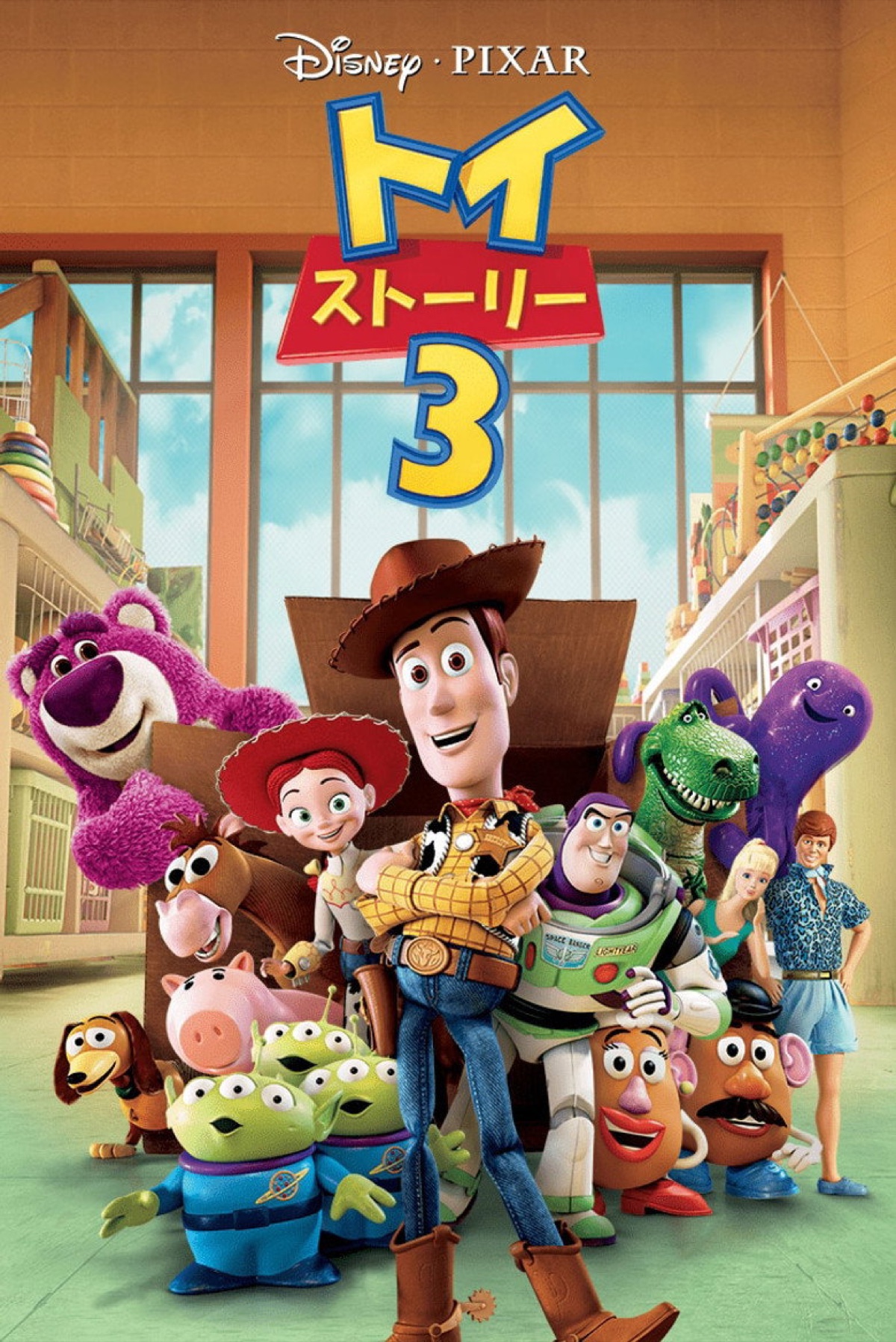
📖 Synopsis – No Spoilers
Andy is seventeen and about to leave for college. His mother wants the room dealt with, and there are three destinations on offer: the college box, the attic, the trash. The toys sit in a box waiting to learn which pile they belong to. Then a mix-up sends them somewhere nobody intended, and they arrive at Sunnyside Daycare.
Sunnyside looks like paradise from the front door. Children rotate through every year, so a toy here is never outgrown. The welcome comes from Lotso, a worn strawberry-scented teddy bear who runs the place. The room they are actually assigned to is full of toddlers who throw, chew and swing whatever is handed to them. Woody wants to go back to Andy. The rest of them are not so sure, because if you stay here, somebody plays with you forever.
✨ What Makes It Special
Why It’s Exceptional
- The right to decide moves from the toys to their owner, and the series turns inside out
- A heavy question settled without one convenient miracle
- Lotso, a villain whose reasoning you can follow the whole way down
- A daycare built entirely out of prison-movie grammar
This time the toys are not the ones choosing
In the first film and the second, the one making decisions was Woody. Accept Buzz or get rid of him. Museum or bedroom. A toy stood at every fork in the road, and the story moved because a toy picked a direction. They were on the side that gets to choose its own fate.
The third film flips that. The opening act is Andy sorting his possessions into three heaps, and the toys can only sit in a box and wait to hear which heap they are in. Three films’ worth of attachment is held by the party with zero say in the outcome.
Which makes this the most powerless Woody has ever been. All he can do is keep telling the others that Andy would never throw them out, with no way on earth to prove it. He is holding a conviction and not one piece of evidence. The others start to doubt him, and they are not wrong to.
Move the decision to the owner and the subject of the film moves with it. The first one was about what a toy is for. The second was about what a toy wants. The third is about what it means for a person to grow up, told from the point of view of the things he is growing out of. I cannot name another series that carried itself that far across three sequels. Worth noting who steered it there: Lee Unkrich, who directs here, was one of the co-directors on Toy Story 2. The person who built that film’s central choice came back eleven years later to close the story on his own.
One small thing changes the scene from where I am sitting. Those three piles assume a house with an attic, and an attic is not a standard feature of Japanese housing. The nearest local equivalent is the oshiire, the deep sliding-door closet, or a rented storage unit, or your parents’ cupboard back in the town you left. An attic in this film is where things go to be kept and not used. Take that option off the table and the bin bag becomes the realistic pile, which is roughly how the opening reads over here.
If the time runs out, was the love worth anything?
This series has always said that the best thing that can happen to a toy is being played with. Woody’s panic in the first film and Jessie’s grief in the second both stand on that single point. But the premise has a hole in it. No child on earth keeps playing with the same toy.
So the happiness this series named had an expiry date stamped on it from the beginning. What becomes of the time before the expiry? Does being loved get cancelled backwards the moment it stops? Toy Story 2 raises the question and parks there. Woody picks the road that ends, and the film does not follow him past the ending.
The third one walks past it. The specifics stay here, but the closing stretch updates what the word love is allowed to mean in this series. Whether “finite” and “worthless” can be pulled apart. The last ten minutes are the entire bet, and the bet comes in.
What makes the answer good is that nobody gets spared a loss on the way to it. What is lost is really lost. Then the film runs one narrow path through which the thing that ended does not turn out to have been worthless, and no convenient miracle shows up to help.
I have been discussing this like philosophy homework, so here is what makes it work as a movie: none of it is ever said out loud. A child watches a jailbreak with a teddy bear in it. The adult next to that child is quietly being asked what they intend to do once nobody needs them. Toys on the surface, adults all the way down.
Deeper Themes
How do you live once your role is over? Retirement takes the job title away. Children grow up and go. The thing you gave years to stops needing you. How long does a person keep pretending to still be in service, and where do they finally accept it? Plenty of films change meaning between your twenties and your forties. This one changes more than most.
Lotso is a villain you can follow all the way down
A soft old bear that smells of strawberries, running a daycare. He is difficult to deal with, and not because he is powerful. He is difficult because the reason he became this is far too recognizable. He was loved once and then left behind, which puts him on exactly the same side of the ledger as Jessie.
Anyone who has been let down can follow his logic to the end of it. Somebody betrayed by the thing they trusted decides never to trust again, and as self-protection that is not irrational. Lotso is a victim who crossed over into being a perpetrator, and the crossing is laid out carefully enough that writing him off is not an option the film gives you.
Then it draws the line anyway. Woody has been through the same thing, passed over and set aside, and he did not turn into Lotso. Being hurt is not a licence to hurt other people. Standing the two of them next to each other produces that conclusion without a single line of sermon. The villain is not an obstacle here. He is the same question solved in the other direction.
🎭 Memorable Scenes
Nobody came back for them. The rain did not start until days later.
1. Lotso’s flashback
It takes very little screen time. Without those few minutes he would be a shape with a voice. The film shows where the three of them were left, on the grass beside a highway rest stop, what he did about it, and what he decided somewhere on the way back. The frightening part is not the moment of despair. It is the reasoning he talks himself into afterwards, which is a piece of reasoning humans use constantly.
2. The crisis near the end
From the middle onward the daycare runs on head counts, patrols and lookouts. It is a prison movie, and taken by itself that stretch is straightforwardly fun. Then the register changes completely. I am not going to describe what happens. For a matter of seconds the screen behaves like a different film, and in those seconds every relationship the group has built since 1995 does the work. Nothing gets solved by an action beat, which is the point.
3. The last scene in the yard
Fifteen years and three films were assembled to make those few minutes possible. There is not much dialogue and nothing showy occurs. The question the series asked in its very first act, what a toy is for, closes there quietly and stays closed.
💭 How It Made Me Feel
What this film leaves behind is the feeling of having been handed an answer. Afterwards, my resistance to letting go of things I own sits a little lower than it did going in. That is what happens when a question raised in the first ten minutes actually gets a reply.
The other residue is Lotso. There is a point in his argument where anybody would catch themselves nodding. The line between good and bad in this film runs closer to you than it looks from outside.
Timing had something to do with how it landed here. Toy Story 3 opened in Japan on July 10, 2010. The year before, Hideko Yamashita’s book had put the word danshari into general Japanese circulation, three characters for refusing, disposing and detaching, a method for cutting your possessions down to what you actually use. By 2010 it was on the shortlist for the country’s new-words-and-buzzwords award. Japan spent that year arguing about how to throw things away, and then a film arrived in which the things get a say. It took ¥10.8 billion at the box office here.
👉 Watch it on Disney+, which keeps the other three films behind the same paywall.
Who Should Watch This?
- Anybody who came through films one and two and wants the ending
- Anyone working out what comes after a role finishes: retirement, the last child leaving, stepping down
- Anyone interested in how a villain gets built (strongly recommended, because Lotso is among the best animated antagonists of the last twenty years)
😅 Where It Falls Short
That is a lot of praise in a row. Two things stayed stuck.
Lotso deserved a sliver of mercy
He never lets go of his logic. Him refusing to reform is the correct call for the story, since a sudden repentance would wreck everything the film spent an hour constructing. The problem is that the ending he gets, unreformed, contains no mercy of any kind.
After that much care spent on why he became this, the landing is a straight push away. There was surely a version where a little light reached him. The conclusion is already secured by the contrast with Woody, so the punishment could have come down a notch and cost the film nothing. This is the one part I still have not swallowed.
You can see the machinery in the last act
The closing sequence is extremely effective, and precise enough that the blueprint shows through it. Where the music comes in. How long the cuts run. Where the emotional peaks are placed. Assembled that precisely, a viewer watching with their guard up will read the hand being played before it is played.
This film has one of the strongest reputations in the series, and I can understand somebody walking out of it wondering what the fuss was about. It works less well the more braced you are. Go in unarmed, once, and do not read the ending first.
The Downsides
- Lotso’s ending offers him nothing, which sits oddly against how carefully he was built
- The final act is engineered well enough that you can occasionally see the engineering
Who Might Not Enjoy This?
- Newcomers who have skipped films one and two. This one stands on what they built, so save it for third
- Anyone who cools off the second they can see a film reaching for tears
📺 Streaming Guide by Service
Which service is the right one for Toy Story 3?
One subscription, one shelf. Disney+ is where the four films sit together, and nothing else in the US carries this one at all. So the split is simple. Renting is cheaper if you only want the finale once. Disney+ is the right call if you intend to run the series.
And you should run the series, because this film changes size depending on what you have already seen. Woody’s history with Buzz from the first film, and what Jessie carries out of the second. Knowing those two things alters the density of the last twenty minutes completely. Note the trap in the table above: the original is on Hulu, the sequels are not, so a Hulu-only plan gets you exactly one third of this trilogy.
Where to Stream
- Disney+: Streaming (all four films)
- Amazon Prime Video: rent or buy, not included with Prime
- Apple TV: rent or buy, same on Fandango at Home, YouTube and Google Play
- Hulu / Netflix: not available in the US
Soundtrack
- Spotify: available
- Apple Music: available
Randy Newman scored every film in the series. “We Belong Together” won Best Original Song at the 83rd Academy Awards, the same ceremony where Toy Story 3 took Best Animated Feature and picked up nominations for Best Picture, Adapted Screenplay and Sound Editing. In the film itself the song plays light and bouncy. It means something else entirely on the way home.
📀 On Disc
Of the four, this is the one worth owning physically, because the last act invites a rewatch and Disney+ has a habit of reshuffling what it carries. The US release is a 4K UHD plus Blu-ray combination.
🎬 If You Loved Toy Story 3, Watch These 3 Next
Crayon Shin-chan: The Adult Empire Strikes Back
The mirror image of this film, and it is Japanese. A theme park rebuilds the Japan of the 1970 Osaka Expo era so convincingly that the country’s adults walk in and refuse to come back out, because living inside the smell of your own childhood beats the present. Toy Story 3 is about an owner who grows up on schedule. This is about a whole generation that would rather not, and the one who has to go in after his parents is five years old. Getting hold of it in the US takes effort, since no subscription carries it, and the review below lays out where it currently stands.
👉 Read the Crayon Shin-chan: The Adult Empire Strikes Back review
Millennium Actress
Satoshi Kon, 87 minutes, and the same question answered by a Japanese film. An actress spends her entire life chasing a man she met once and never finds him. What the ending does is decide whether a love that never paid off was wasted, which is the Toy Story 3 problem with the toys taken out and a human left standing there alone. If the last ten minutes of this film worked on you, that one works on the same nerve. HBO Max carries it in the US.
👉 Read the Millennium Actress review
Up
Pixar’s other film about what a person does when the thing they organized a life around is finished. Released the year before this one, and it takes the same problem from the human side: a widower straps balloons to his house rather than let the house go, and the runtime is spent taking that decision apart. Same shelf on Disney+, same question, no toys to hide behind.
📝 Final Thoughts
Three films across fifteen years, digging at one question from different angles, and here they arrive at an answer. A toy’s happiness is being played with. That happiness comes with an expiry date. So what was the time before it? Toy Story 3 refuses to dodge that, and it refuses to soften the losses on the way to a reply.
The Lotso problem is still lodged in me. Even so, as the closing chapter of Andy’s three films and as a story about how a thing works out what it is, I cannot picture a better shape for it. If you have never seen them, block out an evening and run all three in order. The last ten minutes of the 103 arrive carrying the weight of the two films in front of them, and there is no shortcut to that weight.
⭐ Series at a Glance
| Category | Rating | Note |
|---|---|---|
| Story | ★★★★★ | Fifteen years of setup arrive in the last ten minutes |
| Characters | ★★★★★ | Lotso raised the ceiling for animated villains |
| Themes | ★★★★★ | Life after your role, handed to a toy |
| Visuals | ★★★★☆ | Texture work at the top of what 2010 could manage |
| Aftertaste | ★★★★☆ | The reach for tears is visible in places |
Usagi’s Recommendation Score
⭐⭐⭐⭐⭐⭐⭐⭐☆☆
8.5 / 10
Finite and worthless are not the same thing. This proves it in 103 minutes.

