*This page contains affiliate links. We may earn a commission if you make a purchase through these links.
A sports anime where the sport is drawing.
It is the shortest honest description of Bakuman I can give, and it is also why I left it sitting in my queue for years. Twenty-five episodes of two boys at a desk. I could not work out where the second episode was supposed to come from. What finally got me to press play was the byline. Tsugumi Ohba and Takeshi Obata wrote Death Note, a series whose entire premise is a bored honor student finding a notebook that kills people. Their follow-up is friendship, effort, victory, played completely straight.
In Japan those three words are not a genre label. They are the slogan Weekly Shonen Jump’s first editor-in-chief pulled out of a reader survey in the 1960s, and it has clung to the magazine ever since. Jump’s own editors have never agreed that it is actually the house policy, and one later editor-in-chief dismissed it as the sort of thing only an idiot says. Everybody here quotes it anyway. So when the two men who spent 108 chapters of Death Note arguing against that slogan turned around and delivered it without a wink, I decided it was worth 25 episodes of my evening.
📺 Where to Watch Bakuman Season 1 (October 2026)
| Service | Status | Notes |
|---|---|---|
| Tubi | Streaming | Free with ads. All three seasons, 75 episodes |
| Hulu | Not available | No longer carries the series |
| Crunchyroll | Not available | Has never had it in the US |
| Netflix | Not available | Absent from the US catalog |
| Amazon Prime Video | Not available | No digital copy for sale either |
Tubi is the one place in the US to stream Bakuman right now, and it is free: all 75 episodes across the three seasons, with ad breaks. Hulu used to carry Season 1 and has since dropped it, though some streaming guides have not caught up. Crunchyroll is where most people look first, on the fair assumption that a Shonen Jump adaptation lives there. It does not, and neither Netflix nor Amazon offers it in any form.
👉 If you came here because of the authors rather than the premise, start with Death Note. It is the same two men doing the exact opposite thing.
🎙️ Is There an English Dub of Bakuman?
Only for the first seven episodes, and only on a 2011 DVD. Media Blasters licensed the first two seasons for North America with an English dub, put episodes 1 to 7 out on DVD on November 22, 2011, halted the second volume in February 2012, and announced that November that it was discontinuing the series. No dubbed episode past the seventh was ever released. Treat Bakuman as a subtitled show.
Of all the anime I would ask someone to watch with subtitles, this is one of the easiest. Almost every scene is people talking at a desk: an editor going through pages, two partners arguing about a storyboard, a rival drawing at a speed nobody in the room can match. There is no fight choreography to miss while your eyes are on the bottom of the screen. The scenes I rate highest in this review, Hattori pushing the pages back across the table, play as well in text as they would in any voice.
For planning purposes: Season 1 is 25 episodes of about 25 minutes, so a little over ten hours, and the whole series is three seasons of 25 each, 75 episodes in total. Season 1 ends at the serialization meeting. That is a natural place to stop and decide, and since Tubi carries all three seasons, carrying on is one click.
🎬 Trailer
I could not find an official English trailer for the 2010 broadcast, so what is above is VIZ Media’s trailer for the English edition of the source manga, cut from Obata’s pages. It still gets the shape of the thing across. The fight happens on the paper.
Work Info
- Title: Bakuman. Season 1
- Broadcast: October 2, 2010 to April 2, 2011, NHK Educational TV, 25 episodes
- Directors: Kenichi Kasai, Noriaki Akitaya
- Series composition: Reiko Yoshida
- Animation production: J.C.Staff
- Original manga: Tsugumi Ohba and Takeshi Obata, serialized in Weekly Shonen Jump, 20 volumes, complete
- Voice cast: Atsushi Abe as Moritaka Mashiro, Satoshi Hino as Akito Takagi, Saori Hayami as Miho Azuki, Nobuhiko Okamoto as Eiji Nizuma, Kentaro Tone as Akira Hattori
- English release: VIZ Media publishes all 20 manga volumes. Media Blasters’ 2011 dub stopped at episode 7. Plan on subtitles
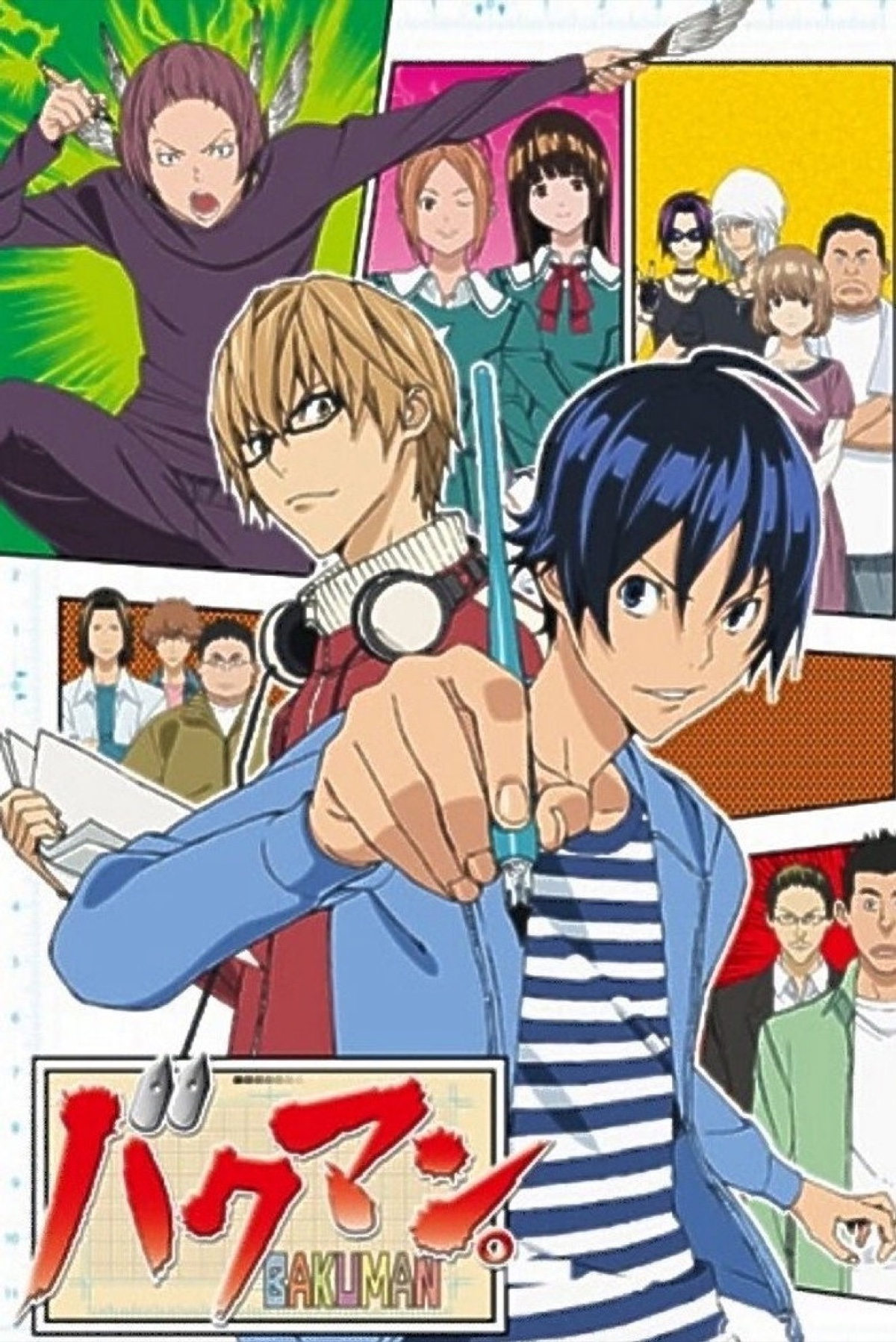
📖 Synopsis – No Spoilers
Moritaka Mashiro is a third-year middle school student who can draw. He leaves a sketch of a classmate in a notebook, and Akito Takagi, top of the year and a natural writer, finds it. Takagi’s proposal is that the two of them team up and become manga artists. Mashiro says no. His uncle, Nobuhiro Mashiro, drew under the pen name Taro Kawaguchi, had a hit big enough to get an anime out of it, never landed a second hit, and died of overwork after the cancellation. Mashiro has already watched how this job can end.
He signs on anyway, because of a promise he blurts out over Miho Azuki, a classmate who wants to be a voice actress. From there the series is submissions, meetings with an editor, rookie awards, and the arrival of a rival one school year ahead of them who draws faster than anyone in the building. Season 1 runs from the day the partnership forms to the editorial meeting that decides whether they get a slot in the magazine. They graduate from middle school in episode 12 and spend the rest of the season in high school.
✨ What Makes It Special
Why It’s Exceptional
- Reader survey rankings turn making manga into a league with a visible table
- Akira Hattori, the editor, is the most useful boss in any anime I have sat through
- Ohba’s plotting never idles, so 25 episodes go down in roughly two sittings
- The manga inside the manga sounds good enough that not being able to read it is a real irritation
Nobody wins a fight, and somebody still loses every week
There are no special moves in this series. No tournament bracket, no power levels, no last-minute transformation. What the characters do is sit at a desk and move a pen. The closest thing to violence in the whole season is a single punch thrown in episode 8, and it is about somebody sneering at a drawing rather than about winning anything. Every episode still ends with a result.
That works because the weekly magazine system hands out wins and losses as numbers. Reader survey rankings. The cutoff for a rookie award. The count of open slots at a serialization meeting. Days left until a deadline. None of it was invented for the story. The reader survey is a real institution here. It arrives as the survey postcard bound into the magazine, it is why the table of contents reshuffles week to week, and it is the mechanism sitting behind a cancellation. Kids in Japan grow up knowing that the order stories appear in is a scoreboard, and this show is built directly on that knowledge. Most shonen has to invent power levels to get a number on screen. This one picked a world that already came with one.
Where it puts the walls is the other half of the trick. Eiji Nizuma is one school year ahead of them, draws at a speed that reads as faintly unfair, and his pages land in the same ranking table as theirs, so the gap is legible at a glance. The wall is not only outside the room, though. Takagi writes, Mashiro draws, and a single manuscript has to carry both of them. When one is on form and the other is not, the page shows it. One pulls ahead, the other gets left behind, and neither of them can pretend the problem belongs to somebody else. As a story about a two-person team, it is not remotely gentle.
Then there is the pace. Take the pages in, get them pulled apart, redraw, take them in again. Every turn of that loop lands further along than the last one, which is how a series with no action sequences ends up hard to switch off. I put on episode 1 to sample it and looked up at episode 6 with the lights still off.
Akira Hattori is the best boss in anime
The editor assigned to them is Akira Hattori, and the episodes he appears in are, more or less, episodes about work.
Hattori does not praise. He lists what is wrong with the pages, attaches a reason to each item, then stays in the chair and thinks about the fix alongside them. He separates the parts they can already produce from muscle memory from the parts they will have to gamble on. That distance is close to the ideal shape of a manager. Because he is so stingy with approval, the rare occasion he calls something good carries weight the series never had to manufacture.
Look, I know I sound like I am reviewing a corporate training video. But consider what fiction usually does with editors. They are the enemy of art, or they are the man who only reads numbers. Hattori is neither. He is in the room from the first page as a collaborator, and that one design decision is why a story about two teenagers reads as a story about a job.
It looks like a teenage dream and lands on the employed
The leads are still in middle school when this starts. The audience it actually hits is people with jobs.
Your pitch gets turned down. The person above you wants something different from the thing you want to make. Somebody who started the same year as you ships first. The deadline arrives, so you hand in work you do not believe in. All standard issue once you are employed. Because the show is dressed as a teenage dream, none of it arrives through your guard. Reading through Japanese reviews of this show, the ones that stayed with me came from people who watched it in the middle of a job change, and were not expecting a series about middle schoolers to land where it did.
Deeper Themes
The quiet argument running under all 25 episodes is that talent is real and talent is not the whole account. Nizuma has more of it than anyone else on screen, and the series never pretends otherwise. What it sets against him is not a hidden power. It is a second person, a deadline, and a reason to keep going. Whether that is enough is the question the entire run keeps asking.
🎭 Memorable Scenes
Hattori slides the pages back across the table
The distinction he draws here, between work that is well made and work that is interesting, sets the value system for everything that follows. That includes the moment the faces of the two people who came in expecting praise go flat. Anyone who has carried work to somebody with the authority to reject it knows this table.
Eiji Nizuma finishes a page
The speed, and the complete absence of self-consciousness in his hands. He is worse than a villain precisely because he is not one. Not an obstacle to be defeated, just somebody one school year ahead with more raw ability, being perfectly pleasant about it. The temperature of the series drops a degree from the episode he arrives.
The partners turn on each other
Split a job into writer and artist and the ownership of a failure gets blurry. Which of them is carrying the reason it is not working becomes a live question, and the partnership grinds. That the series bothers to show how irritating it is to make one thing with two people is the honest choice, and it is the part I did not expect from a show aimed at teenagers.
💭 How It Made Me Feel
The first thing I wanted at the end of episode 25 was to read the manga inside the show. The pair’s series, Nizuma’s series, all of it exists as a premise plus a reaction shot and nothing more. I would buy those volumes tomorrow. Getting an audience to that point is the entire case this show is making about what manga is for, and it wins the case using material you are never allowed to see.
The second thing is less convenient. It is your own work. A deadline, an evaluation, then another one behind it. These characters run exactly that loop, with no magic anywhere in it. The ordinariness keeps working on you after the show has stopped. I opened a file I had been avoiding the next morning, which is not the effect a show about middle schoolers is supposed to have on a grown adult.
😅 Where It Falls Short
I never warmed to the heroine
I have been singing this show’s praises for a long stretch now. Time to declare the thing that nagged at me for all 25 episodes. Miho Azuki never worked for me, not once.
She wants to be a voice actress. Her family has money, she is drawn as the prettiest person in any frame she stands in, and nothing sits between her and that goal at a cost you can see. Set against the weight of the promise Mashiro makes about her, whatever she is carrying never comes into view. Her dialogue is written to land, and it lands before I have finished climbing on board. That may well be the complaint of somebody who has been in the workforce too long. It is still true that my attention dropped every time she appeared.
I am not alone in it. Among the Japanese reviews I read, this character is where opinion splits hardest, and the reading in which the whole thing is a pure long-distance romance is right there if you want it, so take my version as a compatibility problem rather than a defect. The structural issue underneath is real, though. The romance is the engine that starts the plot, so if you cannot get on it, the motivation of both leads thins out with it.
The road is remarkably clear
The other problem is how smoothly it all goes. The submissions, the rookie award, the run at a serialization slot. They stumble, and none of it ever comes close to fatal. You can answer that by pointing out that both of them are prodigies, which the show does, repeatedly. But the recovery time after each setback is so short that the climb never accumulates any weight.
It presents itself as a series about how hard the professional world is, while the two leads remain the one thing the story is protecting. As a shonen series that is a defensible call, and it is inseparable from the pacing I spent three paragraphs praising. Given the subject it took on, I still think it could have hurt them more.
The Downsides
- The heroine, and the romance built on her, is easy to bounce off
- Setbacks resolve fast, so the series stays inside conventional shonen limits
- Season 1 does not finish the story. It stops at the serialization meeting
Who Should Watch This?
- Anyone currently stuck on a piece of work or a goal. It lands hardest on people in the middle of it
- Readers who remember chasing a serial in a magazine week to week
- People who make things for a living, especially under deadlines and reviews
Who Might Not Enjoy This?
- Viewers who want action or animation showpieces. There are no battles in it
- Viewers with no patience for convenient plotting. Success comes quickly for these two, and luck helps
- Viewers who want a complete story in one season. This one stops in the doorway
📺 Streaming Guide by Service
Is Bakuman on Crunchyroll or Netflix in the US?
No to both. Tubi is the only US service with it, free with ads, and it has all three seasons, so if season 1 lands and you want to keep going the same night, nothing stops you. The absence to plan around is Crunchyroll, which carries an enormous amount of Shonen Jump material without carrying this. Hulu used to carry Season 1 and no longer does.
Where to Stream
- Tubi: Streaming, free with ads, all three seasons, 75 episodes
- Hulu: Not available. The series has left Hulu
- Crunchyroll: Not available in the US
- Netflix: Not available in the US
📚 Read the Manga
Ohba and Obata’s original ran 20 volumes, finished properly, and VIZ Media has the whole run in English. Season 1 stops at chapter 33, near the end of volume 4. That makes volume 5 the one to reach for on the night episode 25 leaves you wanting the next thing immediately. Obata’s linework on the craft itself, the nibs and the screentone and the wreckage on the desk, holds detail the animation smooths over. On paper the tools look like tools.
- Bakuman., Vol. 5: The volume that picks up where season 1 stops
- The full 20-volume run: For anyone who would rather start at volume 1
🎬 If You Liked Bakuman, Watch These 3 Next
Three shows that come at the same nerve from different angles. One is the authors’ previous job, one is the same industry structure filmed from the cold side, and one takes the talent gap that gives Bakuman its best scenes and refuses to soften it. If it was the meetings with Hattori that kept you watching, our anime and films about work list is ten more stories where the job itself is the plot.
Death Note
The same two men, one job earlier, apparently pointed in the opposite direction. Read them next to each other and the method turns out to be identical. Set the rules first, then run people at full speed inside them. The conditions for using the notebook, the machinery of a weekly serialization. In both cases the tightness of the constraint is what converts into the entertainment. Bakuman is the version where nobody dies.
[Oshi No Ko] Season 1
The same project, filmed from the other temperature. This one takes the entertainment industry apart from the inside, pulling the machinery out of the lit places one piece at a time. Where Bakuman shows you the heat of making something, [Oshi No Ko] shows you the identical structure with the heat removed. Watch both and the world behind the work becomes three-dimensional, which is not always a comfortable result.
👉 Read the [Oshi No Ko] review
Ping Pong the Animation
My second complaint about Bakuman was that its setbacks never cost anybody anything. This is the show that charges full price. Table tennis, eleven episodes, and it stays with each of its five players past the moment they find out exactly how far their ability goes, which is the part most sports stories cut away from. If Eiji Nizuma left you uneasy, this is the show that names the feeling. Fair warning about the art: it is deliberately ugly, and a lot of people quit before the first episode ends.
👉 Read the Ping Pong the Animation review
📝 Final Thoughts
Remember what I said at the top about not seeing where the second episode was supposed to come from. The answer is that the second episode comes from a ranking, and the third from a deadline, and by the sixth you have stopped asking. The two men who built the most cynical shonen of the 2000s turned around and delivered friendship, effort, victory with a completely straight face. The arena is a desk. The weapon is a pen. The gap between how dull that sounds and how hot the show runs is the best thing about it.
The heroine never landed for me, and the leads are protected in a way the rest of the cast is not. I am still giving this a 7.5, and it is a strange 7.5, because the parts that earn it are the meetings. An editor telling two kids exactly what is wrong with their pages. A rival one year ahead being casually better. Those are scenes that people with jobs recognize from their own week. Season 1 closes at the serialization meeting, so there is a natural stopping point if you want one, with two more seasons waiting if you do not. Whether you watch it as a story about a dream or a story about work changes almost everything you take away from it.
⭐ Series at a Glance
| Category | Rating |
|---|---|
| Story | ★★★★★ |
| Pacing | ★★★★★ |
| Characters | ★★★★☆ |
| Animation | ★★★☆☆ |
| Holds Up for Adults | ★★★★☆ |
Usagi’s Recommendation Score
⭐⭐⭐⭐⭐⭐⭐☆☆☆
7.5 / 10
A sports anime played at a desk. It works best on the nights work has beaten you.

