*This page contains affiliate links. We may earn a commission if you make a purchase through these links.
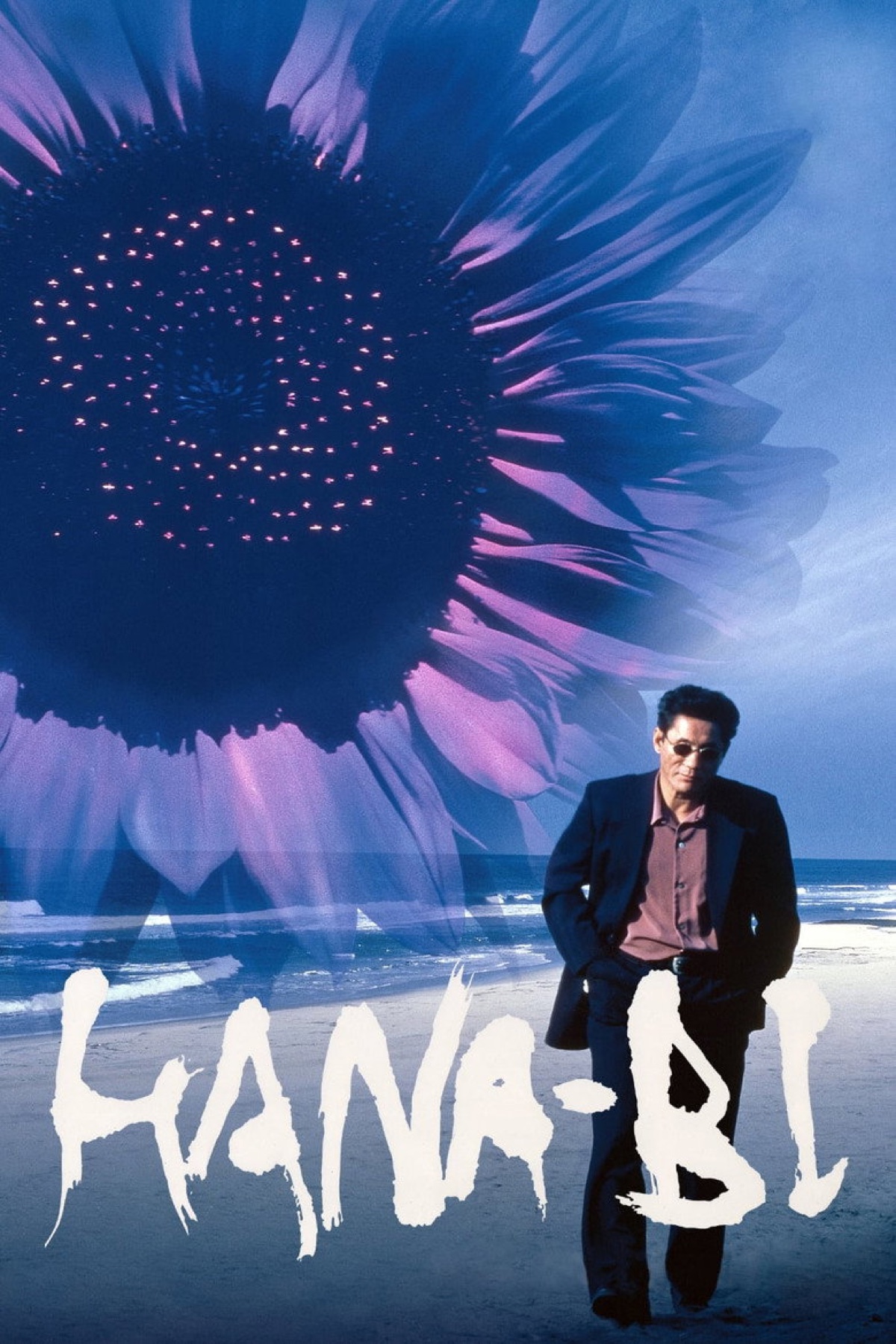
Somebody put a hyphen in the middle of a word, and then built a hundred and three minutes around it. In Japanese, hanabi is one word. It means fireworks. Split it and you get hana, flower, and bi, fire. Takeshi Kitano titled his 1997 film with the split in place, and every Japanese viewer reads the seam before the first shot arrives.
Flower is the living half: happiness, tenderness, the wife. Fire is the other one: death, ruin, the gun. Once you have that in your head, a former detective staring into a bonfire stops being a mood shot, and a paralyzed colleague pausing outside a florist stops being a coincidence.
📺 Where to Watch Hana-bi (October 2026)
| Service | Status | Notes |
|---|---|---|
| Google Play Movies | Rent / Buy | Listed as Hana-bi, 103 minutes |
| YouTube | Rent / Buy | Draws on the Google Play store |
| Netflix | Not available | Not in the US library |
| Amazon Prime Video | Not available | Not on Prime, no Amazon rental |
| The Criterion Channel | Not available | Golden Lion, still no slot |
| Tubi | Not available | No free version in the US |
| Kanopy / Hoopla | Not available | Not listed on either |
| Crunchyroll | Not available | Live-action, outside its catalog |
None of the US subscription services I checked carries Hana-bi. The digital route is a rental or a purchase on Google Play, which YouTube shares. On disc, Film Movement Classics released a restored Blu-ray in the US in 2017.
Japan: no service I could find, subscription or rental.
🎆 Is Hana-bi the Kitano Film to Start With?
For a reader in the US, yes, and part of the reason is plain logistics: of the 1990s Kitano films people usually name first, Hana-bi is the one you can rent. Sonatine and Kids Return were not on any US service I checked, to stream or to rent. The other part of the reason: this is close to the most readable film he directed, and a first Kitano should be readable.
What it teaches you is how to watch the rest. Two habits carry over. The cut that skips the violence and drops you into the aftermath, and the long, unmoving shot of somebody sitting and looking at the sea. Learn to sit inside those two here, where a marriage keeps them warm, and Sonatine stops seeming cold and turns out to be the same grammar with the warmth taken out. When you want Kitano in a lighter mood afterward, his 2003 Zatoichi is free with ads on YouTube in the US.
The fire half of the title has its own history in his work, too. Violent Cop, 3-4x October and Brother, the films where violence is the subject, not the interruption, each has an entry with US availability in our most violent Japanese films roundup. Hana-bi reads differently once you have seen what he was holding back.
🎬 Trailer
This clip is Terracotta Distribution’s, an Asian-cinema label licensed in the UK, cut with English text. The 1998 Japanese theatrical campaign has no surviving official upload, so there is nothing from the domestic release to show you. This site will not fill that gap with a fan re-upload. The trailer’s own copy calls the Venice prize a Grand Prix. It was the Golden Lion.
Work Info
- Title: Hana-bi (released in the US as Fireworks. Japanese title: HANA-BI)
- Released: January 24, 1998 (Japan)
- Director, writer and editor: Takeshi Kitano
- Cinematography: Hideo Yamamoto
- Music: Joe Hisaishi
- Cast: Beat Takeshi, Kayoko Kishimoto, Ren Osugi, Susumu Terajima, Tetsu Watanabe, Hakuryu, Yasuei Yakushiji
- Runtime: 103 minutes
- Awards: Golden Lion, 54th Venice International Film Festival (1997)
- Source: TMDB
📖 Synopsis – No Spoilers
Nishi (Beat Takeshi, which is Kitano’s name when he performs rather than directs) is a detective. His daughter is dead. His wife Miyuki has just come home from hospital, and the doctors have stopped pretending that treatment is the plan. Nishi barely speaks. He does not shout, he does not laugh. Instead of a face that reacts, he has a world around him where things break.
Something goes wrong during a stakeout. Nishi’s colleague Horibe (Ren Osugi) is shot, loses the use of his legs, and ends up in a wheelchair. Nishi loses the job. What remains is a wife and a debt he has no honest way to pay. He gets hold of a car, puts Miyuki in the passenger seat, and drives toward the sea without deciding where the sea ends. Horibe, meanwhile, picks up a brush. Two men walk away from the same incident in opposite directions, and that is the frame the whole film hangs on.
✨ What Makes It Special
Why It’s Exceptional
- The hyphen in the title is a schematic of the film, handed over before it starts
- Every frame holds up as a still image, with no budget spent on spectacle
- Two men leave one incident traveling in opposite directions, and run in parallel
- A marriage of decades is built almost entirely without dialogue for the wife
- Violence arrives with no warning shot, out of long silence
The hyphen is the blueprint
Start here, because it costs nothing to carry and it changes everything you see. Flower holds life, happiness and tenderness. Fire holds death, ruin and violence. Watch with that in hand and you find that nearly every shot has been filed on one side or the other. The sorting is never announced. What gives it away is the absence: the two halves almost never share a frame.
The clearest instance is what the two men look at. Nishi looks into a bonfire. Horibe stops outside a flower shop and looks at what is blooming there. The man watching fire moves toward death. The man watching flowers comes back to life. No line of dialogue supports either move. Kitano sets the two shots down side by side and lets that be the explanation.
The scenes with Miyuki follow the same filing system. When she is present, the screen fills with flowers, water and play. When Nishi moves alone, it fills with money, a pistol and flame. There is one sequence on the road where the couple set off fireworks, and it stands out as one of the very few moments when both halves of the title occupy the same image. The word hanabi already carries life and death inside it. Once that registers, what they are lighting changes meaning.
None of this is homework, and the film works fine for a viewer who never notices. The reading does not arrive during the runtime. It arrives afterward, when you look at the title again. Putting your largest device at the entrance where nobody will read it as a device is a fairly mean piece of construction, and I mean that as praise.
Every frame survives being paused
You can stop this film at random and hang the frame on a wall. That happens for a hundred and three minutes without a break. It is not the kind of beauty a large budget buys. There are few people on screen and few objects in the room, and what does the work is where the color sits and how much empty space is left around it. Painterly is the word, and here it is literal.
The color is the concrete part. Snow under moonlight does not read as white here. It sinks into a cold blue. A train station interior is lit so green that the faces standing in it turn green too. The sea and the sky get a shade that reads as the end of the road. Hideo Yamamoto shot it, and the palette is pulled out of whatever light is already in the location rather than painted on top of it, which is why none of it feels staged.
The same discipline governs how information reaches you. Horibe sits on the ground, water creeps toward him, and his socks get wet. Nobody says a word about what has happened to this man, and yet the entire situation is on the screen. The bank robbery is handed to you as little more than security camera footage. No stinger on the soundtrack, no cut in to a face. The less noise it makes, the more clearly you feel how far he has fallen.
The canvases in the film are real, and Kitano made them. He painted them after a 1994 motorcycle crash that paralyzed the right side of his face, during a period when a return to work was not assumed. They existed before the screenplay did. So the plot beat where a broken man starts painting is the director restaging what he himself had just done. The paintings do most of the talking.
Something worth saying for readers outside Japan. Kitano is not filed here as a solemn art-house name. For an entire generation he is Beat Takeshi from television, the comedian off the variety shows, the man in the ridiculous game show costume. The gap between that person and the man who shot these frames is enormous, and the Golden Lion landed in Japan partly as a shock. I grew up with the television version first. Watching this still feels slightly illegal.
Two men, one incident, opposite directions
The film is bleak without becoming a one-way street, and the reason is that there are two men in it. One walks toward death. One nearly dies and then walks back toward living. Nishi loses his job and any future with his family, then leaves on a drive with no destination. Horibe loses the use of his body, then holds a brush anyway. Same starting incident. Only the heading differs.
Ren Osugi carries this. He plays a man in a wheelchair with a brush in his hand as neither a tragic figure nor a brave one. He is simply a person doing the next available thing in order. That is why the air loosens a little in his scenes, and only in his scenes. With a man who cannot stand placed beside a man losing his wife, a viewer gets somewhere to stand on either side.
The parallel is built into the images too. The same stretch of sea shows up twice, framed the same way, at different points in time. One man is looking at an ending. The other is looking at a continuation. The same view means something different depending on who is standing in it, which is an obvious idea that the film delivers without a single line about it.
A marriage that never says the word
The marriage sits in the center of the frame, out in the open. The dry cool that runs through Kitano’s gangster work is turned down here, and what fills the space is feeling. The film runs several degrees warmer than Sonatine, and that is the whole trade.
Miyuki has, effectively, two lines, both near the end. Everything before that is a nod, a small smile, or stillness. The years between these two people still land, because the film keeps picking up the residue of a shared life. She takes the strawberry off her own slice of cake and passes it to her husband. She holds up playing cards for him to guess. A plainly grilled fish shows up on the table announced as Italian cooking. Each of these runs a few seconds. None of them is explained.
I think this works because nothing verbal is left over. A couple who can still say the word have some slack in the system. These two have no slack at all, so a strawberry has to carry it. Of the hundred and three minutes, the part that took me is that handful of seconds.
Deeper Themes
The violence is built the way it was built in the early films. Chopsticks fly. A rock goes into a sock and gets swung. None of it grants you the second of warning that would let you brace, and by the time you register that it started, it is over. Long quiet stretches are what make the drop that steep. The difference in this film is what the drop is used for. It is not working on fear. It is working on how little time these two have left together, because a tension with no known expiry date gets stretched thin across every calm moment of the road trip. Kitano splits flower from fire and then keeps fire mostly outside the frame. That allocation is what separates this film from earlier ones assembled out of identical parts.
🎭 Memorable Scenes
The beach comes first. It is winter, the sand is nearly deserted, and some way off a young girl is flying a kite. The staging does not suggest two people washed up at the end of a chase. It suggests two people who chose this place. There, at last, Miyuki speaks, and leaves behind two short phrases.
Thank you. I’m sorry.
(Rendered from the Japanese. Subtitle wording and the order of the two phrases vary between releases, and some accounts treat only the apology as her first speech.)
For roughly ninety minutes she has hardly spoken at all. All of that silence collects into those few syllables. What happens on screen afterward stays out of this article. I will say only that the half minute following them is the quietest stretch in the film.
Second is the cake. It is not shot as an important scene, and it is the first thing that came back to me once the credits ran. That is the entire case for including it.
Third is Horibe wheeling past the florist. A man who has lost his work and the free use of his body is looking at things in bloom. Once you see that this shot answers Nishi’s bonfire, the moment stands up as the hinge of the whole film. His decision to start painting is staged at a flower shop instead of spoken.
💭 How It Made Me Feel
What stayed with me was color, three shots of it. The running order of events has gone soft in my memory. Those have not moved at all.
The edge is thinner here. Kitano has made films that cut deeper than this one, and if you make me choose, I pick one of those. This film is beautiful, it has real feeling in it, and it is easy to recommend to almost anybody. I cannot articulate the missing piece cleanly, and I do not trust anyone who says they can. So the score has both things baked into it, the beauty and the small shortfall.
I went looking for Kitano’s paintings once the film ended, and that turned into an evening of its own. If you finish the film, do the same. The canvases are easy to find.
Who Should Watch This?
- Anyone who has never seen a Kitano film and cannot decide where to start
- Anyone with a weakness for marriages that communicate without talking
- Viewers for whom composition alone can hold two hours
- Anyone who finished Sonatine and wants the next one (this is the pick)
😅 Where It Falls Short
Legibility bought at the cost of edge
The story is very simple. Who is doing what, and why, is far easier to follow than in the earlier films. There is no interior state you have to reconstruct from nothing. Among Kitano’s films as a director, this is close to the most readable one. I want that on the record as an asset. The reason it works as an entry point is exactly this.
Legibility was bought with the same money as the edge, and the edge is thinner here. The thing Sonatine has, that uncanny quality of behavior placed in front of you with no reasoning attached, is faint in this one. Once cause and effect line up, you settle, and what you have settled about stops snagging.
People were making this point at the time of release. The reading went that the film had been tidied up with an international audience in mind. A number of viewers found that the Golden Lion and their own impression refused to line up. I think tidied up overstates it. The route by which somebody arrives at that discomfort, though, is one I follow perfectly well.
If the stillness loses you, 103 minutes is long
Most of the running time is made of nothing happening. A car moving. Two people seated. Nobody speaking. All of that is carried on the images alone, so a viewer who is not drawn to color or composition is left with a hundred and three minutes and nothing to do. The score will not lift your mood on cue, and the cutting will not hurry you along. It is entirely possible to sit outside this film from beginning to end.
The first half also shuffles its chronology a little, and until you work out what happened when, you are behind. Everything joins up in retrospect. On a first pass, though, somebody who only wants to follow the plot is being treated slightly unkindly. The gap between the people this lands for and the people it does not is unusually wide, even within this director’s work.
Who Might Not Enjoy This?
- Viewers who need plot momentum to stay engaged
- Anyone expecting a police procedural with a case that gets solved
- Anyone who cannot take violence that arrives with no warning
- Anyone who wants the uncanny early Kitano at full strength (start with Sonatine)
📺 Streaming Guide by Service
How to Actually See It
- Google Play Movies: rent or buy, the quickest way in
- YouTube: rent or buy, the same purchase under a different roof
- Blu-ray: the Film Movement Classics restoration, the option worth owning
- Netflix, Hulu, HBO Max, The Criterion Channel, Tubi: not available
- Kanopy, Hoopla: not listed
A word on which route to pick, because for once it is not automatic. Color is the lead performer in this film, so the difference between a compressed rental stream and a restored disc is not a videophile quibble here. It is the difference between blue-cold snow and gray snow. Film Movement Classics put out the first proper US restoration in 2017. If you expect to revisit the images more than the plot, that is the version to hold.
Soundtrack
Joe Hisaishi wrote eleven cues for this film. That is a small number set against how much of the film you remember as sound, which is the point. Played end to end away from the images, the album shows you that the silence in this film was constructed on the music side as well as the picture side. It streams on Apple Music.
🎬 If You Loved Hana-bi, Watch These 3 Next
Sonatine (1993)
Same director, same stillness, with the marriage removed and the violence moved to the front. Gangsters wait out a truce on a beach and invent games to pass the time, and the temperature drops to something close to freezing. Take the wife out of Hana-bi and this is what is left.
The Blood of Wolves (2018)
In Hana-bi the violence drops out of silence for a second at a time. Here it is the ground the entire film stands on. The boundary between the police and the syndicate dissolves early, and for two hours there is nobody clean to side with. Both films are about a detective coming apart. One does it through quiet, the other through heat. Watch them back to back to see how deliberate the quiet was.
👉 Read The Blood of Wolves review
Merry Christmas, Mr. Lawrence (1983)
Kitano in front of somebody else’s camera, fourteen years before he shot this one. Nagisa Oshima cast him as a POW camp sergeant, and the last shot of that film asks him to hold an enormous amount on a face that barely moves. It is the same instrument Nishi is played with. For readers who know Kitano only as a director, this is the fastest way to understand what he does as an actor, and the Ryuichi Sakamoto score is famous for good reason.
👉 Read the Merry Christmas, Mr. Lawrence review
📝 Final Thoughts
Life on one side of the hyphen, death on the other, and the two are kept apart until the end. The line gets crossed once, by the fireworks the couple set off on the road. This is a film that puts its argument in the arrangement instead of the dialogue, and then leaves the arrangement showing in its own title.
If you are starting on the Kitano films that made his name abroad, this is the one to hand over. Nobody gets lost, the feeling between the husband and wife is right there in the open, and the images are extraordinary. Ask for the early edge and you will notice its absence. As a door into this director, though, I cannot think of a better one.
⭐ Series at a Glance
| Category | Rating |
|---|---|
| Story | ★★★☆☆ |
| Visuals | ★★★★★ |
| Music | ★★★★☆ |
| Performances | ★★★★★ |
| Emotional weight | ★★★★★ |
| Broad appeal | ★★☆☆☆ |
Usagi’s Recommendation Score
⭐⭐⭐⭐⭐⭐⭐⭐☆☆
8.0 / 10
A hundred and three minutes spent drawing one line between flowers and fire.

