*This page contains affiliate links. We may earn a commission if you make a purchase through these links.
Of all the films I have watched, the single image that has stayed sharpest in my memory is not a knockout and not a last-round comeback. It is two boys sharing one bicycle, going in slow circles around a high school yard. The one riding on the back is turned the wrong way and cannot see where they are going. They keep moving anyway. If they stop, they fall over.
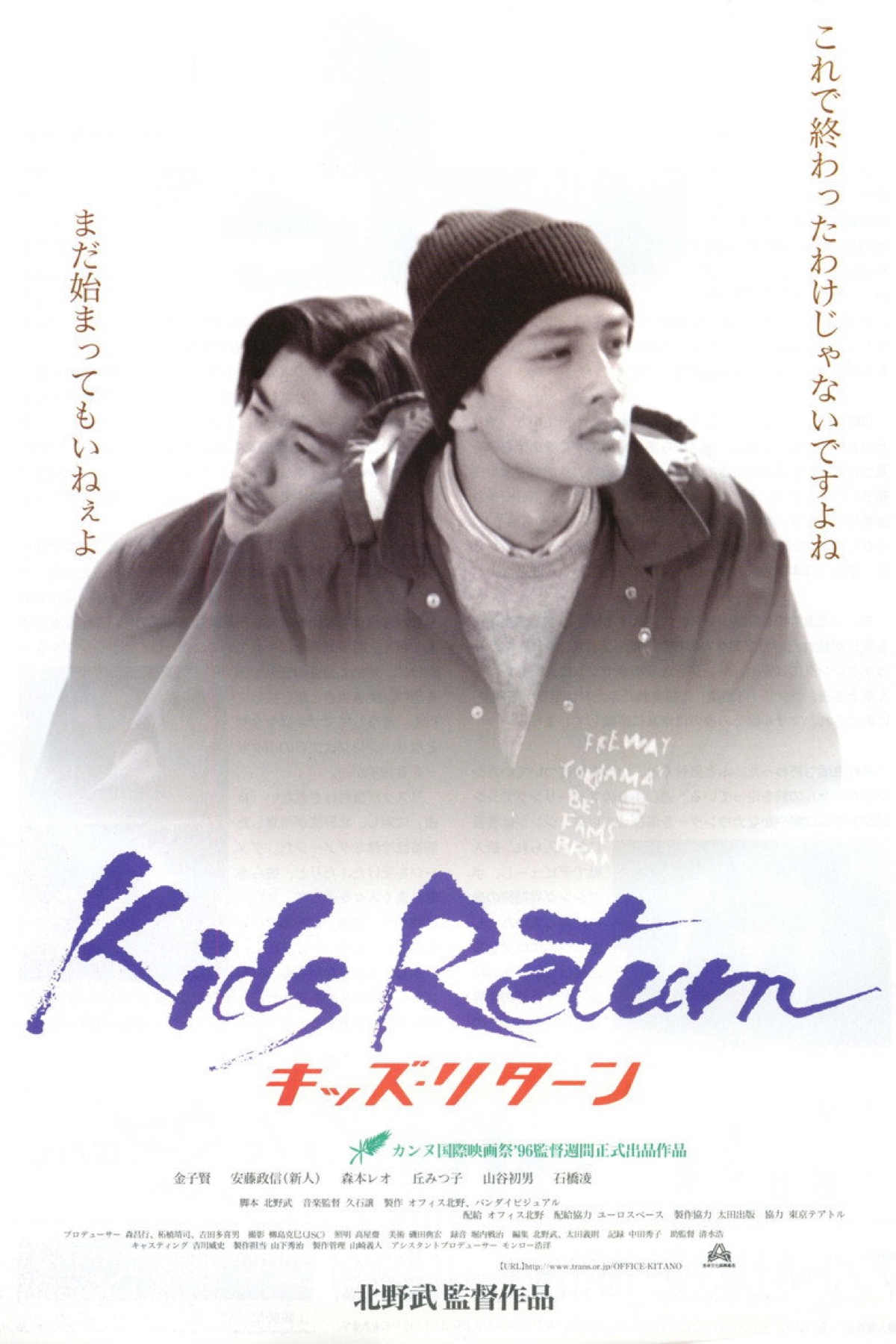
Kids Return is Takeshi Kitano’s 1996 film about two students who drift into a boxing gym. File it on a shelf and it goes under coming-of-age. Watch it and almost nothing behaves the way that shelf promises: neither boy grows, neither boy learns, and the film returns to that same yard at the end. Below is how an American viewer can actually see it in September 2026, plus why the short exchange in the final scene is the part people in Japan keep repeating to each other thirty years later.
📺 Where to Watch Kids Return (September 2026)
| Service | Status | Notes |
|---|---|---|
| Netflix | Not available | Absent from the US catalog |
| Amazon Prime Video (US) | Not available | No subscription, no rental, no digital purchase |
| Hulu | Not available | Not in the US catalog |
| HBO Max | Not available | No US listing |
| The Criterion Channel | Not available | No listing despite the Cannes pedigree |
| Crunchyroll | Not available | Live action, outside its catalog |
| Kanopy / Hoopla | Unconfirmed | Library catalogs vary by system |
| Import Blu-ray or DVD | The one reliable route | English-subtitled discs exist, all of them imports |
As of September 9, 2026, Kids Return is not streaming in the United States at all. I checked the provider data and the aggregator listings on the day of writing, and the American row came back empty on every axis: no subscription, no digital rental, no digital purchase. That is unusual. Plenty of Japanese films are missing from Netflix while sitting on Prime Video for four dollars, and this one is not even doing that.
One honest caveat about the table. Kanopy and Hoopla assemble their catalogs library by library, so I cannot rule either of them out for your particular card the way I can rule out Netflix. If you have access to either, searching costs nothing. Everything else on that list I verified directly, and availability does move, so it is worth a glance at the service pages before you take my word for it.
And since this site is written from Japan, the obvious question: can I stream it at home? No. Not on any Japanese subscription service either, and not for rent. Kitano’s own directorial filmography is close to sealed off from the Japanese subscription market, which means the people best placed to have grown up with this film cannot press play on it tonight any more than you can.
🎬 Trailer
A word on what you are watching. The original Japanese theatrical trailer has not survived on any official channel that still exists, so there is nothing to show you from the 1996 domestic campaign. The clip above comes from Terracotta Distribution, a licensed British distributor of Asian cinema, and it is subtitled in English. This site will not embed a fan re-upload to fill the gap.
Work Info
- Title: Kids Return (Japanese title: キッズ・リターン)
- Released: July 27, 1996 (Japan)
- Written, edited and directed by: Takeshi Kitano
- Music: Joe Hisaishi
- Cast: Ken Kaneko, Masanobu Ando, Moro Morooka, Ryo Ishibashi, Susumu Terajima, Leo Morimoto
- Runtime: 108 minutes (Third Window Films’ official listing; other databases give 103 to 107, most likely different masters)
- Festival: 1996 Cannes Directors’ Fortnight selection
- Awards: Ken Kaneko and Masanobu Ando both took Newcomer of the Year at the Japan Academy Prize; Best Film at the Yokohama Film Festival
📖 Synopsis, No Spoilers
Masaru and Shinji are two high school seniors who spend their days behind the school building rather than in class. They needle their teachers, they shake down classmates for pocket money, and they fill the hours with whatever is nearest. Then one of the boys they have been robbing comes back with a friend who can actually fight, and Masaru goes down in a single punch. That is how the pair end up walking into a boxing gym: not out of ambition, but out of embarrassment. Shinji puts on gloves because his friend did.
What follows separates them in a direction neither of them chose. Masaru stops showing up at the gym and starts looking for a place for himself somewhere else entirely. Shinji, the one who came along for company, turns out to have something. The gap that was invisible while they shared a classroom becomes concrete after graduation. And they are not the only ones: the other regulars at their local coffee shop each get a few years of their own, running in parallel, most of them going nowhere pleasant.
✨ What Makes It Special
Why It Is Exceptional
- The climb is compressed into seconds; the collapse is shown at full length
- One image, two boys on one bicycle in a schoolyard, carries the entire theme without a word of explanation
- Joe Hisaishi writes a theme that loops instead of building, and the film has the same shape
- The flat, unraised delivery is what makes the decline register as something that could happen to you
The climb is skipped. The fall is shown in full.
Most of the pleasure in a sports film sits in the ascent. Roadwork before dawn, the heavy bag, shadow boxing in front of a mirror. The genre makes you feel the accumulated hours before it lets anybody win, which is why winning lands. Kids Return refuses to show you almost any of that. Getting good happens in a short string of cuts, and by the time you have registered it, the result is already sitting in front of you as a fact.
The reverse is true of the collapse. That gets the running time. The awkward silence after something has quietly gone wrong. The nights of being dragged out drinking by a man who should know better. The small bad decisions nobody in the room bothers to stop. Ascent summarized, descent at actual size. Which means you cannot receive the story as a fable about effort. The film never offers the reassuring line of causation where they fell because they did not work hard enough.
That works because it matches how memory actually operates. The stretch when things were going well shrinks in the retelling; the day it went wrong keeps every detail. Kitano takes that distribution and turns it into screen time. So while the two of them are sliding, you never get into the posture of rooting for them. Nothing is handed to you to root with, and the slope only gets steeper.
There is one more piece of engineering here. The same schoolyard scene opens the film and closes it. You start with the two of them circling and you end in the same place. Because of that, the moment in the middle where they promise each other a future, a title for one of them and a rank inside an organization for the other, arrives already contaminated. Identical words land differently depending on the frame they sit inside.
The bicycle that is not facing forward
The handlebars wobble constantly. The boy on the back is turned around, watching where they have been instead of where they are going. They cannot see ahead and they move anyway, and stopping means falling.
Nothing in the film glosses it. It is just left there as school scenery. But the shape of that image is the shape of how the two of them live, which is why the thing you carry out of the cinema is not a speech. It is those thirty-odd seconds on a bicycle. There is a small cruelty in that, and it is the film’s, not mine: the only thing it declines to explain is the thing you cannot forget.
And the composition returns at the very end, unchanged. The first time through it reads as a beginning. The second time the identical frame means something else entirely, and nothing has been added to it: the 108 minutes wedged in between have done all the work.
Deeper Themes
Plenty of viewers read the return to the schoolyard as a second chance. I would put it differently. The circle is not only a symbol of renewal here, because the two of them have not overcome anything on the way back. They went out, lost their footing wherever they landed, and got pushed home. Their possessions have not increased and their characters have not shifted. The standard architecture of a story, where hardship produces growth, is simply not the architecture of this film. The reason the last exchange hits as hard as it does is precisely that: two people with nothing, standing in the one place where they never had anything, saying it out loud to each other.
Joe Hisaishi writes a theme that goes nowhere
Outside Japan, Hisaishi is known almost entirely through Ghibli, which means through swelling strings and flight. This is the other Hisaishi. The Kids Return theme is a short figure that repeats and repeats, and it declines to lift or to make you cry. It issues no instructions about how to feel, so no matter how bad the situation on screen becomes, the temperature of the music does not move. That flatness breathes at the same rate as the film.
The structure of the piece is also the structure of the picture: the same figure again, never resolving, the exact motion of a bicycle circling a yard. When it comes up under the end credits, what happened in the story gets traced a second time in sound. (In Japan this cue has outlived the film for a good number of people, who know the music without having seen where it came from.) It is my favorite thing in here after the ending, and I say that as somebody who does not usually notice scores.
🎭 Memorable Scenes
A sparring session at the gym is the quiet hinge of the whole thing. Two people who had been standing on the same side of everything change places over the course of maybe half a minute. Nobody announces it. The two of them do not notice it. You miss it while you are watching, and then it comes back to you afterwards and you realize that was the spot. The experience of not being able to identify a turning point while you are standing on it has rarely been photographed better.
Then the schoolyard at the end. The two of them ride together and trade a few words. One of them puts a question to the other about the state they are in, and the answer comes back short. That is the entire scene. No swelling music, no held close-up. And every conversation about this film ends up at that one exchange. If you have ever set out to do something and quit partway, the reply reads as though it were addressed to you personally. I will add that on a first viewing it can slip past without registering at all.
I am not going to quote the line. There is a reason for that, and it is a slightly embarrassing one: the Japanese wording gets remembered a dozen different ways by people who love this film, and I could not settle it against a source I trusted. What matters is not the phrasing anyway. It is who is saying it, where they are standing, and how little they have left at that point.
💭 How It Made Me Feel
For a while after the credits there is a residue I cannot name properly. Not sadness, and not relief either. Their circumstances have not improved in any measurable way, and somehow the aftertaste is not bitter. Being left suspended that way is how this film stays with you.
The longer it sits, the more of the memory the final scene takes up. Plot details thin out; the bicycle and the exchange keep their shape. Very few films I have seen survive in me as pictures the way this one does. And the people it takes hardest are the ones who have failed at something: that short reply goes straight through them.
Who Should Watch This?
- Anyone in their twenties who came off the rails once and has not got back on yet
- Anyone far enough along to look back at a decision and wonder about the other branch
- Anyone who has avoided Kitano as a director on the assumption that it is all gangsters and gunfire (strongly recommended)
😅 Where It Falls Short
I have been building this up, so here is the counterweight. Two things stop me recommending it without conditions.
The 1996 of it is very thick
The casual unfairness of Japanese schools and streets in that decade is baked into this film as an unstated premise. A teacher treating a difficult student as refuse to be disposed of. Money taken off classmates as a daily routine rather than an event. The film is not endorsing any of it, but it does not append a criticism either. It goes past as weather.
Whether that distance reads as dated depends a great deal on the age of the person watching. If you remember the atmosphere, it passes as a description of how things were. If you do not, there are a number of moments that will snag. I do not know whether it reaches a younger viewer intact, and putting that uncertainty in writing is more use to you than a confident guess would be.
There is almost no catharsis on offer
Come to it as a boxing movie and you will be disappointed. Barely any slugging, no reversal punch, no roar from the crowd. The bouts are short and the film cuts away at the point where the temperature would normally rise. It will not raise you up and then set you back down, which is the order the genre exists to deliver, so there are viewers for whom 108 minutes go by without anything to hold.
This is the underside of the same virtue. Not raising its voice is exactly what lets the coldness through, and adding heat would produce a different film. Still, when people say they found it boring, I understand the complaint completely. As something to put on with half your attention on a Sunday afternoon, it is the wrong choice.
The Weak Points
- The era’s casual cruelty is presented without comment, and several moments will snag a modern viewer
- The fights are brief and the sports-movie lift is essentially absent
Who Might Not Enjoy This?
- Anyone picking a boxing film for the heat of the bouts and a win to cheer
- Anyone who wants characters to move forward and become better people
📺 Streaming Guide by Service
How to actually get hold of this film
Let me be honest about the part that does not travel well. There is no American subscription answer to give you here, and there is no rental answer either, which puts this film in the small group of Japanese titles that a US viewer has to go out of their way for. The route that works is a disc.
Two things are worth knowing before you shop. Third Window Films in the UK put out a Blu-ray in October 2016 with a making-of and a commentary by the film scholar Aaron Gerow, which is the best English-language edition anybody has produced. It is also out of print and it is Region B, so it will not play on a standard North American player. Japanese pressings with English subtitles do exist and some of the reissues are region free, but region coding on this title varies from edition to edition. Check the region marking on the specific listing before you buy.
The Available Routes
- Import Blu-ray or DVD: the reliable option, subject to the region check above
- Third Window Films Blu-ray (UK, 2016): the best English edition, out of print, Region B
- US subscription and digital rental: nothing, on any service, as of September 2026
- Kanopy or Hoopla with a library card: worth a search, since catalogs differ by system
Soundtrack
The film is locked away from streaming; the score is not. Hisaishi’s Kids Return soundtrack is on both major services, and it is a perfectly good way to find out whether this director’s restraint suits you before you spend money on an import.
- Spotify: available
- Apple Music (US): available
🎬 If You Loved Kids Return, Watch These 3 Next
Sonatine (1993)
The same director, three years earlier, working in the same flat register. Violence and feeling get laid out side by side with no change in tone. What is different is the substitution at the center: death where the youth was. If you want to establish whether the flatness of Kids Return is a mannerism or a decision, put these two next to each other. The answer arrives quickly. (The clip above is the British Film Institute trailer for their Kitano collection, so it covers several of his early films rather than this one alone.)
In Those Days / Ano Koro (2021)
Filming the same subject, the years in which you are nobody in particular, and reaching the opposite conclusion. Where Kids Return sends its pair back to a place with nothing in it, this one argues that the empty years were themselves the point. Watching one after the other tells you which side you would rather stand on, and the fact that the same raw material supports both is worth sitting with. (The trailer is in Japanese; no English one was ever produced.)
👉 Read the In Those Days review
11 Rebels (2024)
Continuous with Kids Return in subject, people with nowhere to go being spent by somebody else, and its exact opposite in delivery. This one keeps turning up the heat all the way through the final act and is built to make an audience shout. Every bit of the elevation that Kids Return withholds is sitting in this film. A useful thing to reach for once the quiet one has finished with you. (Japanese trailer, from the studio’s official channel.)
📝 Final Thoughts
As a coming-of-age film this is a strange specimen. Nothing detonates, and success and failure get laid out in the same register as each other. That levelness is what brings out the texture of a real decline. And it is because neither of them changed that the last visit to the schoolyard does what it does.
I think of it as a film that selects its audience. Somebody who presses play wanting catharsis and gives up halfway is not making a mistake. But for anyone who has abandoned something at some point, that short exchange is going to catch. The words only work because of where the two of them are standing when they say them, and reordering the film would kill the effect. That a US viewer has to import a disc to see it is a genuine shame. It is still worth the trouble.
⭐ Film at a Glance
| Category | Rating | Comment |
|---|---|---|
| Story | ★★★★☆ | Two boys, one decline, no lesson |
| Visuals | ★★★★☆ | Cool and unhurried, the schoolyard above all |
| Music | ★★★★★ | Hisaishi loops instead of building |
| Performances | ★★★★☆ | Both leads took Newcomer of the Year |
| Ending | ★★★★★ | The reason the film exists |
| Rewatch value | ★★★★☆ | It reads differently at a different age |
| Broad appeal | ★★★☆☆ | No catharsis, and it is 1996 throughout |
Usagi’s Recommendation Score
⭐⭐⭐⭐⭐⭐⭐⭐☆☆
8.3 / 10
Everything in it is assembled to serve the last few dozen seconds

