*This page contains affiliate links. We may earn a commission if you make a purchase through these links.
I did not go on opening weekend. I had decided years ago that this series should have stopped at the third film, I thought the fourth was a coda nobody asked for, and a fifth sounded like a franchise that could not find the door. So I let it run for a few weeks before I went. Then I sat there and had to hand it to them.
📺 Where to Watch Toy Story 5 (October 2026)
| Service | Status | Notes |
|---|---|---|
| Disney+ | Streaming | Added September 23, 2026 |
| Amazon Video | Rent / Buy | Digital copy, outside Prime |
| Apple TV | Rent / Buy | Fandango at Home, YouTube, Google Play also sell it |
| Hulu | Not available | Its Toy Story shelf ends at the 1999 sequel |
| Netflix | Not available | Not listed |
| Crunchyroll | Not available | Anime-only catalog |
Toy Story 5 is on Disney+ in the US, alongside the other four films. Without a subscription, the storefronts sell it as a digital copy.
👉 One piece of homework before you press play. This is Jessie’s film, and everything it does with her rests on about two minutes of Toy Story 2. If that scene has gone fuzzy, go back to it first.
📅 When Toy Story 5 Reached Digital, Disc and Disney+ (US vs. Japan)
In the US it went to theaters on June 19, digital purchase on August 18, disc on September 22 and Disney+ on September 23, all in 2026. It runs 102 minutes and is rated PG.
Japan ran on a later clock. The film opened here on July 3, two weeks after the US, and there was no way to watch it at home until digital purchase opened on October 2. The Japanese disc is dated December 23, and Disney+ in Japan has not added it yet. From mid-August on, the film I had only seen in a theater was one American readers could already own.
With all five films on one subscription now, the pairing I would suggest is Four, then Five, on consecutive nights. Five reads as a reply to Four, and a reply lands harder while the question is still fresh.
🎬 Trailer
Work Info
- Title: Toy Story 5
- US release: June 19, 2026 (PG) / Japan: July 3, 2026 (rated G here)
- Director: Andrew Stanton, co-directed by Kenna Harris
- Screenplay: Andrew Stanton, Kenna Harris
- Runtime: 102 minutes
- Voice cast: Tom Hanks (Woody), Tim Allen (Buzz), Joan Cusack (Jessie), Greta Lee (Lilypad), Conan O’Brien (Smarty Pants), Scarlett Spears (Bonnie)
- Japanese dub: Toshiaki Karasawa as Woody, George Tokoro as Buzz. The same two actors for all thirty years of the series
- Score: Randy Newman. End credits: Taylor Swift, “I Knew It, I Knew You”
📖 Synopsis – No Spoilers
Woody is gone from the room. Jessie wears the sheriff’s badge now, and life in Bonnie’s house has settled into a shape: Buzz, Forky and the rest get through the day, then wait for the door. The trouble is not inside the toy box. It is that the kids Bonnie’s age have stopped playing with toys at all, which leaves her with nobody to sit with. Watching their daughter struggle, her parents buy her the newest thing on the shelf, a tablet called Lilypad.
Bonnie stops reaching for the toy box. The room starts wondering whether it is needed at all. Jessie decides to do something about that, word reaches Woody, and Woody comes back. What follows is an argument over whether toys still have a place in a childhood. It is not the argument the trailers promise.
✨ What Makes It Special
Why It’s Exceptional
- Restages a shot from the 1995 film, then swaps out the question inside it
- Finally writes the sentence that comes after “every toy gets outgrown”
- Sets up a villain, then refuses to let it be one
- Gives the human family more screen time than any film in the series
The 1995 setup, replayed with a different question
Look, I came in wanting this to be unnecessary. That stopped working in the first reel, when Jessie squares up to Lilypad. Frightened, and picking the fight anyway. Anyone who has seen the first film knows this shot: Woody looking up at the new arrival on the bed, converting the fear of replacement into hostility. The staging is close to a quotation.
Only the staging, though. What Woody defended in 1995 was a seat. Favourite toy, one room, one boy. His rival was another toy, so the fight could end in a handshake. What Jessie faces does not want her seat. It is the question of whether the room needs toys at all. You cannot settle that by sharing.
This is where the fourth film and this one part ways. Four walked up to the same question and stepped around it. It sent Woody out of the house and let toys pick a life with no owner. That is an answer. It is also the moment the series stopped describing anything I recognise, because a toy that lives for its own sake, belonging to nobody, is not a thing I have ever met. Five did not step around it. Same room, same question, characters left standing in front of it for 102 minutes. My argument with the fourth film is a separate piece, and this one is the reply to it.
Handing this particular film to Jessie is also the right call. Emily, Andy, Bonnie: she is the only one who has passed through three owners, and the only one carrying the memory of what being put down feels like. Woody could not have carried this. She was the only character qualified to answer it.
Which is also why the homework at the top of this article is the second film rather than the fourth. Jessie’s two minutes in Toy Story 2 are the only stretch in the whole series that shows being outgrown from inside the box, in the moment it happens, with no reassurance attached. Everything Five asks her to carry comes out of those two minutes. Skip them and the late scenes here play as a flashback instead of an answer.
The line that comes after “you will be outgrown”
Since the second film, this series has stood on one fixed premise. Children grow up. Toys stop being played with. That does not move, so the second, third and fourth films were all about how to postpone the day or how to accept it. Growing up sat on the dark side of the ledger every single time.
Five adds a line underneath. A time capsule comes out of the ground late in the film, and something inside it changes what one character’s past means. I am not going to say what. Saying it would take the best thing in this film off the table before you reach it. What I will say is that afterwards, the countdown the series has been running since 1999 reads as something other than a countdown.
The shape of it is the shape of how people talk about dying. We die. That does not move either. Because it does not move, everything hangs on whether you can put an “and yet” behind it. That is the sentence this film writes, and it writes it without breaking a single rule of the world the toys live in.
There is a service for this in Japan, which is probably why the ending landed on me the way it did. Old dolls and toys get taken to a shrine, given a proper send-off by a priest, and burned. It is called ningyo kuyo, and it exists because putting a face in the bin feels wrong to people here in a way nobody bothers to justify. I wrote about it in the Toy Story 3 review. What the ritual says is that the end of being played with is not the same as nothing. Five arrives at that position from the opposite direction.
The tablet never becomes the villain
The marketing frames this as toys against technology. That is not the film. Lilypad wants precisely what the toys want, which is to be of use to the child who owns her. Different method, same destination. By the last act there is nobody left to defeat.
The neat part is that the device which isolates Bonnie is also the device that connects her to somebody. No morality gets assigned to the object; the film argues about how it is used. (There is something quietly funny about Pixar making this case entirely in computer graphics.)
Deeper Themes
The opposition here is not digital against analogue. It is a game against play. A game hands you a goal and a set of rules, then rewards you for getting better inside them. Play hands you nothing, so the child has to build the frame, which means whatever comes out is a picture of how that child sees the world. That is why the film never tells anyone to put the tablet down. A kid making aimless drawings on a screen is already doing the second thing. It looks like the film is siding with the toys, but the thing it is protecting is not an object at all. What it defends is a way of playing.
🎭 Memorable Scenes
The time capsule coming out of the ground. The instant its contents land, a premise the series has carried since 1999 changes meaning. The setup is not an obvious tear-jerk, and the angle it hits you from will vary enormously from person to person. Go back to the first four afterwards and several goodbyes taste different.
The new Buzz units waking up together in the last act. Drones in the air, all of them talking to each other, one swinging onto a toy horse. The character who got told this in 1995 has spent thirty years and finally has the hardware:
“That wasn’t flying. That was falling with style.”
Woody, Toy Story (1995)
A space ranger and a western horse running in the same shot is an absurdly expensive joke about where this series came from. (Fair warning: there are a great many of them on screen at once. If dense clusters of identical objects bother you, brace for that stretch.)
The passages where the picture turns into a storybook while Bonnie plays. Not the world as the toys see it. The inside of a playing child’s head, drawn out. Lines go soft, colour turns to paint. That is the shortest and clearest statement the film makes about what it is defending.
💭 How It Made Me Feel
The first thing I thought when the lights came up was that there had apparently been something left to say. Coming from somebody who declared this story finished at three, that is close to surrender. The theme is right. Putting it on Jessie is right. I do not have a counter-argument.
That is a great deal of praise, and something still would not settle. A film built this well can be built again. If the toys can keep adapting to whatever each era throws at them, this series has no exit. Nothing in Five is clumsy, and the absence of clumsiness is exactly what makes it look like a franchise with no intention of stopping. Good film. Faint unease. Both still sitting there.
And Bonnie’s problem is the part that follows you out. Any parent who has watched their kid go quiet behind a screen while the other kids drift off somewhere else knows this one without being taught it. Before this opened I was telling people I would skip a sixth. I would not. This time I will not pretend I was not looking forward to it.
😅 Where It Falls Short
The landing is good. The road up to it is paved a little too smoothly.
Nobody is ever actually cornered
The first film has Buzz strapped to a rocket with the fuse already lit. The third has the incinerator, and those few seconds where they stop struggling and take each other’s hands are still the most quoted thing in the series. Five has no equivalent.
The reason is that the new Buzz units are overpowered. They fly, they are networked, there are dozens of them, so problems get solved by capability rather than by anyone thinking their way out. No proper antagonist exists either, which leaves the structure with no way to trap anybody. The pacing is fine. Your pulse never moves. 102 pleasant minutes.
The scales are tipped before the argument starts
Refusing to condemn the digital side is the right landing. Getting there, though, the film weights the comparison. The storybook animation only ever happens on the toy side. Nothing on the tablet side is granted that rush of joy. This is not a fair trial followed by a verdict of coexistence. The verdict was written first, then the evidence was arranged to reach it.
One of the reliefs in the final stretch does not survive much thinking either. Accept it, and a decision made earlier in the film makes no sense. Emotionally it works. It also works a little too conveniently. That one crept up on me afterwards, not in the moment.
The 1995 crew is furniture
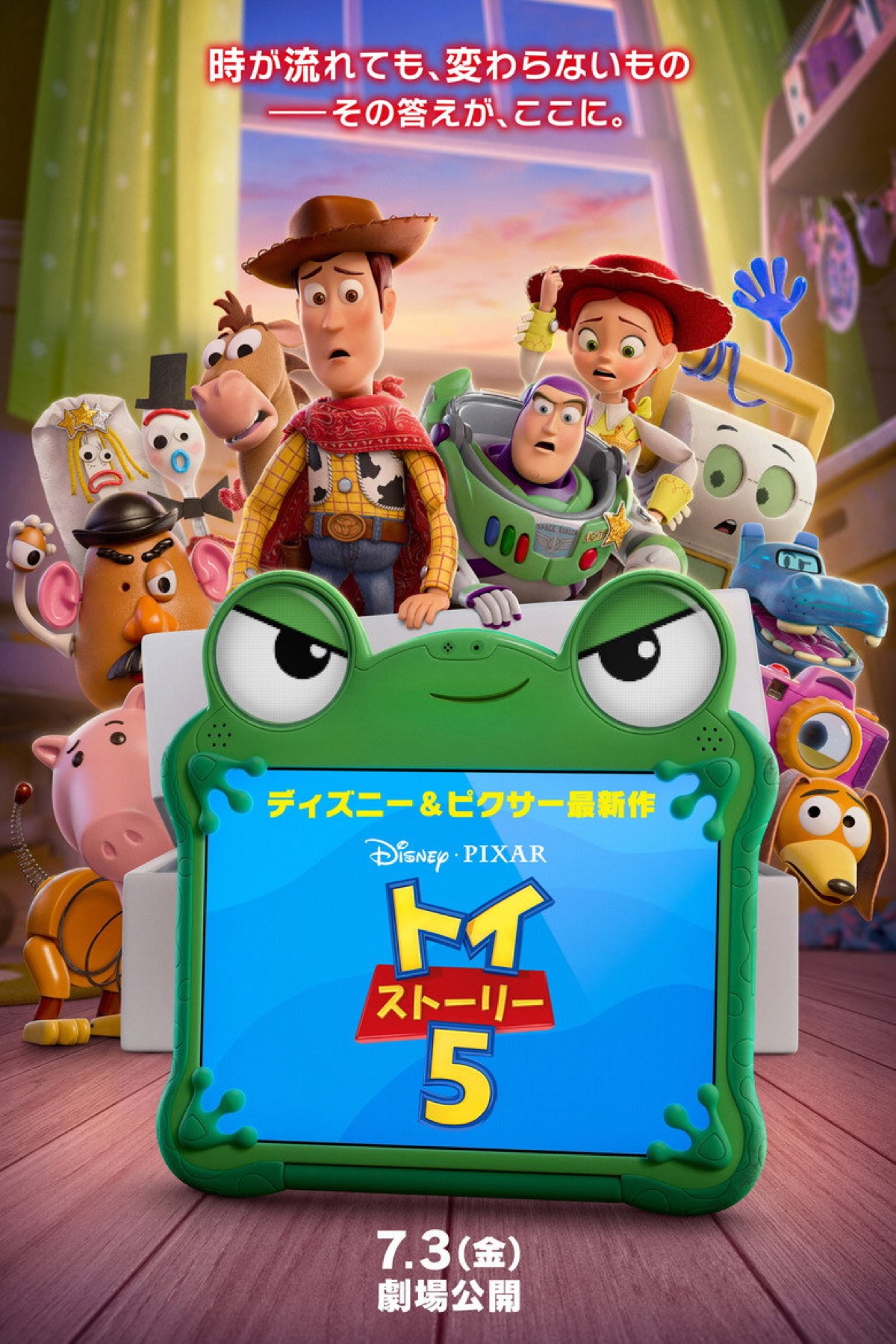
Look at the poster and Woody and Buzz are front and centre with Potato Head, Rex, Hamm, Slinky filling out the frame. Watch the film and that arrangement turns out to be signage. Between the new characters, the swarm of Buzz units, and a plot that splits into three groups, no runtime is left over for the originals. The pleasure of the whole room solving a problem together, which is most of what this series has been for, is thin here.
Woody gets a version of the same treatment. He is called back, then spends a long stretch reacting to events instead of driving them. The faces in the advertising and the faces moving the story are not the same set. Go in knowing this is Jessie’s film.
The Downsides
- No moment where anybody is truly trapped, so the tension never spikes
- The comparison is weighted toward toys long before the film lands on coexistence
- Potato Head, Rex, Hamm, Slinky are given nothing to do
Who Should Watch This?
- Anyone who checked out after the fourth film and has been unsure about this one
- Anyone who decided the story ended at three and never went back
- Any parent watching their kid vanish into a screen every evening (this one especially)
Who Might Not Enjoy This?
- Viewers who want Woody and Buzz driving the story (they play support here)
- Viewers who want the incinerator kind of pressure
📺 Streaming Guide by Service
Which option is right for Toy Story 5?
Buying still makes sense with children in the house. This is a film that gets replayed, and a purchased copy stays put even if your subscription does not.
Where to Stream
- Disney+: Streaming
- Amazon Video: digital purchase
- Apple TV: digital purchase (Fandango at Home, YouTube, Google Play also sell it)
- Hulu: not available
- Netflix: not available
Soundtrack
- Spotify: available
- Apple Music: available
The score is Randy Newman’s, as it has been on all five films going back to 1995. The end-credits song is Taylor Swift’s “I Knew It, I Knew You”, written for the film and pitched country, which fits a Jessie story. Japan still gets a physical CD, dated September 25, and a thirtieth-anniversary compilation covering the first four films came out here on July 15.
📀 On Disc
See the disc editions on Amazon. Worth noting for anyone with the earlier films on disc: the storybook sequences are the part of this film that most rewards a high-bitrate copy over a compressed stream.
🎬 If You Loved Toy Story 5, Watch These 3 Next
WALL-E (2008)
Same director. Eighteen years before this one, Andrew Stanton drew a future where people have been pulled so far into their screens that they can no longer stand up unassisted. The passengers on the Axiom watch floating monitors all day and never look at the person beside them. Read Lilypad as a single unit parked at the entrance to that world and Toy Story 5 turns colder than it plays. The same filmmaker asked the same question twice, eighteen years apart, and the second time he asked it in a nursery. Streaming on Disney+ in the US.
Ping Pong the Animation (2014)
This is the Japanese answer to WALL-E, and the reason I am putting an eleven-episode sports anime under a Pixar review. Across eleven episodes it works on the difference between playing to win and playing because it is fun, and nothing else animated has argued that as well. One boy treats the sport as a game with a ladder to climb. The other treats it as the thing he did after school with his friend. The show refuses to say either of them is wrong, which is the exact move Toy Story 5 makes with the tablet. Streaming on Crunchyroll in the US.
👉 Read the Ping Pong the Animation review
A Letter to Momo (2012)
Three yokai get assigned to watch over a girl who has just lost her father. They are loud, greedy, invisible to everyone else, and their posting ends the moment she stops needing them. That is a toy’s job description written in a different language. It is the closest thing Japanese animation has to the last twenty minutes of a Toy Story film. Free on Kanopy with a US library card. Rent or buy it at Fandango at Home, or buy it on Apple TV.
👉 Read the A Letter to Momo review
📝 Final Thoughts
As a film, it got a concession out of somebody who had written the series off at three. The slack tension bothers me, the tipped scales bother me, the near-absence of the original crew bothers me. It also did the one thing the series had never done. It put a second sentence after thirty years of the first one, and it did that without breaking the rules of a world where toys go still the moment a person walks in. The fourth film had to leave that world to find an answer. This one stayed inside it. Ask me whether I will show up for a sixth and the answer is yes, which is more than I could have told you a month ago.
⭐ Series at a Glance
| Category | Rating | Note |
|---|---|---|
| Story | ★★★★☆ | The right question, reached a little too easily |
| Characters | ★★★★☆ | Jessie is fully served. The 1995 crew is not |
| Themes | ★★★★★ | Writes the sentence the series had been avoiding |
| Visuals | ★★★★★ | Scuffed paint, chipped plastic, plus the storybook passages |
| Tension | ★★☆☆☆ | Nobody is cornered across the whole 102 minutes |
Usagi’s Recommendation Score
⭐⭐⭐⭐⭐⭐⭐⭐☆☆
8.0 / 10
I wanted this to stop at three. Five took that opinion off me.

