*This page contains affiliate links. We may earn a commission if you make a purchase through these links.
The entire plot of the Entertainment District Arc fits into one sentence. Three demon slayers follow a Hashira into Tokyo’s licensed pleasure quarter to look for his three missing wives, people keep vanishing, and eventually there is a fight. Eleven episodes of it, and I did not trim that summary to protect you from anything. The story really is that thin.
I went in assuming the animation would settle back down. Mugen Train was a feature with a feature’s schedule and a feature’s money behind it, and the reasonable expectation was that a weekly television season would return to weekly television standards. It did not. Eleven episodes went out at broadly the same density, and the tenth of them is, for my money, the best twenty-four minutes ufotable has ever put on air. So this review takes the thin story as a given and then argues that just under five hours of your time is still a fair trade.
📺 Where to Watch Demon Slayer: Entertainment District Arc (August 2026)
| Service | Status | Notes |
|---|---|---|
| Netflix | Streaming | All 11 episodes. The ad-supported tier has it too |
| Crunchyroll | Streaming | Subs and the Aniplex dub. Also sold as a channel through Amazon |
| Hulu | Streaming | All 11 episodes on their own series page |
| Disney+ | Add-on | The same catalogue entry, reached through the Hulu integration |
| Amazon Prime Video | Purchase | Sold by episode or by season. A Prime membership alone does not open it |
| Apple TV | Purchase | Season purchase, no subscription needed |
As of August 19, 2026, all eleven episodes sit on four separate US subscriptions: Netflix, Crunchyroll, Hulu and Disney+. Hulu and Disney+ are one answer rather than two, since Disney owns Hulu and the two libraries point at the same catalogue entry. The practical upshot is that the question here is not where to watch this arc but which bill you are already paying. One note on searching, though: the services file these by arc name rather than by number, so type Entertainment District instead of a season number. Nothing agrees on whether this is season two or season three, and you will get different answers on different sites. Streaming rights get reshuffled, so look at the service page yourself before you pay for a month of anything.
👉 One thing before you press play. Episode 1 opens directly on the wreckage of the arc before it, and the mood of that opening is unreadable if you do not know what these three just lost. Our Mugen Train review covers that story in both of the versions US services carry.
🎬 Trailer
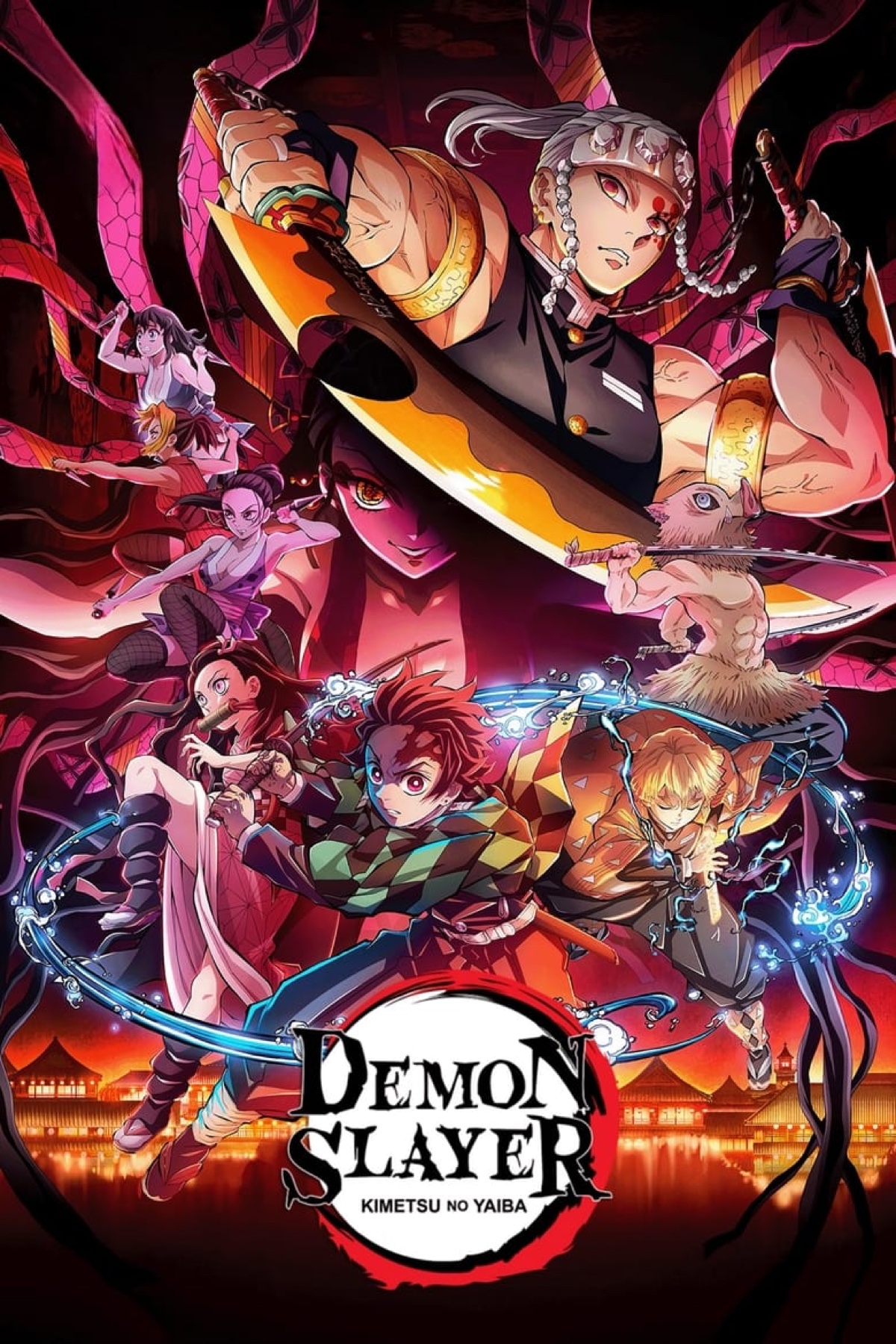
That is Aniplex USA’s key visual trailer, cut around the illustration ufotable produced to announce the arc. Watch what it chooses to show you: lanterns, kimono, wooden lattice, a street at night. Almost none of it is fighting. That is a fair advertisement for the first half of this season, and a very unfair one for the second.
Work Info
- Title: Demon Slayer: Kimetsu no Yaiba Entertainment District Arc
- Broadcast: December 5, 2021 to February 13, 2022 on Fuji TV and affiliates
- Episodes: 11. Episode 1 ran about 47 minutes as a broadcast special, episodes 2 to 10 run about 24, and the finale is extended to about half an hour
- Director: Haruo Sotozaki
- Animation production: ufotable
- Original manga: Koyoharu Gotouge, volumes 8 through 11 of 23
- Music: Yuki Kajiura and Go Shiina
- Theme songs: Zankyosanka by Aimer (opening), Asa ga Kuru by Aimer (ending)
- English release: Crunchyroll, subtitled with the Aniplex of America dub. Manga from VIZ Media
📖 Synopsis, No Spoilers
Tanjiro, Zenitsu and Inosuke have just come out of the worst night of their lives, and their next assignment attaches them to Tengen Uzui, the Sound Hashira. Uzui had sent three wives into Yoshiwara as informants. All three have stopped reporting. The four of them go in to find out what happened, which means the boys are put into makeup and kimono and placed inside three different houses as staff.
A word about the setting, because the English name softens it considerably. Yoshiwara was a real, walled, licensed prostitution district in Edo-era Tokyo, and the Japanese title of this arc uses the word for exactly that. These are not nightclubs and the women working in them are not there by choice. The show does not lecture you about it and does not show you anything explicit, but the economics of the place sit underneath every scene, and by the end they turn out to be the actual subject. What eventually surfaces is a demon of the Upper Ranks, the tier of Muzan’s twelve that nobody in the Demon Slayer Corps has managed to kill in 113 years. Note that number and note that it is not zero. The Corps has done it before. Just not in a very long time.
✨ What Makes It Special
Why It’s Exceptional
- Episode 10 is the high point of the entire franchise so far
- A weekly broadcast season holding a feature film’s level of finish
- Yoshiwara at night, drawn richly enough that losing it costs something
- Tengen Uzui, the least noble Hashira and the most interesting one
Episode 10 Is the Whole Argument
Japanese viewers talk about this season by episode number, which is not how people usually talk about anime here. The number is ten. Its title in English is Never Give Up, and the phrase that circulated on Japanese social media the night it aired was that it felt like five minutes. It runs twenty-four.
What actually happens in it is not complicated. A group that has been comprehensively beaten collapses, reassembles, and gets back up. That is the shape of a great many episodes of a great many shows. The difference is that for twenty-four minutes the picture never once stops moving. Blood-formed sickles, sashes whipping between rooftops, bodies put through walls, a street coming apart underneath all of it. The camera does not settle and neither do the characters, and you lose track of where your own breathing is supposed to go. I have seen more than one Japanese viewer describe forgetting to breathe during it. Having watched it twice in one night, I am not going to call that an exaggeration.
Then it resolves, and the ending theme comes in over a district that is burning, with embers going up over the whole frame. Won, technically. What is on the screen is wreckage. The elation and the cost arrive in the same thirty seconds and neither one gets to finish first. I did not get up off the sofa while that played, and I doubt many people did.
Everything in front of it exists to make that land. The slow infiltration stretch, the comedy, the general sense in episodes three and four that not much is happening: it all turns out to be a run-up. Which cuts the other way too. You cannot form an opinion of this season without reaching episode 10, and I know people who stopped at four and told me it was mediocre. They are not wrong about the four episodes they watched.
A Weekly Broadcast That Held a Feature Film’s Density
Here is what I was wrong about. Mugen Train had 117 minutes, a theatrical release plan and the production runway that comes with both. A television season has a Sunday night slot and a schedule that does not move. Those are different jobs with different budgets, and I said out loud to a friend that the ceiling had already been reached and that this would be the polite step back down.
It never stepped down. Eleven episodes went out on broadcast television at a level of finish that has no business being on broadcast television, and episode 1 went out as a 47-minute special in a one-hour slot, which in Japan is the sort of thing you do for a national event rather than for a Sunday cartoon. Japanese viewers spent that whole winter saying some version of the same sentence, that this could not really be a TV series. A fair number of them argued it was better than the film. I would not go that far. I would say the gap is much smaller than it has any right to be.
The setting is doing a lot of that work. Lantern light on wet ground, the particular reds and golds of the kimono, shadows thrown through lattice screens. The scenes with no fighting in them are the ones that establish what the place is worth, which is the entire reason the destruction later registers as loss rather than as spectacle. Choreography alone does not produce that.
The Demon’s Story Starts After the Demon Loses
The thing this franchise does that almost nothing else in shonen bothers with is still here. You do not get to finish with a villain. Once a demon is beaten, the show goes back and shows you the human being it used to be and the specific afternoon that ended. The Entertainment District Arc holds to that, and what it puts at the end is the childhood of the people you spent nine episodes wanting dead.
So you get walked into sympathy for someone you were, minutes earlier, willing an entire cast to kill. It is a genuinely uncomfortable manoeuvre and Gotouge runs it every single time. Nobody in this series is ever just an obstacle. The question of who is actually at fault gets handed to you after the win, when there is nothing left to do with it.
Deeper Themes
This season puts two sets of siblings on the screen and builds one out of the other. Tanjiro and Nezuko hold each other up. The other pair hold onto each other and go down together, one dragging the next. Read side by side they are the same wish, which is simply to not be separated, pointed in opposite directions. What separates them is not character. It is where they were born and how few options that left them, and the season is honest enough that you cannot say with any confidence which pair would have been which had the addresses been swapped. That is why the setting cannot be swapped out for a nicer one. Yoshiwara is a place where a person could be sold, and a shortage of options is the landscape rather than the backstory.
🎭 Memorable Scenes
Things are gonna get real flashy!!
Uzui’s catchphrase, and the title of episode 5. He introduces himself as the god of flamboyance and behaves accordingly for about four episodes. I want to be careful here, because the series has already run the loud-Hashira-turns-out-to-be-serious play once and running it twice would be lazy. Uzui survives the repetition by being a considerably worse person. He arrives openly transactional, tells three teenagers to their faces roughly how expendable they are, and keeps a running count of what he can and cannot do. He is not admirable, and that is what makes him worth watching.
No Matter How Many Lives
The title of the finale. Who says it, and to whom, stays out of this review. But walking in aware that those five words are sitting at the end of it changes how the previous ten episodes read. It looked like a season about a fight and it closes as a season about who somebody belongs to.
Third one, and it is a single shot. Nezuko catching fire. Whatever else this show has done with her, she has spent most of it being the thing that gets protected, and the colour of that scene is so far outside the rest of the palette that it reads as a change in her status before you have processed what is happening. Very few shows can promote a character with a colour.
💭 How It Made Me Feel
The first thing in my head at the end was not satisfaction. It was: how did they get away with putting that on television. Emotionally the story moved me a normal amount, which is to say not much. Episode 10 stayed with me for days regardless. It taught me something slightly deflating about my own taste, which is that a thin script and overwhelming craft will shut me up completely. I went and reread volumes 10 and 11 the next morning to work out how much of that episode was on the page. Not a lot of it was.
😅 Where It Falls Short
Right. That was a great many words about twenty-four minutes of a five-hour season. Now the other two hundred and seventy.
The Story Is Not Eleven Episodes Thick
That one-sentence summary I opened with is the whole thing, start to finish. No mystery gets solved in a way you did not expect, no development lands sideways, nothing gets rearranged on you. Killing an Upper Rank for the first time in 113 years is genuinely a hinge for the whole series, and the road up to that hinge is flat.
The middle stretch is where you feel it. The infiltration material is charming and I laughed at some of it, but it is not moving the story anywhere, and eleven episodes is not a length that can afford three of them idling.
Too Many Flashbacks, and All of Them Mid-Swing
Cutting to the past during a fight is standard practice for this franchise and I am not objecting to the technique. I am objecting to the frequency and the length. This season goes back constantly, the trips are long, and each one lands at the moment the scene had just built up pressure. The brakes come on, repeatedly, at the worst available time. Plenty of Japanese viewers read it as padding, and I understand how they got there.
Related, and more serious. The demon backstory I praised two sections ago is dumped almost entirely into the final stretch. The intention is the best idea this series has. The execution here gives you nine episodes of unbroken menace and then asks you to reverse your feelings inside twenty minutes with almost nothing seeded in advance. The information arrives. The feeling does not have time to catch up with it.
The Rescue Comes From a Power That Shows Up When Needed
Late on, a situation with no way out is resolved by an ability of Nezuko’s. It has not been built toward. It looks like something that manifested because the script required a manifestation. The relief of a reversal never arrived for me. What arrived was a raised eyebrow.
That bothered me specifically because of how hard the season had worked immediately beforehand. Episode 10 wins by exhausting every option a group of people has. Undoing tension that expensive with a convenience is a bad trade, and the better the fight was, the worse the trade looks.
The Downsides
- A one-sentence plot spread across eleven episodes, idling in the middle
- Long flashbacks that interrupt fights at their tightest moments
- The demons’ history arrives at the end, too late for the feeling to follow
- The final crisis is solved by a power that appears on demand
Who Should Watch This?
- Anyone who picks what to watch by how it is drawn rather than by what happens in it
- Anyone who wants the villain given a life rather than a motive
- Anyone with one free evening who wants to be flattened once and be done
Who Might Not Enjoy This?
- Viewers who grade on script construction and plotting
- Viewers who dislike flashbacks inside action scenes, which this season has more of than any other
- Parents watching with young children. The setting is a prostitution district, the question of who is bought and sold comes up plainly, and the gore is heavier here than anywhere else in the series
📺 Streaming Guide by Service
Is the Entertainment District Arc on Netflix, Hulu or Crunchyroll?
All three of them, and Disney+ as well. Every one of those four has the complete eleven episodes, so the honest answer is to open whichever one you already pay for. The single difference worth knowing is that Crunchyroll carries the English dub alongside the subtitles, and it is a good dub. Hulu and Disney+ share a catalogue entry, so treat them as one option rather than two. If you subscribe to none of the four and want nothing except these eleven episodes, buying the season outright from Amazon or Apple works out cheaper than a subscription you will cancel in a week.
Where to Stream
- Netflix: Streaming, all 11 episodes, ad-supported plan included
- Crunchyroll: Streaming, all 11 episodes with subs and the dub
- Hulu: Streaming, the whole arc on its own series page
- Disney+: Streaming, the same entry via the Hulu integration
- Amazon Prime Video: purchase by episode or by season, not part of Prime
- Apple TV: season purchase only
Soundtrack
Aimer’s Zankyosanka was the song I could not get away from in Japan during the winter of 2022. It was in shops, it was on variety programmes, and it was in every karaoke room I went into for months. Underneath the episodes, Yuki Kajiura and Go Shiina are quietly responsible for a decent share of why episode 10 feels shorter than it is.
- Spotify: the score, plus both Aimer singles
📚 Read the Manga
This arc runs from volume 8 to volume 11, so volume 12 is where you pick the story up afterwards, and its opening pages deal with the consequences of what happens in episode 11. Comparing the two formats here is instructive in a way the earlier arcs are not: the flashback problem I complained about above is much smaller on paper, because you set the pace yourself and a page you can pause on does not stall anything. Everything I said about episode 10 stops being true in print, which tells you where the value was added.
- Demon Slayer, Vol. 12: The Upper Ranks Gather: where this arc leaves you
- The arc on Blu-ray: for anyone who would rather own it than rent the right to watch it
🎬 If You Loved the Entertainment District Arc, Watch These 3 Next
Three picks, each chosen against a specific thing this season did. One makes the same trade even more openly, one fixes the exact flaw I complained about, and one is the opposite kind of fight altogether.
Solo Leveling Season 1
The same trade, made without any embarrassment about it. A weak man gets strong, in order, on a schedule you can predict from episode two, and A-1 Pictures animates it as though it were adapting something profound. If you enjoyed this season while knowing perfectly well the story was thin, Solo Leveling is that experience with the story stripped down even further and the craft turned up. Watching it back to back with the Entertainment District Arc is a clean way to find out how much of your enjoyment was ever about plot. For me the answer was uncomfortable.
👉 Read the Solo Leveling Season 1 review
PLUTO
My main complaint above was placement: the demons get a history only once they are dead, so the sympathy has nowhere to go. PLUTO does the identical humane thing and puts it the other way round. You meet each character, learn what their days consist of and who is waiting at home, and only then does the story come for them. Same conviction that an enemy is a person. Opposite decision about when you are told. Nothing else about it resembles Demon Slayer, which is exactly why it makes the point so cleanly.
One-Punch Man Season 1
Episode 10 is twenty-four minutes of people emptying themselves against something they cannot reach. One-Punch Man is a show in which the hero has never needed a second swing, and everything interesting therefore has to happen somewhere other than the outcome. Struggle that pays off versus struggle that is structurally impossible. Made in the same years, aimed at the same audience, and pointed at the opposite end of what a fight scene is for. Madhouse also went absurdly hard on the animation, so you are not giving anything up on that front.
👉 Read the One-Punch Man Season 1 review
📝 Final Thoughts
This is not a season that wins on writing. The plot fits in a sentence, the flashbacks are relentless, and the last crisis is resolved on credit. What justifies the eleven episodes is one of them. Read the other ten as the distance a run-up needs and the sagging middle stops being a problem and becomes a cost.
I enjoyed watching it, for whatever that is worth. It is easy to follow and there is no point at which you are lost. But the story itself stays weak the entire way through, and my strongest reaction was never to anything that happened in it. It was to the fact that this level of work was going out weekly, on a broadcast channel, on a fixed schedule. Approach it as a season that overwhelms you with craft rather than one that grips you with story, and it delivers exactly what it has. I would still put it below the film. I would also watch episode 10 again tonight if somebody asked me to.
⭐ Series at a Glance
| Category | Rating | Note |
|---|---|---|
| Animation | ★★★★★ | Feature-film finish on a broadcast schedule |
| Music | ★★★★★ | Zankyosanka, and a score built for the fights |
| Characters | ★★★★☆ | Uzui and the demons carry it, not the trio |
| Story | ★★★☆☆ | One sentence, stretched to eleven episodes |
| Pacing | ★★☆☆☆ | The flashbacks keep arriving mid-swing |
Usagi’s Recommendation Score
⭐⭐⭐⭐⭐⭐⭐☆☆☆
7.0 / 10
A strange 7. The writing earns less and the craft earns more.

