*This page contains affiliate links. We may earn a commission if you make a purchase through these links.
Everything you think this film is about turns out to be wrong, and it tells you so in the last line. Eighty-seven minutes of a woman chasing a man across sixty years, several centuries, and at one point into outer space, and then a single sentence that reframes the entire thing. People have been arguing about that sentence for over twenty years.
I came to it without knowing who Satoshi Kon was, which in retrospect was the right way round. It arrived as a recommendation on a streaming service, I started it with low expectations, and I was embarrassed about those expectations roughly ten minutes in. If you are looking for the entry point to a director whose reputation is that he is difficult, this is it.
📺 Where to Watch Millennium Actress (August 2026)
| Service | Status | Notes |
|---|---|---|
| HBO Max | Streaming | Subscription. An Amazon add-on channel carries it too |
| Plex | Free with ads | Cineverse carries it on the same terms |
| Retrocrush | Streaming | Cult Japanese catalog, also via AsianCrush |
| Apple TV | Rent / buy | Fandango at Home as well |
| Netflix (US) | Not available | Japan lost it too |
| Crunchyroll | Not available | Never in the catalog |
As of August 18, 2026, American readers have it better than we do. HBO Max carries it on a standard subscription, Plex and Cineverse will give it to you free with advertising, and Retrocrush has it as part of a catalog built for exactly this kind of title. Availability moves, so check before you plan an evening around it.
In Japan the situation is worse and slightly absurd. The film had a Netflix run that produced a wave of people telling each other to watch it, then quietly disappeared from the service. Today the only subscription route here is a niche anime channel bolted onto Prime Video. A film that shared the top prize at the Agency for Cultural Affairs Media Arts Festival with Spirited Away is easier to watch in Ohio than in Tokyo.
🎬 Trailer
Shout Factory’s trailer for the restoration. Note how many costumes and centuries go past in ninety seconds. That rate of change is not trailer editing. That is roughly what the film does.
Work Info
- Title: Millennium Actress (Sennen joyu)
- Premiered 2001, Japanese theatrical release September 2002, 87 minutes
- Director: Satoshi Kon
- Screenplay: Sadayuki Murai, Satoshi Kon
- Animation: Madhouse
- Music: Susumu Hirasawa
- Awards: Grand Prize, Japan Media Arts Festival, shared with Spirited Away
📖 Synopsis, No Spoilers
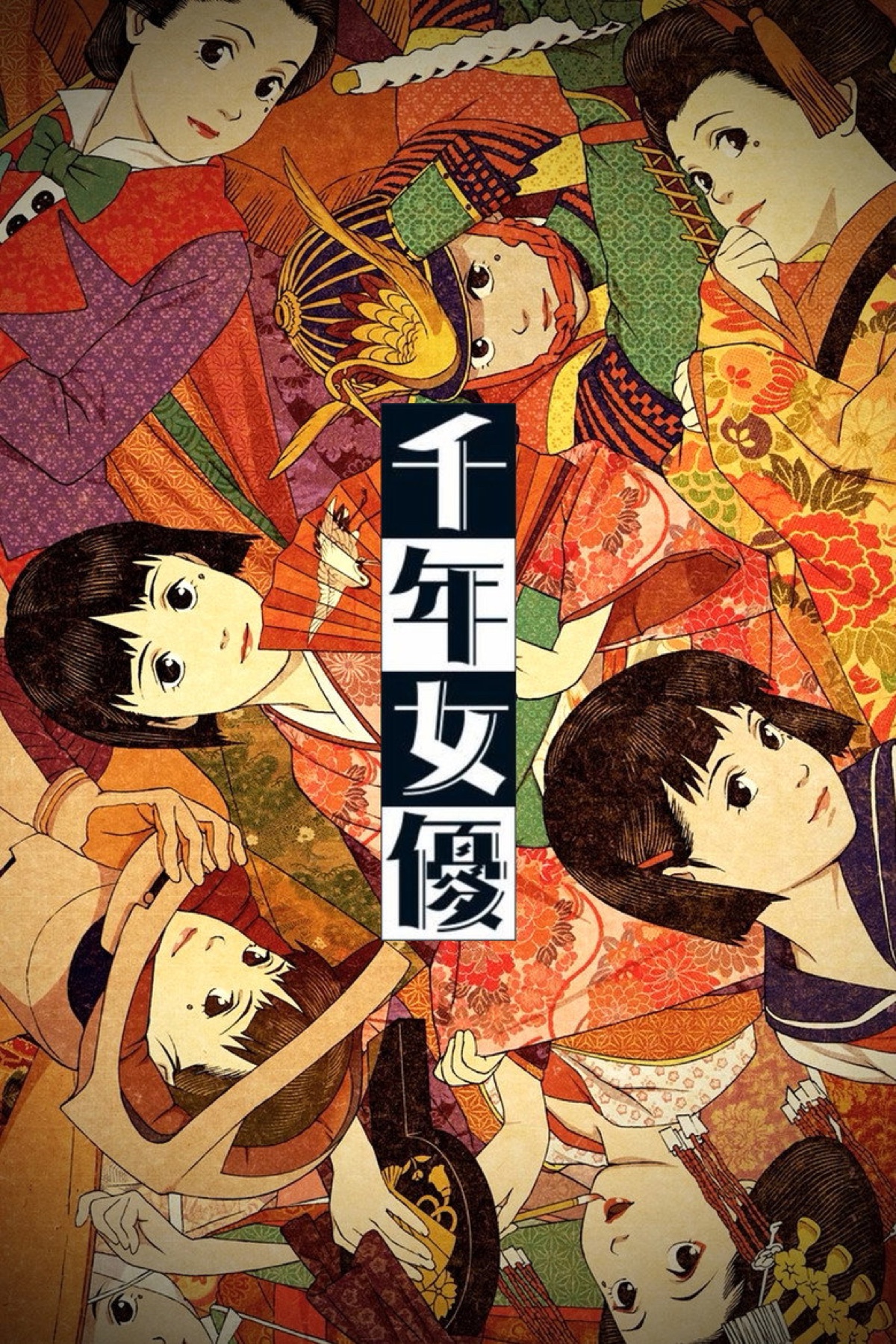
Genya Tachibana runs a small production company and has spent his career wanting to make one documentary. Its subject is Chiyoko Fujiwara, the biggest film star Japan produced in the postwar decades, who walked away from the industry thirty years ago and has not spoken publicly since. She agrees to see him. He arrives at her house in the mountains carrying an old key.
She begins to talk, and the film begins to misbehave. She tells him about a painter she met once as a schoolgirl, a man on the run from the authorities whose name she never learned, and how she became an actress in order to keep looking for him. As she talks, the room becomes a film set, then a castle under siege, then Manchuria, then the surface of the moon. Tachibana and his cameraman go with her. They are physically inside her memories, and inside her films, and after a while the distinction stops being available to anyone including you.
✨ What Makes It Special
Why It Is Exceptional
- Memory, film, and present tense dissolved into one continuous take of a life
- A closing line that retroactively rewrites everything before it
- A hundred years of Japanese cinema compressed into eighty-seven minutes
- The one Satoshi Kon film you can hand to somebody who does not watch anime
Why this is the Kon film to start with
Satoshi Kon’s reputation rests on removing the floor from under an audience. Perfect Blue and Paprika both work by making you uncertain which images you are allowed to trust, and both are, in the ordinary sense, hard work. This one does the same trick with a handrail bolted to the wall.
The handrail is the documentary crew. Tachibana and his cameraman are dragged into the memories along with you, and they react the way you would: bewildered, occasionally delighted, running to keep up, at one point actively participating in a swordfight. Having two people onscreen who are also lost gives you somebody to be lost alongside. It converts disorientation from a problem into a shared joke.
The transitions themselves are the reason animators talk about this film. Chiyoko runs out of a burning castle in period costume and arrives in a wartime street in a schoolgirl’s uniform without a cut, without the film pausing to explain, and without you losing the thread. Kon described the structure as circular, like Bolero: the same motif returning and accelerating. Once you notice the comparison you cannot unsee it, because the last twenty minutes are the same figure at four times the speed.
But here I have to be honest. Relatively easy is not the same thing as easy. I did not follow everything the first time, and a second viewing turned up a great deal I had simply missed, including one entire piece of plot machinery. If you finish it slightly unsure what happened, that is not a failure of attention. It is the design, and the film rewards a rewatch more than almost anything I can name.
A hundred years of Japanese cinema in one woman
Chiyoko is not a real actress, but she is built out of two of them. Kon has said the character draws on Setsuko Hara and Hideko Takamine, and the Hara connection is the one that will mean something to you if you have seen Tokyo Story. Hara was Ozu’s great collaborator, was nicknamed the Eternal Virgin by a press that could not cope with an unmarried leading woman, and then retired at forty-two in 1963 and never appeared in public again. She lived quietly in Kamakura until 2015. Nobody ever got the interview.
Chiyoko’s filmography is therefore a tour of what Japanese studios were making decade by decade. There are Ozu compositions, shot from the low camera position he insisted on, with the symmetry he insisted on. There is a castle sequence lifted straight out of Kurosawa’s Throne of Blood, and it matters to the plot rather than being decoration. There is a period swordplay serial. There is a monster picture that is unmistakably the original Godzilla. You are watching one woman’s life and the history of an entire national cinema at the same time, and they are the same footage.
There is a stretch set in Manchuria, which Western viewers will read as an exotic location and Japanese viewers read as the colonial project. Chiyoko goes there to make films for a studio operating in occupied territory, and the film neither editorializes nor pretends it is nothing. Growing up here, that section lands with a weight that I suspect does not survive the border, and it is worth knowing it is doing more than providing scenery.
Hirasawa, and what the score is actually doing
Susumu Hirasawa is a strange figure in Japanese music, a former progressive rock bandleader who has spent decades making something that sounds like folk song from a country that does not exist, sung by choirs that turn out to be machines. Kon used him repeatedly, and this is the best of those collaborations.
Most film scores accompany. This one pushes. During the running sequences the music is not underlining Chiyoko’s momentum, it is supplying it, and when the closing theme comes in over the credits the effect is to lift a single woman’s disappointing love life into something the size of a myth. I hit replay before the end titles finished, which I have done for perhaps three films in my life.
Deeper Themes
The film is quietly interested in the fact that a memory and a performance are stored the same way. Chiyoko cannot separate the scenes she lived from the scenes she shot, and the film declines to help her, because the argument is that after sixty years there is no meaningful difference. What she has is a reel.
Tachibana complicates this further. He is a fan before he is a documentarian, and the film is sharp about what that does to him. He wants her story preserved, he also wants his version of her preserved, and by the end he is holding a truth he would have been happier not knowing. Anyone who has ever loved an artist from a distance will recognize the position.
🎭 Memorable Scenes
After all, what I really love is chasing after him.
The last line, and the whole argument. Eighty-seven minutes of what looks like devotion to a man, resolved into devotion to the act of pursuit. Some viewers hear self-knowledge in it and some hear something closer to horror, and the film provides no adjudication whatsoever.
My favourite thing in it is not a scene but a colour. On the night Chiyoko first meets the painter, the sky behind her goes red. She has not worked out yet what has happened to her. The film has, and it says so with a background wash and no dialogue at all. I did not catch it the first time. The second time it raised the hair on my arms.
Then there is Tachibana simply walking into the past. He is the interviewer, he has no business being in these images, and there he is holding a boom mic in a castle in the sixteenth century. It plays as comedy for most of the film. In the last act you find out why he specifically had to be the one standing there, and the joke turns out to have been load-bearing.
💭 How It Made Me Feel
Restless and slightly exhilarated, and unwilling to let it end, which is why I restarted it immediately. Eighty-seven minutes is short enough that this is a genuinely available option, and I would recommend planning for it.
The after-effect was musical. For about a fortnight I listened to Hirasawa on the train to work, and every time the closing theme started I got the image of Chiyoko running through a century. That is the specific danger of Kon’s films. They do not stay in the evening you watched them in.
Who Should Watch This?
- Anyone who has seen Tokyo Story and wondered what happened to Setsuko Hara
- People who like films about films more than they like romance
- Viewers who bounced off Perfect Blue and want a way back into Kon
- Anybody who will happily watch something twice in one night
😅 Where It Falls Short
Why I hesitate to recommend it
Look, I have been enthusiastic for a thousand words, so here is the counterweight. This film loses people, and the reasons are structural rather than fixable. The switching between present, memory, and film happens faster than a first-time viewer can reliably track, and the documentary crew who are supposed to anchor you get swept up themselves. Finishing it with no clear idea of what took place is a completely available outcome, and I have watched it happen to somebody sitting next to me.
Second, that closing line splits audiences down the middle and always has. I read it as a woman refusing to be ashamed of how she spent her life. Other people hear a romance evaporate and something colder take its place, and describe the ending as the moment the film turns into horror. Both readings are supported by the text. If you need a film to tell you how to feel at the end, this one will leave you standing in the corridor.
Third, and this is the honest gatekeeping problem: the layers only open if you have some grounding in Japanese film history. Without knowing what Throne of Blood is, or how an Ozu frame is composed, or who Godzilla was to a 1954 audience, a good deal of the film reads as costume changes. The animation alone will carry you. The moment where you sit up and realize what Kon is doing tends to require the homework.
One practical note, since people search for it: there is no sexual content and no graphic violence here. Unlike Perfect Blue, which has both, this is a film you can put on with family in the room.
The Weak Points
- Reality and fiction switch faster than a first viewing can follow
- The final line divides audiences and the film refuses to arbitrate
- Much of the richness requires knowing classic Japanese cinema
Who Might Not Enjoy This?
- Viewers who want a story told in order
- Anyone who needs an ending that states its own meaning
- People with no interest in classic cinema as a subject
📺 Streaming Guide by Service
Sub, dub, and the case for watching twice
Pick HBO Max if you already pay for it. If you do not, Plex will hand you the film for free with advertising, which for an eighty-seven minute picture is a very small tax. Renting is the worst of the three options here and there is no reason to reach for it first.
An English dub exists and was rerecorded for the restoration, and it is competent. I would still take subtitles, for one specific reason: the last line is short, plain, and carries the entire film, and the Japanese phrasing is more ambiguous than any English rendering manages. If you only watch one version, watch that scene in Japanese.
Set aside three hours rather than ninety minutes. Almost everybody who likes this film watches it twice, and the second pass is where the structure becomes visible instead of merely fast.
Watch It Here
Soundtrack
Susumu Hirasawa’s score turns up on any audio service you already use, and it is the rare film album that works as a record in its own right. Synthetic choirs, modal melodies, percussion that behaves like a machine trying to sound like a village festival.
The closing piece, which Hirasawa has also released on his own albums as Rotation, is the one that follows people around for weeks afterwards. Fair warning: it will put the image of a woman running back into your head at inconvenient moments.
📀 On Blu-ray
There is no source manga or novel. Kon and Sadayuki Murai wrote it directly for the screen, which is true of everything Kon made and is part of why his filmography is so unlike anybody else’s.
What that means practically is that the disc is the only artifact. Given how much of this film only arrives on a second or third viewing, and how readily streaming rights evaporate, it is one of the more defensible purchases in animation. Check current listings on Amazon.
🎬 If You Loved Millennium Actress, Watch These 3 Next
Tokyo Godfathers
Kon doing the same sleight of hand on the other side of the street. Three homeless people find an abandoned baby at Christmas, and coincidence stacks on coincidence until the film is openly arguing that reality has a script. Funnier than this one and considerably warmer. The obvious second Kon.
👉 Read our review of Tokyo Godfathers
Crayon Shin-chan: The Adult Empire Strikes Back
An unlikely pairing that turns out to be exact. Made at almost the same moment, also about Japanese adults and the pull of the postwar past, and it reaches the opposite conclusion. Kon treats memory as fuel for a life. Keiichi Hara treats it as a trap you have to be dragged out of. Watch them back to back and each one sharpens the other.
👉 Read our review of The Adult Empire Strikes Back
Your Name
Two people searching for someone they can no longer quite remember, across a gap that keeps widening. Makoto Shinkai took Kon’s editing grammar and pointed it at a mass audience, and the debt is visible in almost every transition. Start here if the structural games appealed but you want the version with a resolution.
👉 Read our review of Your Name
📝 Final Thoughts
I would not press this on everybody. The structure loses people, the ending divides them, and the deepest layer is locked behind a familiarity with Japanese film that most viewers reasonably do not have. Anyone who tells you it is a straightforwardly beloved classic is skipping the part where a good number of people finish it puzzled.
And I would still put it in the small group of films I am glad exist. Eighty-seven minutes, one woman, a key, and a century of cinema running past at a speed nothing else has managed. Satoshi Kon died in 2010 at forty-six, with four features finished. This is the one to start with, and the argument for the other three.
⭐ Film at a Glance
| Category | Rating | Comment |
|---|---|---|
| Writing | ★★★★☆ | A simple pursuit refracted into a kaleidoscope |
| Animation | ★★★★★ | Transitions nobody has matched since |
| Music | ★★★★★ | Hirasawa propels rather than accompanies |
| Characters | ★★★★☆ | Chiyoko’s drive, Tachibana’s fandom, doubled |
| Emotional impact | ★★★★☆ | Depends entirely on how you hear the last line |
| Accessibility | ★★☆☆☆ | Fast, allusive, unforgiving on a first pass |
Usagi’s Recommendation Score
⭐⭐⭐⭐⭐⭐⭐✨☆☆
7.5 / 10
Hard to recommend, easy to love. Watch it twice, and watch the last line in Japanese.

