*This page contains affiliate links. We may earn a commission if you make a purchase through these links.
Forty-seven minutes. That is the whole film, credits included, and in 2003 it became the first Japanese animated feature ever selected for the Cannes Film Festival, premiering in Directors’ Fortnight on the eighteenth of May. A cycling picture, made by a man who had spent the previous decade drawing for Studio Ghibli, shorter than an episode of prestige television.
I follow road racing at the level of somebody who watches the Tour every July and could not name a domestique to save his life. That is the exact audience this film destroys. I have watched a hundred sprint finishes on television and none of them put the last two hundred meters inside my body the way this one does, which was annoying, because it is a cartoon and it is over before dinner.
📺 Where to Watch Nasu: Summer in Andalusia (October 2026)
| Service | Status | Notes |
|---|---|---|
| Hoopla | Streaming | Free with a library card Hoopla accepts |
| Amazon Video | Rent / Buy | Cheap, given the running time |
| Fandango at Home | Rent / Buy | Rents it, sells it too |
| Crunchyroll | Not available | Never licensed there |
| Netflix | Not available | Not in the US catalog |
No paid subscription carries Nasu in the US, and you do not need one. Hoopla streams it free if your library participates, and Amazon or Fandango at Home will rent it, which for forty-seven minutes is a reasonable trade.
🚴 Is There a Sequel to Nasu: Summer in Andalusia?
Yes. Nasu: A Migratory Bird with Suitcase came out in Japan on October 24, 2007, as a direct-to-video release, again written and directed by Kitaro Kosaka, with Yo Oizumi back as the voice of Pepe.
This time the race comes to Japan. Pepe, still riding for the beer team and still working for other people’s results, is entered in the Japan Cup Cycle Road Race in Utsunomiya, Tochigi Prefecture. From Japan, that premise is the draw: a real Japanese race, seen through the eyes of a Spanish domestique, drawn by the man who made Andalusia feel hot.
The catch is getting hold of it. AnimEigo’s 2025 Blu-ray covers the 2003 film only, and no US service lists the sequel, so in America Andalusia is the half of Pepe’s story you can actually watch. It stands on its own. Nothing in it needs the sequel to make sense.
🎬 Trailer
AnimEigo cut this for the 2025 Blu-ray. It is honest about the heat and the dust, and sensibly refuses to show you the last five minutes, which is where the film does the thing it is actually here to do.
Work Info
- Title: Nasu: Summer in Andalusia
- Released: 2003, 47 minutes
- Written and directed by: Kitaro Kosaka, his first feature
- Animation: Madhouse
- Source manga: Iou Kuroda, three volumes
- Music: Toshiyuki Honda. Ending theme by Kiyoshiro Imawano
- Selected for Directors’ Fortnight, Cannes 2003
📖 Synopsis, No Spoilers
Southern Spain, in the middle of the Vuelta a Espana. Pepe Benengeli rides for a team sponsored by a beer company that is about to stop existing, and over the race radio he catches the news that his contract will not be renewed. He is a domestique, which means his job is to protect somebody else’s chances and finish anonymous.
Today’s stage runs through the village he grew up in. Today is also the day his older brother marries Carmen, who was Pepe’s girlfriend before he left for military service. The film starts mid-race and never leaves it, so all of this arrives in fragments while the peloton is moving at fifty kilometers an hour. He has one stage in which to justify his own existence to an employer, a village, and a woman, and roughly forty minutes of screen time in which to do it.
✨ What Makes It Special
Why It Is Exceptional
- The final sprint, where the drawing deliberately stops being pretty
- It teaches you road racing tactics without a single explanatory scene
- The family drama is delivered almost entirely in things nobody says
- Ghibli’s muscle-and-weight animator, off the leash for the first time
The last five minutes, where the line falls apart
Everything before the finish is drawn cleanly. Clear outlines, controlled color, the disciplined house style of an animator trained at the most disciplined studio in Japan. Then the sprint starts and the film stops behaving.
The linework goes coarse and scratchy. Pepe’s cheeks hollow out, his face distorts, his tongue comes loose, and there is mucus. It is grotesque on purpose and it is the best passage of animation in the film by a distance, because it is doing something a camera structurally cannot. A live broadcast can only point a lens at a suffering man from outside. Animation can make the drawing itself suffer.
Japanese animation has a specific tradition here that is worth naming, because it reads as a mistake if you have not met it before. The technique is to abandon model consistency at the emotional peak, letting the art degrade into something rougher and more gestural. The most famous domestic example is a man running in a Crayon Shin-chan film, of all things, and if you want the argument for why that works I have written it up in our piece on The Adult Empire Strikes Back. Same instinct, applied here to a bike race.
Kosaka rides, and it shows in ways that have nothing to do with the finish: the way a rider’s weight shifts out of the saddle, the difference between a wheel that is being followed and one that is being dropped. The exhaustion in the last sequence is not researched. It is remembered.
It teaches you the sport without teaching you anything
Road racing looks, to the uninitiated, like a hundred men cycling in a clump. The reasons it is not that are the reasons people watch it, and this film transmits all of them in three quarters of an hour without stopping once to explain.
You pick up that riders shelter behind teammates and burn themselves out doing it. That the breakaway is a calculated gamble, not a display of enthusiasm. That rival teams will cooperate for ten kilometers when their interests happen to line up, then stop. All of that comes through a commentary track built like an actual Japanese sports broadcast, with a real television announcer and a former professional rider in the analyst’s chair, so the tactical information arrives the way it does when you are watching a race with somebody who knows more than you.
Opening cold, with no idea what a peloton is, the first ten minutes are confusing. The film starts mid-stage and expects you to keep up. I would not change it, and the payoff is that by the end you are reading the race, not watching it. Just know that the confusion is a feature you have to sit through, not an accident.
What Kosaka brought out of Ghibli
Kitaro Kosaka was animation supervisor on Princess Mononoke and on Spirited Away. If you have wondered why bodies in those films have such convincing mass, why a boar in agony reads as a boar in agony, a good deal of the answer is this man.
This was his first film as director, made at Madhouse, not Ghibli, and the choice of subject looks less strange once you know his job description. Weight, effort, and the physics of a body under load are the entire content of a bicycle race. He picked the material that was already his specialty and then, freed from having to serve somebody else’s storyboard, pushed it further than Ghibli would ever have let him.
Deeper Themes
The brother took the girlfriend while Pepe was away doing his national service, and then scheduled the wedding for the one day of the year the race would come through town. Written down it sounds like a soap opera. On screen it is handled with the dryness of the landscape: a few seconds of memory, no confrontation scene, no speech about betrayal. The film trusts you to feel the shape of it from the outline.
Under that is a question about whether you are allowed to leave a place and still belong to it. Pepe says he does not like the village. The film keeps quietly disagreeing with him, most effectively through a pickled aubergine dish that carries more emotional freight than any line of dialogue in the picture.
🎭 Memorable Scenes
Look. This is how you eat it.
The pickled aubergine, which is what the title refers to and which nobody could guess from the poster. A man who has spent the film insisting he has no attachment to where he came from, demonstrating the correct way to eat a local dish. Reconciliation with a whole village, done in one gesture and eight words.
Then a shadow crosses the road. Pepe looks up and there is one of those enormous black bull silhouettes that stand on hilltops all over Spain, and he rides underneath it with something close to deference. Nothing is said. His relationship with the landscape is entirely settled in about four seconds of screen time, and the film moves on without pointing at it.
And the credits. Kiyoshiro Imawano, a rock musician Japan lost in 2009 and still misses, singing a comic song that recites bicycle manufacturers by name. Bianchi. Pinarello. Giant. It should not work after what you have just watched. It works completely, and knowing that Imawano was himself a serious cyclist makes it worse in the best way.
💭 How It Made Me Feel
Elated, and slightly cheated, which is the correct response to being handed something this good and then having it taken away after forty-seven minutes. There is no heavy residue. You are simply put down again, faster than you were expecting.
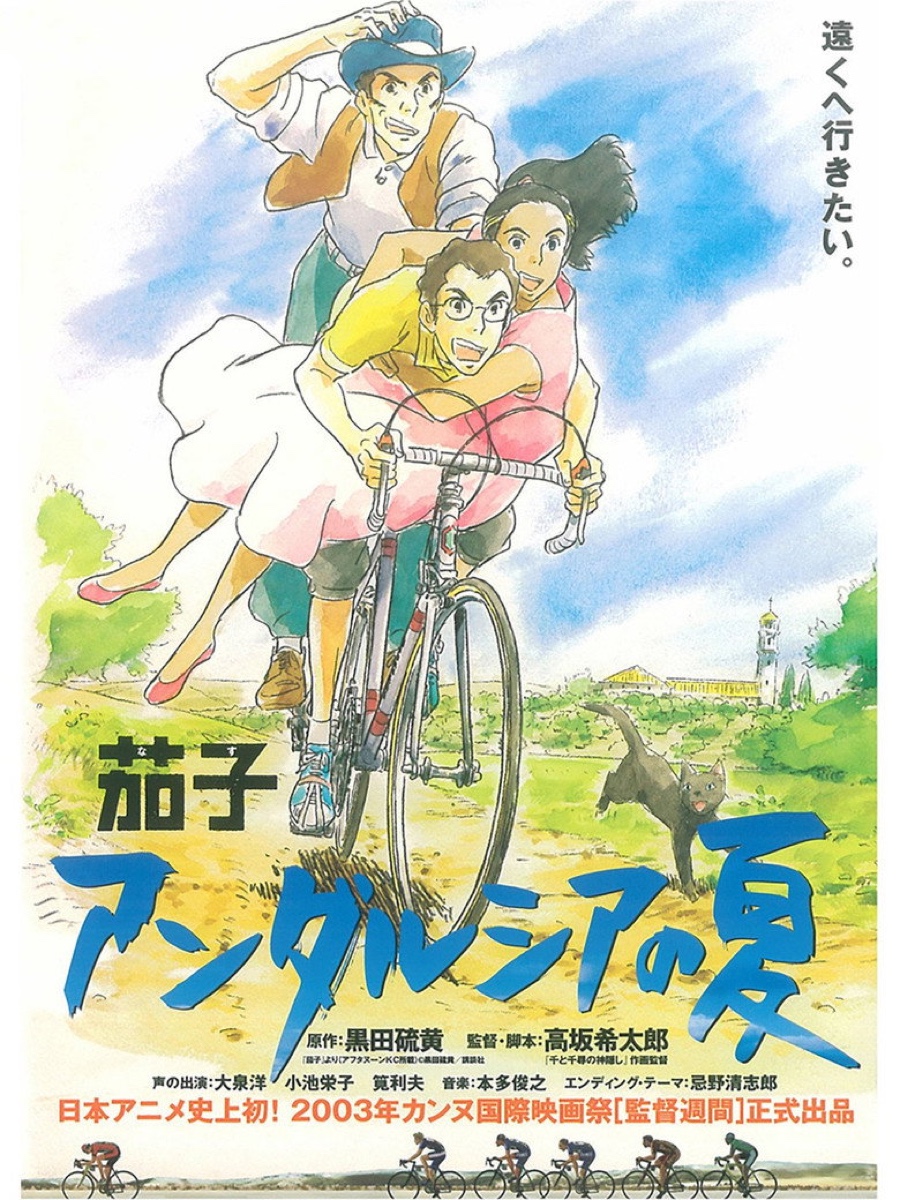
What changed afterwards was how I watch actual racing. When somebody attacks off the front now, I find myself wondering what is going on at home for them, which is a ridiculous thing for a short animated film to have installed in a person. I have also looked at the cover art several times since, the one with three people on a single bicycle, and constructed an epilogue the film never gave me.
Who Should Watch This?
- Anyone with forty-seven minutes and no idea what to do with them
- Cycling fans who have never been offered a film that takes the sport seriously
- Animation people who want to see what a Ghibli supervisor does unsupervised
- Viewers who prefer a story that leaves most of itself unsaid
😅 Where It Falls Short
A title problem, a Spain problem, and a clock
Start with the name, because it has probably cost this film more viewers than any of its actual flaws. Nasu is the Japanese word for aubergine. The English release kept it. Nothing about that title suggests a bicycle race in Spain, and the poster does not help, so a film that would delight a large audience of cycling fans is sitting behind a vegetable’s name. It makes sense once you have seen it. That is not much use beforehand.
The second thing took me out of the film more than once. Japanese animation setting a story in Europe tends to produce Europeans who move like Japanese people, and this is no exception. The heat, the dust and the wedding flamenco are observed with real care. The body language is not. Faces hold expressions a fraction too long, reactions land on a Japanese beat, and every so often the illusion drops. It is a chronic issue with the form, not a failure specific to this production, but it is there.
Third, forty-seven minutes buys you very little characterization. Carmen is a presence rather than a person. The brother gets perhaps two minutes. If you want interiority for anyone other than Pepe, the running time simply does not contain it, and no amount of admiring the restraint changes that.
The Weak Points
- A title that tells you nothing about the film you are getting
- Spanish characters who occasionally move like Japanese ones
- Supporting cast reduced to outlines by the running time
Who Might Not Enjoy This?
- Viewers who need time to attach to characters
- Anyone hoping the family drama gets fully worked through
- People who find in-race jargon actively irritating
📺 Streaming Guide by Service
Free first, then the disc
The order of operations is simple. Check Hoopla, because if your library participates the film costs nothing and the running time means it will barely dent your monthly borrow allowance. If that fails, rent it. There is no subscription service in the US carrying it, so nobody needs to sign up for anything.
AnimEigo’s US Blu-ray is Japanese audio with English subtitles. An English dub does exist, made for the Animax channel’s broadcasts in Asia, but the disc does not include it, and given how much of the tension sits in the commentary track, not the dialogue, I would watch it subtitled anyway.
One scheduling note that sounds trivial. Do not treat this as something to have on in the background. It is short enough that the temptation is real, and the entire film is built to land in a single unbroken sitting that costs you less than an hour.
Watch It Here
- Hoopla: free through a participating US public library
- Amazon Video: rental or purchase, no subscription required
- Fandango at Home: rental or purchase on the same terms
Soundtrack
Toshiyuki Honda wrote the score, leaning on flamenco guitar and hand percussion, which does a lot of the work of convincing you the film is in Spain and not in a studio in Tokyo. It is sparse by design. Long stretches of the race carry no music at all.
The end credits belong to Kiyoshiro Imawano, whose bicycle song is a parody of a 1960s hit about cars. Look him up if the name is new to you. He is one of the founding figures of Japanese rock, and his presence on a small animated film about cycling was not a marketing decision.
📀 On Blu-ray
AnimEigo gave the film its North American disc debut on March 11, 2025, with two Kosaka interviews twenty years apart, the full storyboards, and the original Japanese promos. For a 2003 title this obscure, that is a generous package.
The source manga is a different matter. Iou Kuroda’s three volumes have never been licensed in English as far as I can determine, so the disc is the only way to own any of this. Check current listings on Amazon.
🎬 If You Loved Nasu: Summer in Andalusia, Watch These 3 Next
Ping Pong the Animation
The other great argument that sports animation should not look conventionally attractive. Masaaki Yuasa throws out clean linework entirely and gets closer to what effort feels like than any photographed match ever has. If the last sprint was your favorite part, this is eleven episodes of that idea. More finishes drawn with that kind of conviction are collected in these best sports anime.
👉 Read our review of Ping Pong the Animation
Princess Mononoke
The obvious homework, and the reason to do it is Kosaka. He supervised the animation here, so the bodies straining under load in Mononoke and the bodies straining under load in Andalusia come from the same hand. Watching them close together is a short course in what an animation director actually contributes.
👉 Read our review of Princess Mononoke
Blue Giant
Physical extremity again, this time with a saxophone. The same conviction that a body pushed past its limit is worth animating rather than merely filming, expanded to feature length with the volume turned up. Where Nasu is dry and clipped, this one wants you crying in a jazz club.
👉 Read our review of Blue Giant
📝 Final Thoughts
Cannes did not invite this film because anime had become fashionable in 2003. It invited it because somebody watched forty-seven minutes about a domestique having the worst and best day of his professional life and recognized that the running time was exactly right. Nothing here is compressed. There is simply nothing extra.
It has changed how I watch bike racing, which is a strange debt to owe a cartoon about a vegetable. When somebody goes clear of the peloton now, I think about what they are riding away from as much as what they are riding toward. If you have an hour free, there is no faster way to acquire an entire sport.
⭐ Film at a Glance
| Category | Rating | Comment |
|---|---|---|
| Writing | ★★★★☆ | Short, with the silences doing the work |
| Animation | ★★★★★ | The final sprint is worth the whole running time |
| Sport authenticity | ★★★★★ | Tactics transmitted without a lesson |
| Music | ★★★★☆ | Flamenco score, then Imawano at the end |
| Characters | ★★★☆☆ | Forty-seven minutes buys outlines |
| Pacing | ★★★★★ | Starts mid-race, never stops |
Usagi’s Recommendation Score
⭐⭐⭐⭐⭐⭐⭐✨☆☆
7.5 / 10
Forty-seven minutes, and the shortest possible route into a sport you thought was boring.

