*This page contains affiliate links. We may earn a commission if you make a purchase through these links.
“Those who recognize their own sin have no sin. So I ask you: are you a sinner?”
That riddle sits at the center of a thirteen-episode series from 2002 in which, for the first third, almost nothing happens. Girls with grey wings and floating haloes live in a walled town, take jobs at the bakery and the clock tower, and are forbidden to touch the wall. Then the show quietly reveals what it has actually been about, and people who watched it two decades ago still bring it up unprompted. Here is where to find it, which is harder in the US than it should be, and why the slow start is the point.
📺 Where to Watch Haibane Renmei (August 2026)
| Service | Status | Notes |
|---|---|---|
| Apple TV Store | Buy only | Per episode or by season. The one legal US route |
| Crunchyroll | Not available | Licensed by Funimation, never carried over |
| Netflix | Not available | Neither the sub nor the dub |
| Prime Video (US) | Not available | Not for rent or subscription |
| Amazon (US) | DVD, out of print | Funimation Anime Classics, resale only |
As of August 18, 2026, there is no subscription service in the United States carrying this series. Apple sells it, and that is the whole list. JustWatch confirms the same thing in plainer words: there are no free streaming options for Haibane Renmei right now. The old Funimation DVD sets turn up secondhand, and the licence has never made the jump to Crunchyroll despite Funimation’s catalog largely doing so.
From where I sit, this is backwards. In Japan the series is on three subscription services at once: U-NEXT, dAnime Store, and FOD, all of them flat-rate, all of them with a free trial long enough to finish thirteen episodes twice over. A Japanese viewer can watch this tonight for nothing. An American has to buy it. That inversion is worth naming, because the usual complaint runs the other way, with Western fans getting the simulcast and Japan waiting on discs.
One practical warning that applies in both countries. Titles from 2002 fall off services without notice, and the Japanese Blu-ray box was a limited production run rather than a standing item. If you intend to watch this, do not file it under someday.
🎬 Trailer
There is no trailer embedded here, and the reason is worth stating. The only official English trailers are the spots Funimation cut for the 2012 DVD reissue, which now sit on the Crunchyroll Dubs channel and are region-locked out of Japan, so I cannot verify from here that they play. This site’s rule is that an embed has to be checkable before it goes on the page, and a dead grey box is worse than no box. Search for the Anime Classics trailer if you want a look first. The series also never had a modern promotional campaign, which tells you something about how it was released.
Work Info
- Title: Haibane Renmei, the Charcoal Feather Federation
- Broadcast: October to December 2002, 13 episodes
- Original work, script and series composition: Yoshitoshi ABe
- Director: Tomokazu Tokoro
- Animation: Radix
- Music: Kow Otani
- Runtime: about 24 minutes per episode
📖 Synopsis, No Spoilers
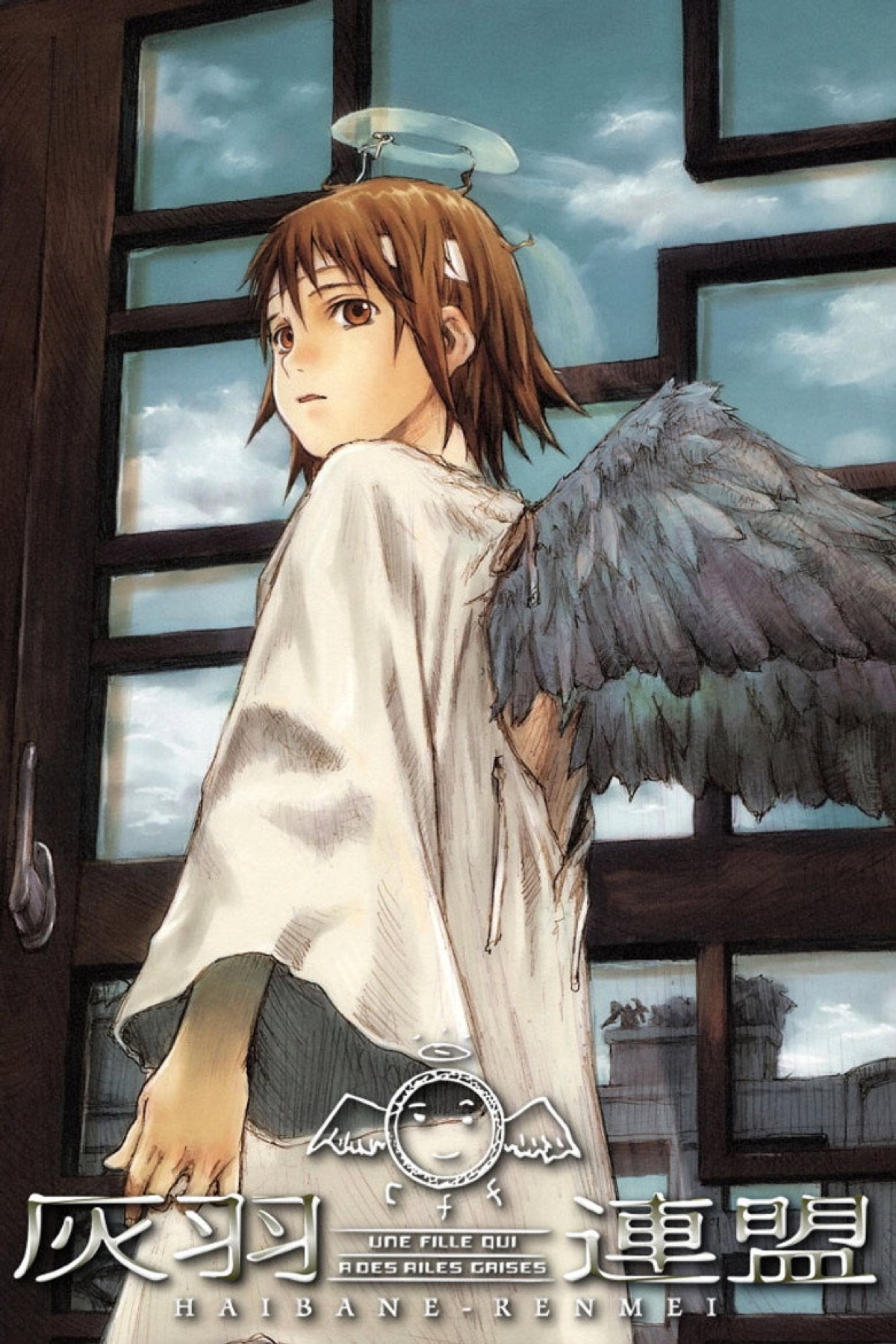
A girl dreams she is falling through the sky, and wakes inside a cocoon. She is given the name Rakka, grey wings push painfully out of her back, and a halo is fitted to her head. This is Glie, a town enclosed by a high wall, where a small community of winged young people called Haibane live alongside ordinary humans who mostly leave them alone.
Rakka remembers nothing before the cocoon. An older Haibane named Reki takes her in, and she settles into the routine: a job she has to choose, a curfew, and two absolute prohibitions. Do not go beyond the wall. Do not touch it. Then someone she knows takes their Day of Flight and leaves, and Rakka starts asking what the wall is keeping in. The answers arrive slowly and are not what a synopsis can carry.
✨ What Makes It Special
Why It Is Exceptional
- A setting that never explains itself and never cheats either
- The most generous treatment of self-forgiveness in television animation
- Quiet built by subtraction rather than by adding atmosphere
The questions are the plot
What are the Haibane. Why is the town walled. Why are crows the only things that cross freely. The series drops these early and lets them sit, and a first-time viewer reasonably files them as fantasy furniture that will be explained in episode twelve.
They are not furniture, and the explanation never arrives as an explanation. What happens instead is that the questions turn out to have been one question, about guilt and what it costs to put it down, and you understand this some distance before anyone says it. The show does not reveal its structure so much as let you notice you already knew. Nothing is spelled out at the end, and the final interpretation is left with the viewer, which some people find unforgivable and others find the reason to rewatch it.
Japanese viewers reach for Haruki Murakami to describe this, and the comparison is more exact than it sounds. Hard-Boiled Wonderland and the End of the World has a walled town nobody leaves, a narrator missing his own past, and a refusal to confirm what any of it stands for. If you are an English reader who wants the literary neighbor, that book is translated and sitting in every bookshop.
I should flag what this style costs, because I have been describing ambiguity as a virtue for three paragraphs. A show that withholds answers is indistinguishable from a show that has none, right up until the moment it proves otherwise. This one proves it around episode seven. Before that, you are taking it on trust.
It is about forgiving yourself, and it means it
Rakka and Reki are both carrying something they cannot name and have decided they do not deserve to be rid of. That is the engine. Not a villain, not a mystery to solve, just two people convinced they are the problem.
The answer the series lands on is that you cannot do this alone and are not supposed to. Someone reaches you, and in being reached you become able to reach somebody else, and the debt clears in both directions at once. Put that flatly and it sounds like a poster in a waiting room. The reason it works here is that the show spends twelve episodes earning it, in a register with no uplift and no music cue telling you to feel better.
The quiet is engineered, not atmospheric
Yoshitoshi ABe’s character designs are soft and unemphatic, the backgrounds are held to a narrow, faded palette, and Kow Otani scores it like chamber music rather than a television soundtrack. Nothing is loud. Nothing tries to be striking.
The word I keep coming back to is thin, in the way a good clear broth is thin. The design principle is removal, and the reason no other show substitutes for this one is that most of them are adding. It is the correct thing to put on when louder anime has worn you out.
Deeper Themes
The riddle at the top of this page is the whole thesis compressed. Admit you are a sinner and, by the terms of the riddle, you are not one. Insist you are innocent and you have failed to recognize anything, which makes you guilty. There is no position inside it that resolves.
The way out is not an argument, and the series is clear about that. Nobody thinks their way past the loop. Somebody else has to say the thing you cannot say to yourself, which is why this ends up being a story about a household rather than about a girl.
🎭 Memorable Scenes
Those who recognize their own sin have no sin. So I ask you: are you a sinner?
I have translated that loosely, because the Japanese is doing something the subtitles let go of. The phrasing is stiff and archaic, closer to a legal summons than to speech, and it lands in the original as a question aimed past the character and at you. Rendered as normal conversation it stops feeling like an accusation.
The other thing that stayed with me is smaller and has no dialogue at all: the wings. They come in wet and unpleasant, they need cleaning, they molt, and they are treated throughout as a chore rather than a blessing. Ten seconds of somebody’s roommate trimming their feathers tells you more about what these people are than any of the exposition does.
💭 How It Made Me Feel
Warm, which is not what the material predicts. The story is sad throughout and the ending is not a happy one in any ordinary sense, and I came out of it lighter than I went in. That combination is rare enough that I distrusted it at first and went looking for the trick.
There is no trick. What the series does is make a case that being unable to forgive yourself is a normal condition rather than a personal failure, and then show it being survived by ordinary means. The feeling afterward is permission, and it is the reason I recommend this to people who are not otherwise interested in anime.
Who Should Watch This?
- Anyone carrying something they have decided they do not get to put down
- Readers of Murakami, or of any fiction that leaves its symbols unexplained
- Viewers who liked the stillness of Mushishi or ARIA and want it aimed at something
- Anyone who wants thirteen episodes rather than a multi-season commitment
😅 Where It Falls Short
The first stretch loses people, and I understand why
Honestly: the opening episodes are very quiet. Rakka arrives, gets her wings, picks a job, meets the household, and the show is in no hurry about any of it. Come to this expecting incident and you will conclude that nothing is happening, because in the conventional sense nothing is.
If you are here from serial experiments lain because of the shared designer, adjust your expectations further. There is no visual aggression in this at all, no dense collage, none of that show’s discomfort. The two works share a hand and nothing else.
My advice is to hold on until episode six. That is where the register changes and the earlier calm turns out to have been load-bearing. Anyone who quits at three has watched a different and much lesser show, and I would rather say that plainly than pretend the pacing is not a real barrier.
The Weak Points
- Slow opening episodes, and a high drop-off rate because of them
- The setting is never explained outright; the reading is left to you
- Heavy on interior confession, and too much if you are in a bad stretch yourself
Who Might Not Enjoy This?
- Anyone wanting the worldbuilding confirmed before the credits roll
- Viewers who find sustained melancholy hard going
- Anyone here for action, since there is none whatsoever
📺 Streaming Guide by Service
Buying it is the only honest recommendation
With no US subscription option, the choice is Apple or a secondhand disc. Apple sells the series outright and the transfer is the one you want, since a 2002 production shot for standard definition does not benefit from anything the DVD masters can offer.
Buying a thirteen-episode show sight unseen is a real ask, so here is a fair test. Watch the first episode and then episode six. If the second one lands, the ten hours are worth your money, and if it does not, this was never going to be your series. That is a cheaper experiment than committing to the season.
On pacing, take it two or three episodes at a time rather than in one sitting. The show works by accumulation and the gaps between viewings do it no harm, which is the opposite of most of what I recommend here.
Your Options in the US
- Apple TV Store: buy by episode or by season, the only legal streaming purchase
- Amazon: the Funimation Anime Classics DVD set, out of print and secondhand
Soundtrack
Kow Otani’s score came out under the title Hanenone, and both major streaming services carry it. Small ensemble, a great deal of space, and it stands up entirely detached from the series.
Otani is better known abroad for Shadow of the Colossus, which makes the restraint here more striking. Same composer, opposite brief.
📚 Where It Came From
This did not start as a pitch to a studio. ABe drew it as a self-published doujinshi called Old Home’s Haibane and sold it himself at Comiket, Japan’s enormous fan-publishing convention, and the anime was commissioned afterward from that.
The doujinshi has never been licensed in English, so the series is the only version available to most readers here. It also explains the shape of the thing: nobody was ever asked to make this commercial.
🎬 If You Loved Haibane Renmei, Watch These 3 Next
Violet Evergarden
The same problem approached from a different angle. Someone who cannot forgive what she has done works her way toward it sideways, by writing other people’s letters. Where Haibane is thin and faded, this is lavish, and the underlying question is identical.
👉 Read our review of Violet Evergarden
Mushishi
The closest match for the texture. Episodic, unhurried, faintly sad, and built on the same conviction that a story does not need to raise its voice to land. If what you valued here was the quiet rather than the puzzle, start with this one.
Made in Abyss
A boundary you are told not to cross, gentle character art, and a cruelty underneath that the designs do nothing to warn you about. Swap the wall for a vertical hole in the ground and the structure rhymes. Be aware this one is considerably harsher.
👉 Read our review of Made in Abyss
NieA_7 comes from the same creator, and it is the comedy version of the same loneliness. 👉 Read the NieA_7 review
📝 Final Thoughts
Twenty-four years on, this is still the series I reach for when somebody says they cannot let something go. It does not argue them out of it. It shows a walled town where everyone is in the same position, and then shows the way people actually get free, which is by accident and through each other.
The obstacle is that America has made it awkward to watch, and the obstacle is not going away on its own. Thirteen episodes, bought outright, is a small price for the one work that does this particular thing. Watch to episode six before you decide, and if the wall is still just a wall to you by then, no harm done.
⭐ Series at a Glance
| Category | Rating | Comment |
|---|---|---|
| Writing | ★★★★★ | Thirteen episodes with nothing wasted |
| Characters | ★★★★★ | A household rather than a cast |
| Visuals | ★★★★☆ | Muted by design, and dated in the good way |
| Music | ★★★★★ | Kow Otani, chamber-scale and exact |
| Themes | ★★★★★ | The most useful thing anime has said about guilt |
| Accessibility | ★★☆☆☆ | Slow opening, and awkward to obtain in the US |
Usagi’s Recommendation Score
⭐⭐⭐⭐⭐⭐⭐⭐⭐☆
9.0 / 10
A quiet masterwork you will want to stay inside. Worth buying outright.

