*This page contains affiliate links. We may earn a commission if you make a purchase through these links.
Nine episodes into this season I stopped and checked how many were left. I wanted to know how much more of it there was before I gave up the evening to it.
Season 1 ended with two teenagers winning a slot in the biggest manga magazine in Japan. Season 2 picks up the following week, and what it hands them is a new editor they did not ask for, a series they do not want to be drawing, and eventually a hospital bed. Twenty-five episodes about the part that comes after you get what you wanted. It is the hardest of the three seasons to sit through, and I would still argue nobody should skip it. What kept me in the chair, if I am being honest about it, was a character who shows up here for the first time and spends the entire season refusing to work.
📺 Where to Watch Bakuman Season 2 (August 2026)
| Service | Status | Notes |
|---|---|---|
| Hulu | Streaming | Subscription. All 25 episodes |
| Tubi | Free with ads | Seasons 1 to 3. No charge |
| Crunchyroll | Not available | Missing despite the Jump pedigree |
| Netflix | Not available | No US listing at all |
| Amazon Prime Video | Not available | Nothing to rent, nothing to buy |
As of August 14, 2026, Hulu is the single US subscription service with season 2 on it, and Tubi has the same episodes free with ads. Two services, one of them costing nothing, which is a better position than this show occupies in the country that made it. The specialist anime service over here, d Anime Store, has dropped seasons 1 and 2 outright. Open the service page yourself before you pay for anything, because catalogs move without announcing it.
👉 Season 2 opens mid-conversation and assumes you know these people. If you have not started yet, go to the Bakuman Season 1 review first.
🎬 Trailer
There is no English trailer for this season, and the reason is worth knowing. Media Blasters licensed the anime in 2011, dubbed seven episodes of season 1, ran out of money, and let the rights lapse in 2013. Season 2 has never had an English home video release at all. What is above is the anniversary promo Shueisha cut for the manga on its own Jump Channel, in Japanese, because that is what exists. One detail you can hear in it: the season 2 opening is Dream of Life by Shohei Ito, and it pushes a lot harder than season 1 ever did. A season about people running out of road opens every week with a shout.
Work Info
- Title: Bakuman. Season 2
- Broadcast: October 1, 2011 to March 24, 2012, NHK Educational TV, 25 episodes
- Directors: Kenichi Kasai, Noriaki Akitaya
- Series composition: Reiko Yoshida
- Animation production: J.C.Staff
- Original manga: Tsugumi Ohba and Takeshi Obata, serialized in Weekly Shonen Jump, 20 volumes, complete
- Manga covered: chapters 34 to 91, ending three chapters into volume 11
- Music: opening Dream of Life by Shohei Ito. Endings monochrome rainbow by Tommy heavenly6, then Parallel by Ikuya Sashida
- Voice cast: Atsushi Abe as Moritaka Mashiro, Satoshi Hino as Akito Takagi, Masakazu Morita as Kazuya Hiramaru, Daisuke Kirii as Goro Miura, Tomoyuki Shimura as Takuro Nakai, Ayako Kawasumi as Yuriko Aoki
- English release: none for this season. The dub stopped at episode 7 of season 1. Subtitles only
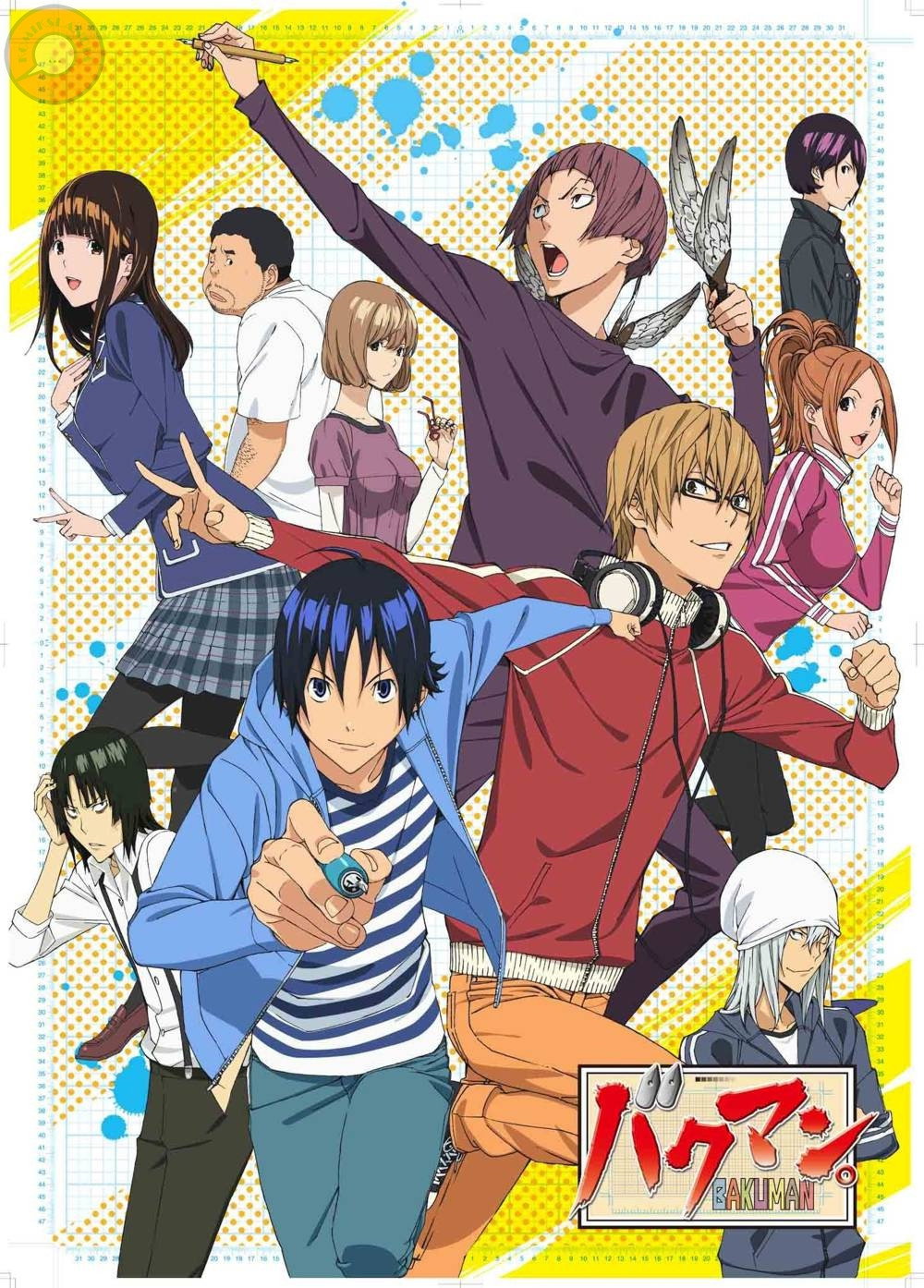
📖 Synopsis – No Spoilers
Moritaka Mashiro and Akito Takagi have their slot. Their series runs in Weekly Shonen Jump now, which means a chapter every week, a reader survey result every week, and a number attached to their name that anyone in the building can read. The thing they spent 25 episodes chasing turns out to be a thing that has to be defended, starting immediately, with no gap in between.
Then Akira Hattori, the editor who found them, is taken off their series. His replacement is Goro Miura, and Miura wants different things from their pages than Hattori did. Around the same time, the artists who stood in the background of season 1 start getting slots and rankings and cancellation notices of their own. The premiere is titled Silence and Party, and the two halves of that title tell you the shape of the whole season.
✨ What Makes It Special
Why It’s Exceptional
- Swap one editor for another and the job itself changes shape. The season proves it over 25 episodes
- The supporting artists get their own serializations, their own rankings, their own cancellations
- Kazuya Hiramaru arrives with real talent and no reason on earth to use it
- Failure by failure, the pair works out what kind of manga they are not
One editor leaves, and the job stops working
The best thing in season 2 is also the thing that makes it painful. Hattori goes. Miura arrives. Nothing else about the pair changes.
Hattori, in season 1, would name the specific weakness on a page, attach a reason to it, and then stay in the chair while the three of them worked out the fix. Miura does not operate that way. He is trying hard, which is the part that hurts, but his instincts move around from meeting to meeting, and he steers the pair toward whatever he believes the survey will reward rather than toward the thing they are actually good at. You watch the manuscript drift away from its own centre one meeting at a time. Same two artists, same hours at the desk, different result, and the only variable that moved was who sat across the table.
Here is the part I did not expect to have to admit. I spent the entire season finding Miura insufferable, and then I did the arithmetic on him. He is in his second year assigned to the Jump editorial department. Second year. In a Japanese company you are not usually asked which department you would like. You are placed in one in April, along with everybody else hired that spring, and where you land is settled by people you have never spoken to. There is a piece of slang for the next part of it: jōshi gacha, the boss lottery, borrowed from the capsule-toy machines and then from mobile games, where you pay and something comes out and you do not get to choose which. Everybody here uses it, usually about themselves, usually after a reassignment.
Miura is on both sides of that lottery at once. He is a bad roll for the artists, and he is himself somebody with a manager upstairs asking what his numbers look like this quarter. Caught between protecting the people he is responsible for and producing a result, he does neither well. Villainy would be simpler. What the show puts in front of you is a man two years into a job he is not yet good at, and it never once lets him off the hook for the damage that causes. I went in ready to enjoy hating him and came out with a worse question: in my own second year, was I somebody else’s Miura?
And the wreckage is not wasted. Steered onto ground that does not suit them, the pair produce work that does not suit them, and every one of those failures narrows the field. The stretch that reads as stagnation while you are in it turns out, by the finale, to have been the process by which they found out what they are. That reversal is the reason this season exists.
The rest of the cast finally gets to lose something
The artists who filled the background of season 1 come forward here, each carrying a serialization and a weekly position in the same table as everyone else.
The one with no mercy in it is Takuro Nakai. He is in his thirties, still working as somebody else’s assistant, still unable to put the ambition down, and the season removes his footholds one at a time. Some of it is luck and some of it is entirely his own doing, in roughly equal measure, which is what makes it hard to watch. Nakai carries the argument this franchise would otherwise never make: that wanting it badly enough is not a payment plan. Because he absorbs that, the leads are allowed to succeed without the success turning weightless.
Elsewhere the movement is the other direction. Yuriko Aoki, all sharp edges in season 1, softens by degrees until you notice you have changed your mind about her without being asked to. Shinta Fukuda keeps running hot and drags people along in his wake. Every one of them has pages due and a number coming. The show gets thicker as an ensemble, and the amount of information packed into a single episode rises with it.
Kazuya Hiramaru does not want to work
Every manga artist in this series is a grinder. The all-nighter, the deadline, then back at the desk the next morning. Then Hiramaru walks in: a former salaryman who quit his job, taught himself to draw at speed, landed a serialization on the first try, and immediately regretted the entire enterprise because it turned out to involve working. He is the only person in the show with talent and no reason to spend it. His editor, Koji Yoshida, spends the season coaxing, flattering, bribing and finally openly manipulating him into producing pages, and the schemes escalate every time.
Those scenes are the only air in the entire season, and I laughed out loud at them. He is also, and I say this with no pride whatsoever, the one manga artist here I actually recognized. Everybody else in this cast is a person I admire. Hiramaru is a person I have been.
Deeper Themes
Season 1 was about reaching the thing. Season 2 is about holding it and repeatedly dropping it. What saves the season from being a flat 25 episodes of misery is that no two of those failures are the same failure. Each one rules out a different answer, and each time the pair learns one more thing they are not built to do. The whole season is an elimination process, and what gets eliminated is every version of themselves that was never going to work. It reads as a stall because they are still inside it. Cut this season out and season 3 has nothing underneath it. The same arithmetic applies to a career, incidentally, and it takes about the same number of years.
🎭 Memorable Scenes
A meeting with Miura that refuses to connect. Nothing he says is wrong. The point about the survey is fair, the point about what readers respond to is fair, and the faces across the table still go flat. Correct advice and useful advice separating in real time is the most accurate depiction of office life this show ever manages.
Yoshida working on Hiramaru. An editor who needs pages against an artist who will do anything except produce them. This one pairing runs on comedy logic while the rest of the season runs on dread, and the temperature change is what makes the episodes around it survivable.
Episode 6, Disease and Drive. The bill for months of overwork comes due, and for the first time since episode 1 of season 1 the story physically stops. What happens next is decided by what gets chosen from a hospital bed rather than from a desk. Three episodes later, in Resumption and Low Rank, you find out exactly what the pause cost.
💭 How It Made Me Feel
Episode 25 left me tired rather than satisfied. Bad shows produce a different kind of tired, though. The season asks you to carry the stall along with the characters for 25 weeks of their lives, and it succeeds, which is a strange thing to praise a piece of entertainment for. Season 1 leaves you elated. This one leaves a residue, and the residue is the point.
It did not land while I was watching. It landed a week later, when somebody sent back a piece of work of mine with notes I disagreed with, and I caught myself on the wrong side of the desk from Miura. I went and reread a message I sent to somebody I was managing about three years ago. It was not as good as I remembered it being. That is what this season does if you have ever had a job.
👉 All 25 episodes are on Hulu, or free with ads on Tubi.
😅 Where It Falls Short
The romance got harder to ride, not easier
I have spent a long stretch defending this season. Time to say what it costs you. Whatever kept me at arm’s length from the Miho Azuki thread in season 1 is still here, and season 2 adds to it rather than resolving it. The promise the two of them made still forbids them from meeting, that arrangement still has to hold across another 25 episodes, and now a third party with an agenda is pushing on it from the side. Set next to a work plot that has become genuinely unpleasant in a realistic way, the romance is running at a completely different temperature. Bounce off it and the pacing of the whole season gets heavier. I bounced off it.
People behave differently depending on the episode
More characters plus more running time equals more places for somebody to contradict themselves. Somebody holds a clear position in one episode and argues the opposite three episodes later without anything visible having changed their mind. It happened often enough that I noticed the plot deciding first and the character catching up afterwards. You can file that as the price of the ensemble getting bigger, and it is a fair defence, but once you have seen it you keep seeing it.
Twenty-five episodes without a reward
This is the real one. Things fail to work, meetings fail to connect, effort fails to convert, week after week after week. If what brought you here was season 1’s climb, the middle of this season will feel like being left behind by your own show. Depicting a stall is a legitimate artistic choice. Sustaining it across 25 episodes asks something of the viewer as well. Anybody who quits partway through is not making a mistake, exactly. They are declining to pay.
The Downsides
- The romance is even easier to bounce off than it was in season 1
- Characters shift position between episodes to suit the plot
- The unrewarded stretch runs long. This is the most static season of the three
Who Should Watch This?
- Anyone who hit their goal and then stalled out behind it
- Anyone who has had a manager swapped out in the middle of a project
- Readers who want the side characters to get real defeats, not decoration
Who Might Not Enjoy This?
- Viewers who came for more of season 1’s momentum
- Viewers who check out when a show stops rewarding them for a while
- Anyone planning to start the series here. Almost everything rests on season 1
📺 Streaming Guide by Service
Is Bakuman Season 2 on Crunchyroll or Netflix in the US?
Neither one has it. Hulu is the only US subscription with the season, and Tubi carries it free with ads, so the entry price is either one subscription you may already have or nothing at all.
Which of the two you pick matters more for this season than for any other part of the series, and the reason is where episode 25 leaves you. Season 2 does not resolve. It sets up. Everything the pair spends these episodes ruling out is a deposit that season 3 spends, so the gap between finishing this season and starting the next one is the worst possible place to get stuck behind a paywall. Tubi has all three seasons sitting in one shelf at no cost, which makes it the one to start on if you intend to keep going the same night.
Worth knowing if you are comparing notes with Japanese fans online: over here the show sits behind Anime Times, an extra paid channel on top of an Amazon Prime membership, and the specialist anime subscription service has removed seasons 1 and 2 from its catalog altogether. On this title the American shelf is the better one, which almost never happens with a Jump adaptation.
Where to Stream
📚 Read the Manga
This season adapts chapters 34 through 91, which puts the finale three chapters into volume 11, Title and Character Design. VIZ Media has the full 20-volume run in English, so volume 11 is the one to pick up the night episode 25 leaves you hanging. You reread the last three chapters and then keep going. Obata’s pages are also the better format for this particular season, because so much of it is people looking at artwork and disagreeing about it. On paper you can look at the same panel for as long as they do.
- Bakuman., Vol. 11: where season 2 stops
- The complete 20-volume run: for readers who would rather begin at the first volume
🎬 If You Liked Bakuman Season 2, Watch These 3 Next
Three shows aimed at the specific nerve this season presses. One shows you the version of Miura who is good at the job. One is a different genre entirely with the identical structural problem. One is the romance that works, for anybody who spent this season wishing the other half of it would land.
Medalist
The counterweight to Miura. Figure skating, a child with almost no time left to start, and a coach who never got far enough himself to have the credentials anybody would respect. What he does have is the ability to see precisely what is in front of him and say the useful thing. Watch this after 25 episodes of unproductive meetings and it works as repair. Same job, same power imbalance, opposite outcome.
Attack on Titan Season 2
Nothing whatsoever in common on the surface, and the exact same problem underneath. Twelve episodes that a large number of viewers write off as the slow one, sitting between a season everybody loves and a season everybody calls a masterpiece, quietly laying track that the later seasons run on at full speed. Second seasons that plant rather than harvest get a bad reputation, and both of these earn a re-evaluation from the other side. Read the two together and the shape becomes obvious.
👉 Read the Attack on Titan Season 2 review
Hi Score Girl
For everybody the Azuki thread lost. Kids in 1990s arcades, a girl who will not speak, and a result on the screen at the end of every match. The obsession and the romance are the same object here rather than two plots running side by side at different speeds. If the long-distance promise in Bakuman felt like an idea rather than a relationship, this is the version built out of behaviour. It also happens to be a very good hour on the arcade floors I grew up next to.
👉 Read the Hi Score Girl review
Season 3 takes the serialization war to its conclusion, and it is the part of the story the first two seasons were building toward. 👉 Read the Bakuman. Season 3 review
📝 Final Thoughts
Remember me checking how many episodes were left. The answer to why I kept going is that the season is testing rather than spinning, and that difference only becomes visible from the far end. A new editor with the wrong instincts, work that suits nobody, a body that gives out, a supporting cast falling and climbing in the same magazine. It is the most static season of the three and the most tiring to sit through, and cutting it out would leave season 3 standing on nothing.
I am giving this a 7.0, half a point under season 1, and it is an awkward 7.0, because the thing dragging it down is the same thing I rate it for. Twenty-five episodes of not succeeding is a real cost to the viewer and I am not going to pretend otherwise. What I will say is that Kazuya Hiramaru arriving to complain about having to work is worth more to this season than any dramatic beat in it, and that a show which made me go back and reread my own old feedback to somebody has done something that most anime about ambitious teenagers cannot. Hard season. Skip it and you lose.
⭐ Series at a Glance
| Category | Rating |
|---|---|
| Characters | ★★★★★ |
| Workplace Realism | ★★★★★ |
| Story | ★★★☆☆ |
| Pacing | ★★☆☆☆ |
| Works on Its Own | ★★☆☆☆ |
Usagi’s Recommendation Score
⭐⭐⭐⭐⭐⭐⭐☆☆☆
7.0 / 10
Winning takes one season. Keeping it takes this one.

