*This page contains affiliate links. We may earn a commission if you make a purchase through these links.
The soundtrack to this cartoon about a koala runs through Elton John, Stevie Wonder, Frank Sinatra, and Queen with David Bowie. For me that is very close to the entire review.
That is not only a coincidence of taste. Part of it is an accident of geography. Over here this playlist is not the furniture it is in an American living room. Elton John and Stevie Wonder fall under what Japan calls yogaku, meaning Western pop, and yogaku is a taste you go out and acquire on purpose rather than something your parents had on in the kitchen. So the film handed me a jukebox stocked entirely from my own generation’s shelf, then let a gorilla loose on it.
📺 Where to Watch Sing (October 2026)
| Service | Status | Notes |
|---|---|---|
| Amazon Video | Rent / Buy | Not included with a Prime membership |
| Apple TV | Rent / Buy | Also on Fandango at Home, Google Play, YouTube |
| Netflix | Not available | Left the US catalog on October 3, 2026 |
| Peacock | Not available | Its run ended on September 30, 2026 |
| Hulu | Not available | Not carrying this title |
| Disney+ | Not available | Illumination is a Universal studio, never Disney |
| Crunchyroll | Not available | Not an anime service title |
👉 If what brings you here is the idea of a film where the music does the heavy lifting, Japan has an answer that arrives from the opposite direction. Blue Giant spends its entire runtime on one saxophone.
🎤 Is Sing on Netflix?
Not in the US anymore. Netflix took Sing out of its American catalog on October 3, 2026, three days after Peacock dropped it, which leaves the 2016 film with no subscription home in the US for now. Until a service picks it up, a rental is the way in.
In Japan it is the other way round. Prime Video, Hulu and U-NEXT all carry it, and Netflix is the one that does not. The film also exists here in a form American viewers never got, with a dub that re-recorded every song, which comes up further down.
🎬 Trailer
Work Info
- Title: Sing (2016)
- Director / Writer: Garth Jennings
- Studio: Illumination
- Runtime: 108 minutes
- Songs featured: more than 60
- Voice cast: Matthew McConaughey / Reese Witherspoon / Scarlett Johansson / Taron Egerton / Tori Kelly / Seth MacFarlane / John C. Reilly
- US theatrical release: December 21, 2016
- Japanese theatrical release: March 17, 2017
📖 Synopsis – No Spoilers
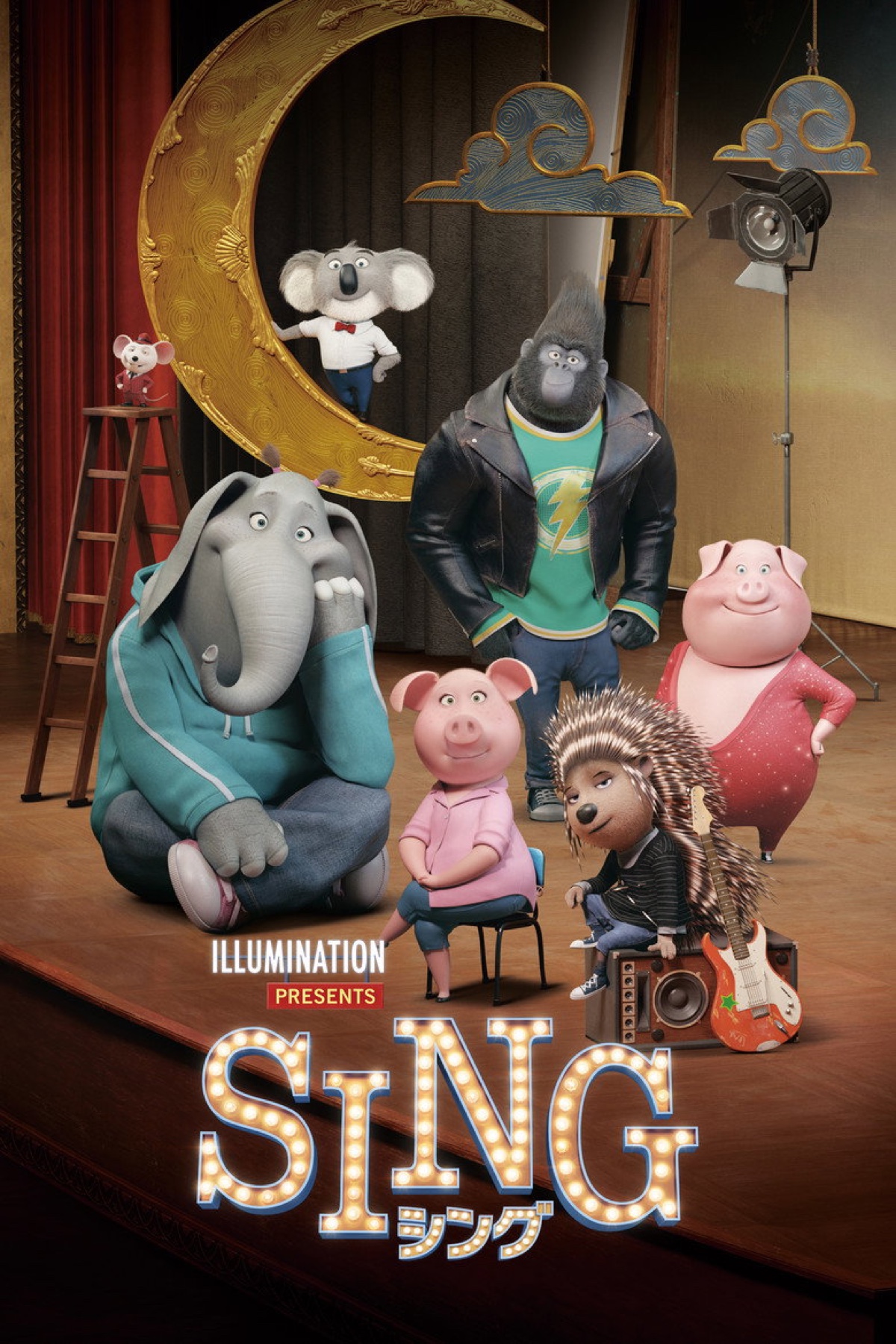
In a city where animals live the way people do, Buster Moon, a koala, runs the theater his father spent a lifetime of car washes buying for him. It used to be the pride of the neighborhood. Now the house is empty, the bank is writing letters, and the power is one unpaid bill from going off. Buster decides the way out is the largest singing competition the building has ever hosted.
His elderly assistant, distracted by her own glass eye landing on the keyboard, puts two extra zeroes on the prize money, and a fan blows the whole misprinted stack of flyers out of the window before anybody proofreads them. By morning the queue runs down the block. Out of it come a housewife pig with twenty-five piglets, an elephant who freezes in front of people, a porcupine in a band with her boyfriend, a gorilla whose father runs a criminal crew, a mouse with a good voice and a mouth to match, and a pig who mostly wants to dance. Nearly every one of them has something going on at home. What drives this film is never the result of the audition. It is the something going on at home.
✨ What Makes It Special
Why It’s Exceptional
- More than 60 songs in 108 minutes, sequenced with no concessions to the target audience
- Five of the six finalists start the film already stuck, which the animation makes bearable
- Every closing number doubles as the answer to whatever that character was hiding
- A cast led by actors rather than session singers, so the voices refuse to match
The playlist is the main character
The lead in this film is not an animal. It is the running order.
More than sixty songs go past in 108 minutes, and the selection makes no allowance whatsoever for the audience the poster was aimed at. What matters, and what most write-ups blur, is that the film uses two different tools. A run of tracks arrive as the records themselves. Queen and David Bowie’s Under Pressure over the building of the new stage. The Gipsy Kings’ Bamboleo through a supermarket PA. Kanye West, Drake and Wham! turn up the same way. Those are the original masters, playing in the room. But every song that carries a character is sung by the animals. The Beatles’ Golden Slumbers comes through Jennifer Hudson as the young Nana. Sinatra’s My Way through Seth MacFarlane. Elton John’s I’m Still Standing through Taron Egerton.
That distinction carries more weight than it sounds like it should. A needle drop asks you to remember a song. A cover asks you to watch somebody decide to sing it. This film knows which of the two it wants at any given moment, and it is right almost every time.
Sixty songs sounds like wallpaper. It is not. Each one is doing scene work. Thirty seconds of the city gets a track. The chaos of the audition queue gets a track. It is a spendthrift way to use a library that expensive, and the film still comes in at a hundred and eight minutes.
Then there is who is singing. Not session vocalists. Scarlett Johansson, Taron Egerton, Reese Witherspoon. Competence is the floor here; what makes it land is that they are all good in incompatible directions. A record made by professionals would be described as well matched. A cast of actors going at it full force produces something better, which is the repeated small shock of watching a person go further than you assumed they would.
(Four paragraphs into a review of a film about a koala, and I have written about nothing but the records. I am aware of it. The cuteness is the doorway. What is behind the door is somebody’s music library.)
Making them animals is load-bearing
Look at what these six are actually carrying. Debt with collectors attached. A mother who walks out of her own household for a while. A father running a crew that gets arrested. A breakup that costs a band as well as a boyfriend. In live action that material goes one of two ways. Either the film gets heavy, or the performances have to oversell it to stay light, and the seams show either way.
Animation absorbs both problems without appearing to try. A pig with twenty-five piglets dancing down a supermarket aisle reads as joy. The identical scene with a human actress reads as a woman coming apart. Because the film never has to slow down and manage that, the story runs in a straight line from beginning to end, which is a genuine structural advantage rather than a shortcut.
Everyone’s last number is their answer
Musicals normally use songs to raise the volume on a feeling. This one runs them backwards. You can work out what a character was hiding from the song they eventually pick. Meena, who cannot get a sound out with people watching, closes on Stevie Wonder. Johnny, who has spent the film failing his father, sits at a piano and plays a song about still being on his feet.
The sharpest one is Ash. Every other lead gets handed a classic to cover. She gets an original written for the film, Set It All Free, because the whole point about her is that she stops performing somebody else’s material. Nobody says that out loud. It is just in the running order. Half the screenwriting on this film was finished the moment somebody assigned the songs.
Deeper Themes
Buster wants the theater saved for reasons that are entirely his own, and he lies freely to get there. What he ends up doing is giving five other animals somewhere to put the thing they were stuck on. The last scene works because his selfish dream turns out to have been holding everybody else up. That is the trade this film makes. It gives up any reach into satire or moral instruction, and what it buys with the money is permission to run straight at the stage without stopping to justify itself.
🎭 Memorable Scenes
Rosita’s daily route through the supermarket turns into choreography
A housewife buried under twenty-five piglets rigs the house to run itself, gets out of the door, and pushes a shopping cart through the aisles while the Gipsy Kings play. Note that this is the actual Gipsy Kings recording, not a cover, so the scene is her moving to something that exists outside her. Nothing remarkable happens for those few minutes. The same shelves and the same aisle become a stage the instant the music arrives. It is the clearest statement of what this film thinks singing is for.
Johnny sits down at the piano with nothing prepared
A gorilla raised to inherit his father’s crew sneaks off to a keyboard the way other teenagers sneak out a bedroom window. That the song waiting for him there is Elton John tells you what kind of film this is. He is not trying to sing well, which is the best decision in the scene. It lands as the voice of somebody with something to say rather than somebody with technique.
Meena finally lets a note out
The best singer of the six, and the one who seizes up the moment anybody looks at her. She opens her mouth and the room changes temperature. Completely standard as a beat, and it works anyway because the film has been patient about the approach to it. She is also the only one of the six whose problem is recognizably modern: the ability is all there, and none of it will come out.
💭 How It Made Me Feel
This is a film I want to watch again with my kids in the room. Films that satisfy an adult and films that hold a child to the end are usually two different lists. Sing brute-forces its way onto both. The children are carried by the animals and the spectacle, the adults by the running order. The division of labor is so clean that two people can watch the same screen and be enjoying separate movies.
The other thing that stayed with me is that not one of them is admirable. Buster lies without blinking. Mike is unpleasant to everybody. Rosita rigs her household to run without her. The stage still comes together at the end. You can rise without first becoming admirable, which is a fairly reckless thing to tell an audience, and the film says it without flinching.
The Japanese track is worth knowing about. Japan is reported to be the only territory allowed to translate and re-sing the entire catalog rather than just the dialogue. Other dubs kept the licensed songs in English; a few re-recorded the film’s one original number in their own language, and that was the ceiling. So Meena is sung by MISIA, one of the largest voices in the country, and Johnny by Takuya Ohashi of the band Sukima Switch. It grossed 5.11 billion yen here. That is not a reason to watch it, but if a disc ever puts the Japanese track in front of you, it is a different experience.
👉 In the US it is a rental on Prime Video or Apple TV.
Who Should Watch This?
- Adults currently stuck somewhere in work or life. It lands hardest on the people avoiding it as a kids’ film
- Anybody with a record collection. Worth watching as a sixty-song jukebox alone
- Anyone hunting for the one film the whole household can sit through without an adult going quietly mad
😅 Where It Falls Short
All of that holds only if the records land for you. Strip the playlist out and a different film shows up, thinner and more obviously assembled. That version is worth describing. The second of its problems is the one I actually care about, and it comes directly out of what I usually spend my evenings watching.
Six storylines pile up in the middle
Having given all six leads a situation at home, the film then has to service all six. Rosita’s household, Johnny’s father, Ash’s band, Mike’s creditors. None of it gets cut, so the film keeps hopping to the next thread before the last one has warmed up. The middle stretch is the price of the film’s own generosity, and you can feel it as clutter.
Nobody is ever shown getting better at anything
This is the complaint I did not expect to have, and it exists because of where I watch from. Japanese animation about performing has an entire grammar for the unglamorous middle. Blue Giant puts a man on a riverbank with a saxophone until his hands give out. Medalist counts the failed jumps one by one. Akane-banashi sits a girl on a floor cushion telling the same story until it stops belonging to somebody else. In those shows the practice is the subject, not a montage.
Sing puts up the walls and then declines to climb them. Ash cannot write a song. Johnny cannot play. Meena cannot open her mouth in public. Every one of those is settled in roughly one night. I understand the arithmetic, since there are sixty songs to fit into 108 minutes and something had to go. It still leaves the dream running hotter than the work, in a film whose stated subject is people repairing their lives through work. That gap is where the comeback loses some of its weight.
There is no reach past the stage door
Zootopia came out the same year, on the same premise of a city with animals instead of people, and used it in the opposite direction: species standing in for prejudice, worked all the way through. Sing has essentially no satire in it, very little in the way of a lesson, and a plot that arranges itself helpfully whenever it needs to. If you are watching to have your head switched off, none of that is a problem. Press play expecting weight and you will come away holding nothing. This is the one place where the strength and the flaw are the same object seen from two sides.
The Downsides
- Six parallel storylines make the middle stretch restless
- Every obstacle the film raises is cleared in about one night
- No satire, no lesson, and a plot that helps itself along
Who Might Not Enjoy This?
- Anyone who needs a tightly built script above everything else
- Anyone physically allergic to characters bursting into song
- Anyone with no attachment to this era of pop, since half the film’s pleasure disappears
📺 Streaming Guide by Service
Where to Stream
- Amazon Video: Rent / Buy, not part of Prime
- Apple TV: Rent / Buy
- 4K UHD / Blu-ray: For keeping a copy of your own
Soundtrack
🎬 If You Loved Sing, Watch These 5 Next
This site is written from Japan, so what follows is five Japanese titles rather than the sequel. Sing is about people rebuilding themselves in front of an audience, and that happens to be a subject Japanese animation has been working on for decades. Mostly by showing the part Sing skips.
Blue Giant
The exact opposite method, aimed at the same target. Where Sing wins by volume of songs, this wins with one instrument in one pair of hands. A boy plays a tenor saxophone at a riverbank in the cold until the film has convinced you that hours of unwatched practice are the interesting part. If the jukebox is what pulled you in, this is what a Japanese film does with the same energy and none of the catalog. It also has the practice sequences I complained about missing.
Tokyo Godfathers
Take my third complaint, that Sing arranges its plot too conveniently, and hand it to Satoshi Kon. Three homeless people in Tokyo find an abandoned baby at Christmas, and from there the coincidences stack up so high that the film is clearly daring you to object. It is the definitive argument that a convenient plot is only a problem when the film is embarrassed about it. Sing is not embarrassed either. This one is simply better at it.
👉 Read the Tokyo Godfathers review
Akane-banashi
Buster’s theater with the stakes turned up and the budget turned down. Rakugo is Japanese solo storytelling, performed kneeling on a cushion with a fan for a prop, and a girl enters that world to undo, from the same kind of stage, what was done to her father. Same idea as Sing, that a performance is where a life gets rewritten, except the audition here never stops and nobody improves overnight. Start with this if the stage is what you came for.
👉 Read the Akane-banashi review
Medalist
This is the missing reel. A girl who started figure skating too late, an adult who never got where he was going, and a show that refuses to skip the hours. Where Sing solves an inability to perform in one night, this spends episodes on a single jump. Watch it after Sing and the comeback you enjoyed will read slightly differently, which I mean as a recommendation for both.
Ping Pong the Animation
My first complaint about Sing was that six storylines jam the middle. Ping Pong is the version that solves it. Five table tennis players, five separate reckonings with the limit of their own talent, and every one of them landed inside eleven episodes. The animation looks like nothing else and puts people off in the first ten minutes, so go in warned. Nobody gets an overnight breakthrough in this one either.
👉 Read the Ping Pong the Animation review
The thing Sing skips, people practicing until their hands hurt, is exactly what Japanese anime about performing is built on, and the strongest examples, Blue Giant and Bocchi the Rock! among them, are gathered in the best music anime.
📝 Final Thoughts
The plot helps itself along, the hard work happens offscreen, and there is no Zootopia-sized idea anywhere in the building. What is left at the end is still a mood nobody can be sour in. The reason is not complicated. The songs are the right songs, more than sixty of them are packed into 108 minutes, and each one is doing a job in the scene it sits in. Against that volume, a loose script turns into a small matter.
What I keep coming back to is that none of them is asked to become a better person first. Every one of them walks onto that stage still carrying whatever they came in with, and the film never asks them to fix it first. Putting broken adults inside animals is how this film carries all of that without ever sounding like a sermon. Kids can sit through it, adults can grin at the running order, and very few films manage both. Sunday evening, the whole household in the room, is exactly where it belongs.
⭐ Series at a Glance
| Category | Rating |
|---|---|
| Music | ★★★★★ |
| Characters | ★★★★★ |
| Visuals | ★★★★☆ |
| Story | ★★★☆☆ |
| Pacing | ★★★☆☆ |
| Watch With Kids | ★★★★★ |
Usagi’s Recommendation Score
⭐⭐⭐⭐⭐⭐⭐☆☆☆
7.2 / 10
A jukebox with a story attached, and that is the compliment.

