*This page contains affiliate links. We may earn a commission if you make a purchase through these links.
Classical rakugo turns out to be sheet music. The same routine, the same words, performed by a different person, becomes a different piece of art. It works the way a jazz standard works: everyone plays Autumn Leaves, nobody plays it the same. I had never listened to rakugo that way, and twelve episodes beat it into me.
Rakugo is everywhere in Japan and almost nobody my age actually sits down to listen to it. It lives on TV variety shows and in school textbooks, filed under “traditional culture,” which is Japanese for “respectable and slightly boring.” This show is a Weekly Shonen Jump series about that art form, and it works on people who have never heard a single routine. Including, apparently, me.
📺 Where to Watch Akane-banashi (October 2026)
| Service | Status | Notes |
|---|---|---|
| YouTube (Akane-banashi Global) | Streaming | Free official uploads for North America |
| Netflix | Streaming | English dub plus subtitles |
| Crunchyroll | Not available | Absent from the US service |
| Hulu | Not available | Not carried |
| Amazon Prime Video | Not available | Not offered there |
| HBO Max | Not available | Not carried |
Akane-banashi is free to watch in the US. The official Akane-banashi Global channel on YouTube posts full episodes for viewers in North and Latin America, and Netflix carries it as well, with an English dub that arrived in May 2026.
Before you go: if the idea of one score being reinterpreted by different performers is what pulls you in, Blue Giant does the same thing from the jazz side, and we have a full review of it here.
🏮 What Is Rakugo, and What Does “Banashi” Mean?
Rakugo is one storyteller, kneeling on a cushion, playing every character in a long comic story with nothing but a folding fan and a small cloth. The performer never stands up. A change of voice, a turn of the head, and those two props carry the whole thing.
The plot runs on rakugo’s rank system, so it helps to know it going in. Storytellers in Tokyo start as zenza, the apprentices who open a program, move up to futatsume, and only after that can be promoted to shin’uchi, the rank that headlines and takes apprentices of its own. Getting there usually takes well over a decade. Akane’s father was one exam away from shin’uchi when he was expelled, which is why episode 1 plays as the end of a career rather than a setback.
Banashi is hanashi, “story,” voiced because it follows Akane’s name, and the kanji used for it is 噺, a character coined in Japan rather than borrowed from Chinese. It is built from 口, mouth, and 新, new, and it is the hanashi in hanashika, one of the Japanese words for a rakugo storyteller. A story made new by whoever’s mouth tells it: the show spends twelve episodes proving that idea, and it was in the title all along.
🎬 Trailer
Work Info
- Title: Akane-banashi (あかね噺)
- Aired: April–June 2026 (12 episodes)
- Director: Ayumu Watanabe (Children of the Sea, After the Rain)
- Studio: Zexcs
- Original manga: Yuki Suenaga (story) / Takamasa Moue (art), Weekly Shonen Jump
- Theme songs: Keisuke Kuwata (both OP and ED, written for the series)
- Season 2: January 2027
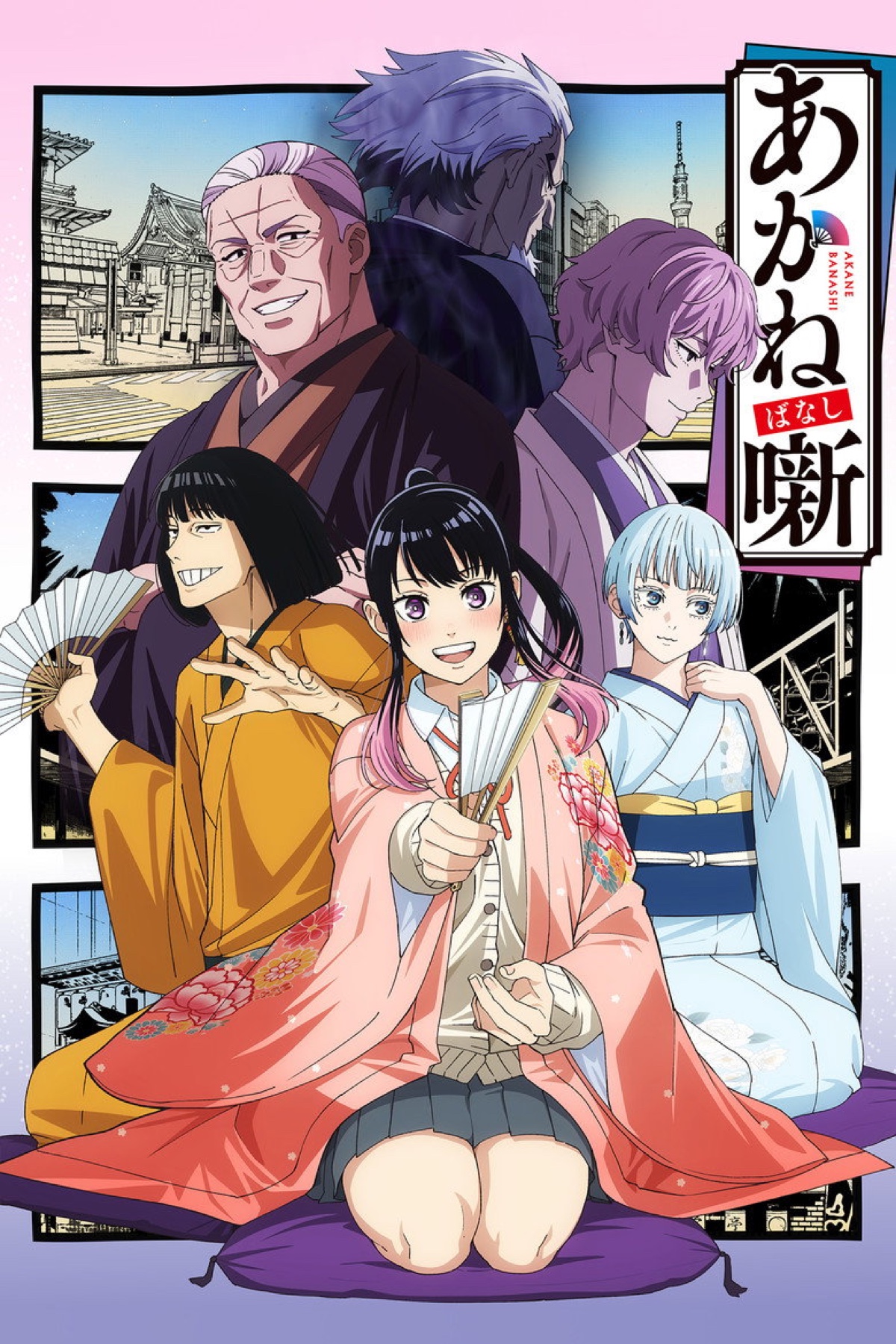
📖 Synopsis – No Spoilers
Akane grew up watching her father perform from behind a sliding door. Shinta Arakawa was one exam away from shin’uchi, the highest rank a rakugo storyteller can hold, when Issho Arakawa — the most powerful figure in that world — expelled him on the spot. No reason given. Akane was eleven. Her father’s career ended in front of her.
Years later, she decides to become a storyteller herself. The plan is to climb to shin’uchi and prove her father’s art deserved the rank he was denied. She apprentices under her father’s own former master and enters a student rakugo tournament, because winning it buys her something she cannot get any other way: a conversation with the man who ended her father’s career.
✨ What Makes It Special
Why It’s Exceptional
- The voice cast performs actual rakugo, not an impression of it
- Built so that someone who has never heard a routine is never left behind
- One floor cushion, one paper fan, and a real sense of combat
- Keisuke Kuwata wrote both theme songs, the Japanese equivalent of Springsteen scoring your anime
The cast isn’t playing storytellers. They’re doing the storytelling.
Nearly everything this show is worth rests here.
Episode 10, Anna Nagase performing Jugemu as Akane. If you know one rakugo routine, it’s this one: a father asks a monk for an auspicious baby name and receives an absurdly long one, which then has to be said in full, at speed, every single time the kid comes up. In Japan it functions as a childhood tongue twister. Everyone knows how it starts. Almost nobody has heard it delivered to the end by someone who can actually do it.
Jugemu, Jugemu, Gokō-no surikire, Kaijarisuigyo-no Suigyōmatsu Unraimatsu Fūraimatsu…
Rakugo calls this kind of run a iitate: a long passage carried in one breath, fast, clean, rhythm intact. What plays in episode 10 is not voice acting that sounds like rakugo. It is rakugo. The breath of someone reading lines and the breath of someone who drilled the form are different, and you can hear the difference without knowing a thing about the art.
There is receipt for the work, too. The official channel put out 13 behind-the-scenes videos under the title “rakugo practice,” following the cast into kimono and onto the cushion for real performances. You don’t publish thirteen of those unless something is actually happening.
Look, I know how that sounds coming from me. I can’t judge rakugo technique. I have no ear for it and no standing to grade it. But episode 10 was audibly a different thing from episode 2, and when a performance is good enough that an outsider can feel the rank change, something real is being transmitted.
You can go in knowing nothing
The trap with this kind of material is that it closes around the people who already care. This show designs its way out.
The routines get acted out on screen as they’re performed, so Jugemu and Tenshiki land as stories even if you’ve never encountered either. No homework required. Twelve episodes will teach you more about how the art functions than an introductory book would.
And it goes further than “here’s what the story is about.” You see why the craft is hard: reading the room, shifting register for the audience in front of you, stretching or cutting a pause because of how a crowd is breathing. The routine is the score. The storyteller is the musician. That idea assembles itself over twelve episodes without anyone stopping to lecture you about it.
A floor cushion becomes a boxing ring
The physical vocabulary is tiny. Seated, always. A fan, a hand towel, a turn of the head, a shift of the eyes. And it still reads as a fight you can score.
When a storyteller is fully locked in, the performer drops out of view and only the people inside the story are left on the cushion. Every rival in the tournament arc has a version of that moment, which is why the competition episodes never get repetitive.
Deeper Themes
These routines have survived for centuries because every generation of performers rewrites them. Classical art doesn’t last by being preserved. It lasts by being overwritten. That is the actual argument underneath the show’s antagonist, and it’s why Issho Arakawa is more interesting than a man who ruined someone’s career: protecting an art form and changing it turn out to be the same job.
Memorable Scenes
Episode 10, again. If you bailed early, come back for this one. It’s the summit of the season and it does not require the eleven episodes around it to hit.
The other is late in the run, when Akane finally stands opposite Issho Arakawa. The expulsion that looked purely cruel in episode 1 reads differently once you’ve watched her learn the craft. A stone thrown in the first episode comes back at exactly the right angle. Japanese viewers latched onto this turn hard, and it’s easy to see why: the revenge story quietly swaps engines and becomes something else while you’re watching it.
How It Made Me Feel
What twelve episodes left me with wasn’t emotion so much as appetite. I wanted to hear the same routine done by somebody else. That impulse is the whole thesis of the show, so I’d say it worked.
The other thing took until the finale to put into words. Every character stands on their own will. The master, the senior apprentices, the rivals: each one has a spine and a conviction that belongs to them, and nobody exists purely to make the protagonist look good. Conflicts land without leaving a bad aftertaste, and that’s rarer in this genre than it should be.
Who Should Watch This?
- Anyone who assumed a traditional Japanese art form would be dry (most recommended)
- Readers who still get fired up by the Shonen Jump formula of effort, rivalry, and victory
- Anyone who loved Whiplash and wants the version where the mentor isn’t a monster
😅 Where It Falls Short
It won’t let you hear a routine all the way through
I have exactly one complaint, and this is it. The performances keep getting interrupted by interior monologue and explanation.
Where Akane is fighting for the crowd, how the audience is taking it, which part of this routine is technically brutal. All of it explained, carefully. Which is exactly why a newcomer never gets stranded. It’s the flip side of the thing I praised two sections ago, so it’s a trade-off, not an oversight.
Still. The routines end up sliced into fragments. Rakugo is an art built on timing and pauses, and the pauses are where the narration keeps arriving. The cast clearly put in the work, and you rarely get to sit in a full performance and just receive it.
Give me one episode per cour with the commentary stripped out and a routine played end to end. The show doesn’t quite trust its own material to carry a scene alone, and that reservation stayed with me through the finale.
Who Might Not Enjoy This?
- Anyone who already listens to rakugo and wants full, uninterrupted performances
- Viewers who find shonen-style dramatization intrusive when it’s applied to a quiet art
📺 Streaming Guide by Service
Is Akane-banashi on Crunchyroll?
No. It’s not on Crunchyroll in the US, Shonen Jump title or not, which trips people up.
Where to Stream
- YouTube (Akane-banashi Global): Streaming. Free, North and Latin America
- Netflix: Streaming. Dub available
- Crunchyroll / Hulu / Amazon Prime Video / HBO Max: not available
Both theme songs come from Keisuke Kuwata, frontman of Southern All Stars and about as mainstream as Japanese rock gets. Hearing him show up on a rakugo anime is strange, and by the end of the season no other choice makes sense. Both tracks are on Spotify and Apple Music.
🎬 If You Loved Akane-banashi, Watch These 3 Titles
Blue Giant
The same idea, moved to jazz: one piece of music becomes a different piece depending on who plays it. If the “score versus musician” framing is what hooked you here, this is the direct companion. The moment the sound changes the air in a room is the same moment a storyteller disappears behind their own routine.
Ping Pong the Animation
Masaaki Yuasa solving the same problem from a different angle: how do you make a contest thrilling when the physical action is small and contained? Table tennis instead of a floor cushion, but the question of what talent is and what winning costs runs on the same track.
👉 Read our Ping Pong the Animation review
Medalist
Two people betting their lives on one discipline, with the technical detail pitched so a newcomer can follow without the heat dropping. If the master-and-apprentice thread is what got you here, this is the closest match on our shelf. (Heads up: the clip above is the Japanese PV. The show streams dubbed on Hulu, but no English trailer was ever released for it.)
We haven’t covered it yet, but Descending Stories: Showa Genroku Rakugo Shinju is the other major rakugo anime, and it goes at the ugliness of a life spent inside the art: the appetites, the wreckage, the debts. If Akane-banashi is the bright front entrance, that one is the dark room at the back.
📚 Read the Manga
Season 1 adapts the manga through volume 4, closing out the Karaku Cup arc. Volume 5 is where the story picks up, and VIZ Media has the English edition in print. Season 2 arrives in January 2027, so there is a long wait if you would rather not read ahead.
📝 Final Thoughts
As an entry point to rakugo, nothing in recent years has a wider door than this. Bring no knowledge at all. The routines get performed for you, the contest structure is pure Shonen Jump, and there’s no point where you’re lost. On top of that it hands over the best part of the art form — that a fixed routine changes shape depending on who tells it — without ever stopping to explain that it’s doing so.
The complaint about never hearing a full performance never went away. Two things outweigh it: Jugemu in episode 10, and the moment the first-episode expulsion pays off near the end. Either one justifies the twelve episodes. Season 2 lands in January 2027, and the version of me who filed rakugo under “respectable and slightly boring” got shut up thoroughly by this one.
⭐ Series at a Glance
| Category | Rating |
|---|---|
| Story | ★★★★☆ |
| Characters | ★★★★★ |
| Animation | ★★★★☆ |
| Music | ★★★★★ |
| Voice Performance | ★★★★★ |
| Pacing | ★★★☆☆ |
Usagi’s Recommendation Score
⭐⭐⭐⭐⭐⭐⭐⭐☆☆
8.0 / 10
Come in thinking rakugo is boring. Just make it to episode 10.

