I keep going back to one stretch in episode 7. Out of eight episodes, it runs maybe three minutes. A kid who joined professional sumo purely for the money finally falls for the sport itself, and the heat of that spreads through his stable one wrestler at a time. I know exactly what is coming. I get worked up anyway, every single time.
Sanctuary is a Netflix original from Japan, eight episodes, and it sits near the top of my list of Netflix Japan shows. I am not going to pretend it is flawless. Getting to those three minutes takes six episodes of run-up. This review is, more than anything, an argument for surviving those six episodes.
📺 Where to Watch Sanctuary (August 2026)
| Service | Status | Notes |
|---|---|---|
| Netflix | Streaming | All 8 episodes. Netflix Original |
| Crunchyroll | Not available | Live action, not licensed here |
| Hulu | Not available | No US listing |
| Amazon Prime Video | Not available | No rental, no purchase |
| HBO Max | Not available | No US listing |
As of August 8, 2026, Netflix is the only place this exists. Netflix produced it in-house at Toho Studios in Tokyo, so it does not rotate onto other platforms the way licensed titles do. There is no rental option, no digital purchase and no US Blu-ray release. Availability does change, so it is worth confirming on the official site before you plan an evening around it.
One practical note. The whole thing runs 6 hours 54 minutes across eight episodes, with the finale clocking in at just 31 minutes. That is a single weekend, not a commitment.
🎬 Trailer
Work Info
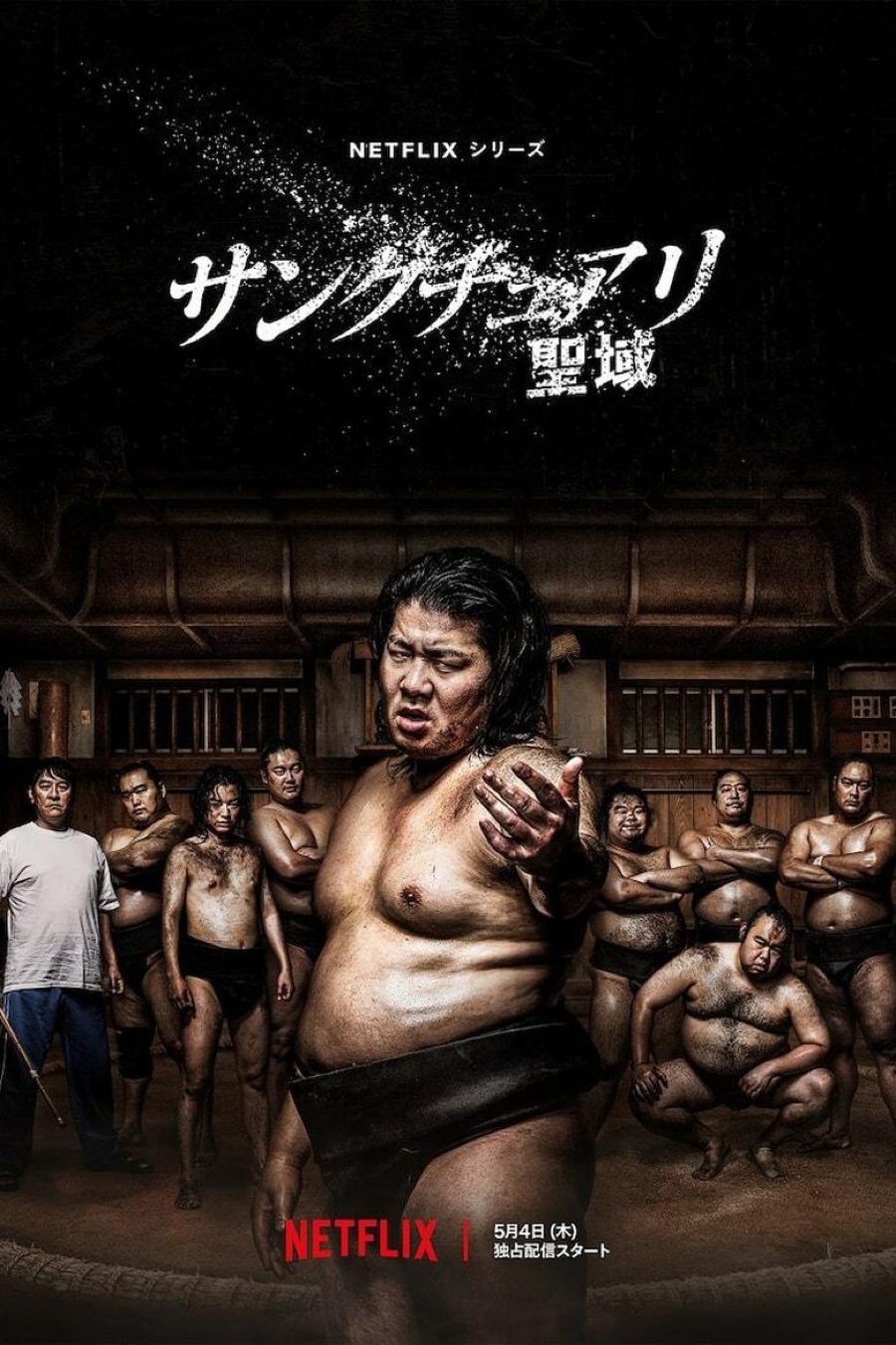
- Title: Sanctuary (Japanese title: サンクチュアリ -聖域-)
- Released: May 4, 2023 (Netflix Series, 8 episodes)
- Director: Kan Eguchi
- Writer: Tomoki Kanazawa
- Starring: Wataru Ichinose / Pierre Taki / Shota Sometani / Shioli Kutsuna / Koyuki
📖 Synopsis – No Spoilers
Kitakyushu, in the south of Japan. Kiyoshi Oze is the local menace, paying his way through fights and shakedowns. The family sushi restaurant he was proud of closed under a debt his father took out in his mother’s name, and that debt is still sitting there. His father works traffic control into old age. His mother has moved on to other men. Into that mess walks the stablemaster of Ensho stable with one pitch: sumo pays. No reverence for the sport, no curiosity about the tradition. Kiyoshi signs up for the money and nothing else.
What he finds inside is hierarchy, ritual and violence. He pushes back, skips training and swings at his seniors. His street instincts are genuine, though, so the wins start piling up before the discipline does. He is given the ring name Enno. His behavior draws the attention of the sumo association, and enemies accumulate outside the ring as fast as they do inside it. Then a mountain of a man who barely speaks a word steps across from him.
✨ What Makes It Special
The best special effect in this show is the cast’s body weight. What carries the story is the actual flesh on screen, not the camera and not the script.
Why It’s Exceptional
- Every actor playing a wrestler spent roughly a year rebuilding their body under professional supervision
- Shu-ha-ri, the stablemaster’s creed, doubles as the structural spine of all eight episodes
- Hazing, match fixing, patrons and even religion — none of the sport’s taboos get softened
- The supporting cast outside the ring is as fully written as the wrestlers inside it
The bodies are the screenplay
There is a straightforward reason sumo almost never gets filmed. You cannot cast it. Masayuki Suo’s 1992 comedy Shall We Sumo? (released in Japan as Shiko Funjatta) set itself at a dying university sumo club, which let him fill the roster with normal-sized students. Point a camera at the professional world instead and the project dies at the casting stage.
Netflix solved that with time and money. Every actor cast as a wrestler trained under specialists, trainers and nutritionists through roughly a year of body transformation, then put in six months or more of sumo practice on top of that. Director Kan Eguchi has said some of them spent two years on the physique alone. What ends up on screen is not an actor in a fat suit. It is a wrestler. The set of the neck, the way the belly rides, the hip opening on a leg stomp. You do not need to know a single rule to register that this is the real category.
That foundation buys the script an enormous amount of forgiveness. Plot beats that would read as contrivance land fine, because colliding bodies and flying sweat arrive first and your brain agrees before it gets a chance to argue. Flip that around and you get the honest version: the same screenplay would collapse without these bodies. Opinion in Japan is split on whether the lead is a good actor. Nobody argues about the physique.
The bodies also do narrative work. Early on Kiyoshi is heavy in a shapeless, undisciplined way. By the back half he has hardened. The back you see in the final stretch belongs to a different person than the back in episode 1, and almost none of that growth needs a line of dialogue to explain it. That is a luxurious way to make television. (Brutal for the people doing it, presumably.)
Shu-ha-ri, the three words the stablemaster lives by
The Ensho stablemaster’s creed is shu-ha-ri. Keep the form, break the form, leave the form. Japanese martial arts, tea ceremony and rakugo all teach progression in those three stages, and this show uses them as the skeleton of its eight episodes.
Kiyoshi tries to skip the first stage entirely. Why stomp your legs into dirt when you can just win. The cruel trick of the writing is that he is allowed to be right for a while. Instinct alone gets him wins, a patron, a girlfriend and a very inflated opinion of himself. The show does not stop him short of the wall. It lets him hit it at full speed.
Which is why the fall goes so deep, and why the climb back is satisfying. What he eventually reaches for is the exact thing he had been sneering at: the most boring drill in the building.
It refuses to protect the sanctuary, so the sanctuary becomes real
Sumo is a Shinto-rooted ritual as much as a sport, which usually means a Japanese production will tiptoe toward some tidy lesson about tradition being precious. This one goes the other way. Kawaigari — literally “showing affection,” the industry’s euphemism for beating juniors in training — is on screen in the first episode. So are thrown matches, stable politics, tanimachi patrons buying influence, broken families and a religious group with its hooks in. Japanese networks would never have cleared this script.
Here is the strange part. After all that filth, the ring looks more sacred, not less. Salt flies, feet come down, two men face each other, and for those thirty seconds everything else washes off. A sanctuary is not a place that hides its dirt. It is what stands after you walk through it. The title turns over on itself somewhere in the back half, and the show earns that.
Deeper Themes
Underneath the sport there is a second subject: parents. Line up the backstories of the main wrestlers and you get a catalogue of broken homes: a mother who chased money and men, a father who used his fists, a mother whose overprotection curdled into something illegal. The sumo stable functions as a replacement family, and that is not an accident. Men wrecked by blood relatives get repaired by strangers who feed them, outrank them and drill them. Japanese viewers picked up on this fast, and it is the layer that keeps working even if you have no interest in the sport at all.
🎭 Memorable Scenes
First, episode 7. After Kiyoshi changes, the air in the training room changes with him, mid-episode. One man starts hitting the drills like he means it, the guy next to him quietly matches the pace, and the one after that speeds up. Nobody gave an order. You can watch the temperature of the whole stable rise. Then the bout at the end of the episode landed on me like a hit. Six episodes of being made to feel bad get repaid in one go.
Second, shiko. The leg stomp, sumo’s most basic and least glamorous drill. Early Kiyoshi finds it beneath him, and while he is winning on instinct that is a defensible position. Told to stomp, he laughs it off, and honestly you skim past it too. Later, when he is alone in the room raising and dropping one leg at a time, the same instruction lands with weight. An identical movement reads completely differently depending on who is doing it and why. The show makes that argument in images instead of speeches, over and over.
Third, a senior wrestler’s danpatsu-shiki, the ceremony where a retiring wrestler’s topknot is cut off. Guests take the scissors one at a time, and the show holds on it far longer than a Western edit would. That length is the point, because the minutes stand in for the years he spent on the clay. It is the scene Japanese viewers cry at most, and the quietest climax in the series.
💭 How It Made Me Feel
What stayed with me afterward was not the satisfaction of finishing eight episodes. It was the urge to go watch those few minutes of episode 7 again. And I have, more than once. The pull is toward one specific stretch rather than the whole arc, which is an unusual way for a series to stick.
The feeling right after the finale, though, was not clean. I will get to that below.
Who Should Watch This?
- Anyone who wants the Rocky or Slam Dunk shape of story, in a world they have never seen
- Viewers who care about physical transformation and casting as craft
- Anyone who bailed during episode 1 and never went back (this one is aimed squarely at you)
😅 Where It Falls Short
Six episodes of run-up is a lot of run-up
Praising episode 7 is the same as admitting that six episodes come first, and those six are hard going. Cruelty piles up, the lead struts around being insufferable, and I was irritated with him repeatedly. I understand the argument that all of it is scaffolding for the turn. I still wanted more of the after. The ratio is off.
“Hang on until episode 6” has become the standard advice among Japanese viewers, and it is a compliment wrapped around a warning. Plenty of people never made it that far.
It raises a question and then quietly puts it down
A reporter raised abroad gets access to the stable and challenges the rule that women may not step onto the ring — a real and still-live controversy in Japanese sumo, not an invention for television. As a way into the collision between tradition and the present, that setup is excellent. The show then declines to carry it anywhere. Her objections get played for comedy partway through, and at some point the question simply stops being asked.
Given how much else it was willing to expose, flinching here is a waste. If she was always going to end up as the outsider watching a hot room from the doorway, she should not have been handed such a sharp question in the first place. It shrinks the show by a size.
An ending built on a season 2 that may never come
I know this one splits people, so let me be plain. I am against how it ends. The rivalry gets built with real care across eight episodes, and then the story stops rather than finishes.
There is also a practical problem specific to this production. The actors’ bodies are the foundation, so a second season means rebuilding all of them from scratch. As of August 2026 no season 2 has been announced, and Eguchi himself has said he has no idea whether one is coming. With no guarantee attached, ending on a cliff was a bad bet. Closing the story as a self-contained eight hours would have made it stronger.
Who Might Not Enjoy This?
- Anyone sensitive to bullying and physical abuse (episode 1 opens on it)
- Viewers who need a story to close properly
- Anyone who wants to like the protagonist early (that takes several episodes here)
📺 Streaming Guide by Service
Sanctuary streams on Netflix only
There is no second option to weigh. Netflix produced this in-house, so it never entered the licensing pool that moves shows between Crunchyroll, Hulu and Prime Video. No rental, no purchase, no US disc. If you are outside a Netflix subscription, this one is genuinely out of reach.
The upside is the runtime. At 6 hours 54 minutes total, with a 31-minute finale, it fits comfortably inside a single billing cycle alongside whatever else is in your queue.
Where to Stream
- Netflix: Streaming — all 8 episodes
No official soundtrack album has been released for the series.
🎬 If You Loved Sanctuary, Watch These 5 Next
Ping Pong the Animation
The connection is the wall that talent alone runs into. Taiyo Matsumoto’s table tennis series takes the opposite angle from shu-ha-ri and stares at how brutal raw ability can be to the people around it. If the episodes where Kiyoshi gets arrogant were the ones that hooked you, this will land. It is also unusually good on the people who do not become the hero, which is the same job the senior wrestlers do here.
👉 Read the Ping Pong the Animation review
Blue Giant
If what got you in episode 7 was heat jumping from one person to the next, go here. A jazz film where one obsessive player drags his bandmates up to his level and changes what they are capable of playing. The subject is a group getting carried away, not an individual improving, which is the exact pleasure Sanctuary delivers in its back half. Turn it up.
Akane-banashi
Structurally this may be the closest match on the list. Swap sumo for rakugo, Japan’s solo comic storytelling tradition, and you get the same skeleton: a young outsider taking on a closed world with masters, apprentices, rankings, expulsions and internal politics. If you want to know whether Japanese traditional-arts stories work on you, this is the cheapest way to find out.
👉 Read the Akane-banashi review
Sonatine
Japanese viewers kept reaching for Takeshi Kitano when describing the silent giant in this show, and they were onto something. Kitano built a career out of casting faces instead of resumes and letting men say almost nothing. Sonatine is where that method is purest: a closed world of men, violence that arrives without warning, and long stretches where the quiet does the acting.
Cyberpunk: Edgerunners
The other Netflix Japan production worth clearing an evening for, and proof that the same budget freedom cuts in a completely different direction. Ten episodes, animated, and just as willing to be ugly about what ambition costs. If Sanctuary convinced you that Netflix Japan is where the interesting risks are being taken, this is the follow-up.
👉 Read the Cyberpunk: Edgerunners review
📝 Final Thoughts
The thing I most want to get across is that you do not need to care about sumo. Most of the Japanese fans raving about this open their reviews by admitting they had never watched a match. The way in has nothing to do with the rulebook. It runs through one man who climbed onto the clay for money while believing in nothing, and the show tracks his change closely enough that zero background knowledge is required. Growing up in Japan, sumo is something you absorb as wallpaper on daytime television. This is the first time I have seen it filmed as something worth being curious about.
The flaws are real. The run-up drags, a serious question gets abandoned, and I do not accept the ending. Even so, those eight episodes exist for the few minutes when the training room catches fire and for the bout that closes episode 7. If you gave up in episode 1, hold judgment until episode 7. The payback is waiting there.
If this was your first Japanese live-action series, there is a shelf of them worth knowing about. I sorted ten Japanese drama series by what each one is actually doing, from Netflix's first local original to a 2025 piece by Hirokazu Kore-eda, with US streaming checked for each.
⭐ Series at a Glance
| Category | Rating |
|---|---|
| Story | ★★★★☆ |
| Visuals & Direction | ★★★★★ |
| Cast & Performance | ★★★★★ |
| Pacing | ★★★☆☆ |
| Payoff | ★★★☆☆ |
Usagi’s Recommendation Score
⭐⭐⭐⭐⭐⭐⭐⭐☆☆
7.6 / 10
The run-up is long. Those eight episodes still exist for the few minutes in episode 7.

