*This page contains affiliate links. We may earn a commission if you make a purchase through these links.
Ask two Japanese fans about Mushoku Tensei Season 2 and you will often get two different shows. Talk about the first cour and the words that come back are sluggish, a step down, hard to finish. Talk about the second cour and you get best season in the franchise. Same 25 episodes, split straight down the middle.
My own reaction tracked that split pretty closely. What I was left with at the end, though, was not a verdict on quality. Season 2 improved almost everything except the one thing I wanted improved: my distance from it. I was impressed the whole way through. I was never once inside it. This review is about where that gap comes from.
📺 Where to Watch Mushoku Tensei Season 2 (August 2026)
| Service | Status | Notes |
|---|---|---|
| Crunchyroll | Streaming | Subtitled plus dubbed, all 25 episodes |
| Hulu | Streaming | Included with the Hulu plan |
| Amazon Prime Video | Purchase only | Not part of the Prime catalog |
| Apple TV | Purchase only | Digital purchase per season |
| Netflix | Not available | No US rights |
As of August 7, 2026, the cheapest complete route in the US is Crunchyroll, which carries the entire series with both subtitles and a dub. Hulu has it as well if you are already paying for that. Netflix does not have it in the US, so if that is where you were hoping to find it, the answer is no. Streaming rights move around, so double-check the official pages before you commit to a subscription.
Season 2 opens on the assumption that you have watched the 23 episodes of Season 1, and it does very little to catch newcomers up. If you are starting from scratch, my Mushoku Tensei Season 1 review lays out what the show is actually doing.
🎬 Trailer
The official promo from TOHO animation. The English-subtitled versions are region-locked in ways that break embeds, so this is the one that will actually play for you.
Work Info
- Title: Mushoku Tensei: Jobless Reincarnation Season 2
- Aired: July to September 2023 (Cour 1, 13 episodes including episode 0), April to July 2024 (Cour 2, 12 episodes)
- Director: Hiroki Hirano (Cour 1), Ryosuke Shibuya (Cour 2)
- Series Composition: Toshiya Ono
- Character Design: Masae Shimada, Yoshiko Saito
- Music: Yoshiaki Fujisawa
- Studio: Studio Bind
- Source: Light novel by Rifujin na Magonote
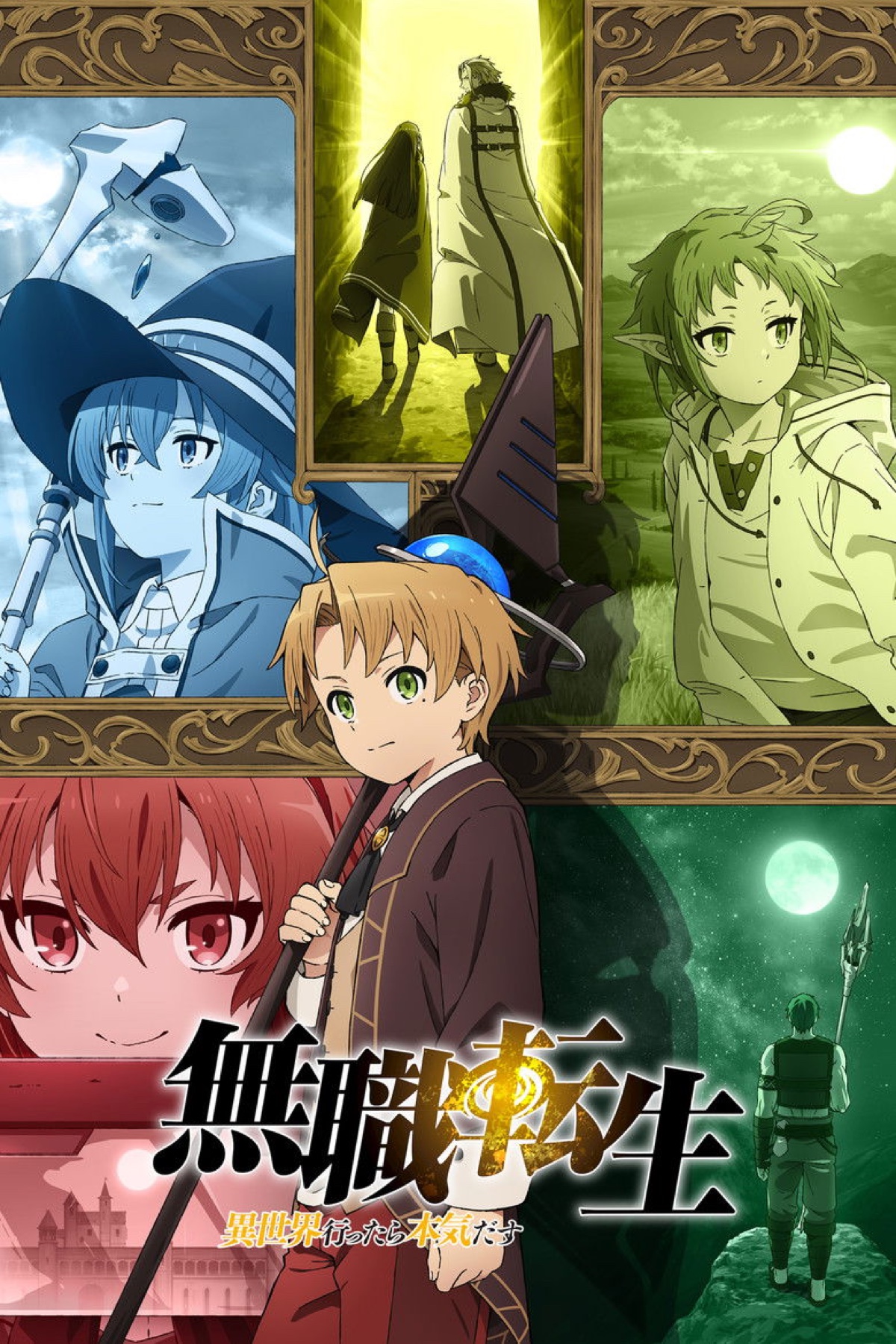
📖 Synopsis – No Spoilers
Scattered from his family by the teleport incident, Rudeus arrives at Ranoa Magic University carrying a loss he has not processed. His reason for enrolling is not ambition. Something has gone wrong with him, and the university is the last place he can think of to look for a fix. Waiting for him there is an upperclassman going by the name Fitts, a prince named Zanoba who cares about nothing but dolls, and Cliff, a bishop’s grandson so principled he is exhausting to be around.
The second cour leaves the campus behind. The search for his missing family becomes the spine of the story, and the setting shifts to a labyrinth. I will not say what happens there. What matters structurally is that every quiet hour the first cour spent building his ordinary life gets converted into weight in the second half. The slow part is slow on purpose.
✨ What Makes It Special
Why It’s Exceptional
- Facial animation that carries emotion before the voice does
- A second cour that lands squarely on family
- New faces like Zanoba and Cliff who arrive fully alive
- Yoshiaki Fujisawa’s score and Yuiko Ohara’s ending themes
The face does the acting before the voice does
This show does not lead with spectacle. The swordfights and the magic are there, but the animation is spending most of its budget on faces during conversations. An eyebrow drops half a beat late. A gaze slides off the person being spoken to. A smile stops before it finishes forming. None of that is written in the dialogue, and all of it reads.
Normally the voice actor carries that job. Here the drawing gets there first and the performance confirms it afterwards. In Japan you see people describe it as better acting than most live-action, which sounds like fan hyperbole until you sit with a scene where nobody says anything for four seconds. There were stretches across these 25 episodes where watching the animation was enough on its own.
The quiet moments are where it bites hardest. Someone stays silent. Someone cannot find a place to rest their eyes. There is no explanation attached, so you fill it in yourself, and the moment you have filled it in you are no longer a neutral observer of that character.
I did not plan to spend this much of the review on drawings. It got away from me.
The second cour lands on family
For most of the first cour it is genuinely hard to say what this show is about. He enrolls, the cast expands, daily life continues. Things are happening. Where any of it is going is not visible.
The second cour collects on all of it. The subject is family. A man who skipped his own parents’ funeral in his previous life is now the one out searching for his. Every calm hour banked in the first half comes back as the cost of losing people. That is why Japanese viewers who call this the best season of the franchise are almost always talking about the second cour specifically.
There is a short exchange on the walk back from visiting a grave. Nothing dramatic happens. People walk, they say a few things, it ends. Because 25 episodes of accumulation sit underneath it, an offhand line lands like a punch to the chest.
Zanoba and Cliff have a pulse
The characters who move to the center in Season 2 are uniformly good. Zanoba, who is interested in figurines and essentially nothing else. Cliff, who is too rigid for his own good. Fitts, who is doing something more complicated than being a helpful senior. None of them behave like pieces placed for plot convenience.
Roxy and Sylphie were already established, but the new arrivals turned out to be people I liked just as much. Long-running shows usually dilute as the cast grows. This one adds without thinning out.
Deeper Themes
Yes, it is isekai. No, that does not mean what you think. The genre in Japan is built on a promise that effort converts cleanly into reward, and this show refuses to make that promise. There is no guarantee that trying hard is enough. The rollercoaster payoff most reincarnation stories run on has been traded for something closer to the speed of an actual life. If the label alone has kept you away, the label is misleading you.
What sits underneath that care, though, is an occasional glimpse of the author. Characters can look less like people acting on their own reasons and more like people being carried along a current that was mapped out in advance. It happens because the plotting is strong, not weak, which makes it awkward to file as a flaw. It is still one of the reasons I stayed outside the story.
🎭 Memorable Scenes
I am not going to say what happens in any of these. I will say where they sit.
The walk back from the grave. Barely any dialogue, almost no directorial flourish, two people covering ground on foot. Ask Japanese viewers for the strongest moment in the second cour and this one comes up more than anything else. It only works if you have done the 25 episodes, which is exactly the point.
A reunion in the first cour. No names from me. What I will say is that once you register how far back the setup for it was planted, the first cour’s use of its time stops looking indulgent and starts looking deliberate.
Meeting Roxy again. A lot of people were waiting on this one. The reunion itself matters less than the direction the story takes immediately afterwards. Letting you feel good and then showing you how little the world cares is a rhythm this series has run since the beginning.
💭 How It Made Me Feel
Twenty-five episodes later, the thing I was holding was that was well made.
Which is supposed to be praise, and reads on the page like a person keeping their distance. Nothing that happened on screen came home with me as my own. The big moments landed as big moments. The pane between me and the screen never came down.
Remember what I wrote in the Season 1 review about watching this show from one step back? Season 2 is the better season by most measures. It did not close that step.
Who Should Watch This?
- Anyone who finished Season 1 and is deciding whether Season 2 is worth it
- Anyone who avoids isekai on principle but keeps hearing about the animation
- Anyone who stalled somewhere in the first cour and never went back (this one especially)
😅 Where It Falls Short
Everything above is about what the show is doing. What follows is about what I brought to it.
The first cour is thorough and baggy at the same time
Season 2 spends an entire cour resolving one personal problem. I cannot think of another show that would allocate twelve-plus episodes to that particular subject, and the fact that the staff took it seriously is genuinely admirable. It makes the complaint awkward to voice.
It is also true that the pacing loosened noticeably compared to Season 1. Season 1 covered childhood through a continental crossing in 23 episodes. The first cour of Season 2 barely leaves campus. Thorough and baggy are not opposites here, and both apply. When Japanese viewers say they dropped it partway through the first cour, that is a speed complaint, not a quality complaint.
My honest read is that it should have moved faster. The change of director between the two cours is probably not a coincidence.
The romance runs on a different clock
The romantic material moves at the opposite extreme. A show pacing itself to the speed of a human life suddenly fast-forwards for this one thread. The standard of care is not applied evenly.
It makes sense that this is where the audience fractures. Some of the strongest negative reactions in Japan are aimed squarely at how the late-season material resolves. For what it is worth, I came down on the side of it working. The show tells you repeatedly that this world does not run on modern Japanese ethics, and whether you can accept that is built into the design. I also understand the people who could not. It is a genuinely risky bridge to walk across.
Who Might Not Enjoy This?
- Anyone expecting Season 1’s momentum to continue
- Anyone whose attention breaks when the fanservice piles up
- Anyone who cannot let go of a protagonist’s romantic choices once they object to them
📺 Streaming Guide by Service
Is Mushoku Tensei Season 2 on Netflix in the US?
No. Netflix does not hold US rights to any part of this series, and there is no sign of that changing. The complete run lives on Crunchyroll, subtitled and dubbed, which also makes it the only single subscription that gets you Season 1, Season 2 and the currently airing Season 3 in one place. Hulu is the alternative if you already subscribe there. Buying it outright on Apple TV or Prime Video only makes sense if you want it permanently.
One practical note on volume: Season 1 is 23 episodes and Season 2 is 25, so a complete catch-up is 48 episodes before Season 3 even enters the picture. Plan the month accordingly.
If you would rather read ahead than wait on the anime, Season 2 adapts volumes 7 through 12 of the light novel, so the story continues in Volume 13, published in English by Seven Seas. The English manga edition has not caught up to this point yet, so the novels are the only way forward in English right now.
Soundtrack
Yoshiaki Fujisawa returns from Season 1. The openings are spiral by LONGMAN and On the Frontline by Hitorie, while Yuiko Ohara handles the endings across both cours. The ending that made Japanese viewers cry is the first cour one.
- Spotify: available
- Apple Music: available
🎬 If You Loved Mushoku Tensei Season 2, Watch These 5 Next
Violet Evergarden
On the specific question of reading emotion off a face, this one goes further. Its lead does not know the names of her own feelings, so the drawing has no choice but to do the talking. If facial animation alone is what you want to be wrecked by, start here.
👉 Read the Violet Evergarden review
Frieren: Beyond Journey’s End
The closest relative in terms of how it treats time. It is unafraid to spend episodes where nothing obvious happens, then cash the whole stack in late. If you made peace with the first cour of Season 2, you will get along with this. If that pacing broke you, the same wall is here.
Attack on Titan Season 2
The same homework, solved the opposite way. Twelve episodes, packed to the seams, in and out. Set beside a 25-episode season that takes its time, it is a useful demonstration that there is more than one correct way to build a sequel.
👉 Read the Attack on Titan Season 2 review
Made in Abyss
Another fantasy world that declines to protect the people living in it, and another show that hides that behind an inviting art style. The labyrinth stretch of the second cour and this one are drawing from the same well of dread.
👉 Read the Made in Abyss review
Oshi no Ko
Reincarnation used as a tool for something else entirely. Instead of a fantasy world, the second life gets spent inside the Japanese entertainment industry, and the memories of the first one work as a knife rather than a cheat code.
📝 Final Thoughts
Whether you file Season 2 under careful or under bloated has less to do with the show than with what you wanted 25 episodes to do for you. I landed on careful. An isekai that runs at the speed of a real life is a rare enough experiment that seeing it through was worth the hours.
The pane stayed up, though. I admired this season repeatedly. Admiring is what I did. Being pulled in is what I did not. If you stalled somewhere in the first cour, push through to the second one. That is where the verdict changes, if it is going to.
We file this one under INTP. Personality typing is a blunt instrument for fiction, but it is a useful shorthand for who a story is built to satisfy, and it is how this site sorts its recommendations. If you want the reverse lookup, our MBTI anime quiz takes all sixteen types and points each one at something from Japan.
⭐ Series at a Glance
| Category | Rating |
|---|---|
| Animation | ★★★★★ |
| Characters | ★★★★★ |
| Story | ★★★★☆ |
| Music | ★★★★☆ |
| Pacing | ★★☆☆☆ |
| Newcomer friendly | ★☆☆☆☆ |
Usagi’s Recommendation Score
⭐⭐⭐⭐⭐⭐⭐☆☆☆
6.5 / 10
25 episodes that taught me a show can be well built and still keep me outside. Get to the second cour.

