*This page contains affiliate links. We may earn a commission if you make a purchase through these links.
One hundred and forty-four chapters. Eleven episodes.
Everything below is elaboration on that. Season 1 spent twelve episodes on chapters 1 to 37 of the manga, which is about three chapters an episode. What was left of the story at that point ran to 144 chapters, and the second season was handed eleven episodes to hold them, which is about thirteen chapters an episode. Four times the load, every week, for a season that also has to introduce an entire new world. If you watched this and lost the thread somewhere around the middle, you did not miss a clue. There was no space in the episode for the clue.
I finished the manga years ago, all twenty volumes, so I am not a neutral party here and I would rather say so at the top. What I did not expect was where the irritation would end up pointing. Not at the scripts. Not at the director, and certainly not at anybody who drew a frame of it. The number eleven is the problem, and somebody chose that number before a storyboard existed. The US streaming answer is short, so it goes first.
📺 Where to Watch The Promised Neverland Season 2 (October 2026)
| Service | Status | Notes |
|---|---|---|
| Crunchyroll | Streaming | All 11 episodes, subtitled, plus the Aniplex English dub |
| Prime Video | Add-on | The same Crunchyroll library, billed by Amazon |
| Amazon Video | Rent / Buy | Sold outright. Single episodes, full seasons. Prime covers none of it |
| Apple TV | Rent / Buy | Purchase only. No rental option |
| Netflix | Not available | Neither season. Not in the US, not in Japan |
| Hulu | Not available | Carried the series in the US while it was airing. Not there now |
| HIDIVE | Not available | Both seasons left on January 8, 2026 |
| Funimation | Not available | Ran the 2021 US simulcast. The service shut down on April 2, 2024 |
One US subscription has Season 2, and it is Crunchyroll: all eleven episodes in Japanese with subtitles, next to the Aniplex of America English dub. If you would rather pay through one bill, the same library is resold as a Crunchyroll channel on Amazon. Buying is the other route, though at the usual per-episode price eleven of them cost more than a couple of months of the service that already includes them.
Most of the wrong answers floating around come from the fact that this season was licensed differently from the first one. Funimation, not Crunchyroll, ran the American simulcast in 2021, and Funimation stopped existing on April 2, 2024 when Sony folded it into Crunchyroll, so a good deal of what was written about Season 2 before then points readers at a service that is gone. Netflix does not carry either season in the United States. Hulu carried the show while it was on air; that listing is gone too. HIDIVE let both seasons go on January 8, 2026.
One thing before the review proper. If you have not seen the first season, start there instead and treat this page as a warning label you can read afterwards. Those twelve episodes are good, and the case for them is in the Season 1 review, whose title says the bad reputation belongs to Season 2. This is where I show my working.
🔮 Is There a Promised Neverland Season 3?
No, and the anime has nothing left to adapt. The last two episodes of Season 2 carry the rest of the manga to its ending, much of it in the closing run of still images, so the TV series is complete at 23 episodes over two seasons. The manga itself finished in June 2020 at 20 volumes and 181 chapters. Whether Season 2 was cut short is a separate question, and I answer it further down.
The franchise is far from dormant, which is probably where the question keeps coming from. The tenth-anniversary plans announced in April 2026 included a new one-shot chapter by Kaiu Shirai and Posuka Demizu for Weekly Shonen Jump, a full-scale stage musical, a full-color digital edition of the manga and a pop-up store. A new anime was not on the list.
So if Season 2 left you wanting the version that should have existed, the manga is your Season 3. The reading section near the bottom of this page has the starting point, and it is earlier than most people expect. I would rather send someone there than have them wait for an announcement nobody has made.
🎬 Trailer
That is Aniplex of America’s own trailer, cut for the American Blu-ray release in 2022. It is the only English-language Season 2 trailer I could find still playing on an official channel, which says something in itself.
Work Info
- Title: The Promised Neverland, Season 2 (Yakusoku no Neverland)
- Aired: January 8 to March 26, 2021, 11 episodes, Fuji TV’s noitamina block
- Animation: CloverWorks
- Director: Mamoru Kanbe / Series composition: Toshiya Ono with Kaiu Shirai, credited on episodes 1 to 9 / Character design: Kazuaki Shimada
- Music: Takahiro Obata / Opening: “Identity” by Kiiro Akiyama / Ending: “Mahou” by Myuk
- Original manga: Kaiu Shirai (story) with Posuka Demizu (art), 20 volumes, 181 chapters, completed June 2020
- English dub: Erica Mendez as Emma, Jeannie Tirado as Norman, Laura Stahl as Ray, Laura Post as Isabella. Premiered on Adult Swim’s Toonami in April 2021
📖 Synopsis – No Spoilers
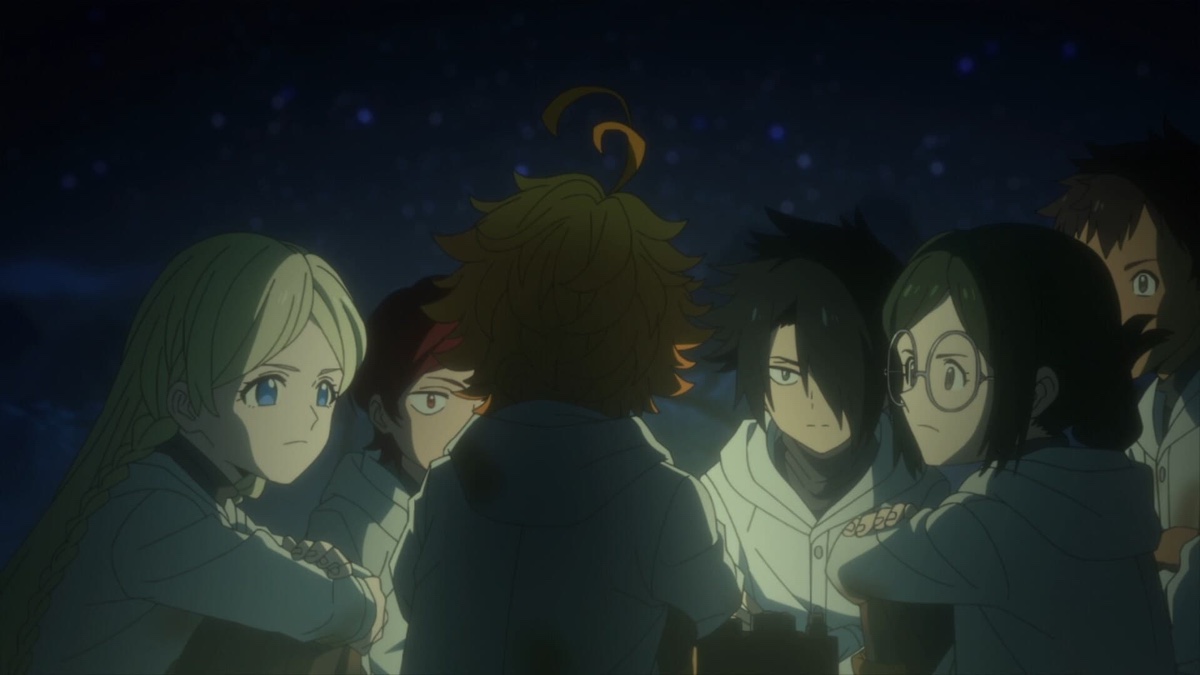
Season 2 opens with the children standing on the far side of the wall. Whatever any of them pictured out there, this is not it. No people, no map, no food they recognize, no route to anywhere, and something in the treeline that eats them. What they have is a handful of clues left behind by an adult none of them has met, plus the habits of thought that eleven years of daily testing put into their heads.
The first season asked one question and answered it: how do you get out of the house. The second asks what the outside is for, and the answer keeps widening. Forest, then a demon town, then the human side of the arrangement, then the arrangement itself, which turns out to be a thousand-year-old contract somebody signed. It is a much bigger story than the first season told. It is also exactly as wide as eleven episodes, which is how wide a season about a single house was.
✨ What Season 2 Still Gets Right
What Holds Up
- Animation, backgrounds and score all sit at the first season’s level throughout
- The demon town is the most inventive design work in either season
- One character is left in a better place here than the manga leaves her
- Whatever else it does, it pushes people toward the source material
Nobody drew this badly
For a season with a reputation this bad, almost nobody attacks the pictures. Read through Japanese write-ups of these eleven episodes and the complaints are strikingly uniform: the cuts, the speed, the finale. The drawing gets left alone. Line work holds up. The demons are more elaborate than they were in the first season, and there is a whole town of them built out in detail that the story afterwards has no time to use. CloverWorks did the job that was in front of them.
Takahiro Obata came back for the score without changing his approach, which was correct, because the trick of laying an uneasy string under a calm scene still works when the calm scene is a campfire in a forest that eats children. Kiiro Akiyama’s opening, “Identity”, is rougher and harder than the first season’s was, which suits a story that now happens outdoors. Myuk’s ending, “Mahou”, does the opposite job and does it well. The Japanese cast is not under attack either. Maaya Uchida’s Norman in particular is doing careful work on a version of the character who is given almost no room on screen to arrive anywhere.
I want to stop on this, because of where blame flows when a production goes wrong. It flows toward the names attached to the images, since those are the names anybody can see. On this one the evidence points the other way. What is visible in these eleven episodes is a crew executing well inside a shape that could not have worked for anyone. Being angry at whoever painted the backgrounds of that town would be a category error.
One change I think improves on the manga
There is a character whose fate differs between the two versions, and it is Isabella, the woman who ran the house. I am not going to say what happens to her here, and I am not going to give away the manga’s version either, since both are worth arriving at cold. What I will say is that on this single point I prefer what the anime did.
The manga’s handling reads as a settlement. She carried a great deal, so the story squares the account. The logic is sound. What I could not get past, reading it, was that I could see the decision being taken: this placement produces the strongest reaction, so this is the placement. Once the machinery is visible my own reaction stops dead. Contrivance is not only characters surviving things they should not survive. It is also an ending that arrives because it will play well.
The anime declines that move, and what it leaves her holding is heavier than an exit would have been. Closing a story with the first season’s antagonist parked somewhere that is neither punishment nor forgiveness is the undramatic option, and undramatic is a hard thing to sell in a writers’ room. I think it is the better call. In a season with eleven episodes to spend, it is the one place where somebody clearly thought for a long time before deciding.
Deeper Themes
Stop counting what was removed for a moment and list what survived, because the survivors are not random. Two things are protected all the way to the last episode: how this world came to exist, and what the demons are actually doing. Everything else is traded away to keep those two intact. What that leaves is a season organized around a single question, whether two kinds that cannot share a table can share a world, with Emma and Norman splitting on precisely that line. As a principle it is coherent, and you can tell somebody chose it on purpose rather than arriving there by accident. The cost is that narrowing a theme means dropping the others, and the others were where this series actually lived: children shifting a little at a time, adults with histories of their own, the slow accumulation that made the first season’s cast feel like people rather than positions.
It sends people to the manga, which is not nothing
The strange part is who says so. In Japanese comment threads the sentence I keep running into is some version of: watching this made me want to read the manga. It comes overwhelmingly from the people who disliked the season rather than the people who enjoyed it. The outline of what got skipped stays legible even when the content is missing, and a legible outline is an invitation. As praise that is faint. As a description of what the season does in the world it is accurate, and it is the reason the score at the bottom is not lower still.
🎭 Memorable Scenes
The final episode gives its last stretch to a run of still images, one after another, carrying the remainder of the manga. It is the single most discussed passage in the season and the place where every opinion about it collects. You can follow what happened. You cannot feel what any of it weighed. A reader recognizes every frame and rebuilds the missing hours out of memory without noticing they are doing it. Somebody who has only watched the anime gets unfamiliar people reaching unfamiliar conclusions at high speed.
Second, the sequence where Norman’s position changes. In the manga you climb with him. What he decides, what it costs him, what he puts down in order to keep holding the decision, all of it laid out in order so that you arrive where he arrives. On screen the order is gone, so the conclusion is handed over without the staircase underneath it. The same words, minus the ascent, are not the same words.
Third, and this is the one that bothers me most, there is a conversation at the center of the entire premise, the one the series takes its name from, that goes past almost unremarked. Half-showing it is worse than not showing it. If there was no room, the honest move was to point at the manga and say so.
💭 How It Made Me Feel
My irritation changed target somewhere around episode eight.
While I was watching, it was aimed squarely at the scripts. Why remove that, why sprint through this. Then I looked properly at the credits and the shape of the thing changed. Kaiu Shirai, who wrote the manga, is credited on series composition for episodes 1 through 9. That credit did not exist on Season 1, where Toshiya Ono held it alone. His name is then absent from the writing credits on episodes 10 and 11, which people noticed at the time, and I do not know what that means. I am not going to invent a story to fill the gap.
What was left afterwards was flatter than anger and rather worse. I think the people who made this were hunting for the best available option inside a brief that contained no good ones. The better part of sixteen volumes of story in one broadcast cour is not a job anybody completes. Japanese viewers who bother to run the sum tend to land on four seasons as the honest figure, and the numbers agree with them. Somebody accepted that shape anyway, and the crew and the audience split the bill between them.
For what it is worth, I pulled volume 9 off the shelf the same night, partly to check that I had not spent five years overrating an arc that is not in the show. I had not.
😅 Where It Falls Short
Three complaints, in the order they matter.
The best arc in the manga is not in this season
The Goldy Pond arc, volumes 9 through 11 of the manga, is not adapted. Not compressed, not referred to in passing, not folded into something else wearing a different name. Absent.
That arc rebuilds the shape of Season 1 under completely different rules. A closed space again, an opponent holding every advantage again, children who have to win by thinking rather than by hitting. Plenty of readers in Japan rate it level with the escape from the house, and I am one of them. Taking it out is not trimming. It is removing a wall the upper floors were standing on, and you can hear the rest of the season creaking.
Take one person out and the plot stops joining up
An arc was not the only thing cut. Yugo, who does most of the work inside that arc, does not appear in this season at all. He belongs to a generation before Emma’s. He knows the history, he has skills no eleven-year-old could have, and he understands what he is for. Structurally he is the bridge between what these children can plausibly do and what the story needs them to do next.
Take the bridge out and you can see exactly where it used to stand. Abilities turn up without training behind them. Information turns up without a source. Japanese viewers itemise these and the lists get long: water-storing plants discovered at the moment the water runs out, a trap already built along the route they happen to be fleeing down, a stranger arriving at the last possible second. Every one of those is a place where a person used to be.
So the standard complaint, that the writing turned convenient, is aimed a few degrees off. Convenience is the symptom. The cause is that the character who made those moments earn themselves was taken out, and something had to hold the gap open.
The finale is a summary of a story rather than a story
I have been assembling a case against this season for several paragraphs. The worst of it, stated plainly: Everything remaining in the manga past the point these episodes can reach arrives in the last two, a good deal of it as static images with narration over the top. The plot completes. Completion is not the issue. The steps between the events are gone, so it finishes before anything has a chance to land on you.
The complaint is not confined to manga readers. People who came to this cold, having never opened a volume, describe it in the same words. They can tell that something important was fast-forwarded past them without knowing what the something was. In March 2021, when the finale went out, the series trended in the United States over it, and Anime News Network wrote the reaction up that week. That is not a fandom defending a favorite scene.
Too abbreviated for readers, too thin for everybody else. Failing both audiences with the same twenty minutes is an unusual way to fail.
The Downsides
- The Goldy Pond arc, volumes 9 through 11, is not adapted at all
- Yugo is cut, so several developments arrive with no cause behind them
- The last two episodes compress the remainder of the manga into montage
- Character turns are delivered as conclusions, with the process removed
Who Should Watch This?
- Anyone who finished Season 1 and wants the destination without reading twenty volumes to reach it
- Anyone whose interest is the world rather than the plotting, because the demon side is the best-served thing here
- Anyone still deciding whether to start the manga. Eleven episodes will settle that question fast
Who Might Not Enjoy This?
- Readers who want to see the manga on screen. This is not that
- Anyone hoping the Season 1 mind games continue past the wall
- Anyone who wants the story to land properly. The manga is finished, so that option exists
🤔 Was The Promised Neverland Season 2 Cancelled?
No. Eleven episodes was the plan from the beginning.
The season ran from January 8 to March 26, 2021 in Fuji TV’s late-night noitamina slot, eleven episodes, one broadcast cour. No shortened order was announced, no production halt, no collapsed schedule. It was built to fit that block and it fit it. There was a delay, announced in April 2020, moving the premiere from October 2020 to January 2021 because of the pandemic. A delay moves a season. It does not shrink one.
The word keeps surfacing because the season ends the way cancelled shows end, and that is the nearest available word for the feeling. Look at how people actually write it and most of them are asking a question rather than stating a fact.
Which leaves the matter of who is responsible, and the credits take the easy answer away. The story where somebody outside the manga took a knife to another person’s book does not survive contact with a series composition credit that has the author’s name on it, a credit that did not exist on the first season. Whatever happened around episodes 10 and 11, this was not an adaptation carried out behind its writer’s back.
My objection sits further upstream than any of that. At some point somebody decided that 144 chapters would be one cour of television. That decision is what this season should be filed under. By the time anybody sat down to write episode one, the ending had already been chosen for them.
📺 Streaming Guide by Service
Can you watch Season 2 without a Crunchyroll account?
Only by buying it. There is one subscription in the United States carrying this season, either directly or resold as a channel on Amazon. Netflix does not carry it. Hulu no longer does. HIDIVE gave up both seasons at the start of 2026, and nothing free with ads has picked them up since. So the real choice is a Crunchyroll subscription, the same catalog billed through Amazon, or buying it outright from Amazon or Apple, which costs more.
On the dub, since people ask: all eleven episodes are finished, the principal cast from the first season came back for it, and Adult Swim’s Toonami began airing it in April 2021. If you watched Season 1 dubbed there is no reason to switch halfway.
Where to Stream
- Crunchyroll: streaming, all 11 episodes, subtitled or dubbed
- Prime Video: the Crunchyroll channel as an Amazon add-on. Individual episodes are sold here as well
- Apple TV: sold, not rented
- Netflix, Hulu, HIDIVE, Disney+: not available in the US
Soundtrack
Takahiro Obata’s music for the second season shares an album with his first-season score, which is fitting, because the two are of a piece. If one thing survives these eleven episodes intact it is the way the writing for strings keeps treating the outside world as somewhere nothing has been settled yet.
- Spotify: the combined Season 1 and Season 2 soundtrack
- Apple Music: the same album on the US store
📚 Reading the Manga After Season 2
Kaiu Shirai and Posuka Demizu finished this in June 2020 at 20 volumes and 181 chapters. The complete English edition is available from VIZ Media.
The practical point first, because it catches people out. Watching Season 2 does not move your starting position in the manga. You still begin at chapter 38, in the same place a Season 1 viewer begins, and the Season 1 review has the detail on which volume that falls inside. The reason is that this season does not consume the source in order. An arc is missing, events are resequenced, one character finishes somewhere else entirely. Your memory of the anime will not work as a bookmark.
If you want a shorter test before committing to twenty volumes, buy volume 9. That is where the arc this season skipped begins, and it runs to the end of volume 11. Read those three and you will know whether the rest is for you. My guess is that you will keep going.
- The Promised Neverland, Vol. 9: The Battle Begins: the start of the arc Season 2 leaves out entirely
- Season 2 on Blu-ray: the Aniplex of America release, all eleven episodes across three discs
🎬 If This Left You Frustrated, Watch These 3 Next
Three adaptations that were handed the same problem and answered it differently.
Fullmetal Alchemist: Brotherhood
Twenty-seven volumes, sixty-four episodes, every setup discharged before the credits roll on the last one. This is what a production looks like when it is given the runway its source needs, and it is the cleanest available answer to the question Season 2 raises. Watch the two close together and the variable stops being talent, or budget, or how much anybody cared. The variable is time.
👉 Read the Fullmetal Alchemist: Brotherhood review
PLUTO
Eight volumes, eight episodes, each of them running about an hour. Compression is not the crime, which is the useful thing PLUTO demonstrates. Urasawa’s manga is dense, the adaptation is denser still, and it lands because somebody went and found the hours instead of looking for shortcuts. What Season 2 lacked was never editing skill. It was running time to edit into.
Death Note
The mirror image, which is why it belongs next to this one. Death Note is the other Shonen Jump series people warn each other about halfway through, except that there the drop belongs to the manga and the anime follows it down faithfully. Neverland is the reverse. The source holds all the way to its final chapter, and the adaptation is where the damage happens. Same complaint from viewers, opposite cause, and telling the two apart changes what you should do about it. With one of them you stop watching. With the other you go and read.
📝 Final Thoughts
I am not going to defend this. The strongest arc in the manga is gone, the character holding the middle of the story together is gone, and the last act is a montage. Readers get a summary of something they already know is better. Newcomers get less than they need in order to feel anything at all. If somebody tells me this does not work as a piece of television, I have no argument to offer them. Two out of ten, and it is an odd two, because two of the seven rows in the table below are not the problem and never were.
What I do not have is anybody to be angry at. This much story and this many episodes were never going to meet. Two cours, or permission to stop where the first season stopped, and we would be having a different conversation entirely. The Season 1 review ends by arguing that those twelve episodes ought to have been the entire adaptation. Eleven episodes later, that reads less like an opinion than like a description of what happened. The rest of this story does exist, finished, in twenty volumes, and it is worth the shelf space it takes up. The twelve episodes that did work are why the series is in our best mystery anime list at all, and the entry there is written for the escape plan, which is all Season 1.
⭐ Series at a Glance
| Category | Rating | Note |
|---|---|---|
| Story | ★☆☆☆☆ | Complete on paper. Unfelt on screen |
| Structure | ★☆☆☆☆ | 144 chapters, 11 episodes |
| Characters | ★★☆☆☆ | Turns arrive as conclusions |
| Animation | ★★★★☆ | The one department that delivered |
| Music | ★★★★☆ | Obata continues, unchanged |
| Pacing | ★☆☆☆☆ | A sprint, then a montage |
| Faithfulness | ★☆☆☆☆ | An arc gone, a character gone, an ending altered |
Usagi’s Recommendation Score
⭐⭐☆☆☆☆☆☆☆☆
2.0 / 10
The crew ran hard. The distance they were told to cover was wrong.

