*This page contains affiliate links. We may earn a commission if you make a purchase through these links.
How much damage can a badly received sequel do to a story that was already finished?
Type the title into a Japanese search box and the autocomplete finishes it for you: “second half boring” and “boring after the jailbreak.” Those suggestions are the first thing a person on the fence sees, and a lot of them stop right there. So before anything else: that reputation is about the wall and everything past it, which is Season 2 and the back half of the manga. It has nothing to do with these twelve episodes. I followed this in Weekly Shonen Jump from the first chapter to the last one, and I have watched Season 2 as well, so I am in a position to draw that line precisely. The reasoning is further down. Streaming first, because in the United States the answer is short.
📺 Where to Watch The Promised Neverland (October 2026)
| Service | Status | Notes |
|---|---|---|
| Crunchyroll | Streaming | The full run of 12, with subtitles or the finished English dub |
| Prime Video | Add-on | Crunchyroll resold as an Amazon channel. One bill instead of two |
| Amazon Video | Rent / Buy | Per episode or per season. A Prime membership covers none of it |
| Apple TV | Rent / Buy | Ownership only, a few dollars per episode |
| Netflix | Not available | No US license. Japan lost it as well |
| Hulu | Not available | One of the two launch homes in 2019. Gone now |
| HIDIVE | Not available | Both seasons left on January 8, 2026 |
As of October 2, 2026, in the United States this lives on Crunchyroll and on no other subscription. Twelve episodes, subtitled, with the Aniplex English dub that aired on Toonami alongside them. Readers who would rather not keep a separate login can bolt the same catalog onto Amazon as a Crunchyroll channel subscription. Buying it runs a few dollars an episode, so the full twelve costs more than a few months of the service that already includes them.
The negative answers are worth spelling out, because they are what people actually type. Netflix does not have this in the United States, and before anyone assumes that is an import problem, Japan does not have it on Netflix either. Hulu is the one that catches people out: Hulu and Crunchyroll shared the American simulcast when the show launched in January 2019, so half the articles you will find still say Hulu, and the listing is no longer there. HIDIVE dropped both seasons in January 2026. That leaves one subscription. Unusual, for a series this well known.
🔢 How Many Episodes Is The Promised Neverland Season 1?
Twelve. Each one runs about 23 minutes, so the whole season comes to roughly four and a half hours, which is less than most people spend on a single prestige-drama weekend. It aired in Japan from January 11 to March 29, 2019, one episode a week. If you decide to continue afterwards, Season 2 adds eleven more.
The number is small, but how you split it matters more than usual, because the twelve are not evenly weighted. My suggestion, after taking the last four in one sitting myself and half regretting it: take the first eight over two evenings, fairly close together. The middle stretch is about waiting and watching, and it actually reads better when you keep the details fresh, since so much of it depends on remembering who noticed what. Then slow down for episodes nine to twelve and leave a night between them if you can. Those four spend everything the first eight set up, and they hit harder when you have time to sit with each one.
One small thing from the Japanese side: this was made as a single late-night cour, and it ends exactly where the escape arc in the manga ends. Twelve episodes is the full, intended shape of the jailbreak, not a cut-down version of it.
🎬 Trailer
That is Aniplex of America’s trailer from the January 2019 premiere window, English subtitled. Ignore the list of services in its description, which is seven years out of date and now reads like a small piece of streaming history.
Work Info
- Title: The Promised Neverland, Season 1 (Yakusoku no Neverland)
- Aired: January 11 to March 29, 2019, 12 episodes, Fuji TV’s noitamina block
- Animation: CloverWorks
- Director: Mamoru Kanbe / Series composition: Toshiya Ono / Character design: Kazuaki Shimada
- Music: Takahiro Obata / Opening: “Touch off” by UVERworld / Endings: “Zettai Zetsumei” and “Lamp”, both by Cö shu Nie
- Original manga: Kaiu Shirai (story) and Posuka Demizu (art), serialised in Weekly Shonen Jump
- English dub: Erica Mendez as Emma, Jeannie Tirado as Norman, Laura Stahl as Ray, Laura Post as Isabella, directed by Steve Staley
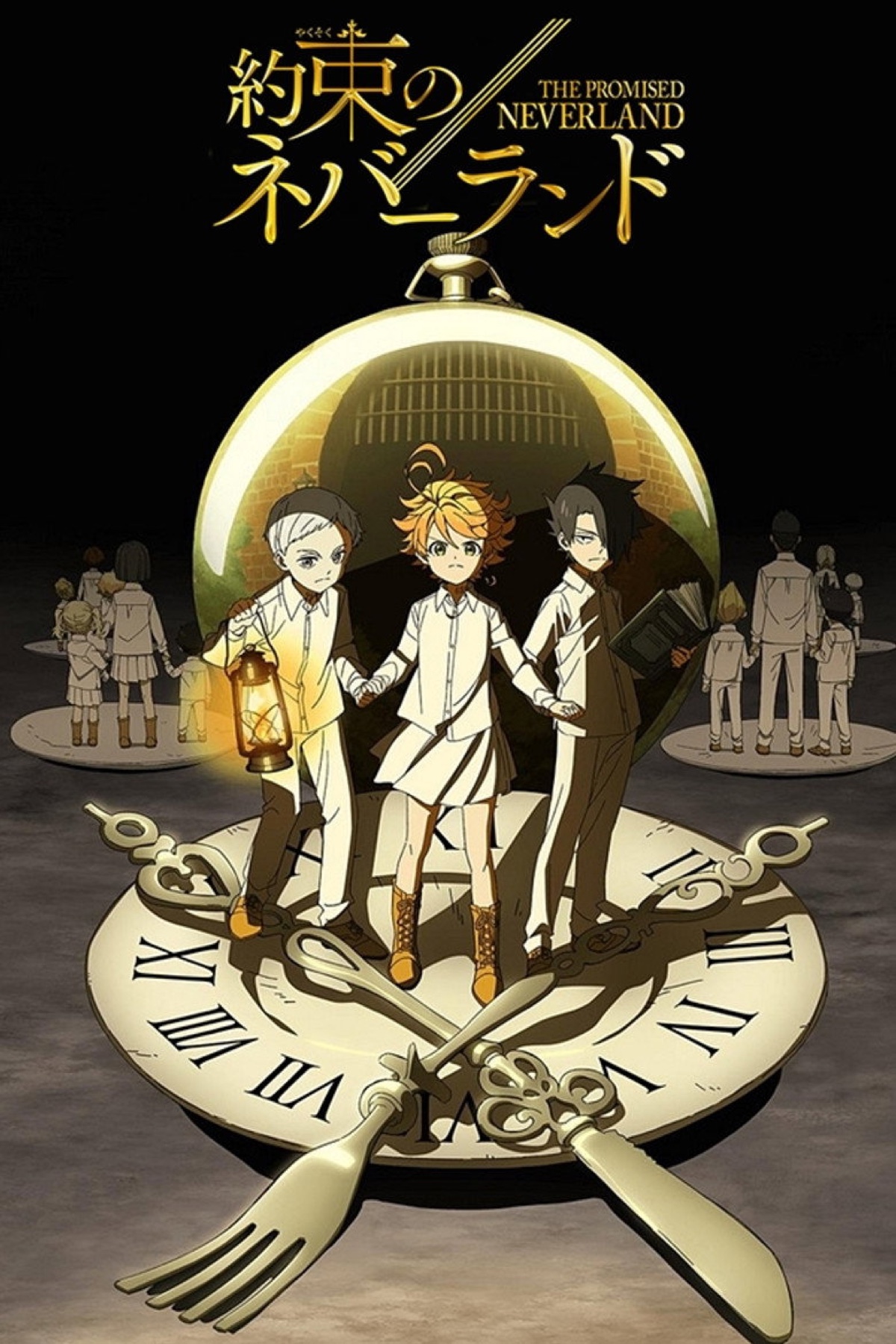
📖 Synopsis – No Spoilers
Grace Field House is a white building in a clearing, ringed by forest, where thirty-eight children live under a woman they all call Mom. None of them are related to her or to each other. The food is warm, the clothes are clean, and nobody is punished so long as they sit the test every morning. The three oldest, Emma, Norman and Ray, are eleven, and they post perfect scores on that test week after week without appearing to strain.
One evening, after seeing off a younger sister who has been placed with a foster family, Emma notices something the girl left behind. Running it out to the gate is how the two of them find out what the house is actually for. All of that lands inside episode one. This is not a show that hoards its premise and doles it out over a season; the truth gets handed to the audience and to the children at the same moment, and the remaining eleven episodes are about eleven-year-olds who now have to sit at breakfast pretending they do not know.
✨ What Makes It Special
Why It’s Exceptional
- It is willing to take the children’s strongest piece off the board, and to make them play on without it
- The character art is soft and warm, and the eyes are where it stops lying to you
- The last four episodes spend every object the early ones quietly left lying around
- The adult running the house is written as a person with a position, not as a monster with a motive
It gives away its best weapon before the fight is over
A jailbreak story runs on one pleasure, and everybody reading this knows what it is. The clever side turns out to have been one move ahead. There is a plan, there is a counter-plan, and at the end a card gets turned over that was face down the whole time. This one walks away from that pleasure while the story is still running. Shortly before the final stretch, the child with the highest processing power in the group is removed from the board. I am not going to say who or how. What is worth knowing before you start, because it changes how you watch, is that these kids go into the last act with their best mind gone.
The effect is immediate and physical. If you have been following this as a competition between two intelligences, the floor comes out. The remaining children have no good reason to believe they can win, and they have to leave anyway. What was a plan for winning turns into a plan for surviving the next hour, and you can feel the moment it converts. Nobody in these twelve episodes wins a fight, either. For a series that ran in the same magazine as One Piece and My Hero Academia, that is a strange thing to notice, and it is not an oversight. The opposition here is not the kind of thing an eleven-year-old defeats. It is the kind of thing an eleven-year-old gets away from, and the show is honest about the difference.
Most people describe this series by its surface contrast, the sweet drawings over the horrible subject. Watch all twelve and something else stands out first: how unsentimental the construction is. Letting the kids keep their strongest asset and win anyway would have been easier to write and much easier to sell. The show declines. What that leaves you with is the specific discomfort of watching a plan proceed with nobody left in the room who can count the moves ahead.
There is a second half to this that gets less attention. The taking is handled well, and so is the taker. The woman supervising the house does not hate the children, and she is not enjoying the control. She has a position, that position has a history, and the history surfaces in a single line very late in the season. Plenty of stories hand their antagonist a justification. This one mostly refuses to explain her at all and lets her behaviour carry it, which is why she keeps working on you afterwards. Come back to episode three once you have finished and watch what her face is doing while she is being kind. Different show.
Four paragraphs of praise is enough without a warning label, so here is mine. The middle of this season is noticeably slower than either end, it gets its own section below, and it is the single thing keeping this off an eight.
The drawings are gentle. The eyes are not
Posuka Demizu’s manga art has a scratchy, overloaded quality that reads as handmade. CloverWorks smoothed it out and rounded the children off. Soft hair, soft jawlines, warm light coming through the windows of the house. Pull any frame of the first ten minutes and you have a picture of small siblings playing tag in a very large garden.
Then the eyes go. In the scenes where somebody is doing real calculation or has just understood something, the whites take over and the pupils shrink to almost nothing. Nothing else about the face changes, no line work, no colour shift, and yet something else is clearly behind it. There is no wind-up, no cue, no music sting arriving first to prepare you. I caught myself flinching at a child’s face in a sunlit room. That is not a normal reaction to have to a cartoon. Plenty of shows use a cute-to-cruel drop as a party trick. What makes this one land is that the cute side is done properly rather than cheaply, so there is real height to fall from.
The sound design is pointed the same way. Takahiro Obata’s score puts a thin, wrong string underneath ordinary domestic scenes and then declines to resolve it. Nothing happens. The episode ends. Do that four or five times in a row and you stop being able to relax during the happy parts. That appears to be the entire design goal. Across twelve episodes there is no stretch where this show tells you it is safe to sit back.
Deeper Themes
The question underneath is not how to escape. It is whether a person can give up a safety they did not choose and were not asked to pay for. There is no hunger inside that house and no violence in it. Staying, right up until the day your name comes up, is a genuinely comfortable offer, and the show is careful to present it as one rather than stacking the deck. The children walk toward the lower survival rate on purpose. Managed peace against dangerous freedom, argued from the side of the eleven-year-olds, is a harder version of that question than most stories are willing to set, because the adults watching have already spent years accumulating reasons to take the first option.
👉 If the part that grips you is the wall rather than whatever stands on the other side of it, Attack on Titan Season 1 is the same floor plan built at enormous scale.
Episode nine onward, it stops being able to slow down
The last four episodes move. Things that were mentioned once and left alone, the height of the wall, what happens to the smallest children, the limits the adults are working under, all start operating at the same time, and the situation is different at the end of every episode than it was at the start. Setup gets spent rather than merely paid off. By the finale there is very little left sitting unused. Rarer in a twelve-episode adaptation than it sounds.
What that does to a viewer is worth naming, because it inverts the usual shape. Most twelve-episode series save their volume for the finale and keep the run-up quiet. This one gets louder from the ninth onward and never puts the landing gear down. Streaming lets you take all four in one sitting, which is what I did, and I would gently suggest not doing that. Nobody watching the original late-night broadcast in 2019 had the option, and a week between episodes turns out to be roughly the right dose. The gap is where you register what you have just watched being done to a room full of children.
That acceleration is bought with the slow patch before it, and I will get to the bill in a minute. It is worth the crossing.
🎭 Memorable Scenes
Episode 1, at the gate. Two children go to return a forgotten toy and come back knowing what they are.
Twenty-three minutes. That is the entire budget this show spends on its central reveal, and other series would have made a season out of it. Handing the audience and the protagonists the same information at the same time is a real structural choice with a real cost, since it burns the biggest card in the deck immediately. What it buys is eleven episodes of a much better game, where the tension comes from what the children are hiding rather than from what the viewer has not been told.
The second one is quieter and I will keep it vague. There is a moment where an adult says one short sentence, and that sentence tells you the plan has been visible from above the whole time. The camera does nothing. The music does nothing. It is the coldest thing in the series and it is delivered at conversational volume. Whoever directed that recording session made the right call about how little to give it.
Then the last line of episode twelve, spoken over children walking away: “If I may wish for one thing, let there be light ahead of them.” I am translating the Japanese there rather than quoting the subtitle, because the phrasing varies by release. Who says it, and to whom, is the part worth arriving at cold. It re-colours a good deal of what you have already watched.
💭 How It Made Me Feel
I came to this already knowing every beat. That is the least advantageous way to watch anything, and it held up. The reason is where the adaptation stops. The jailbreak is the strongest sustained run in the whole manga, and the anime takes it from the beginning to the completion of the escape and then puts the pen down. Nothing is left dangling because nothing was started that it could not finish. Twelve episodes, one arc, all of it.
Here is the honest part about reading it first, though. There were almost no surprises left for me, and I do not want to oversell what a manga reader gets out of this. One thing, exactly one, arrived that the page could not give me. The lullaby has a tune. In the manga you watch her sing it to the younger children and you get nothing, because paper does not carry a melody, and I had been looking at that image for years. The anime hands it over. “Isabella’s Lullaby” ended up as the signature track of the score and now runs in three arrangements across the soundtrack album, and hearing it the first time was the single moment where being a reader put me at a disadvantage rather than an advantage. I went and found the album that night. I am also not alone in this: go through Japanese write-ups by people who read the manga first and you will keep hitting the same note, some version of so that is what the song sounded like, you could never tell from the page. It is the one thing the adaptation could add that the source physically could not hold.
And if you are coming to this with no idea what happens, you are getting the version of this story that Jump readers got in 2016, at the original strength, with nothing sanded off. That is the whole job of an adaptation and this one did it.
😅 Where It Falls Short
Two real problems, and the second one is the whole distance between 7.7 and an eight.
The internal monologue is gone, and the reading is now your job
The manga is enormously talky on the inside. Who suspects what, who has worked out how much, which of the three is bluffing the other two, all of it laid into the margins as thought text until the pages are dense with it. The anime cuts most of that and asks faces and silences to carry the same load.
As direction it works. There are pauses here that are better than the lines they replaced, and a straight audio transcription of the source would have been unbearable in a different way. But information was lost, and the amount is not small. The middle episodes are built almost entirely on tracking who knows what about whom, and when that gets handed to expressions alone, the audience has to do more work than the story admits. Readers patch the gaps automatically from memory and never notice. Watching it cold, there are places where you will be a step behind and it will not be your fault.
Around episode seven, the story stops moving
This is the soft spot. The location never changes. Neither does the objective, which stays at information-gathering plus a feint plus more waiting. A new character comes in and the relationships shuffle, but the actual position on the board is the same two or three episodes later. The per-episode hooks are strong enough that few people will drop the show here, but the momentum visibly sags.
Which is the whole complaint. If the middle feels like it is idling, hold on until episode nine, because everything that stalls in the seventh is being loaded for the ninth. That is a real cost and I have priced it into the score, but it is a dip and not a decline.
The Downsides
- The manga’s thought captions are cut, so the psychology has to be read off faces
- The middle stretch around episode seven holds still, in one location, for two or three episodes
Who Should Watch This?
- Anyone who watches prison-break television for the planning rather than the running
- Live-action people who do not watch much anime, since the grammar here is closer to a cable thriller than to a shonen series
- Above all, anyone who scrolled past the thumbnail on the assumption that it was made for children
Who Might Not Enjoy This?
- Viewers who cannot sit with small children in danger. Very little blood is spilled here, which does not make it lighter
- Viewers who need one season to close out the whole story. The arc closes here, the larger plot does not
🤔 About That “It Gets Bad” Reputation
Is The Promised Neverland Season 1 worth watching if Season 2 is bad?
Yes, and the two questions are less connected than the internet makes them look. Here is what that reputation is actually made of. Both of those autocomplete phrases point at what happens after the wall, which means Season 2 and the second half of the manga. Season 1 covers the escape from Grace Field House and stops at the completion of it. The one complaint that genuinely belongs to these twelve episodes, the slow stretch around episode seven, is a different and much smaller thing, and it already has its own section above. The material people are angry about is not in here at all, and these twelve episodes are not a prologue to it in any way that obliges you to continue.
What makes this genuinely annoying is that the warning is reaching people before they have watched anything. Read Japanese comments on Season 1 and you keep finding the same shape: “apparently Season 2 is not well liked, so I will stop here,” “I have heard it goes badly and I am nervous about starting.” Those are people talking about a season they have not seen, in a post about a season they liked. The bad reputation has become the first thing anybody encounters, and Season 1 is absorbing damage it did not earn.
To be fair to the sequel for a moment, the most common criticism deserves a small argument. People say the mind games disappear. They do, largely. But these children were never running a mind-game story because they enjoyed mind games; they were doing arithmetic because they wanted to stay alive, and arithmetic was what the situation required. Change the situation and the required skill changes with it. Whether the new one is as interesting is a fair fight to have. Calling a change of terrain a betrayal is a different claim, and a weaker one.
Either way, none of it touches the decision in front of you. Season 1 is a self-contained jailbreak that closes, and you are allowed to stop there. I did watch the rest, and I still think stopping is a legitimate way to own this story.
👉 If the pitch that lands for you is a child playing chess against an adult who is better resourced, Death Note is the obvious neighbour, and the differences are more instructive than the similarities.
📺 Streaming Guide by Service
Is The Promised Neverland on Netflix or Crunchyroll in the US?
One of those two, and it is the second one. Netflix is the search people run most often and the answer there is no, in America and in Japan alike, which at least spares you the feeling of missing out on a regional edition. Hulu, as covered above, lost the listing years ago despite what 2019-era articles still say. HIDIVE held both seasons until January 8, 2026 and let them go. Nothing free and ad-supported exists, so it comes down to a Crunchyroll account, the same catalog billed through Amazon, or buying the episodes.
On the dub, since this comes up: it is complete for all twelve episodes, Aniplex of America produced it with Bang Zoom!, and it went out on Adult Swim’s Toonami. Erica Mendez as Emma and Laura Post as Isabella are both good, and Post has the harder assignment by some distance, because the role requires warmth that a second viewing has to be able to reinterpret. Sub or dub is a coin flip here. Twelve episodes will also fit into one evening, and for the reasons given above I would space them out.
Where to Stream
- Crunchyroll: Streaming, the complete season with both audio tracks
- Prime Video: attach Crunchyroll to an Amazon account as a channel. Single episodes are sold here too
- Apple TV: sale, never rental
- Netflix, Hulu, HIDIVE, Disney+: not available in the US
Soundtrack
Takahiro Obata’s complete score runs 35 tracks and came out on December 21, 2019. The one to find is “Isabella’s Lullaby”, which appears three times on the album: the vocal version, an instrumental, and a mandolin arrangement. It is the piece the manga could not give me, and it is the reason I have this album rather than merely remembering it.
- Spotify: the Season 1 original soundtrack in full
- Apple Music: the Complete Edition on the US store
📚 The Source, and Where to Pick It Up
Kaiu Shirai and Posuka Demizu ran this in Weekly Shonen Jump from 2016 and finished it in June 2020 at 20 volumes. VIZ Media publishes the whole run in English.
Now the bit that most guides get wrong, so it is worth being exact. Season 1 adapts chapters 1 to 37. Chapter 37 is not the end of a volume; it sits third from the front of volume 5, which holds chapters 35 to 43. So the volume to buy is 5, and the chapter to start on is 38, “Forest of Vows”. Skipping ahead to volume 6 is the common advice and it costs you six chapters of the immediate aftermath, which is precisely the stretch where the story reveals what kind of thing it intends to be next.
Reading from volume 1 instead is a defensible choice, and not just for completeness. The internal monologue the anime cut is all still on the page, so the middle stretch that felt underexplained on screen is fully spelled out there.
- The Promised Neverland, Vol. 5: Escape: where the anime stops. Start at chapter 38
- Season 1 on Blu-ray: the US home video release, for anyone who would rather own it than rent a license
🎬 If You Loved The Promised Neverland, Watch These 3 Next
Kakegurui
An academy that ranks its students by how well they gamble, and formally reclassifies the ones at the bottom as livestock. Their money, their standing and the shape of their adult life all get reassigned to whoever holds the debt. Grace Field sits a test every morning; this school sits one every night. What makes the pairing useful is the price. Kakegurui lets children risk things they can survive losing, so the puzzles stay puzzles. Put it next to Emma’s group and you can see precisely which part of a mind-game story comes from the cleverness and which part comes from the cost.
Made in Abyss
If what stayed with you was the distance between the drawings and the content, here is the same instrument played much harder: a children’s-book surface over material that goes places The Promised Neverland does not attempt. Consider it a warning as much as a recommendation. The gap that makes Grace Field unsettling is, in this one, the entire design of the show, and it does not blink first.
👉 Read the Made in Abyss review
The Summer Hikaru Died
This one is here because it is the mirror. A face you love, and warmth coming off it that is entirely genuine, attached to something that is not what it says it is. The children at Grace Field learn that about Mom and run. The boy in this one finds it out and decides to keep it, because the alternative is losing his friend a second time. Set the two endings side by side and Emma’s choice stops looking obvious. That is the best possible argument for how much courage the show was quietly asking of her.
👉 Read The Summer Hikaru Died review
If the part you enjoyed most was working out the rules of Grace Field before the children did, our best mystery anime list is built from shows that reward the same habit.
📝 Final Thoughts
Having seen where the story goes afterwards, my verdict on this adaptation is that it should have been allowed to be the whole thing. I do not mean that as a dismissal of everything downstream. I mean the twelve episodes are finished work, and I cannot name anything you could add to that final shot that would improve it. The judgement this production got right, above all the others, was where to stop.
So if the autocomplete is what has been holding you up, you have the order backwards. Watch these twelve first and make the sequel decision afterwards, with your own opinion instead of somebody’s summary of one. The escape closes cleanly and nothing in it is contingent on what follows. Speaking as someone who spent four years waiting a week at a time for the next chapter, being able to stop here is a privilege that only arrives once a story is finished, and it is yours for free.
⭐ Series at a Glance
| Category | Rating | Note |
|---|---|---|
| Story | ★★★★★ | One arc, told start to finish, cut in exactly the right place |
| Tension | ★★★★★ | Never once lets you off the hook |
| Characters | ★★★★☆ | Three leads and one supervisor, all of them load-bearing |
| Animation | ★★★★☆ | Warm and rounded, and then the eyes |
| Music | ★★★★☆ | Wrong strings under happy scenes, plus that lullaby |
| Pacing | ★★★☆☆ | Episode seven idles. Episode nine onward does not |
| Faithfulness | ★★★★★ | Almost nothing altered beyond the cut monologue |
Usagi’s Recommendation Score
⭐⭐⭐⭐⭐⭐⭐⭐☆☆
7.7 / 10
A Shonen Jump series where nobody defeats anybody. “It should have ended here” is the highest compliment I have for it.

