*This page contains affiliate links. We may earn a commission if you make a purchase through these links.
I started this one expecting to laugh at a man. Forty years old, no job, living up a mountain, throwing punches at trees and rehearsing a transformation pose from a children’s show that first aired in 1971. I gave it three episodes on the assumption that the joke would run dry and I would quietly drop it.
Then the show does something I was not ready for. The costumed idiots he keeps running into stop being costumed. Shocker is real in this world, and so are the monsters, which means the sad man in the homemade mask is now standing somewhere people actually die. The genre changes underneath you while you are still smirking.
Twenty-four episodes later this sits among my favourite things I watched all year, and I want to be precise about why, because it is not the reason I expected. These men are chasing something they know for a fact they cannot have. The distance between the fantasy and the room they are standing in shrinks a little every week. And when the moment finally arrives where one of them gets to trade punches with a real kaijin, the thing that surfaces on his face is relief. He cries mid-fight, because he got what he wanted. The flaws in this thing are numerous and I will list every one of them further down.
📺 Where to Watch Tojima Wants to Be a Kamen Rider (August 2026)
| Service | Status | Notes |
|---|---|---|
| Crunchyroll | Streaming | All 24 episodes, subtitled plus a full English dub |
| Amazon Prime Video | Add-on | Via the Crunchyroll channel. No rental, no purchase |
| Netflix | Not available | Crunchyroll holds the licence outside Asia |
| Hulu | Not available | — |
| HBO Max | Not available | — |
As of August 29, 2026, Crunchyroll carries this in the United States and nobody else does. What sits on that page is the complete run: both cours, subtitles, and the English dub that trailed the Japanese broadcast by two weeks. If you would rather keep everything on one bill, the same catalogue arrives through the Crunchyroll channel on Prime Video, which is an add-on rather than a second licence. Buying or renting an episode is not an option on any US storefront. Rights get reshuffled often enough that it is worth opening the service yourself before you clear a weekend for this.
One thing worth knowing before you press play: this show assumes you grew up with Kamen Rider, and in the United States almost nobody did. The franchise has run in Japan more or less continuously since 1971. It reached America twice, both times rebuilt from the ground up. Saban cut Kamen Rider Black RX into Masked Rider for Fox Kids in 1995, and Kamen Rider Dragon Knight reworked Ryuki in 2009. Neither of them is what Tojima is talking about. The good news is that the actual source is free: the original 1971 series streams on Tubi in the US at no cost. Two episodes of that is all the homework this show needs.
👉 If the idea of grown adults organising their whole lives around a fandom is the part that interests you, In Those Days is the live-action Japanese film that covers the same ground without any monsters in it.
🎬 Trailer
Work Info
- Title: Tojima Wants to Be a Kamen Rider
- Aired: October 2025 to March 2026, 24 episodes across two consecutive cours, meaning a straight six-month run (the second cour began January 10, 2026)
- Director: Takahiro Ikezoe
- Series Composition: Touko Machida
- Character Design: Cindy H. Yamauchi
- Music: TeddyLoid
- Animation: LIDENFILMS
- Original manga: Yokusaru Shibata, begun in Monthly Hero’s in 2018 and now running on the Comiplex website
- Tojima: Katsuyuki Konishi in Japanese, Patrick Seitz in the English dub
- Opening: “Wanna be” by TeddyLoid feat. Shigeru Matsuzaki and TOPHAMHAT-KYO / Ending: “One More Time!” by TeddyLoid feat. Ryoji Tokito
- Made with the cooperation of Toei Company and Ishimori Productions
📖 Synopsis – No Spoilers
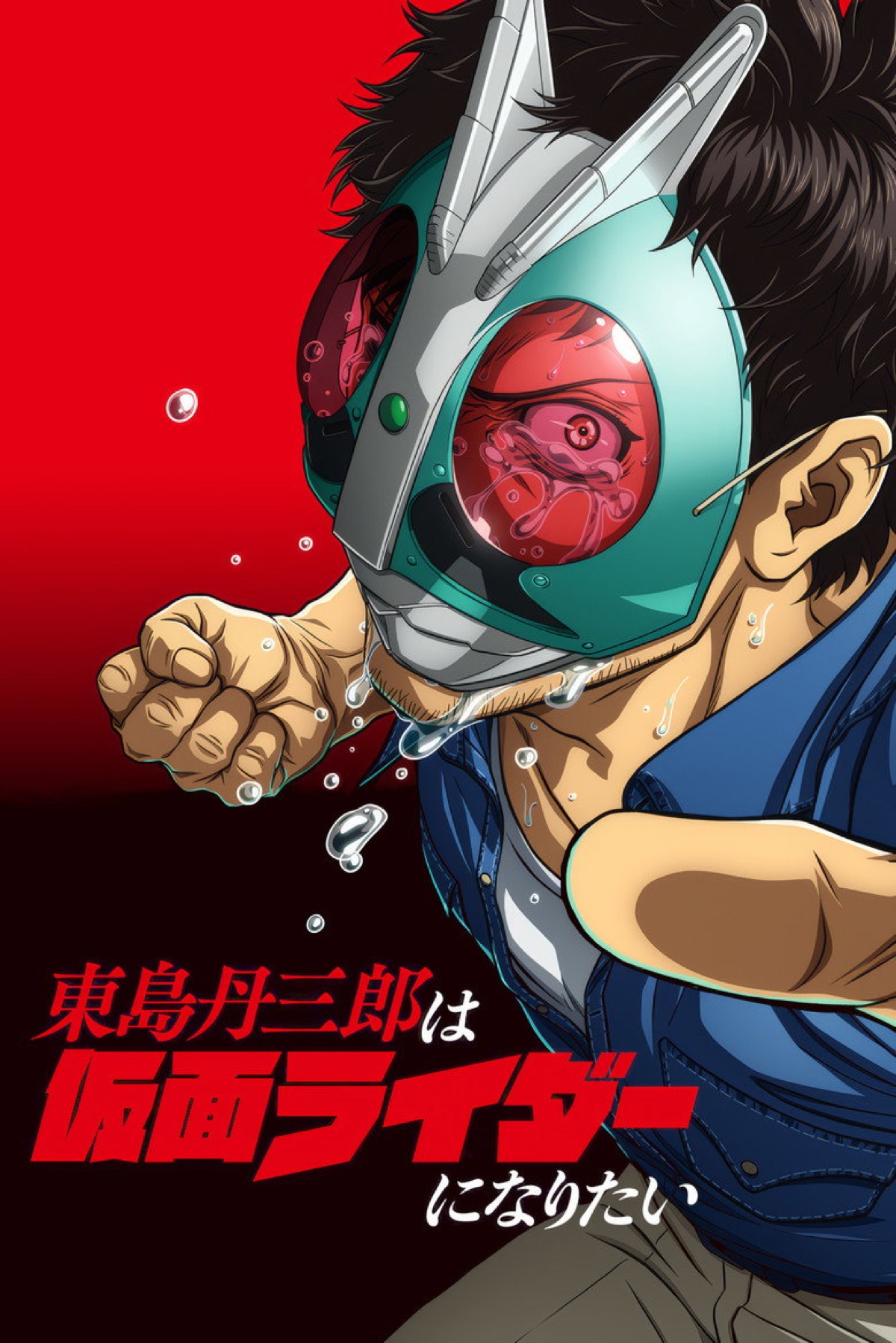
Tanzaburo Tojima is forty. What he saw on television as a small boy never left him, and rather than growing out of it he built a life around it: no career, a body trained past anything a hobby would justify, and a private curriculum of drills repeated until they stopped being an impression and became a technique. He is not alone in it either. There are others out there who fixed on a different hero from the same era, and when they find each other they spar. To everyone watching from outside, this is grown men playing pretend. Tojima is the only person in the room who has never once thought of it that way.
Then a string of robberies breaks out, committed by people dressed as Shocker, the terrorist organisation from the old show. Tojima puts on a mask and knocks them down, and for a moment that looks like the whole story: a man in costume beating up other men in costume. Somewhere behind the imitators, though, the real thing is operating, and the modified humans it builds are not people in suits. The world these men believed in as children starts pushing into the one they actually live in. What they were doing for fun becomes the place where they can die.
✨ What Makes It Special
Why It’s Exceptional
- A premise built for one sketch gets 24 episodes and nobody in the credits hedged
- Faces deform when they get hit, so every exchange carries actual weight
- Toei and Ishimori Productions signed off, so the original footage, sounds and songs appear as themselves
- Shigeru Matsuzaki takes the chorus of the opening and TeddyLoid scores the rest
The premise is a joke and not one person involved played it as one
Try writing the pitch document. “An unemployed forty-year-old wants to be a Kamen Rider.” That is the whole idea, and it is the kind that gets four episodes and a merciful ending. This one got 24, and it holds, because the stupidity of the concept and the seriousness of the execution are turned up to exactly the same volume.
The training is where you see it. At one point the man goes hand to hand with a bear. Not as a gag, not with a cutaway to somebody rolling their eyes at him. The show lets you watch and moves on, never once nudging you to file this as a middle-aged man’s hobby. What that buys is arithmetic you can follow: by the time a genuine kaijin is standing in front of him, you have seen enough of the cost to have an opinion about the outcome, and the opinion you land on is that he might actually win.
The other thing holding it up is the paperwork. Toei and Ishimori Productions are credited as cooperating, which means the show is not doing an impression of the original series, it is allowed to use it. Footage, sound effects and music from the 1971 material turn up in the frame as themselves. Fan projects can only gesture at these things from a legal distance, while this one is allowed to pick them up and use them. When the transformation sound fires, it is the sound. If you have only met Kamen Rider through the American versions, that is the difference between somebody humming a song at you and somebody putting the record on.
How far that access goes is settled in episode 1. There is Kamen Rider footage playing on a screen inside the show, and the voice of Takeshi Hongo coming out of it belongs to Hiroshi Fujioka, the actor who originated the role on television in 1971 and who came back to perform it again here. That is not a licence you buy. Somebody senior has to decide this project deserves it, and they did.
Here is the honest version of my first hour. I had this filed as a show about a man whose fandom had curdled into something clinical, and I was watching it the way you watch a documentary about a hoarder. That reading came apart episode by episode. The training piles up, the world starts confirming things he was never supposed to be right about, and eventually his turn comes to stand in front of a monster. What is on his face at that moment is not fear and it is not resolve. It is a man being handed the thing he has wanted since he was six. Very few shows have the nerve to film a dream coming true as something this frightening.
Something else the paperwork buys, which will land harder in Japan than anywhere else: the men around Tojima are not generic Rider fans. Each one has fixed on a specific figure from the 1970s. One is chasing V3, one is chasing Riderman, one is chasing Tackle, the Electro-Wave Human who fought alongside Kamen Rider Stronger in 1975. A Japanese audience needs none of that explained, because these are real characters from real shows their parents also watched. The joke and the tenderness both live in how precise the choices are. Nobody outside this country would have thought to make Tackle somebody’s whole personality.
Faces deform, and the Rider Kick stays in the drawer
The fighting has a texture I have not felt from an action anime in a while. A punch lands and the receiving face changes shape. Nobody is launched across a car park by a jab. Damage accumulates the way it does in professional wrestling, which is to say slowly and visibly, and the source manga’s heavy, unlovely line survives the adaptation intact, so every blow leaves something behind on screen. Because the training was filmed honestly, you also know roughly how many years went into the fist that just landed, which is why the brawls make sense in a way choreography on its own cannot manage.
What sells it is that nothing is instant. A knockdown takes several exchanges to arrive, the loser gets back up a little slower each time, and the show is willing to spend real screen time on a fight that is simply going badly. Modern action anime tends to compress all of that into two impact frames and a shockwave. This one lets the bad minutes run, which is the reason the good ones cost anything.
The sharpest decision in the whole show is how rarely Tojima throws the Rider Kick. He can do it. He has trained for it his entire adult life. And he keeps it holstered, deep into the run, because it belongs to somebody he reveres and spending it casually would cheapen it. One withheld move tells you more about the size of his devotion than any speech could. The transformation cuts are treated with the same care, drawing and sound and vocal delivery all pulled toward the originals until the scenes acquire the grain of live-action tokusatsu.
Deeper Themes
The opponent this show is really fighting is not Shocker. It is the look people give a grown adult who has not put a childhood thing away. Tojima is uncomfortable to watch, and that discomfort is not a verdict on him. Most of us got off the ride early, and being shown the exact stop where we did it is not a pleasant experience. If you ever wanted something badly and then stopped wanting it on a schedule that suited everyone around you, these men are hard to look at directly.
Shigeru Matsuzaki sings the chorus, TeddyLoid does everything else
Handing this show to TeddyLoid was the single smartest production decision on the sheet. English-speaking listeners have almost certainly met him twice already without filing the name: he scored Panty & Stocking with Garterbelt in 2010, and he co-produced Ado’s “Odo” with Giga. A club producer with that range is a strange fit for a story about a middle-aged man in a homemade mask, right up until you hear what he does with it.
The opening is “Wanna be”, credited to TeddyLoid featuring Shigeru Matsuzaki and TOPHAMHAT-KYO. TOPHAMHAT-KYO takes the rap, and then the chorus is handed to Shigeru Matsuzaki. For readers outside Japan that name needs a footnote: he is a singer whose voice has been on Japanese television since the 1970s, the kind of full-throated Showa delivery anyone here can identify inside two bars without knowing they know it. Put that against a modern club track and you get two eras sharing one song without either apologising for the other. The opening theme is the show’s structure in ninety seconds.
Then there is the sheer quantity. The score alone runs to 65 cues across 24 episodes, which works out to dedicated music for the fights, for the training, for the gags, and for the shabby unemployed weekday afternoons in between. Most television anime reuses a handful of beds until you stop hearing them. This one keeps finding a specific piece of music for a specific kind of scene, and the shabby daily-life cues are as carefully written as the battle ones.
The best single move is what plays when a fight turns: a modern arrangement of “Let’s Go!! Rider Kick”, the theme from the 1971 series. Once that comes in, the outcome on screen is a formality. The ending, “One More Time!” with Ryoji Tokito, is set to visuals with almost nothing to do with the plot and a great deal to do with takoyaki, and after twenty-odd weeks I stopped skipping it. The full album runs 67 tracks and streams in the US. I still have it on regularly, months after finishing the show, which is not something I can say about most things I score in the eights.
🎭 Memorable Scenes
Episode 1, the mask goes on, and he is crying while he throws punches
Tojima walks into the Shocker robbery, puts on his homemade mask, and fights. What the scene refuses to do is play it for laughs all the way through. He is weeping mid-swing, out of joy at standing where he always wanted to stand and out of relief that the day finally came. The show hands you its entire thesis inside five minutes, in a shot that opens as a gag and closes on tears. Everything after this is elaboration.
The tournament that fills the middle of the run, from episode 8 onward, is the most purely entertaining stretch in the series. People who all want to be a hero take turns knocking each other down, one on one, which strips away any question of good and evil and leaves only who is better and why. I could not call a single match. The construction is careful about the losers too: each defeat comes with a legible reason, so nobody who goes out is diminished by going out.
Then there is the finish, the last two episodes and the fight with the bat kaijin. This is where the show cashes everything in. The show’s own opening theme starts up in the middle of the battle, which is nakedly unfair as a technique and works completely, and it is stacked with a moment that leans on the 1971 series for its power. My arms were off the desk before I noticed I had moved them. Twenty-four episodes of a man insisting he was not playing land in the space of about four minutes. I have watched a lot of finales that were louder. Not many that were earned this specifically.
💭 How It Made Me Feel
These are men who never got off, and on that one measure I cannot compete with them. I expected to finish feeling small. What I got instead was something closer to fuel.
The line that stayed with me is one a Japanese viewer put better than I can, and I am paraphrasing: being laughed at is about the right amount. Not a consolation prize. A measurement. If what you are after is small enough that nobody smirks, it was never much of an ambition. That reframing has been rattling around in my head for weeks now, and it is doing more work than most of the things I have been told sincerely.
The concrete outcome, since that is the only honest way to measure this: I went and watched the 1971 original afterwards, which is free in the US and which I had never sat down with properly. Then I found myself doing the pose in my kitchen. Once. I am not going to defend it.
😅 Where It Falls Short
I have been enthusiastic for a while now, so here is the other column. It is not short.
The middle sags, and Japanese viewers said so at the time
This is the biggest problem in the show. There is a run of episodes in the middle you could lift out without anybody noticing a hole. Training and the tournament take up a lot of room, and across that stretch the amount of forward motion per episode drops to nearly nothing. I would not blame anyone who quit in there.
Japanese reaction split hard on exactly this material, and the split is clean: the same episodes get called blistering by one group and interminable by another, with very little middle ground. If tempo is what you care about most in a series, assume you are in the second group. The show is asking for patience it does not always repay in the moment, and it only settles the debt at the very end.
Shocker is never actually designed
Kaijin and foot soldiers are being manufactured at industrial volume, and the society around them carries on as though this were a weather event. Nothing changes. No institution reacts. Set that aside as a genre convention if you like, but the organisation itself has the same hollowness. Shocker’s conduct is sloppy, and after 24 episodes I still could not tell you what it is trying to accomplish. A group that announces it wants to conquer the world never gets around to showing you the plan.
The cost is structural rather than cosmetic. With no shape to the enemy, every ounce of tension has to be generated by how badly the heroes want it, and threads get left hanging when the credits roll. Some of that is the ordinary condition of an adaptation that has not caught up with a manga still in progress. Some of it is the show declining to build a villain worth the men fighting it.
The women are drawn for a very specific reader
Chests and exposure are emphasised across the board, in the unmistakable register of a Japanese seinen magazine, and the anime carries it over without softening. This is the single most common complaint I saw from viewers here, and it is usually the first thing raised rather than an afterthought, including by people who loved the show. Some viewers stop registering it after a few episodes. Others never do, and for them it sits there as noise in scenes that were asking for their attention. It also removes an obvious audience: this is not something to put on with a kid in the room, which is an odd place for a Kamen Rider story to end up.
The Downsides
- A stretch in the middle could be cut without damaging the story
- Shocker’s goals and structure are never drawn, so the threat stays abstract
- Several threads are still open when it ends, which a second season would fix
- The female character designs are aggressive enough to be a dealbreaker for some viewers
Who Should Watch This?
- Anyone who had a thing they were going to be, and quietly stopped saying so out loud
- Tokusatsu viewers who want to see a Showa-era franchise handled by people with the rights and the reverence
- Anyone who likes fight choreography where the hits hurt and the finisher gets saved (this one especially)
Who Might Not Enjoy This?
- Anyone who ranks pacing first, since the middle will test you
- Anyone who needs a villain with clear aims and a coherent organisation
- Anyone put off by heavy fan service, or hoping to watch this with children
📺 Streaming Guide by Service
Is Tojima Wants to Be a Kamen Rider on Crunchyroll or Netflix in the US?
Crunchyroll, and nowhere else. The licence covers everything outside Asia, so Netflix, Hulu and HBO Max were never in the running, and unusually for a title this recent you cannot even buy an episode outright. The one alternative route is the Crunchyroll channel sold as an add-on inside Prime Video, which is the same catalogue billed through Amazon rather than a separate deal.
The dub is worth flagging because it is complete rather than partial. Crunchyroll started it two weeks after the Japanese premiere and carried it through to the end of the run, with Patrick Seitz as Tojima. At roughly 24 minutes an episode the whole series runs a little under ten hours, so a determined weekend covers it. If you want to check the material it is built on first, the 1971 series is free on Tubi and two episodes are plenty of preparation.
Where to Stream
- Crunchyroll: Streaming, all 24 episodes, subtitles plus the full English dub
- Prime Video: the same episodes through the Crunchyroll add-on channel, with no rental or purchase option
- Netflix, Hulu, HBO Max, Apple TV: not available in the US
Soundtrack
TeddyLoid’s score was released on January 28, 2026 as a 67-track album, which is the 65 cues plus the television-size opening and ending. It streams in full in the US.
- Spotify: the complete album
- Apple Music: same album, US store
📚 Read the Manga
Yokusaru Shibata started this in Monthly Hero’s in 2018 and it is still running on Comiplex. The Japanese edition stands at 18 volumes, the last of them dated May 7, 2026. The story continues past where the anime stops. The English edition is brand new, so the translation is a long way behind the show rather than ahead of it. Titan Manga launched the English edition with volume 1 in 2026, so it is the place to start if you want Shibata’s original art, and the wrong place to look if you have finished all 24 episodes and want to know what happens next.
- Tojima Wants to Be a Kamen Rider, Vol. 1: the Titan Manga English edition
- The rest of the English run: for checking what has been published since
🎬 If You Loved Tojima Wants to Be a Kamen Rider, Watch These 3 Next
Shaolin Soccer
Same operation, different country. Stephen Chow takes an idea with no dignity in it whatsoever, playing football with Shaolin kung fu, and then commits real craft and real bodies to executing it. You laugh for the first twenty minutes and then the laughing gradually stops, because the kicks have weight and the performers can genuinely do what they are doing. Being ridiculous and being lazy are not the same condition, and this is the clearest demonstration of it on film. Put it next to Tojima and the shape is identical.
Samurai Flamenco
A 2013 series about a young man with no powers who decides to be a hero of justice anyway. It performs the same swap Tojima does: a story about one person’s private obsession turns into a story with actual monsters in it, and the ground moves under the audience partway through. Anyone who watched Tojima and thought “I have seen this structure somewhere” is usually thinking of this. It lands somewhere very different from where Tojima lands, which is the interesting part of the comparison.
Kick-Ass
The 2010 film where an ordinary teenager buys a costume and starts fighting crime with no ability of any kind, and is beaten half to death for it almost immediately. Same question as Tojima, answered from the painful end: what happens to a person armed with nothing but longing when real violence touches them. Where Tojima is about how terrifying it is when the dream finally arrives, this one is about a body that cannot keep up with the dream, which is exactly why they belong on the same shelf.
👉 One more from this site, and it is the mirror image of Tojima: Crayon Shin-chan: The Adult Empire Strikes Back, a film about the pull of staying in the past, where this one is about carrying the past forward.
📝 Final Thoughts
The middle drags. The enemy organisation is sketched rather than built, and the series signs off with threads still loose. I am putting this near the top of my year anyway, and the reason is not complicated: I watched 24 episodes of people reaching at full stretch for something they know is out of reach, and at no point could I find a scene where somebody involved in making it decided to take the afternoon off. Not in the training, not in the brawls, not in a single bar of the score.
From the outside these men are embarrassing, and the show lets characters say so to their faces. Watch them refuse to stop for long enough and the question quietly turns around, until the place where you got off starts looking like the thing that needs explaining. If you were ever going to be something, the back half of this will sting. It stings and then it hands you a little bit of fuel, which is a better trade than most shows offer. Start with episode 1 and watch until the man puts the mask on and weeps while he swings. Whether that lands is the whole test. If it does, the other 23 are yours.
⭐ Series at a Glance
| Category | Rating | Note |
|---|---|---|
| Conviction | ★★★★★ | Nobody in the credits treated the premise as beneath them |
| Action | ★★★★☆ | Hits land with weight, and the finisher is rationed |
| Music | ★★★★★ | Matsuzaki on the chorus, TeddyLoid across 67 tracks |
| Story structure | ★★★☆☆ | A slack middle and an enemy who never gets designed |
| Entry point for newcomers | ★★★☆☆ | Plays fine cold, and rewards anyone who knows the 1971 original |
| English dub | ★★★★☆ | Complete for all 24 episodes, two weeks behind Japan |
Usagi’s Recommendation Score
⭐⭐⭐⭐⭐⭐⭐⭐☆☆
8.3 / 10
Count every flaw and it is still one of my favourites this year

