*This page contains affiliate links. We may earn a commission if you make a purchase through these links.
The verdict up front, because this film does not reward suspense about its quality. It contains some of the best battlefield violence Japanese cinema has produced this decade, attached to a screenplay with holes you could ride a horse through. If you want two and a half hours of extremely committed carnage, go. If you want the plot to hold together, do not.
📺 Where to Watch 11 Rebels (October 2026)
| Service | Status | Notes |
|---|---|---|
| Tubi | Streaming | Free with ads |
| The Roku Channel | Streaming | Free with ads |
| Plex | Streaming | Free with ads |
| Amazon Prime Video | Streaming | Included with Prime |
| Hi-YAH | Streaming | Asian action service, also an Amazon channel |
| Hoopla | Streaming | Free with a participating library card |
| Apple TV | Rent / Buy | Amazon, Google Play, YouTube and Fandango too |
| Netflix | Not available | Netflix Japan has it, the US service does not |
| Crunchyroll | Not available | Not in its catalog |
You can watch 11 Rebels in the US without paying anything: Tubi, The Roku Channel and Plex all carry it with ads, and Prime Video still includes it for members. A library card gets you Hoopla as well.
Japan: Netflix on subscription, a rental everywhere else.
📜 Is 11 Rebels a True Story?
Half of it. The betrayal is history; the eleven convicts are fiction. In 1868, during the Boshin War, the Shibata domain in what is now Niigata Prefecture had joined the northern alliance against the new imperial government without much enthusiasm, faced strong opposition inside its own ranks, and switched to the imperial side. That turn is the real backbone of the film.
The squad of condemned men, the fort and the promise of a pardon come from a plot Kazuo Kasahara wrote for Toei’s Kyoto studio in 1964. The script was shelved after the head of Toei’s Kyoto studio disliked the ending, and Shiraishi’s film is the first time it has reached the screen.
It helps to know which half is which while you watch. The domain’s turn is documented, so the elders’ maneuvering is the part you can take at face value. The men they spend to buy time are the invention, and they are where the film puts its anger. Practical details: it runs 155 minutes, and Japan rated it PG12, its advisory for parental guidance under age 12.
🎬 Trailer
Toei’s theatrical trailer, in Japanese. The energy in it is not exaggerated for marketing purposes. The finished film has roughly ten times this much powder and blood in it.
Work Info
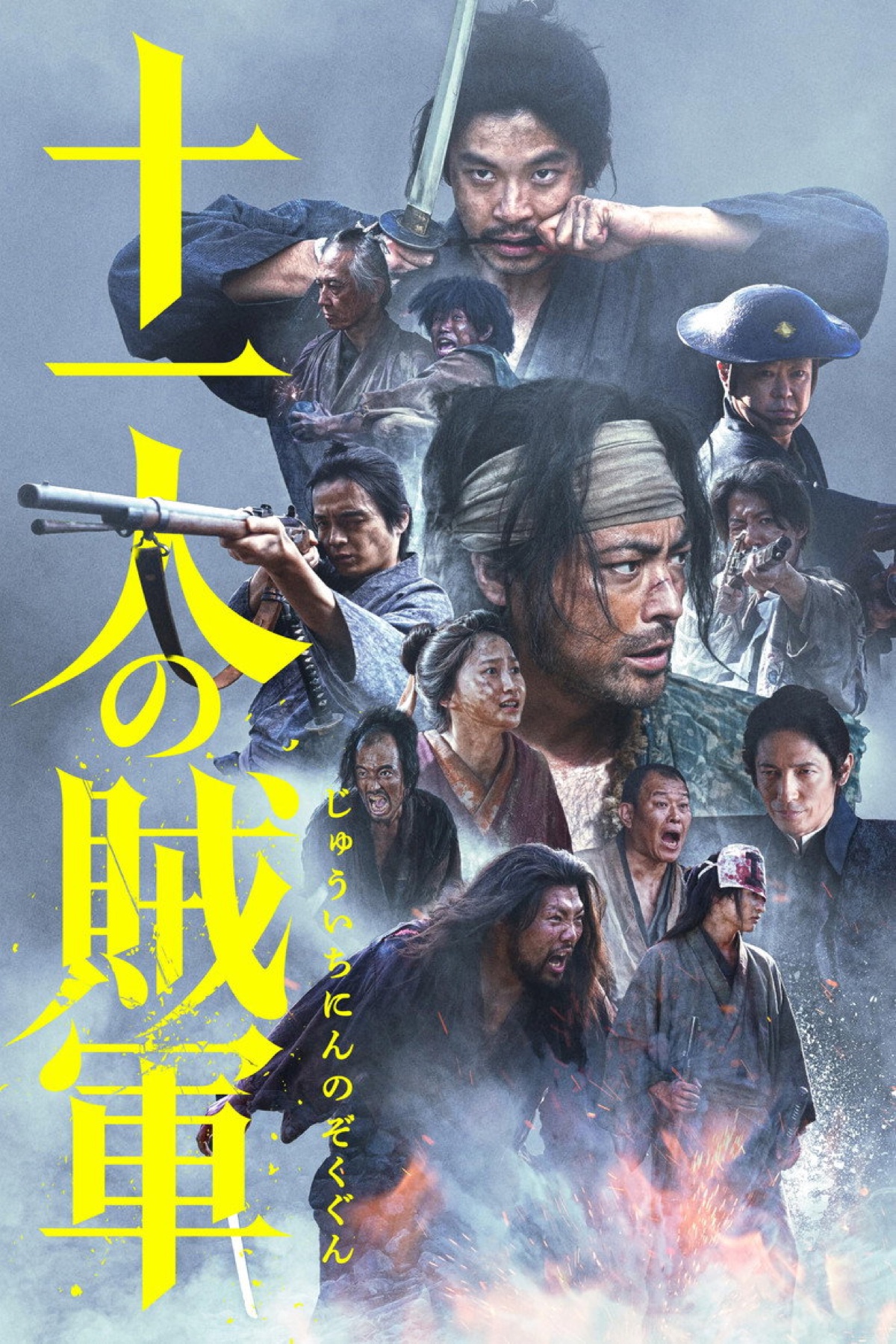
- Title: 11 Rebels, released in Japan as Juichinin no Zokugun
- Released: November 2024, 155 minutes
- Director: Kazuya Shiraishi. Screenplay: Junya Ikegami
- From an original story by Kazuo Kasahara, written decades earlier
- Starring: Takayuki Yamada, Taiga Nakano, Riho Sayashi
- Studio: Toei
📖 Synopsis, No Spoilers
1868, during the civil war that ended the shogunate. The small domain of Shibata is caught between the new imperial army and the old regime, and its survival depends on switching sides at exactly the right moment without being seen to do it. The senior retainers need time to arrange that.
Their solution is to send condemned prisoners to hold a fort. Eleven of them, including a palanquin bearer, the son of a swordsmanship school, and a woman imprisoned for arson, are told that if they hold the position they walk free. They are not told what the domain actually intends, and what the domain actually intends is the film.
✨ What Makes It Special
Why It Is Exceptional
- Violence that hurts rather than choreography that impresses
- Protagonists with no honor, no loyalty, and nothing to lose
- Riho Sayashi, in a performance nobody expected from her
- Toei’s disposable-soldier tradition, revived at full scale
Shiraishi does not do elegant swordplay
Kazuya Shiraishi made The Blood of Wolves, and he has brought the same principle to the period film: wounds are supposed to be unpleasant. There is no clean choreography here and no beautiful geometry. Blades open people up, explosions remove parts of them, and the camera does not cut away out of politeness.
The final battle is enormous, and it is mud rather than spectacle. Bodies in the wrong positions, weapons that do not work, men who are simply too tired to defend themselves. Anyone whose reference point for the samurai film is graceful duelling should be warned that this is closer to a war picture than to a chanbara.
Watching a sixty-year-old unproduced screenplay reach the screen with a modern budget is a peculiar pleasure in itself.
Nobody here is a samurai
The structural decision that makes this interesting is that the eleven are criminals rather than warriors. They have no code, no loyalty to the domain, and no interest in dying well. What they have is self-preservation and appetite.
They try to run. They consider selling each other. The film keeps you uncertain about who will break next and how, which is a tension the honorable-warrior version of this story cannot generate. Takayuki Yamada plays the palanquin bearer as a cringing survivor, and Taiga Nakano plays the swordsman’s son as somebody whose sincerity has curdled into something dangerous, and the contrast carries a lot of the film.
This is also the political point, and it is not subtle. The domain regards these people as consumable. The senior retainers are buying time with lives that cost them nothing, and the film is completely clear that this is a normal administrative decision rather than an aberration. The Japanese title says exactly that: the eleven are not rebels in any romantic sense, they are a rabble the state has assigned a use.
Riho Sayashi is the reason to watch
The single best thing in this film is a performance from somebody the Japanese audience knew for entirely different reasons. Riho Sayashi spent her adolescence in Morning Musume, which is to say in the biggest idol group the country has produced, and there is a well-worn path from that world into thin acting work.
She does not take it. Natsu is the only woman among the eleven and the film could easily have used her as decoration. Instead Sayashi is covered in mud and blood for most of the running time, holds her own physically against a cast of much larger men, and plays a specific and unglamorous thing: pure attachment to staying alive. The whole performance is in her eyes, and it is the best work anybody does in this picture.
If you have any interest in what happens when a Japanese idol is given a real part by a director who takes her seriously, that alone justifies the two and a half hours.
Deeper Themes
The Boshin War sits awkwardly in Japanese memory because the losing side was not evil and the winning side wrote the textbooks. Domains like Shibata spent 1868 trying to guess which way to jump, and the people who paid for those guesses were never the people making them.
The film’s argument is narrow and effective: it does not ask whether the restoration was good. It asks what a government does with people it has already decided are expendable, and answers that the answer has not changed much. That is the same question Toei’s gangster films asked about foot soldiers fifty years ago, transplanted backwards a century.
🎭 Memorable Scenes
Live. For the sake of the ones who did not.
The scene I would keep is the drinking on the night before the assault. Eleven condemned people, one evening of something like peace, and a set of conversations across differences of birth and crime that none of them would have had anywhere else. It is quiet, it is warm, and the film knows exactly what it is buying: the massacre afterwards costs more because of it.
The other one is the sequence where the fort’s defences finally work, which is the closest this film gets to pleasure. It is engineered like a trap springing, and the audience I saw it with made noise.
Then the mud. Not a scene, a texture. By the last act everybody on screen is the same color, and telling the sides apart becomes difficult, and I am fairly sure that is deliberate.
💭 How It Made Me Feel
Exhausted, and that is the first honest word. A hundred and fifty-five minutes with almost no relief, and a story that never offers anybody a way out, takes something out of you.
It was not a bad tiredness, though, which surprised me. What I came out with was a mixture of respect for something substantial and irritation on the film’s behalf, because the gap between what the action achieves and what the script manages is so wide. I have rarely wanted to rewrite a film I basically enjoyed this much.
Who Should Watch This?
- Anyone who wants a samurai film that plays like a war film
- Viewers who came out of The Blood of Wolves wanting more of that
- People interested in the Toei tradition of films about expendable men
- Anybody curious what a former idol does with a serious role
😅 Where It Falls Short
The script, in detail
The action and the acting are excellent, and I have to be blunt about the rest. This screenplay has logic problems severe enough to pull you out of the film while it is happening.
Start with the premise. Putting a group of violent, undisciplined criminals inside your own fort is a considerable risk, and the domain had an obvious alternative: station them near the position and stall the imperial army by negotiation until the deadline passes. The plan exists because the film needs a siege, and you can see the machinery through it. There is a point in the second hour where I caught myself wondering what anybody was actually fighting for.
Then the protagonist’s withheld information. Yamada’s character is sitting on something that would be devastating to the imperial side, and disclosing it earlier would have prevented most of the slaughter. His silence drives the body count, and the film never gives him a reason for it strong enough to keep you on his side. The imperial forces are no better served: at the climax, a single rope bridge is the only route in and nobody has posted a guard on it. Armies do not work like that.
And the arithmetic problem in the title. Eleven prisoners in one film means most of them get a trait rather than a character. When they start dying, several deaths land as a question about who that was, which is a waste of the entire premise. Six rebels would have been a better film.
The Weak Points
- The siege exists because the film wants one, not because it makes sense
- The hero’s silence causes the massacre, with no adequate reason given
- Eleven characters, most of whom never become people
- 155 minutes with no relief anywhere in it
Who Might Not Enjoy This?
- Anybody who cannot ignore plot logic while watching
- Viewers with a low tolerance for graphic injury
- People who want a period film with any grace in it
📺 Streaming Guide by Service
Prime, subtitles, and one scheduling note
Tubi, The Roku Channel or Plex if you do not mind ads, Prime Video if you have Prime and would rather not sit through them. Hi-YAH is the better home if you watch a lot of Asian action and want the rest of that catalog alongside it. With this many free routes, renting is hard to justify.
Subtitles are the only sensible route and I have not seen an English dub. Much of the dialogue is regional and rough by design, since these are not educated people, and a dub would sand that off entirely.
One piece of practical advice. Do not split this across two nights. The film has no natural break, the middle hour is where the plot problems live, and stopping there gives you the worst of it with none of the payoff. Give it a full evening or leave it.
Watch It Here
- Tubi: free with ads, no subscription
- Amazon Prime Video: included with a Prime subscription
- Hi-YAH: subscription, also sold as an Amazon add-on channel
- Apple TV: rental or purchase, as with the other storefronts
Soundtrack
The score works hard and is not what you will remember. What carries the battle sequences is sound design rather than music: powder, wet impacts, and the specific noise of people moving through deep mud in a hurry.
Play it loud, or at least on something better than a laptop. A great deal of what this film does to you is happening below the dialogue.
📀 The Script That Waited
Kazuo Kasahara is the writer behind Toei’s great gangster cycle of the seventies, films that were fundamentally about foot soldiers being spent by the people above them. He developed this story and it sat unproduced for decades.
Knowing that reframes the film’s flaws slightly. It is a seventies Toei picture built with a 2024 budget, and seventies Toei pictures were not scrupulous about plot logic either. They were about the temperature. On that measure this delivers exactly what it was written to.
🎬 If You Loved 11 Rebels, Watch These 3 Next
The Blood of Wolves
The same director doing the same thing with a script that works. Police and gangsters in 1988 Hiroshima, with characters who are actually developed and a moral argument that goes somewhere. If you liked the temperature here and wanted the writing to match it, this is the film.
👉 Read our review of The Blood of Wolves
The Kiyosu Conference
The exact opposite end of the period film. No battle at all, just powerful men deciding the country’s future by lobbying each other in corridors. This film is about the people such decisions get spent on. Watching them as a pair is instructive, though only one of them is available to you.
👉 Read our review of The Kiyosu Conference
Princess Mononoke
The other Japanese film that refuses to make pre-modern killing weightless, and the one with the writing to go with it. Miyazaki gives every faction a defensible position, which is the thing this film most conspicuously lacks. Same conviction about the cost, far better constructed.
👉 Read our review of Princess Mononoke
📝 Final Thoughts
11 Rebels is a strange object: a sixty-year-old Toei story about disposable men, executed with a modern budget by a director who is very good at physical cruelty and visibly uninterested in tidying the plot. The siege makes no sense, the hero’s silence is unjustified, and four or five of the eleven never become anybody. The battle is still one of the best pieces of large-scale violence in recent Japanese cinema, and Riho Sayashi is better in it than anybody had any right to expect.
The useful thing about this one is that you can act on it, which makes it the rare Japanese film I can recommend without a paragraph of apology about availability. Set aside a full evening, do not think too hard about the plan, and turn the sound up.
⭐ Film at a Glance
| Category | Rating | Comment |
|---|---|---|
| Action | ★★★★★ | Mud, powder, injuries that read as injuries |
| Riho Sayashi | ★★★★★ | The best performance in the film by a distance |
| Writing | ★★☆☆☆ | The premise does not survive inspection |
| Characters | ★★☆☆☆ | Eleven names, roughly five people |
| Sound design | ★★★★☆ | Doing more than the score is |
| Availability | ★★★★★ | On Prime Video, unlike most of this list |
Usagi’s Recommendation Score
⭐⭐⭐⭐☆☆☆☆☆☆
4.0 / 10
Superb carnage bolted to a script full of holes. Watch it for the mud and for Riho Sayashi.
11 Rebels is the newest entry in our roundup of the ten best Japanese samurai films, which puts it next to the 1960s films it is quietly arguing with.

