*This page contains affiliate links. We may earn a commission if you make a purchase through these links.
For twenty-two years this was the highest-grossing live-action Japanese film ever made. Seventeen and a third billion yen, a record nothing touched until a film called Kokuho passed it by about two hundred million in November 2025. I was a student in a cinema the summer it happened.
I enjoyed it that night without reservation. What I have noticed on every rewatch since is that the memory of enjoying it and the actual contents of the film have drifted into different places. This is a hundred and twenty-eight minute lunch box. Every item is good. None of them came out of the same kitchen.
📺 Where to Watch Bayside Shakedown 2 (August 2026)
| Service | Status | Notes |
|---|---|---|
| Netflix | Not available | Only the Japanese catalog has it |
| Amazon Video | Not available | No US rental, no US purchase |
| Criterion Channel | Not available | Never a candidate for art house |
| Kanopy / Hoopla | Not available | Absent from both library platforms |
| Japanese services | Widely available | Netflix, Prime Video, U-NEXT, DMM TV |
As of August 19, 2026, the highest-grossing Japanese live-action film of the last quarter century has no Western release of any kind. Say that out loud and it sounds like a mistake. It is simply what happened.
Here it streams on four services at once, and Fuji Television is broadcasting it nationally this month, one weekend at a time across all nine films, ahead of a brand new entry in September. If you want the full picture of what this franchise is domestically, our piece on the first film covers it.
🎬 Trailer
In Japanese, because nobody ever cut an English version. It promises scale, and the film does deliver scale. What it cannot promise is that the scale adds up to a story.
Work Info
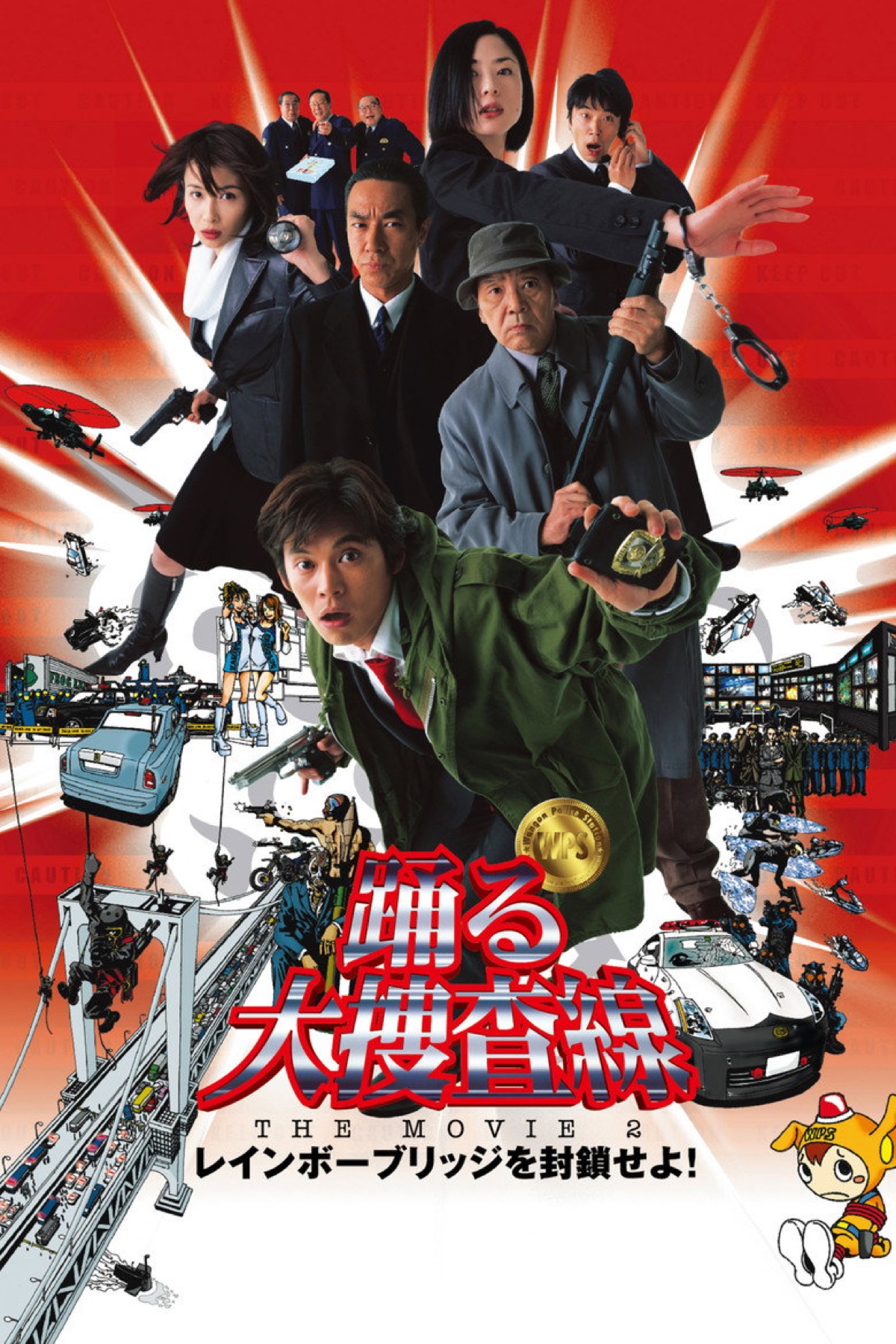
- Title: Bayside Shakedown 2, subtitled Save the Rainbow Bridge
- Released: July 2003, 128 minutes
- Director: Katsuyuki Motohiro. Screenplay: Ryoichi Kimizuka
- Starring: Yuji Oda, Toshiro Yanagiba, Eri Fukatsu, Miki Maya, Chosuke Ikariya
- Music: Akihiko Matsumoto
- Box office: 17.35 billion yen, a Japanese live-action record for 22 years
- Chosuke Ikariya’s final appearance in the series
📖 Synopsis, No Spoilers
Five years on. The waterfront district that was empty lots in the first film is now a tourist destination, and Wangan precinct spends its days giving directions, managing traffic, and finding lost children. Over a three-day holiday weekend, a family of pickpockets works the crowds and somebody starts attacking young women. Aoshima complains that none of this is a real case.
Then a company executive turns up murdered and headquarters installs a special investigation unit in the building. It is led by Hitomi Okita, the force’s first female superintendent, with Muroi as her deputy. Okita calls the local detectives errand boys, pushes a street surveillance camera system as the investigative method, and manages the room accordingly. A second body follows.
✨ What Makes It Special
Why It Is Exceptional
- Chosuke Ikariya’s last time out, and the film knows it
- The most famous line in Japanese cinema, handed to the villain, inverted
- It shows what comes after the anti-authority speech, which almost nothing does
- An opening ten minutes that is close to perfect
The old man leaving
Chosuke Ikariya plays Waku, the veteran detective at Wangan who has never stopped believing in walking the ground, and who lectures both the young men above and below him. This was his last appearance in the series. He died the following March, at seventy-two.
His central line, roughly, is that while the headquarters people are climbing marble staircases the local police are crawling in the dirt. It works because he does not hate headquarters. In a scene with a man of his own generation from the top of the organization, he is warm, easy, and completely without resentment. Two people who once walked the same corridor. He is not shouting up from below. He is somebody who understands both sides and has chosen to stay on this one.
Late on, the two old men sit together and one of them asks the other, essentially, to stop hurting the young ones. Nothing in the scene is about rank. It is one generation checking something before handing it over. The film stops entirely for a couple of minutes, the investigation disappears, and what remains is the time belonging to a man on his way out. Nobody involved knew it would read as a farewell. It does.
I have rewatched this several times and my posture changes at that scene every single time. While I am remembering it, I am not thinking about the murders at all, which turns out to be the honest summary of this entire film.
Giving the famous line to the enemy
The first film produced a shout that became one of the most quoted lines in Japanese cinema: the incident is not happening in the meeting room, it is happening out here. Twenty-seven years later people still say it in offices.
This film hands it to Okita, the antagonist, reversed. Her version, roughly: the incident is not happening out there, it is happening in the meeting room, so do not get confused. It is a shot that only a sequel can fire, because it assumes every person in the cinema is carrying the original line already.
What makes it land is that Aoshima is given no comeback. She says it, turns away, and the film moves on. The frustration has nowhere to go and gets deposited with the audience instead. Ryoichi Kimizuka came up writing sketch comedy and this instinct, for standing on the audience’s own memory, is all over the film. The opening is built the same way: an armed tactical unit storms the precinct, you brace for a siege, it turns out to be a training exercise, and the local officers playing the criminals beat the professionals.
It bothers to describe the alternative
Plenty of films attack hierarchy. Very few say anything about what should replace it. After Okita is removed, Muroi takes the investigation and tells the room, roughly, to forget rank and position and use their own judgement, provided they report everything, because he trusts the people on the ground.
Aoshima’s later line answers it: if the leader is good, the organization is not so bad. Those two statements sitting next to each other are the most useful thing this franchise has ever done, and if you have worked for somebody bad and then somebody good, they land considerably harder than the plot around them.
Deeper Themes
Running underneath the murders is a story about inheritance. Waku leaves the field, Muroi moves up, Aoshima stays where he is. Who passes what to whom, and what it costs to accept it. That material is handled with considerably more care than the criminal investigation, and for anyone who has followed the series it is plainly the real film.
The surveillance camera subplot is the other thread worth noticing, and in 2003 it was more prescient than the film realized. Okita’s method is to replace judgement with data collection. The film treats that as villainy. Two decades later it is simply how policing works, which gives her argument a weight the script never intended her to have.
🎭 Memorable Scenes
While you lot are climbing the marble stairs, we are crawling around in the dirt.
Muroi’s declaration that taking responsibility is his job is placed immediately after a hundred and twenty minutes of Okita pushing responsibility downward, and it works entirely because of that placement. One line, reversing the whole film’s weather.
The other one is harder. Sumire is shot, and the film stays with the ambulance and the surgery far longer than a series with this comic temperature has any business doing. The change of register is genuinely shocking, and it is only available because the preceding two hours were so relaxed. I would add that if the film wanted that moment to hit this hard, it could have tidied up rather more of what surrounds it.
And the tactical unit opening, which remains the single best-constructed ten minutes in the franchise.
💭 How It Made Me Feel
I can list great scenes from this film indefinitely. I still cannot summarize the plot. Who the killer was and what he wanted is something I look up on every rewatch and forget again within a week, while Waku’s lines come back in order after twenty-three years.
That is not a memory problem, it is how the film is built: enormous care spent inside scenes, very little spent on the lines connecting them. What I am left with is the satisfaction of a Bayside Shakedown night out, which never quite converts into the satisfaction of a good film. I check that those two things are still separate every time, and they always are.
Who Should Watch This?
- Anyone who has worked under a manager who blamed downward
- Viewers who have already seen the first film and the television series
- Anybody curious what a Japanese box office record actually looked like
- People who want to see Chosuke Ikariya’s last performance in the role
😅 Where It Falls Short
Everything I praised was a performance or a line
You will have noticed that none of the above is about the case. The good material in this film is acting, dialogue, and organizational argument, and the corollary is that the investigation has nothing in it at all.
Start with Okita. Miki Maya’s performance is excellent, from the way she descends a staircase to the pause before she calls the local detectives errand boys. The problem is the role, not the actor. The first film worked because both sides had a case: headquarters had its logic, the precinct had its reality, and you understood both while siding with one. Okita has no case. She arrives wrong and leaves wrong, not one of her decisions is ever vindicated, and so the conflict never becomes a conflict. Aoshima does not defeat her. She collapses while he watches.
What compounds it, and I want to be direct: she is specifically written as the force’s first female superintendent, installed as a public relations exercise, who then fails and departs. Whatever was intended, what ends up on screen is a film demonstrating that a woman could not manage it. That was borderline in 2003. It is considerably worse now, and it is the single hardest thing to defend about this movie.
Then the structure. Three cases run at once, and they never touch. Neither investigation opens the other, the criminals are unconnected, and the two smaller threads simply stop once they have served their purpose. The murderer suffers most from this: his motive is a single line about being made redundant, and he exists as an instrument for satirizing the organization rather than as a person. That is why I forget him on every rewatch.
The Weak Points
- The antagonist is a target rather than an opposing argument
- Writing the first woman in the job as a failure has aged very badly
- Three cases that run in parallel and never connect
- Aoshima argues the opposite position in the first and second halves
Who Might Not Enjoy This?
- Anyone coming to the franchise cold
- Viewers who want a mystery that resolves into something
- Readers who will not forgive how the female lead is written
📺 Streaming Guide by Service
Where this sits, if it ever reaches you
Second film in a nine-film series, and the one that made the money. Release order is correct and this comes straight after the first. Everything I have said about it being a sequel first and a film second applies double if you have not seen the television series underneath it.
The Japanese discs share a Blu-ray region with North America but carry no English subtitles, which for a dialogue comedy about civil service hierarchy is not a workable route. The route that does work is an import: Panorama put out an English-subtitled Hong Kong Blu-ray, and YesAsia still lists it. Stock and region coding both move around on these, so check the listing before you order.
If the box office record is what brought you here, the number worth knowing is that a Japanese live-action film held the top spot for twenty-two years with a comedy sequel about paperwork. That says more about the domestic market than any review can.
The Available Routes
- Japanese streaming services, if you are here or hold an account here
- Hong Kong Blu-ray (Panorama): English subtitles, stock varies
- Import disc listings: Japanese editions, no English subtitles
- Our first Bayside Shakedown piece has the viewing order and the franchise background
Soundtrack
Akihiko Matsumoto’s main theme carries over from the first film and is doing a lot of work here, because it arrives every time the film needs momentum it has not earned through plot. That is a criticism and it is also why the theme is so effective.
Both major platforms carry the series score. Three seconds of the introduction and any Japanese adult will name the show.
📀 About That Record
Seventeen and a third billion yen in 2003, and nothing in Japanese live-action cinema went past it until November 2025, when Kokuho cleared it by roughly two hundred million. Animated films beat the number repeatedly during those years. Live action did not.
Worth sitting with, because it tells you something about the market. The live-action record was held for two decades by a comedy sequel about jurisdiction, aimed at people who watched the television show, with no international footprint whatsoever.
🎬 If You Loved Bayside Shakedown 2, Watch These 3 Next
Bayside Shakedown
The better film and the smaller hit, which happens more often than the industry likes to admit. Both sides of the argument have a case in the first one, and the organizational material holds together for the full running time. Watch it first regardless.
👉 Read our review of Bayside Shakedown
Negotiator: Mashita Masayoshi
The spin-off that came next, and the opposite failure. Where this film runs three cases and ties none of them, that one runs a single case beautifully and then refuses to tell you who did it. Between them they cover most of the ways a thriller can come apart.
👉 Read our review of Negotiator
Shin Godzilla
Everything this film wanted to be about, executed by somebody who also worked out the plot. Committees, jurisdiction, and who is permitted to sign what, with a crisis that gets exactly as much attention as the paperwork. It is available to you, which settles the argument.
👉 Read our review of Shin Godzilla
📝 Final Thoughts
Bayside Shakedown 2 held a national box office record for twenty-two years on the strength of scenes rather than a story. The farewell to Chosuke Ikariya is genuinely moving, the inverted catchphrase is a piece of writing only a sequel could attempt, and Muroi’s instruction to the room is the most useful thing the franchise ever said. None of that is connected to the murders, which are thin, or to the antagonist, who is written badly in a way that has aged worse than anything else here.
It is unavailable to you and it is not the entry point anyway. What it is worth knowing is that the biggest live-action hit in modern Japanese history was a sequel to a television show about precinct politics. Understanding that explains a great deal about what the Japanese film industry has been doing for the last thirty years.
⭐ Film at a Glance
| Category | Rating | Comment |
|---|---|---|
| Individual scenes | ★★★★★ | The opening, the farewell, the inverted line |
| Plotting | ★☆☆☆☆ | Three cases, none of them joined |
| Antagonist | ★☆☆☆☆ | A target rather than an argument, badly aged |
| Performances | ★★★★☆ | Ikariya’s last. Maya doing her best with it |
| Organizational argument | ★★★★☆ | It describes the alternative, which is rare |
| As a standalone | ★☆☆☆☆ | Almost nothing works without the series |
Usagi’s Recommendation Score
⭐⭐⭐⭐✨☆☆☆☆☆
4.5 / 10
A record-breaking lunch box. Every item good, none of them from the same kitchen.

