*This page contains affiliate links. We may earn a commission if you make a purchase through these links.
Let me give you the answer first, because it is the thing everybody eventually searches for. The culprit in this film is never identified. No name, no face, no motive. He detonates his own car in front of the negotiator and the credits roll. Watching it again does not help, because the information was never there.
I still give it a passing grade, because I saw it in a cinema and had a good time, and I am not going to pretend otherwise now. What I am less sure about is how much of that grade belongs to the film. This is a picture that rewards exactly what you carry into it, and turns up empty-handed if you do not.
📺 Where to Watch Negotiator: Mashita Masayoshi (October 2026)
| Service | Status | Notes |
|---|---|---|
| Netflix | Not available | Only the Japanese catalog has it |
| Crunchyroll | Not available | Live-action, not carried |
| Amazon Video | Not available | No US rental, no US purchase |
| Hi-YAH / Cineverse | Not available | Outside the Asian action catalogs |
| Kanopy / Hoopla | Not available | On neither library platform |
Nothing outside Japan carries this film, which by now will not surprise anybody who read our piece on the first Bayside Shakedown. None of the main Bayside Shakedown films streams or rents in the US either.
Japan: Netflix, Prime Video, Hulu, U-NEXT and FOD, among others.
🚇 Is Negotiator a Bayside Shakedown Movie?
Yes, a spin-off. Negotiator is the first of two 2005 films that hand the Bayside Shakedown franchise to characters other than its lead: Mashita gets this one in May, and Muroi gets The Suspect: Muroi Shinji that August. The story is set on Christmas Eve 2004, the year after the case in Bayside Shakedown 2.
Order matters more than usual here. By release date the films run Bayside Shakedown (1998), Bayside Shakedown 2 (2003), this one, and The Suspect, before the main line picks up again with Bayside Shakedown 3 (2010) and The Final (2012). The first two films are what make Mashita worth a feature of his own. Without them he is a man in a suit taking phone calls, and the Bolero finale has much less to pay off.
🎬 Trailer
In Japanese, with no English version in existence. It is selling a thriller about a hijacked train, which is accurate as far as it goes, and it wisely says nothing about how the film resolves.
Work Info
- Title: Negotiator, released in Japan as Kosho-nin Mashita Masayoshi
- Released: May 2005, 127 minutes
- Director: Katsuyuki Motohiro. Screenplay: Seishi Sogawa
- Starring: Yusuke Santamaria, Susumu Terajima, Kotaro Koizumi, Jun Kunimura
- Music: Akihiko Matsumoto
- A spin-off of the Bayside Shakedown series, the fourth film in it
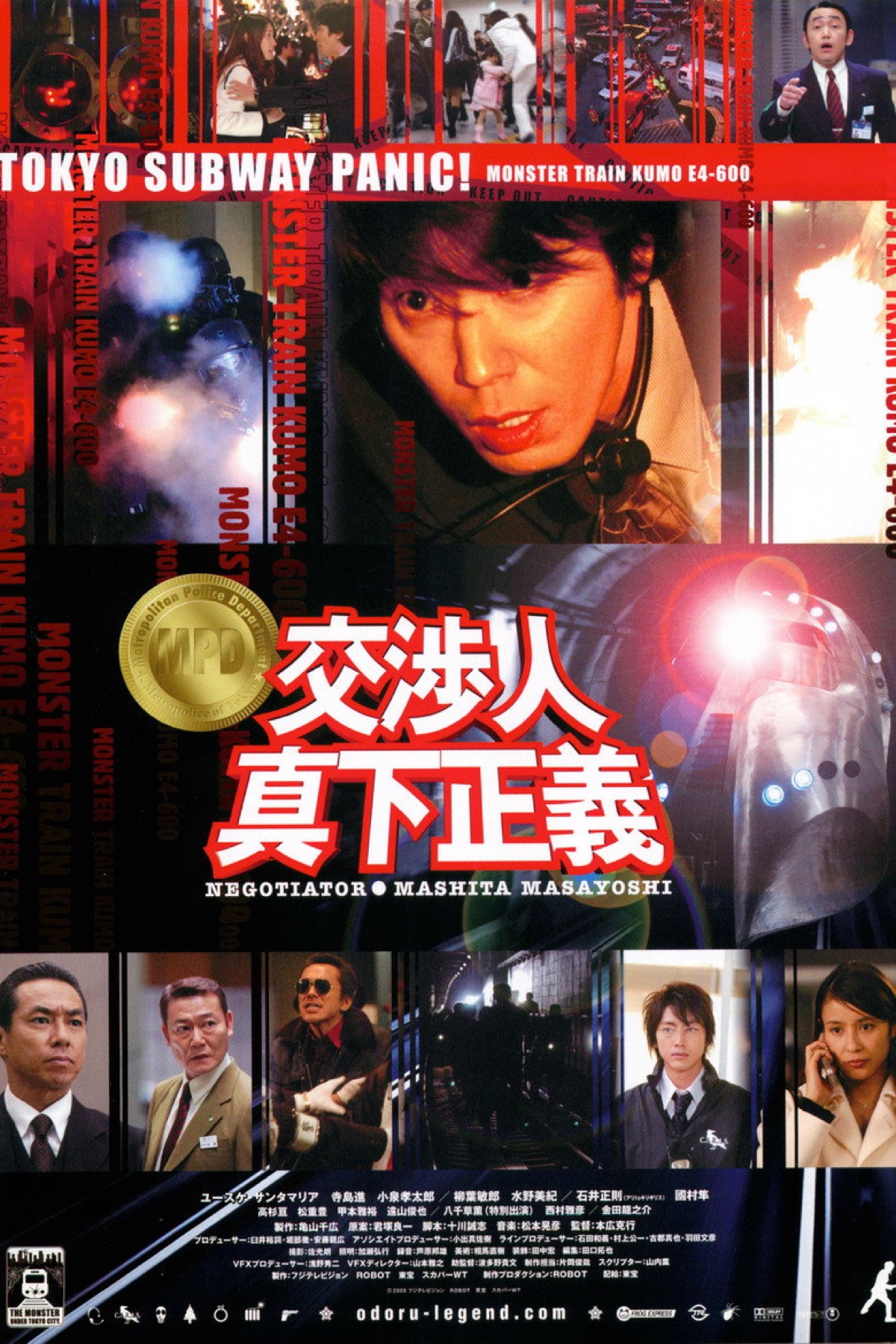
📖 Synopsis, No Spoilers
Christmas Eve, 2004. Somebody defaces the Tokyo Metropolitan Police website with a message inviting Inspector Mashita to come out and play trains. At almost the same moment an unidentified carriage begins moving through the Tokyo subway network: a prototype test vehicle, empty, under remote control by somebody who is not in it.
Mashita, the force’s first designated negotiator, is sent to the subway control center, abandoning Christmas plans with his fiancée on the way. Above ground a detective called Kijima runs the field team. Two million people will use the network that evening. The person on the other end of the line calls himself a fastball pitcher, offers clues in the form of film titles, and will speak to nobody except Mashita.
✨ What Makes It Special
Why It Is Exceptional
- Ravel’s Bolero used as the actual countdown clock
- A subway system run on pencils and rulers when the computers fail
- An empty train filmed as something closer to an animal
- The one entry in the series that does not catch anybody
Sixteen minutes of Bolero, used as a timer
Ravel’s Bolero repeats one rhythmic figure for roughly fifteen or sixteen minutes while instruments pile on top of each other until the whole thing collapses. In the last act of this film, an orchestra begins performing it, and the performance is the deadline.
What makes this work is that the film never has to show you a clock. Bolero is a piece anybody can read without training: the thicker the sound, the closer the end. The audience’s own body keeps the time, which is a far better tension device than a display counting down.
Across those sixteen minutes the film cuts between three places at once. A concert hall, a carriage moving under the city, and the field team above ground. Three separate situations, and one piece of music holding all of them together. The previous film in this series ran three cases in parallel and never managed to tie them; here a single score does the whole job.
What happens the instant the performance ends I will not spoil. I will say that the idea of what sound arrives at that moment is the best thing anybody involved in this production came up with.
The other man, and the pencils
Susumu Terajima’s Kijima is introduced here and immediately becomes the film’s second engine. He is foul-mouthed, works from instinct rather than data, shouts at his subordinates, and is out on the street the entire film. Mashita works from information and stays in a room. The pairing is the oldest one there is and it is executed well.
The best material in the film is somewhere else, though, and it is unusual. When the control system goes down, the subway does not stop. The dispatchers switch to paper, and a specialist called a line-drawer plots every train in Tokyo by hand, with a pencil and a straight edge, in real time. The tensest sequence in a film about a hijacked train is several men doing graph work at a desk. That is a real profession and the film treats it with more respect than most thrillers give their heroes.
The train itself is the other achievement. It is empty, remote-controlled, and shot almost entirely with practical photography rather than digital effects, and the film manages to make an unoccupied carriage feel like something stalking the city. In 2005 that was a choice. Today it looks like the reason the film has aged as well as it has.
The Tokyo subway is the actual subject
Some context for readers who have not used it. The Tokyo network moves several million people a day across a dozen interlocking lines run by two separate operators, with headway measured in single-digit minutes and a punctuality culture that treats a ninety-second delay as an incident requiring apology.
The film is completely alive to what that means. A single unidentified carriage does not cause a crash. It causes a scheduling problem that propagates outward through the entire system until nothing can move, and the horror on the controllers’ faces is about the timetable rather than about anybody dying. Watching this in Japan, that reads as accurate. I suspect it reads as strange restraint anywhere else, and it is the most local thing in the picture.
Deeper Themes
Underneath the thriller is a film about infrastructure and the people who keep it running, which is a subject Japanese cinema returns to more often than most. Nobody in the control center is a hero. They are technicians doing a difficult job carefully, and the film’s admiration for that is genuine rather than sentimental.
The other thread is what a negotiator actually is. Mashita has no weapon, no authority to act, and no way to compel anything. His entire professional capability is keeping somebody talking. Whether that turns out to be enough is the question the ending declines to answer, and the refusal is more deliberate than it first appears.
🎭 Memorable Scenes
Merry Christmas, you idiot.
Kijima’s line, delivered in a register that does not survive translation intact, and the moment the film’s two halves accept each other. What I like is how little the script does to get there. Mashita offers a deduction, Kijima snorts at it and then acts on it anyway, Kijima brings back a hunch and Mashita uses it. Nobody explains the relationship. It just accumulates.
The Bolero sequence is the obvious highlight and deserves the reputation. What people mention less is the control room during it, where a man with a pencil is doing the most consequential work in the film and the camera treats his ruled lines with the gravity another movie would give a firefight.
And then the ending, which is the reason this article exists. A car explodes and the film stops. Nothing is explained, no identity is revealed, and the negotiator is left holding a conversation that was never going to conclude.
💭 How It Made Me Feel
Entertained at the time and increasingly unsure since. That is an honest account of a film I have gone back to more than once specifically to check whether I had missed the explanation, and stopped at the same place every time.
What stayed longest was not the thriller at all. It was the pencils. Years later I still think about that sequence whenever a train here is delayed and an apology comes over the speakers, and about how many people are somewhere out of sight redrawing a timetable by hand.
Who Should Watch This?
- Anybody interested in films about infrastructure and the people running it
- Viewers who enjoy a single piece of music carrying an entire act
- People who already know the Bayside Shakedown cast
- Anyone curious how the Tokyo subway is actually dispatched
😅 Where It Falls Short
The hole where the villain should be
Everything above is worth defending and none of it addresses the central problem, so here it is plainly. A thriller in which the antagonist has no identity, no motive, and no scene where his logic becomes visible has removed the load-bearing wall. You spend two hours with a person who is only a voice, and then he is gone, and the film has nothing to say about who he was.
You can defend it. The film is arguably about a negotiator’s actual professional experience, which frequently includes never finding out. That reading is available and I have used it myself. What I cannot get past is that a film choosing this deliberately would signal the choice, and this one plays the last twenty minutes exactly as though a revelation is coming.
Second, and this compounds it: without the series behind it, Mashita is a thin protagonist. In the parent films he is the comic relief, promoted here on the strength of an earlier case, and the joke is that he is out of his depth. If you have not met him before, that entire layer is missing and what remains is a mild man in a control room.
The Weak Points
- The antagonist is never identified or explained
- The finale is staged as if a revelation were coming
- The lead only works if you know him from other films
Who Might Not Enjoy This?
- Anybody who needs a thriller to name its villain
- Newcomers with no exposure to the parent series
- Viewers who find procedural detail tedious rather than gripping
📺 Streaming Guide by Service
Order, and the honest position
Release order works and the series is designed for it.
There is no subtitled disc either. I have written this piece for the record rather than as a shopping guide, and the reachable alternative is below.
One thing you can do today at no cost: put on Ravel’s Bolero and time it. Sixteen minutes, building the entire way. Whether or not the film ever reaches you, using that piece as a countdown remains a good idea somebody had.
The Available Routes
- Japanese streaming services, if you are here or hold an account here
- Import disc listings: Japanese release, no English subtitles
- Start with our Bayside Shakedown piece for the series context
Soundtrack
Akihiko Matsumoto returns from the parent films, and his brass-driven main theme is one of the most instantly identifiable pieces of screen music in Japan. It is on the streaming services along with the rest of the series score.
The piece that matters here is not his, though. It is Ravel, and specifically the fact that a Japanese police thriller from 2005 had the confidence to hand its climax to a French orchestral work from 1928 and then get out of the way.
📀 Where It Sits in the Series
This was the first Bayside Shakedown spin-off and it opened the door for the rest. A companion film about the career-track inspector followed the same year, and later entries built out the supporting cast further until the franchise reached nine films.
Kijima, introduced here, went on to become a fixture. That is worth knowing because he is the best thing in this film and a large part of the reason it exists at all.
🎬 If You Loved Negotiator, Watch These 3 Next
Bayside Shakedown
The film this one is a spin-off of, and the place to start if the franchise ever becomes reachable. Same director, same composer, and the organizational material that gives the whole series its spine. Equally unavailable outside Japan, which is the running theme.
👉 Read our review of Bayside Shakedown
Shin Godzilla
Japanese infrastructure under pressure, done at the highest level and actually available to you. Anno takes the same interest in technicians, procedure, and who is permitted to act, and gives it a monster to push against. If the control room was your favorite part of this film, Shin Godzilla gives you two hours of it.
👉 Read our review of Shin Godzilla
Cure
If what interested you was a Japanese thriller that refuses to hand over its antagonist’s reasoning, this is the version that does it on purpose and knows exactly why. Kiyoshi Kurosawa withholds the explanation and structures the entire film around the withholding, which is the difference between a choice and a gap.
📝 Final Thoughts
This film has one outstanding idea, one unusual set of scenes about how a subway is dispatched by hand, and a hole where its antagonist should be. Those things do not cancel out. They sit next to each other for a hundred and twenty-seven minutes, and how you feel afterwards depends almost entirely on how much of the series you brought with you.
The useful thing I can leave you with is the trick rather than the film. Give a thriller a piece of music with a known length and let the audience keep time themselves. It works, it is cheap, and almost nobody does it.
⭐ Film at a Glance
| Category | Rating | Comment |
|---|---|---|
| Climax | ★★★★★ | Bolero as a countdown is the best idea here |
| Procedural detail | ★★★★★ | Pencils, rulers, an entire city’s timetable |
| Supporting cast | ★★★★☆ | Terajima’s Kijima earns his later career |
| Antagonist | ★☆☆☆☆ | Never named, never explained, simply gone |
| Lead | ★★★☆☆ | Works only with the series behind him |
| Practical effects | ★★★★☆ | A real train, shot like a predator |
Usagi’s Recommendation Score
⭐⭐⭐⭐⭐☆☆☆☆☆
5.0 / 10
A brilliant climax attached to a thriller with no villain in it. Bring the series with you.

