*This page contains affiliate links. We may earn a commission if you make a purchase through these links.
One Japanese reviewer summed this show up by saying it took Weekly Shonen Jump 40 years to catch up with Mitsuru Adachi. That is a compliment and also an accusation, and once you understand what it means, you understand why a fairly ordinary high school romance became one of the more discussed anime of its year.
I went in expecting to be bored and came out arguing with people online about a girl who does not get the boy. That is the whole experience of Blue Box in one sentence, and I am aware of how that sounds.
📺 Where to Watch Blue Box (October 2026)
| Service | Status | Notes |
|---|---|---|
| Netflix | Streaming | Season 1, all 25 episodes. Season 2 from October 4 |
| Crunchyroll | Not available | Not offered in the US |
| Hulu | Not available | No US listing |
| Amazon Video | Not available | No digital purchase in the US |
📅 When Does Blue Box Season 2 Start, and Where Is It Streaming?
October 4, 2026, and Netflix, which already has all of Season 1, announced the same date for the new episodes. In Japan the season airs weekly on TBS.
The detail Japanese coverage led with was the time slot. Season 1 aired late on Thursday nights, starting just before midnight. Season 2 has moved to 4:30 on Sunday afternoons, on the same 28-station TBS network. Moving a romance this quiet out of late night is a vote of confidence that it can hold a general audience, and I did not expect it.
The studio changes too. Electric Circus animates Season 2 under director Daisuke Sako, where Season 1 was Telecom Animation Film under Yuichiro Yano, so if the look feels slightly different, that is why.
And this time the story has a finish line. The manga ended in Weekly Shonen Jump in July 2026, with the 28th and final Japanese volume due on December 4, so Season 2 is adapting a story whose ending is already written.
🎬 Trailer
TMS cut this one with English titling. It sells the sports material fairly hard, which is a little misleading. By the back half this show is roughly ninety percent romance and it is not apologetic about that.
Work Info
- Title: Blue Box, known in Japan as Ao no Hako
- Broadcast: October 2024 to March 2025, 25 episodes
- Director: Yuichiro Yano. Animation: Telecom Animation Film for TMS
- Source manga: Kouji Miura, Weekly Shonen Jump, 2021 to 2026, 28 volumes
- Openings: Same Blue by Official Hige Dandism, Saraba by Macaroni Empitsu
- Endings: Teenage Blue by Eve, Contrast by Tomoo
- Season two dated October 4, 2026, from Electric Circus
📖 Synopsis, No Spoilers
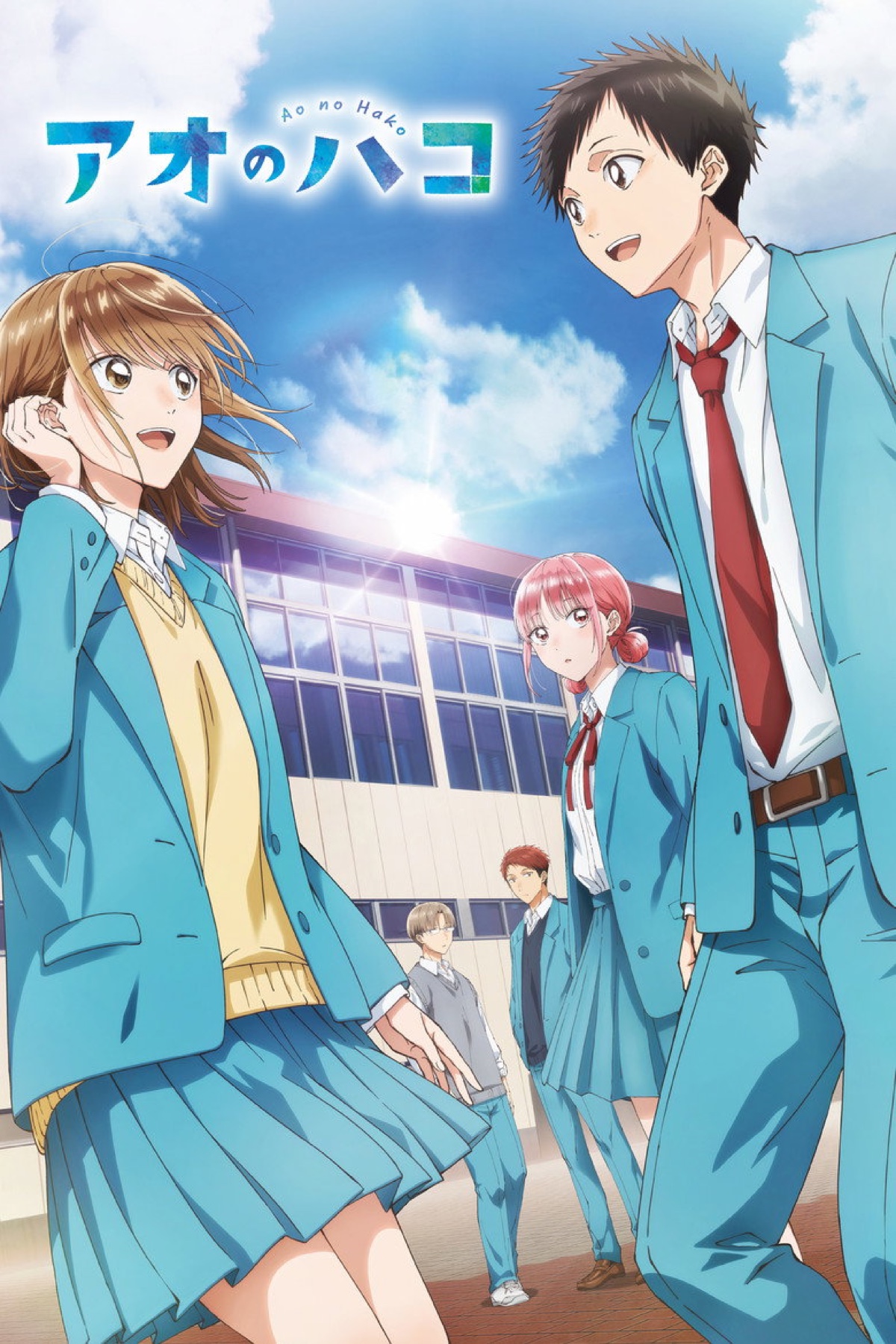
Taiki Inomata is a first year on the badminton team at a school that takes its sport seriously. He trains early every morning, which is how he keeps ending up in the same gym as Chinatsu Kano, a second year and the best player on the girls’ basketball team, on whom he has a quiet and completely hopeless crush.
Chinatsu’s parents are posted overseas. She wants to stay and keep playing, the two families know each other, and the arrangement that results is that she moves into Taiki’s house. Meanwhile Hina Chono, Taiki’s classmate and the star of the rhythmic gymnastics team, has been in love with him for a while and has said nothing about it. The three of them then spend 25 episodes training extremely hard and handling this badly.
✨ What Makes It Special
Why It Is Exceptional
- A sincere romance succeeding in a magazine that never allowed one
- Hina, and what Japanese fandom means by a losing heroine
- It actually answers the question instead of stalling for another season
- A protagonist who knows what he wants and says so out loud
Why this being in Jump is the story
Weekly Shonen Jump is the biggest manga magazine in Japan and has been for 50 years, and its romance record is poor. The formula that survived there was romantic comedy with the emphasis on comedy: accidental nudity, a protagonist with several girls orbiting him, and a resolution permanently deferred. To LOVE-Ru is the archetype. The received wisdom inside the industry was that a straight love story could not hold a slot in a boys’ magazine.
Blue Box has none of that. No fanservice accidents, no harem, no comedy safety net underneath the feeling. It is simply a boy who likes a girl, a girl who likes him, and a training schedule. Doing that in Jump, successfully, is the thing the Japanese audience actually reacted to.
Which brings us to the 40 years remark, and to a name Western readers may not know. Mitsuru Adachi has spent his career, in a rival magazine, writing sport and romance as one substance: Touch, H2, Cross Game. Long silences, understatement, feelings communicated by where somebody is standing. That approach has been the gold standard in Japan since the eighties, and it never made it into Jump. Blue Box is the first time somebody carried it over the wall, and the reviewer’s line means precisely that.
The other thing worth flagging: Taiki is not the dense protagonist the genre normally installs. He knows he likes Chinatsu, he does not pretend otherwise, and when Hina raises the subject he answers her properly rather than tripping over a bucket. That sounds like a low bar. In this genre it is not.
Hina, and the losing heroine
Japanese fandom has a term for this: make-heroine, the losing heroine, the one the protagonist does not choose. It is not an insult. It describes a role with its own dedicated audience, its own conventions, and in recent years its own subgenre, and Hina Chono became one of the most discussed examples of it in years.
What she does is straightforward and devastating. She has known Taiki for years, she teases him like a friend, she knows exactly who he is in love with, and she does not withdraw. There is no scheming and no sabotage. She simply keeps showing up, being excellent at her own sport, and hoping.
The production team are visibly on her side, which is unusual and slightly funny. The second cour’s ending sequence is effectively a music video about Hina, and Tomoo’s song under it does more emotional work than several episodes of plot. Every week the show would hurt you and then hand you three minutes of aftercare aimed at exactly the wound it had opened. Whether a series should be doing that for a character the story has already decided against is a fair question, and it is also why people would not stop talking about her.
It gives an answer
The trap romantic comedies fall into is obvious once named. A popular secondary character keeps the audience invested, so the story never resolves anything, and the pleasant dream continues until the readers age out. Everybody involved knows it is happening.
This show does not do that. In episode 24 the question gets a clear, kind, unambiguous answer. It is short and hard to watch, and the series does not soften it afterward. A large part of the audience described the same double reaction I had, which was to be upset and simultaneously relieved that somebody had finally treated the question as a question with an answer.
Deeper Themes
Underneath the romance there is a quieter argument about what serious training does to a teenager’s inner life. All three of these people are competitive athletes at a school that expects results, and the show is consistently good on how that arrangement leaves almost no room for anything else, including the feelings the plot is made of.
That is also the honest reason the living arrangement works dramatically despite being contrived. Two people in the same house who both leave before dawn and come home exhausted are not living a fantasy. They are sharing a schedule, and the intimacy the show is interested in comes from that rather than from proximity.
🎭 Memorable Scenes
Episode 24, and the reason this series has a reputation. Without saying what happens in it: the direction is the part worth noticing. The camera stays behind one character, the frame tilts slightly, and you watch from the back as the grip goes out of a pair of hands. Shooting that moment from behind is a harder choice than a close-up, and much worse to sit through.
The one I liked best is smaller. A summer festival, Hina in a yukata, and an internal monologue that is entirely about wanting one specific person to think she looks good. Hair, sash, lipstick, all of it inventoried. It is a completely ordinary teenage thought and the show gives it the weight of a sports final.
And the second ending sequence, which several viewers described as the thing that let them close the tab without feeling wrecked. Three minutes a week, aimed squarely at repairing the damage the episode had just done.
💭 How It Made Me Feel
Envious, mostly, in a way I did not enjoy. Not of the romance. Of the schedule: a body that recovers overnight, a thing to be good at, and a completely uncomplicated reason to get up at five. Watching this in your late thirties is a slightly hazardous activity.
The other thing it did was make me argue. I knew from the first episode who the story was going to choose, I agreed with the choice on the merits, and I still spent a week resenting it. Making an audience root against the ending it knows is right is a difficult trick, and this show pulls it off for 24 episodes.
Who Should Watch This?
- Anyone worn out by romances that refuse to resolve
- Readers curious about the losing heroine as a Japanese fandom category
- People who like sport and feeling written as the same material
- Anybody catching up as season two begins
😅 Where It Falls Short
Three real problems
The living arrangement is contrived and the first few episodes have to work hard to get past it. The families know each other, the parents are abroad, fine. It is still the oldest device in the genre and whether you can swallow it in episode 2 determines a lot about the following 23.
The bigger problem is a structural imbalance the show never fixes. Chinatsu, who is the person the story is actually about, is less compelling than Hina, who is not. She is written as quietly diligent and thoroughly decent, which is true to life and thin on screen, and the second cour reduces her presence further while pouring attention into Hina. The result is a series where the character the protagonist loves and the character the audience is rooting for have come apart, and that gap never closes.
Third, the sport. This is sold as sport plus romance and the back half runs at something like nine to one. The badminton is competently animated and never becomes the point. Anyone arriving from a proper sports series will find it thin, and the trade the show made is defensible without being invisible.
The Weak Points
- The live-in premise is pure convenience, however it is explained
- The intended heroine is outshone by the other one
- The sport thins out badly in the second half
Who Might Not Enjoy This?
- Sports anime viewers who want the matches to matter
- Anybody who finds contrived living arrangements unforgivable
- Readers who get too attached to characters written to lose
📺 Streaming Guide by Service
Sub, dub, and catching up
Netflix, 25 episodes, no other decision to make. There is an English dub on the service and it is fine. I would take subtitles here for one specific reason, which is that a great deal of Hina’s characterization lives in vocal register more than in what she says, and Akari Kito’s performance is doing work that no rewrite survives intact.
Official Hige Dandism and Macaroni Empitsu are both extremely large bands in Japan and almost unknown outside it, and their two songs plus the Eve and Tomoo endings amount to one of the better four-song sets attached to a recent series. Do not skip them on the first pass.
Watch It Here
- Netflix: all 25 episodes, subtitled plus dubbed
- The VIZ manga: already well past where season one stops
- More in this register in our best romance anime list
Soundtrack
Takashi Ohmama’s score does its job quietly and is not the reason anybody talks about the music here. The four theme songs are, and all of them are on every streaming service.
Tomoo’s Contrast is the one to start with. She is a singer-songwriter with a small international profile and a very large domestic one, and that track is doing more for a particular character than the script ever quite manages to.
📚 The Source Manga
Kouji Miura serialized this in Weekly Shonen Jump from 2021. VIZ Media is still publishing the English edition and has not caught up to the ending, but unlike most titles I write about, you can read far ahead legally in print.
Season one covers a fraction of that. If 25 episodes leave you unwilling to wait for Season 2 to play out week by week, the VIZ volumes are the way through, and the ending exists instead of being pending.
🎬 If You Loved Blue Box, Watch These 3 Next
Hi Score Girl
The other recent romance that takes a triangle seriously and refuses to keep everyone comfortable. Set in 1990s arcades, with a boy who is only articulate through a game and two girls who deserve better than his attention span. If Hina broke you, be warned that this one has the same shape.
👉 Read our review of Hi Score Girl
Medalist
What Blue Box would look like if the sport were the point. Competitive figure skating, the same interest in what training does to a young person, and considerably more attention paid to the discipline itself. Watch it if the badminton left you wanting.
Bocchi the Rock!
The same school club machinery pointed at a completely different problem. Where Blue Box is about people who are already good and have to survive each other, this is about somebody who is good at one thing and cannot survive a conversation. Funnier by a distance, and it hits harder than it looks.
👉 Read our review of Bocchi the Rock!
📝 Final Thoughts
Blue Box is not the best-written romance anime of recent years and it is one of the most significant, which are different claims. The living arrangement is contrived, the intended heroine is underserved, and the sport quietly evaporates. What it did was prove that a boys’ magazine could run a sincere love story without a comedy airbag underneath it, and then have the nerve to give the question a real answer in episode 24.
Season 1 is 25 episodes, and the second season has just started. If you want to understand why Japanese anime discourse spent an entire season arguing about Hina, that is two weeks of evenings, and the argument is a good one once you are inside it.
⭐ Series at a Glance
| Category | Rating | Comment |
|---|---|---|
| Writing | ★★★☆☆ | Sincere, with a contrived premise to swallow |
| Characters | ★★★★☆ | Hina is the best thing here by some way |
| Animation | ★★★☆☆ | Clean, unshowy, occasionally lovely |
| Music | ★★★★★ | Four theme songs, all of them strong |
| Emotional impact | ★★★★☆ | Episode 24 earns its reputation |
| Sport | ★★☆☆☆ | Present in the first half, then gone |
Usagi’s Recommendation Score
⭐⭐⭐⭐⭐⭐✨☆☆☆
6.2 / 10
The romance Jump was not supposed to be able to run.

