*This page contains affiliate links. We may earn a commission if you make a purchase through these links.
This page contains affiliate links. We may earn a commission if you make a purchase through these links.
For years, the version of this film most of America had seen ran ninety-five minutes. It was called Warriors of the Wind, the heroine was renamed Princess Zandra, and the tagline promised “Flee, fly, foe, fun! Here’s an adventure for everyone.” New World Pictures had removed roughly twenty minutes in 1985: the opening credits, much of Nausicaä walking through the Toxic Jungle, and the childhood flashback that explains why she is the way she is. Miyazaki’s response was to forbid anyone from altering a single frame of a Ghibli film for a foreign market again.
What sits on HBO Max tonight is not that cut. It is the whole 116 minutes, in Japanese or dubbed, at no extra charge on a standard plan. Here is the part I still find absurd: I live in Japan, and I cannot stream it at all. Not on Netflix, not on Amazon, not on any domestic platform, not even for rent. The country that made this film has no legal way to stream it. The country that once cut it to ribbons now carries the definitive version on an ordinary monthly subscription. I first saw it in early elementary school and stopped counting the rewatches a long time ago, and every single one of them was on television or on a disc.
📺 Where to Watch Nausicaä of the Valley of the Wind in August 2026
| Service | Status | Notes |
|---|---|---|
| HBO Max | Streaming | English dub. Japanese audio is a separate listing |
| YouTube TV | Streaming | Included with subscription |
| Amazon Video, Apple TV | Paid rental | Also on Google Play, Fandango at Home, YouTube |
| Hulu | Add-on only | Not on the base plan. Reachable through the HBO Max add-on |
| Netflix US | Not available | Netflix streams Ghibli almost everywhere except the United States |
| Crunchyroll | Not available | Ghibli has never been part of the Crunchyroll catalog |
As of August 7, 2026, HBO Max holds the US streaming rights to the Studio Ghibli catalog, and Nausicaä is included with a standard subscription. One detail worth knowing before you press play: HBO Max lists the English dub and the Japanese audio as two separate titles. If you want Sumi Shimamoto’s original performance rather than Alison Lohman’s, you need the second listing, not the first. A rental runs about four dollars if you would rather not subscribe. Availability moves around, so confirm on the service itself.
Now the inversion. In Japan, this film streams on zero services. Nippon TV holds the domestic broadcast rights and has kept the Ghibli library off subscription platforms for more than twenty years, which is why the release calendar here still runs on television. Nausicaä airs on Nippon TV on August 14, 2026, and for a lot of households that broadcast is the only time all year the film is available in this country at all. You get a catalog item. We get an appointment.
If you want another Ghibli film stuck in the same position, Castle in the Sky and My Neighbor Totoro are both a click away for you and a scheduling problem for me.
🎬 Trailer
Work Info
- Title: Nausicaä of the Valley of the Wind, known in Japan as Kaze no Tani no Nausicaä
- Released: March 11, 1984. Runtime 116 minutes
- Written and directed by Hayao Miyazaki, from his own manga
- Music: Joe Hisaishi
- Japanese cast: Sumi Shimamoto as Nausicaä, Yoshiko Sakakibara as Kushana, Gorō Naya as Lord Yupa
- 2005 English dub: Alison Lohman, Patrick Stewart, Uma Thurman, Shia LaBeouf, Edward James Olmos
- Source manga: 7 volumes, 59 chapters, serialized in Animage from February 1982 to March 1994
- Made a year before Studio Ghibli existed. Its success is what funded the studio
📖 Synopsis – No Spoilers
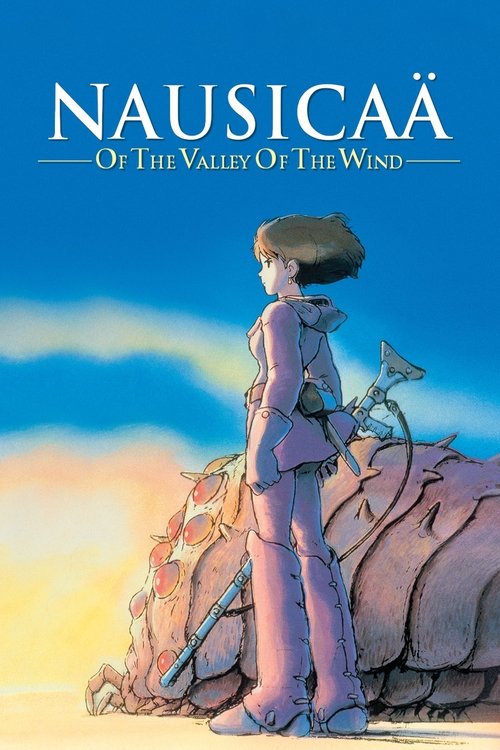
A thousand years after an industrial civilization burned itself down in seven days, what is left of humanity lives in pockets between a spreading forest of fungal growth that exhales poison. The forest is patrolled by insects the size of buildings. Chief among them is the Ohmu, a segmented thing with a wall of eyes that turn from blue to red when it is enraged, and a stampede of them can erase a settlement in a night. The Valley of the Wind survives because a sea breeze keeps the spores off its fields.
Nausicaä is the daughter of the valley’s dying chieftain. She flies a jet-powered glider, she reads the wind, and she can calm an enraged Ohmu, which the adults around her treat as somewhere between a gift and a liability. Then a military transport from the empire of Tolmekia crashes in the valley, carrying cargo the Tolmekians want back and are willing to occupy the valley to get. What that cargo is, and what the forest actually is, are the two questions the film spends its running time answering. Neither answer is the one you expect at the thirty-minute mark.
✨ What Makes It Special
Why It’s Exceptional
- The first five minutes install every rule the next 111 will operate under, without a line of exposition
- An ecological film that never once lets nature be the good guy
- A protagonist defined entirely through what she does, never through what anyone says about her
- Hideaki Anno animated the God Warrior sequence, seven years before Evangelion. You can see him in it
Everything you need is in the first five minutes
The film opens on a man in a mask riding through a dead village, and the shot holds long enough for you to register that the dust on the buildings is not dust. Then Nausicaä walks into the forest alone.
Watch what that sequence does. It shows you an insect corpse and how the survivors harvest it. It shows you spores falling like snow, and it shows you that they kill. It shows a gun being used to keep the forest back. And it shows Nausicaä choosing, repeatedly, to absorb a cost rather than pass it on. No narrator explains the war, the ecology, or the politics. The information arrives as scenery while she does her job.
There is a small moment in there that I think about more than any of the spectacle. A fox-squirrel called Teto bites her finger hard enough to draw blood, and she does not pull her hand away. She holds still and keeps talking to it in a level voice until it stops. That is the whole character, delivered in eight seconds, with the film’s central thesis embedded in it: the way you end violence is by absorbing it, and absorbing it hurts. Nothing in the following hour and a half contradicts that shot.
Compare that with how most ecological films work. They establish a villain, assign him a factory, and let the hero be right at him for ninety minutes. This one spends its opening establishing that the poison is not anybody’s fault in any way that would help.
Here is where I should be honest, though. That density is also what makes the film hard to hand to a casual viewer. There is no on-ramp. If you look at your phone during the first five minutes, you will spend the next thirty quietly confused about what the forest is and why everyone is scared of bugs.
The forest is the argument, not the backdrop
Most of what you have been told about this film is that it is about the environment. That is true and it undersells it badly, because the interesting move is what the film refuses to do with the forest.
It is never framed as wronged. It is never framed as innocent. The Toxic Jungle kills people who go in unprotected, the Ohmu flatten towns, and neither is presented as revenge for anything humans did. The forest is simply indifferent, running a process that has nothing to do with us and no interest in whether we survive it. That indifference is far more unsettling than any lecture about pollution.
Then the film tells you what the forest is actually doing, roughly halfway through, and every battle you have watched up to that point reorganizes itself into a different shape. I am not going to spell it out. I will say that the revelation is not a twist in the plot sense. It is a correction to the question you thought you were asking, and it is the reason this film has kept getting reissued for forty-two years while most eco-parables from the eighties have aged into embarrassment.
Nausicaä is never explained to you
She gets no backstory monologue and no scene where a supporting character stands there summarizing her virtues. What you get instead is a series of decisions.
She spreads her arms in front of a gun barrel. She goes into the poison without a mask when speed matters more than her lungs. She loses her temper exactly once, and the film treats it as the most frightening thing in the movie. Japanese audiences tend to file her under saint, and I think that reading flattens her. The rage is in there. What she does is carry it and keep walking, which is a different and much harder thing than not having it.
Deeper Themes
The film asks whether people and the natural world can share a planet. The manga, which runs five volumes past where the film stops, throws that question away and replaces it with a worse one: what do you do with the power to design living things? Every faction in the later volumes has access to biotechnology, everyone believes they are saving the world with it, and the book declines to tell you which of them is right. The film is the gentle version of this story. Very few people who have only seen the film know that.
🎭 Memorable Scenes
The first line of dialogue in the film belongs to a traveler who rides into a settlement and finds nobody in it:
Another village is dead.
Five words, no music underneath, and the state of the entire world is established. Nobody in this movie is surprised that a village died. That is the horror in it.
Then there is Gol, one of the valley’s old men, holding up hands stiffened and discolored by decades of breathing spores. He is not asking for pity. He says the princess tells him she likes these hands, and he shows them the way you would show a medal. An entire relationship between a leader and her people, done in one gesture and one sentence.
And the moment that stays with me is not a big one. Nausicaä is cornered into a decision that will cost her something, and the film gives her a single beat where her face changes and she looks up. No speech, no swell in the score. Just a jaw setting. Sumi Shimamoto plays the entire turn on one breath.
The valley also has an old prophecy about someone in blue arriving in a field of gold, and children recite it as a nursery rhyme. Pay attention to it early, because what the film eventually does with that prophecy is more interesting than a fulfilled prediction.
💭 How It Made Me Feel
I have watched more films since than I could count. Only the memory of the first time I watched this one has stayed intact. What survived is not the plot. It is the sensation of being a small child and having the film ask, directly, what a life is worth and whether human beings belong on this planet.
What the film hits changes with age. As a kid it was the insects and the flying. Later it was the politics, which are much nastier than a children’s film has any business being. Now what is left at the end is Nausicaä herself. The reason she works is not that she is good. It is that she has anger and hatred in her, and she carries all of it and keeps going anyway. I have not found anything since that lands in the same place.
One more thing that happens to me every single time now, and it is entirely the manga’s fault. The credits roll, and instead of feeling finished I feel slightly dizzy at how much of this story never got animated. Five of seven volumes. Twelve years of work that no film has touched. I would like to see the complete Nausicaä while I am still alive, and I have no reason to believe I will.
😅 Where It Falls Short
The last twenty minutes are in a hurry
The film spends an hour and a half stacking up weight, then resolves it faster than it earned. The pieces are all there, but the landing needed more floor to stand on. Miyazaki himself has described the film as leaving him with homework, which is roughly why he kept drawing the manga for another decade after the movie came out.
This is not a fatal flaw. It is the specific reason the score at the bottom of this page reads 8.1 instead of higher, and it is worth knowing about before you go in expecting a clean click at the end.
It flinches when humans get hurt
Insect suffering is shown without mercy. Wounds, spasms, the noises they make. Human injury gets cut away from almost every time. Soldiers die offscreen, the camera finds a reaction shot, the scene moves on.
For a film built around the stupidity of war, that is a real inconsistency, and it is the flaw that shows up most clearly on an adult rewatch. Princess Mononoke is where Miyazaki fixes it: arms come off, and the camera stays.
Who Should Watch This?
- Live-action viewers who have written animation off. This is the one to test that with
- Anyone who saw it as a child and has not returned to it since
- Readers of Dune, or anyone who likes ecology treated as a system rather than a mood
- Anyone who has only ever seen the ninety-five-minute cut
Who Might Not Enjoy This?
- Anyone with a real aversion to insects. The Ohmu tendrils were not designed to be gotten used to
- Viewers who need a story to close. The big questions here stay open on purpose
- Anyone who came to Ghibli through Totoro and is expecting that temperature
🗡️ The Version America Saw First
This section exists only in the English edition of this review, because there is no Japanese equivalent of it. We never had a bad version here. You did.
In June 1985, New World Pictures released the film in North America as Warriors of the Wind, cut from 116 minutes to 95. Nausicaä was renamed Princess Zandra, and most of the other character and place names were changed too. Gone were the opening credit sequence, a large share of Nausicaä’s exploration of the Toxic Jungle, and the flashback to her as a small child trying to hide a baby Ohmu from the adults. That flashback is not decoration. It is the load-bearing explanation for everything she does later.
The result was marketed as a straightforward adventure film. The tagline was “Flee, fly, foe, fun! Here’s an adventure for everyone.” An ecological tragedy about whether the human species has earned its place had been sanded into a Saturday matinee, and for a decade or more that was the only version American viewers could get hold of.
Miyazaki’s reaction shaped how Ghibli has handled every foreign release since. No cuts, no re-edits, no localized rewrites, for anyone, at any price. The policy became famous in 1999, when producer Toshio Suzuki reportedly had a katana delivered to Harvey Weinstein’s office at Miramax with the words NO CUTS on the blade, after Miramax floated trimming Princess Mononoke. Ghibli has never publicly confirmed every detail of that story, but the policy behind it is entirely real and it is why the version on HBO Max is intact.
Here is the small, funny piece of evidence that the 1985 cut is still haunting the internet. On TMDB today, with the language set to English, the title field still reads Warriors of the Wind. The runtime still reads 95 minutes. The tagline is still the “Flee, fly, foe, fun” one. The database has quietly kept the mutilated version as the canonical English-language record for four decades. If a streaming guide ever tells you this film runs 95 minutes, that is where the number came from, and it is describing a movie that no longer legally exists.
📚 The Film Is Only the First Two Volumes
Miyazaki started the manga in Animage in February 1982, two years before the film, and finished it in March 1994, a decade after. Seven volumes. Fifty-nine chapters. The film stops partway into volume two. It has sold over seventeen million copies in Japan, and it is, I would argue, the best thing he has ever made in any medium.
The scale changes completely. The film is a border incident. The manga is a continental war between the Tolmekian empire and the Dorok, a nation the film never mentions, with Nausicaä going to the front as the representative of a small allied state rather than as someone defending her home. It stops being a fantasy about a valley and becomes hard science fiction that is also a war comic.
The characters change past recognition. Kushana, who is essentially an antagonist on screen, becomes a general who stays at the front with a knife wound in her back and turns into one of the most compelling figures in the book. Kurotowa arrives as a political minder and slowly becomes something else entirely. And there is no villain anywhere in seven volumes. Every faction has a position you can follow and something they are trying to protect. Nausicaä included, and she comes closer to killing someone out of rage than any version of her you have seen on screen.
The page density is the other thing. A two-page spread will be half-filled with insects, each one drawn with its own legs, an army retreating in the background, two people talking in the foreground, and marginal notes explaining the ecosystem. You stop several times per page. It is not a fast read and it is not trying to be.
Good news for English readers: VIZ Media publishes the whole thing. All seven volumes are collected into two oversized hardcovers in a slipcase, with a fold-out poster and color inserts. It is the only way to find out what happens after the movie’s ending, and the answer is genuinely darker than anything Ghibli has put in a cinema.
📚 The Complete Manga
The VIZ Media deluxe box set collects all seven volumes into two hardcover editions in an illustrated slipcase. Five of those volumes cover material no film has ever adapted. If the ending of the movie left you wanting the rest of the argument, this is the rest of the argument.
📺 Streaming Guide by Service
HBO Max has it. Netflix US and Crunchyroll do not.
For US viewers this is about as simple as it gets. HBO Max carries the entire Ghibli library at no extra cost on a standard plan, and Nausicaä is in it, uncut, at the full 116 minutes. YouTube TV subscribers have access as well. Prefer to pay once? The rental on Amazon or Apple TV is a few dollars. Netflix streams Ghibli in most of the world while pointedly not doing so in the United States, and Crunchyroll has never held these titles at all.
Hulu subscribers get a slightly confusing answer. The film has a Hulu page, but it is not on the base plan. It is reachable through the HBO Max add-on, which starts at $10.99 a month on top of Hulu, so you are paying for HBO Max either way.
My own list of options is shorter. Wait for the August 14 broadcast on Nippon TV, or put a disc in a machine. That is it. Signing up for every streaming service in Japan would not produce this film. The first crack in that wall appeared recently, when Grave of the Fireflies became the first Ghibli title to stream domestically on Netflix. Whether Nausicaä ever follows is anybody’s guess.
Where to Watch
- HBO Max: Streaming, English dub
- HBO Max, Japanese audio listing: Streaming, original voice cast
- YouTube TV: Streaming
- Amazon Video, Apple TV, Google Play, Fandango at Home: paid rental
- Netflix US, Crunchyroll: not available
Soundtrack
Joe Hisaishi’s first Ghibli-adjacent score, and it sounds nothing like the orchestral warmth people associate with him now. It is built on early-eighties synthesizers, and the main theme is carried by a child singing a wordless melody, which should not work over images of a dying planet and completely does.
🎬 If You Loved Nausicaä, Watch These 5 Next
Princess Mononoke
Thirteen years later, the same director takes the same question and refuses to soften it. The forest fights back, the humans have a case, and nobody gets to be the hero. If you finished Nausicaä feeling that the ending was slightly too kind, this is the film where he stops being kind.
👉 Read the Princess Mononoke review
AKIRA
The structural twin. Katsuhiro Otomo also adapted a fraction of his own enormous manga into a film, also compressed the ending, and also left the real version on the page. Post-apocalyptic Japan, military appetite for a weapon nobody can control, and animation from the same decade that still humiliates most of what came after.
Evangelion: 1.11 You Are (Not) Alone
Direct lineage, and most people watch both without noticing. Hideaki Anno was the animator on Nausicaä’s God Warrior sequence. That melting, decaying giant biological weapon is the same idea he would spend the nineties rebuilding at feature length. Put the God Warrior next to an Eva unit and the family resemblance is impossible to unsee.
👉 Read the Evangelion 1.11 review
Ghost in the Shell
Nausicaä asks what happens when people gain the power to build life. Oshii asks the same question from the other end of the telescope, in a city instead of a forest, about minds instead of ecosystems. Pair them and you have the two halves of Japanese animation’s argument with biotechnology.
👉 Read the Ghost in the Shell review
Castle in the Sky
Made two years later, and the first film Studio Ghibli officially produced. Same obsession with flight, same ruined civilization, same weapon left over from it. The difference is that this one is having fun. A good chaser if Nausicaä leaves you heavier than you wanted to be.
👉 Read the Castle in the Sky review
📝 Final Thoughts
Forty-two years on, the reason this film keeps getting reissued is not nostalgia. It is that the question it asks has not been retired. A civilization poisons its own habitat, then argues about whose fault it is while the habitat gets on with fixing itself in a way that does not require them. That reads less like an eighties fable every year. Miyazaki set the film a thousand years after the collapse specifically so nobody in it could be blamed, and that decision is why it has not dated.
My position on this film has not moved since primary school, through more films than I have ever bothered to count. You can press play on the uncut version in about four seconds. I will be watching it on August 14 with the rest of this country, on a television, with commercials. The Americans who saw Princess Zandra in 1985 got robbed. You have the real thing sitting there. Go use it.
⭐ Series at a Glance
| Category | Rating |
|---|---|
| World-building | ★★★★★ |
| Music | ★★★★★ |
| Characters | ★★★★★ |
| Thematic depth | ★★★★★ |
| Animation | ★★★★☆ |
| Sense of completion | ★★★☆☆ |
Usagi’s Recommendation Score
⭐⭐⭐⭐⭐⭐⭐⭐☆☆
8.1 / 10
The ending arrives early. Everything before it has held up for forty-two years.

