*This page contains affiliate links. We may earn a commission if you make a purchase through these links.
Season 3 of That Time I Got Reincarnated as a Slime is a business drama with one big sword fight bolted to the front. The feud with Hinata Sakaguchi, the Holy Knight commander who has been circling Rimuru since Season 2, is settled in the first half. After that, the story runs on negotiations, politics and the daily work of keeping a nation open for business.
I’ll say where I stand first. Compared with Seasons 1 and 2, I found this one less fun. The care it puts into diplomacy and planning is real, and I enjoyed that side of it for what it is, but the same care drags the pace down. Below: what happens to Hinata (with the spoiler fenced off), how the 24 episodes are numbered, and which US service carries the season.
📺 Where to Watch That Time I Got Reincarnated as a Slime Season 3 (October 2026)
| Service | Status | Notes |
|---|---|---|
| Crunchyroll | Streaming | All 24 episodes with sub / dub |
| Amazon Prime Video | Add-on | Requires the Crunchyroll channel; single episodes for sale |
| Apple TV | Rent / Buy | Purchase only |
| Hulu | Not available | Season 3 is not in the US Hulu catalogue |
| Netflix | Not available | Streams on Netflix Japan, not on Netflix US |
| HBO Max | Not available | No US licence |
As of October 5, 2026, Crunchyroll is the only regular US subscription that includes Season 3, with Japanese audio and subtitles or the English dub. On Prime Video, Season 3 sits behind the Crunchyroll channel, a separate monthly charge on top of Prime itself, and both Amazon and Apple TV sell individual episodes. Back in Japan the season sits on Netflix, but that licence does not carry over to the US catalogue. Streaming rights shift without much notice, so check the service itself before you pay.
A lot of Season 3 is cleanup after the war with Falmuth. If you want a refresher on that war, and on how Rimuru became a Demon Lord, our Season 2 review covers it.
🎬 Trailer
Crunchyroll’s English trailer is blocked in Japan, where this site is edited, so we can’t confirm it plays. Here is the official Japanese PV from Bandai Namco Filmworks instead, which previews both halves of the season.
Work Info
- Title: That Time I Got Reincarnated as a Slime Season 3 (Tensei Shitara Slime Datta Ken, 3rd Season)
- Broadcast in Japan: April 5 to September 27, 2024 (Nippon TV and other channels, two consecutive cours)
- Episodes: 24 (episodes 49 to 72 in the series count) plus 2 recap specials
- Director: Atsushi Nakayama / Series Composition: Toshizo Nemoto
- Japanese Voice Cast: Miho Okasaki (Rimuru), Manami Numakura (Hinata Sakaguchi), Tomoaki Maeno (Veldora)
- Original Work: Fuse (light novel) / Manga: Taiki Kawakami / Original Character Design: Mitz Vah
- Animation Production: 8bit

📖 Synopsis – No Spoilers
Rimuru is now a Demon Lord, and the Jura Tempest Federation has to start behaving as a real country. The demon Diablo is sent to handle the aftermath of the war with the Kingdom of Falmuth. Beyond the border, the Western Holy Church, whose teachings leave no room for monsters at all, watches Tempest with growing alarm. At the head of its knights stands Hinata Sakaguchi, who, as Rimuru once did, came to this world from Japan.
Neither side manages to get its real intentions across, and a clash with Hinata becomes unavoidable. Once that is settled, the second half turns toward a festival meant to open the monster nation to the human world, with kings and merchants from other countries invited as guests. Most of the back half of the 24 episodes goes to that festival.
⚔️ What Happens to Hinata Sakaguchi in Season 3?
Hinata was a student of Shizu, the woman whose form Rimuru inherited back in Season 1, and yet she stands with the people who will not tolerate monsters. The first half of Season 3 is about how that standoff gets resolved.
The two of them are not fighting out of simple hatred. Other parties with their own agendas sit in the middle, messages get twisted on the way, and the situation sours without either side hearing the other correctly. So the duel is a fight and also the place where a misunderstanding finally comes undone. How the feud is put to rest matters more than who wins.
After the duel, Hinata is no longer an enemy. The Western Holy Church sits down with Tempest to work out a reconciliation and a formal agreement, and a different side of the stern knight commander comes out. Keep her cold face from the first half in mind; the contrast is part of the payoff.
Does Hinata Die? [Spoilers]
⚠ This part covers events from the first half of Season 3. If you haven’t watched it yet, skip to the next heading.
At the moment the duel is decided, a trap that was laid in advance goes off, and Hinata takes a fatal blow while shielding Rimuru. That is not her exit. The Demon Lord Luminous Valentine and those around her bring Hinata back, and from then on she remains in the story, alive. So, does Hinata die? Once, yes. And then she returns.
📚 Episode Numbers, Light Novel Volumes, and What Comes Next
Season 3 keeps the series-wide numbering, so its 24 regular episodes run from 49 to 72. There are also two recap specials: “Digression: Diablo’s Journal” (episode 48.5) and “Digression: Luminous Memories” (episode 65.5). Some listings count those specials as part of the season, so a total that doesn’t match the main story is nothing to worry about.
As for the source, the season covers roughly volumes 7 to 9 of Fuse’s light novels, from the conflict with the Western Holy Church to the close of the festival. If you want to continue the story in print, volume 10 is where to start.
Next in line is the film Tears of the Azure Sea, which opened in Japanese theaters in February 2026, followed by Season 4. Its first two cours aired from April to September 2026, and a third cour is scheduled for July 2027. The last episode of Season 3 plants several threads that lead into all of it.
✨ What Makes It Special
Why It’s Exceptional
- You watch a nation grow without anyone drawing a sword
- A festival with no disaster in it still carries most of a cour
- Behind the relaxed everyday scenes, every country is sizing up the others
- The Hinata feud carried over from Season 2 gets a proper ending
A Country That Grows Without a War
What Rimuru’s side takes on in Season 3 is not a war but the work of running a country. They build an arena and work out how to host the festival crowds, then haggle with foreign merchants. Season 1 was about building a town. This season asks how that town makes money and earns trust, and that question kept me watching.
The fun comes from Tempest being one step ahead of everyone else. There are hot springs, the food is good, the roads and facilities are in order. Every time a visitor from a human country is caught off guard, you get a fresh measure of how wide the gap has grown. In Season 1, this place was a goblin village.
Rimuru also stops standing on the front line himself. He sets the direction, says “let’s try it,” and the others take it from there: Benimaru handles the army, Shuna the food and clothing, Geld the construction. The hero gets less screen time, and in exchange you finally see what the companions who have been with him since Season 1 can do in their own posts.
A Festival Where Nothing Goes Wrong
Most anime would give a festival two episodes. This one also skips the usual move where disaster strikes mid-celebration and the plot takes off. There is an eve party, a martial arts tournament, the grand unveiling of a labyrinth. The trouble amounts to a few gatecrashers and some quarrels over where the money is going.
It fills most of a cour because every part of the festival serves one goal: opening the country. The tournament is there to show off what monsters can do, and the labyrinth is designed to pull in visitors. A dungeon whose main problem is keeping the guests entertained ends up closer to a theme park getting ready for opening day, and that deadpan tone is what the back half runs on.
Polite Smiles, Hard Bargaining
Diablo, sent to clean up after Falmuth, runs every negotiation to his own script from the first word to the last. Watching him work, you can’t decide whether to laugh or be afraid. Rimuru, for his part, sees through most of the schemes aimed at Tempest before they land. That is satisfying to watch, and it is also the root of my biggest complaint further down.
Deeper Themes
Season 3 is about what a nation does once it has become strong. Tempest can no longer lose by force, so the real question becomes how the human countries will accept a neighbor that powerful. The festival is a sales pitch: the moment the monster nation tries to turn from a frightening neighbor into a place people actually want to visit. The pictures stay calm; the ledger underneath does not. Japanese web fiction has its own name for stories built around running a domain, naisei-mono (roughly, “domestic administration stories”), and Season 3 is where TenSura becomes one.
🎭 Memorable Scenes
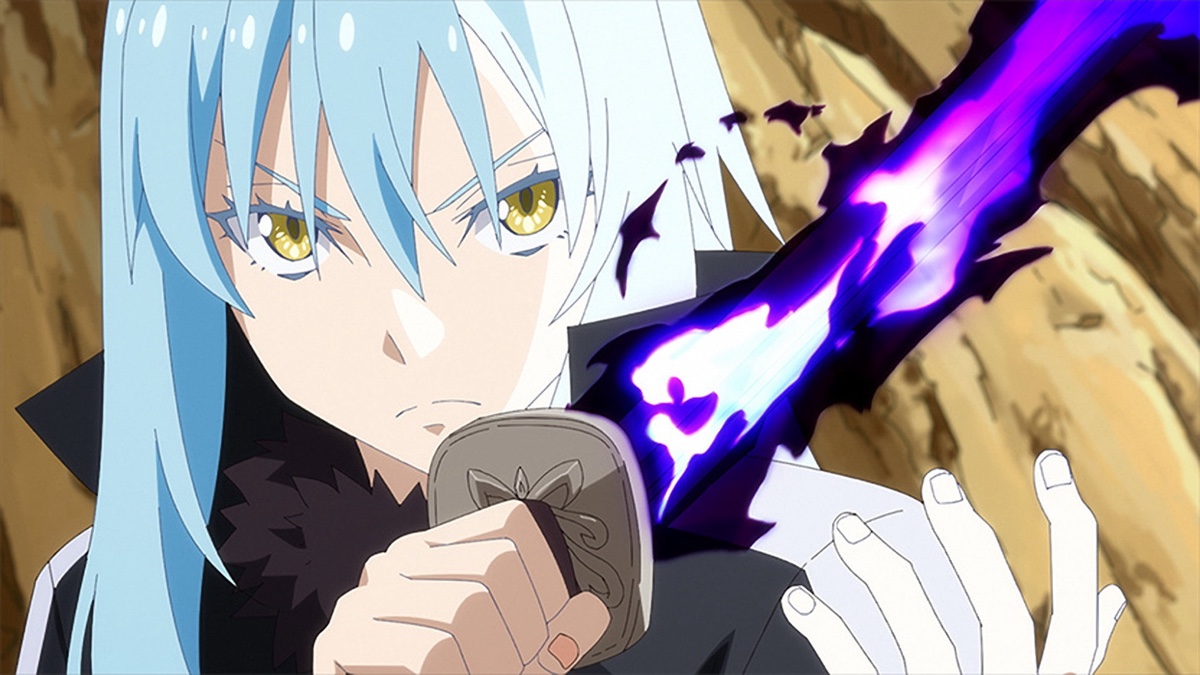
Rimuru’s duel with Hinata, the peak of the first half. Both throw everything they have at each other, yet it plays less as a display of who is stronger than as two people checking whether the other one is serious. The English title of episode 56, one of the duel episodes, sums it up in a single word:
“Misunderstanding”
The crossed wires that ran through Season 2 finally come apart in this fight.
The meal after the duel. In front of a bowl of white rice, Hinata looks genuinely moved. Anyone who grew up in Japan will understand at once what properly cooked rice means to someone who came from there. She hardly seems the same person as the icy knight commander of the first half, and a table where former enemies share a sukiyaki pot holds everything Season 3 means by “after the fight.”

Then there is the martial arts tournament at the festival. The hero Masayuki keeps advancing as opponents step aside and the people around him talk him up far beyond what he can actually do. Gobta, by contrast, scrapes his way through and finally goes all in by fighting as one with his partner Ranga, only to find he can’t quite control the power. In a season where everyone’s strength keeps inflating, this is the one stretch where someone can actually lose.
💭 How It Made Me Feel
I barely remember being nervous at any point. What stays with me is a sense of how big Tempest has become. I watched the negotiations and the management problems get checked off one at a time, and I enjoyed that in its own way. After two seasons of building, this one spends 24 episodes on what all that building was for.
😅 Where It Falls Short
Is Season 3 bad? No. There is real entertainment in it. But once the Hinata fight is over, the swordplay gives way to festival logistics, and if you came for action, parts of it will feel slow. Four things bothered me.
Meetings, Right Up to the Final Episode
The careful treatment of management and diplomacy is the season’s strength, and it is also why the pacing ranks among the slowest in the series. The first half keeps returning to talks, the second half to festival planning, and the very last episode wraps up with a meeting too. Handing most of the second cour to a festival and its preparations will strike some viewers as an odd use of twelve episodes.
Almost No Real Danger
This is where the gap with Seasons 1 and 2 felt widest to me. With someone as far off the scale as Rimuru in charge, Tempest starts the season a step ahead of every other country. Even in the Hinata fight he has plenty in reserve, and he reads most of his enemies’ plots before they unfold. As an ore TUEEE show (Japanese web-fiction slang for a hero nobody can touch), it delivers the rush. As drama, the stretches where you wonder how things will turn out are fewer than in either earlier season.
Too Many New Faces
Season 3 brings in kings and merchants from several countries, members of the Holy Knights and a new hero, all at once. If there has been a long gap since you watched Season 2, names won’t connect to factions right away. I wouldn’t start the series here. At least watch the second half of Season 2 first, so the meetings make sense.
The Banquet Gets Cut Short
The banquet after the reconciliation, a big moment in the source, is much shorter in the anime. The dinner scene is there in the episode itself, but the rest of the celebration, the hot springs and the food, appears mainly in the ending animation. That was presumably a runtime decision, and anime-only viewers may never notice. Readers of the source probably will.
The Weak Spots
- Meetings and festival planning keep the pace slow
- Rimuru is so strong that real danger never arrives
- The cast grows fast, and after a break it is hard to tell who is who
- The banquet from the source is cut down to a short scene
Who Should Watch This?
- Anyone who finished Season 2 and wants to know whether Season 3 has any fighting
- Returning fans who aren’t sure where to pick the series back up
- Viewers who enjoy stories about running a country, building a town or managing a business
Who Might Not Enjoy This?
- Viewers expecting more of Season 2’s war and comeback
- Anyone planning to start TenSura from Season 3
- Viewers whose thumb drifts to fast-forward whenever a negotiation starts
📺 Streaming Guide by Service
Which Service Should You Use?
For a US viewer, Crunchyroll settles it: subtitles or the English dub, both inside the standard plan. Prime households can add the Crunchyroll channel to their Amazon account for a monthly fee instead, and anyone who prefers to own the season can buy episodes on Amazon or Apple TV. At about 24 minutes each, the 24 episodes come to under ten hours, so four a day gets you through in roughly a week. Season 4 is on Crunchyroll as well, so you can keep going without changing services.
Where to Start Watching
- Crunchyroll: Streaming (all 24 episodes, sub or dub)
- Amazon Prime Video: Add-on (Crunchyroll channel subscription needed)
- Apple TV: Buy only
- Hulu, Netflix, HBO Max: Not available in the US
Soundtrack
- Openings: “PEACEKEEPER” by STEREO DIVE FOUNDATION / “Renacer Serenade” by Momoiro Clover Z
- Endings: “Believer” by Rin Kurusu / “Miracle Soup” by MindaRyn
- Score: Hitoshi Fujima (Elements Garden). The soundtrack album carries a very TenSura title, Tensei Shitara Ongaku Datta Ken 3 (“That Time I Got Reincarnated as Music 3”), and is out on music streaming platforms
📚 The Source Novels
Season 3 adapts Fuse’s light novels, available in English from Yen Press. In Japan the main story wrapped up with its 23rd volume in November 2025. Season 3 ends at about the close of volume 9, so That Time I Got Reincarnated as a Slime, Vol. 10 (light novel) is where to continue.
Taiki Kawakami’s manga version, published in English by Kodansha, is still running in Japan, where volume 33 is due out on October 8, 2026. Scenes the anime trimmed, the banquet included, get more room there.
🎬 If You Loved Slime Season 3, Watch These 3 Next
Mushoku Tensei: Jobless Reincarnation Season 1
Season 3’s Rimuru carries a whole country, and once a meeting sets the course, his people do the rest. Rudeus, the hero of Mushoku Tensei, carries only his own life. Still dragging the regrets of his previous one, he is forced into detours wherever he goes and spends years building a place for himself piece by piece. After watching Rimuru hold every card at the council table, Rudeus’s long way around reads as the whole point of the story. In the US it streams on Crunchyroll and Hulu.
👉 Read our Mushoku Tensei Season 1 review
Frieren: Beyond Journey’s End
A show about the years after the Demon King falls. Slime Season 3 is also set after the big war, once a Demon Lord has already risen. Both give you quiet stretches where nothing major happens, which is exactly how to enjoy the festival arc. In Japan, Frieren held Nippon TV’s Friday-night anime slot right before Slime Season 3 took it over. Watch them back to back and you see how differently two shows can handle “after the battle.” In the US it streams on Crunchyroll, Netflix and Hulu.
👉 Read our Frieren where-to-watch guide
Re:ZERO -Starting Life in Another World-
An isekai with the hero’s position flipped. Rimuru arrived with power far beyond the norm; Subaru in Re:ZERO can barely fight. His only ability is Return by Death, which rewinds time to a fixed point whenever he dies. He fails again and again, starts over, and inches forward. The not-knowing-what-comes-next tension that Slime Season 3 gave up is there in almost every episode. In the US it streams on Crunchyroll and Hulu.
📝 Final Thoughts
Season 3 gave up pace and danger. In return it shows the full business of running a country, from the arena to the labyrinth to trade with the neighbors. The Hinata duel sits outside that trade-off as the season’s one big peak. I’m giving it a 6.3, and it’s a 6.3 with an asterisk: most of what pulls the number down is the comparison with Seasons 1 and 2. Taken by itself, it still entertains.
If the end of Season 2 left you wondering how big this country could get, Season 3 is the answer. Watch it to see how far Tempest has come, and the long meetings sting less. If all you want is the next war, enjoy the Hinata fight and then lower your expectations for the rest. I said at the start that I found this season less fun than the first two, and I stand by that. Slower and safer than what came before, but still worth the ten hours.
⭐ Series at a Glance
| Category | Rating | Comment |
|---|---|---|
| Story | ★★★☆☆ | The Hinata duel up front, the festival for the rest |
| Pacing | ★★☆☆☆ | Meetings plus planning; among the slowest in the series |
| Characters | ★★★☆☆ | Hinata’s change works, but the cast is hard to track |
| Tension | ★☆☆☆☆ | Rimuru is too strong for real danger |
| Nation-Building | ★★★★★ | Arena, labyrinth, foreign trade, all handled with care |
Usagi’s Recommendation Score
⭐⭐⭐⭐⭐⭐☆☆☆☆
6.3 / 10
Fewer swords, more ledgers: a monster nation gets ready to open its doors

