*This page contains affiliate links. We may earn a commission if you make a purchase through these links.
Revenge stories hand the protagonist a sword. This one hands her a book, and then spends twelve episodes making the case that the book is the more dangerous object. Sitara is a slave girl in thirteenth-century Persia when the Mongol army arrives. She has no rank, no family left, no coin. What she has is everything she has read, and in a court where almost nobody reads, that turns out to be a lever long enough to move an empire.
I should say where I was standing before episode one. I follow Science SARU the way some people follow a director, so Jaadugar: A Witch in Mongolia was circled on my chart months before it aired. I also had one reservation written down, in ink, about whether this particular drawing style could carry a story about cities being put to the torch. Twelve weeks later I have crossed that reservation out, and the rest of this piece is partly an explanation of why.
📺 Where to Watch Jaadugar: A Witch in Mongolia (September 2026)
| Service | Status | Notes |
|---|---|---|
| Crunchyroll | Streaming | All 12 episodes. Subtitled, plus a full English dub |
| Amazon Prime Video | Add-on | Requires the paid Crunchyroll channel on top of Prime. Episodes are also sold individually |
| Apple TV | Buy | Purchase only, no subscription tier |
| Netflix | Not available | No US licence |
| Hulu | Not available | No US licence |
| HBO Max | Not available | No US licence |
As of September 14, 2026, Crunchyroll is the only US subscription that carries this series, and it has the complete run of twelve episodes in both subtitled and dubbed form. The dub started on July 18 with Cristina Vee as Sitara. Everything else is either a paid add-on riding on top of Crunchyroll or a straight purchase. Licences shift without warning, so confirm it on the service page itself before you hand over a card number.
🎬 Trailer
Work Info
- Title: Jaadugar: A Witch in Mongolia
- Broadcast: July 4 to September 12, 2026 (12 episodes)
- Source: A Witch’s Life in Mongol by Tomato Soup (Akita Shoten)
- Chief Director: Naoko Yamada / Director: Abel Gongora
- Series Composition: Kanichi Kato / Character Design: Kenichi Yoshida
- Animation Production: Science SARU
- Music: Koshiro Hino / OP: “Stella” by SEKAI NO OWARI / ED: “Hoshi” by Queen Bee
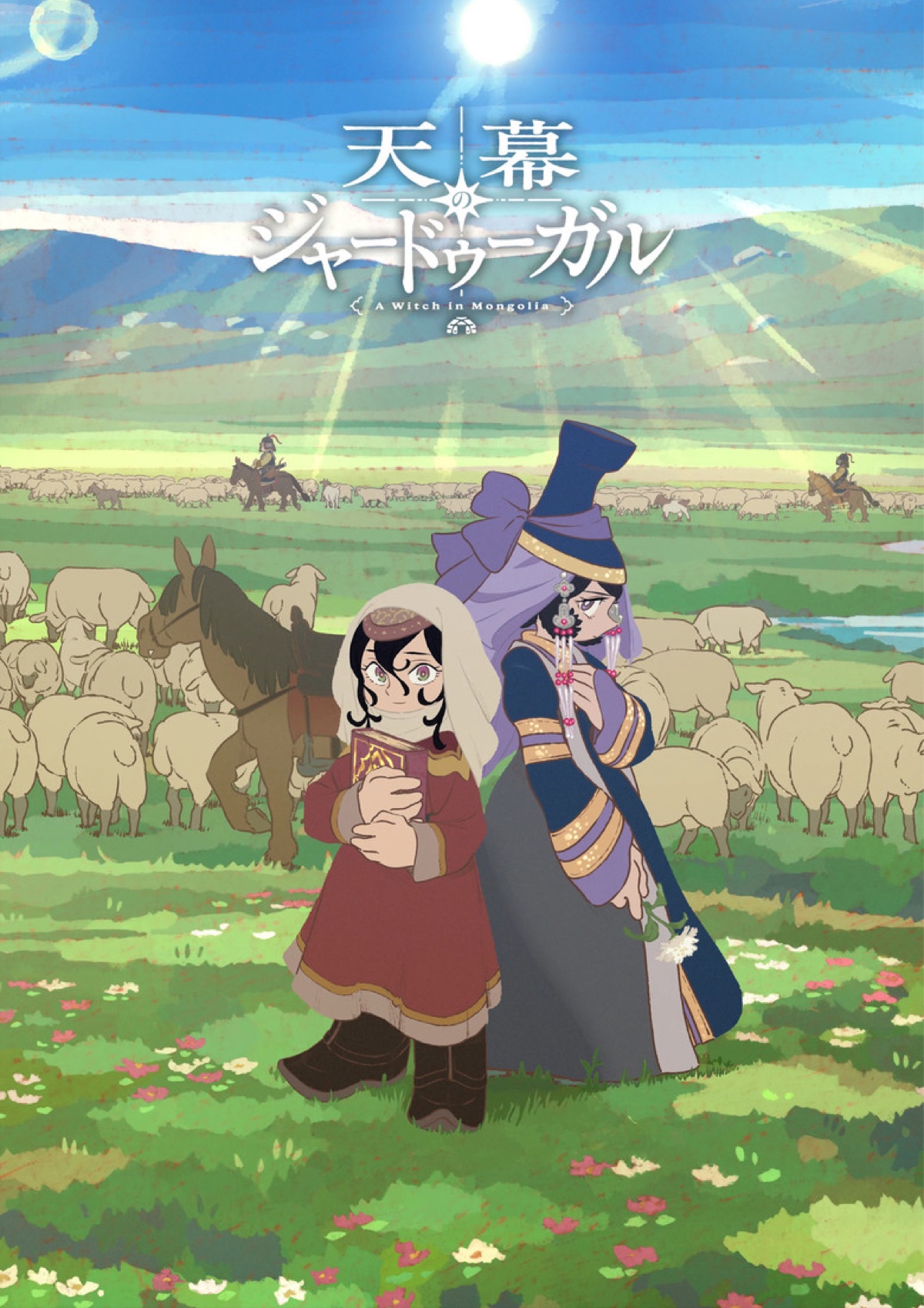
📖 Synopsis – No Spoilers
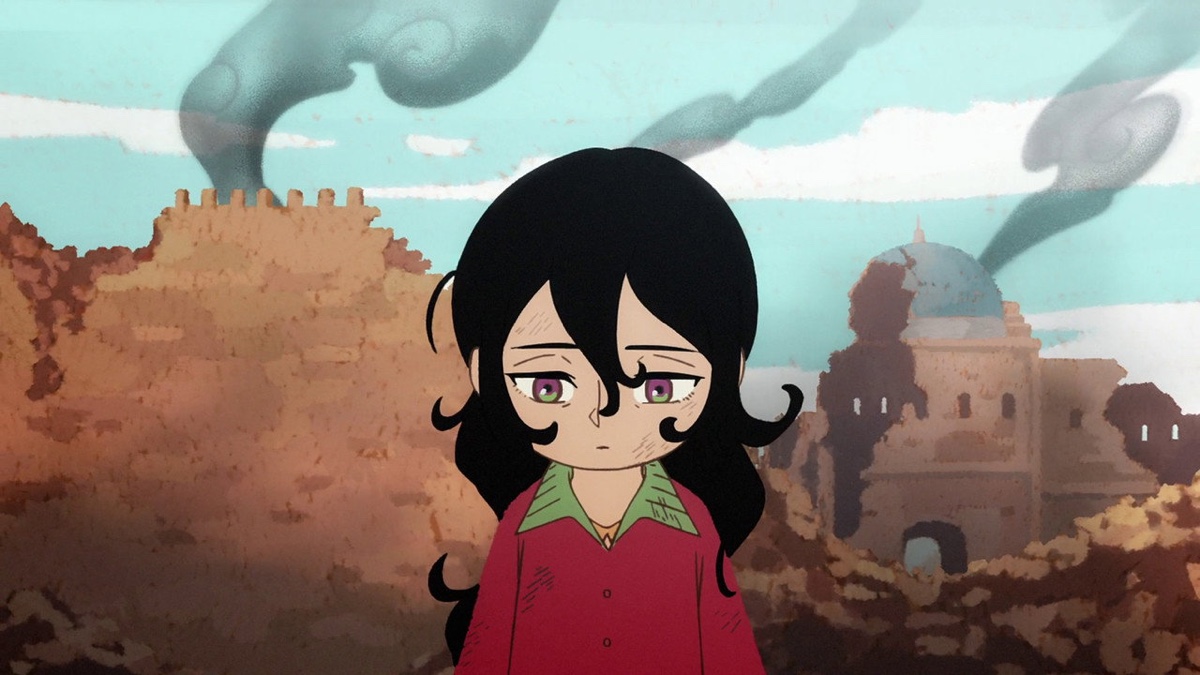
Thirteenth century, the Persian scholarly city of Tus. Sitara is a slave, bought and sold before she could choose anything for herself, until she ends up in the household of Fatima, the widow of a scholar. Fatima does something almost nobody in that society would do for a girl in that position: she lets her read. Greek mathematics, Persian poetry, astronomy, all of it goes into Sitara’s head and stays there. Then the Mongol army comes west. The city burns, the household’s copy of Euclid’s Elements is carried off as plunder, and Fatima is killed where Sitara can see it.
Dragged east as spoils of war, Sitara takes her dead mistress’s name and enters the imperial household of the Mongol Empire as Fatima. She intends to bring the whole thing down from the inside. She will never draw a blade. Her assets are the contents of the books she read and a working map of who resents whom, and she spends the series moving between the tents of rival Mongol houses, serving one, then another, then another. Her employer is also, in practice, the reader’s vantage point. The name in the title, incidentally, is Persian: jaadugar means witch, and it is what the people around her eventually decide she is.
✨ What Makes It Special
Why It’s Exceptional
- The weapon is a book, and literacy visibly moves a slave up through a rigid social order
- The invaders have families, principles and reasons. There is no villain anywhere in the cast
- Every time the heroine changes masters, the audience gets a new vantage point on the same empire
- Central Asia and the medieval Islamic world, a setting anime has barely touched, rendered with real texture
Knowledge Is Not a Theme Here. It Is the Mechanism.
Plenty of shows say that learning matters. This one puts it in the plumbing. Sitara climbs toward the centre of the Mongol court for one concrete reason: she can read, and she has Euclid in her head. On the steppe that is a skill essentially nobody else possesses, so it has a price, and the price buys her a position beside royalty. Not her birth. Not a benefactor. The volumes she got through in a dead woman’s house.
That changes the shape of the revenge itself. Almost nobody raises their voice in this series. What Sitara does instead is work out which two people can be brought close enough together to ruin each other, and then place the correct sentence in front of the correct listener at the correct hour. The grudge gets converted into information, and the information does the damage. It is the slowest possible form of violence and it is riveting to watch, because you can follow every step of the arithmetic.
Here is where I have to be honest, though, because the show does not let you enjoy this cleanly. What raises it further is that it refuses to make the scheming satisfying in the ordinary way. Sitara’s schemes land on people who did nothing to her. People who were never her target lose position, family, and sometimes more, because of a remark she engineered several episodes earlier, and the series makes sure you know the cost. She is not written as a heroine you get to cheer without reservation. She is written as a person who was left no other route, and the twelve episodes do the work of showing you that route being closed off, one door at a time. You finish the season holding the bill along with her.
There Is No Villain in This Show
For the first two episodes the Mongols exist to be hated. They burn a city of libraries, they take the books, they take the people. That is the entire impression the series gives you, and it gives it to you deliberately.
Then, from around the third episode, the camera starts living with them. Herding. Striking and re-pitching tents. Ögedei and Tolui carrying obligations they did not choose, worrying about brothers, doting on children. The faces you were issued as enemies turn into faces you understand, and the series times this so that it happens to you at roughly the same moment it happens to Sitara. Her resolve wobbles in front of the man responsible for her mistress’s death. Yours has already wobbled. That synchronisation is the most precise piece of construction in the show.
Very few war stories give both sides this much care. Making one side stupid or monstrous is the fastest way to get a plot moving, and this one never once takes that shortcut, across all twelve episodes.
The Heroine Doubles as the Camera
Here is the reading I came away with that I have not seen anyone else make. Sitara keeps changing whom she serves: Sorghaghtani of the house of Tolui, then Boraqchin of the house of Ögedei, then Töregene, who came from a people the Mongols crushed. Every time she relocates, the audience relocates with her, and gets shown the inside of another faction.
Historical drama usually parks itself in one camp and leaves the opposing camp as guesswork. Sitara functions instead as something closer to a narrator-figure moving through the story, and each move rewrites the view you had from the previous position. The same man reads as a loyal retainer from one tent and as a schemer from the next. By the finale nearly every judgement you formed in the first three episodes has been revised at least once, and the revision was done to you rather than announced at you.
About That Art Style
Back to the reservation I confessed at the top. Rounded faces, warm flat colour, backgrounds that resemble cut paper: I assumed it would fight the material. My conclusion after twelve episodes is that it does the opposite. The drawing absorbs the physical cruelty, which leaves your attention free for the story. Rendered photographically, the sack of a city would have taken the whole frame and I would have missed the conversation that follows it. Since this heroine fights with information, losing the gore is a net gain. The style strips out noise rather than adding it.
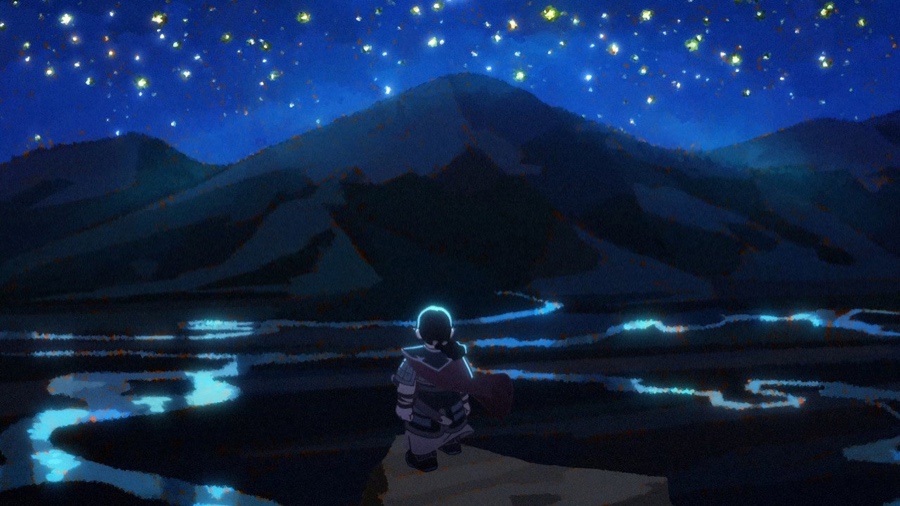
The background art deserves its own paragraph. Hillsides with the grain of torn fabric. Clouds with the dimensionality of embroidery. A deliberate split between what gets rendered in detail and what gets caught in a single broad shape, which means the picture tells you where to look in every cut. Thirteenth-century Persia and the Mongol steppe arrive as texture rather than as reference photography. The two songs sit in the same register: SEKAI NO OWARI’s “Stella” over the opening, Queen Bee’s “Hoshi” over the end credits.
Deeper Themes
Notice what gets taken. The household’s copy of Euclid is not destroyed, it is carried off with the rest of the plunder, and episode three turns into a mission to get it back. The order of operations is the thesis: strip a people of the things they think with, and you have taken their footing before you have taken their lives. It also explains why avenging one murdered woman was never going to be enough for Sitara. Part of her job, for the rest of her life, is to be the person who still remembers what was in those books.
🎭 Memorable Scenes
Start with the relationship between episode one and episode two, because that is the single best decision in the series. Episode one spends its whole runtime on how good Tus is. Books, argument, a girl permitted to learn. Episode two swallows all of it. You are shown the value of the thing before it is destroyed, so the destruction arrives as a felt loss rather than a body count. Some viewers will want to bail here. Please do not; this two-episode pairing is the machine the rest of the show runs on.
My personal pick is different: the first meeting between Sitara and Töregene. Both of them have had their lives torn up by the same empire. Both of them know, and admit, that alone they can accomplish nothing. Neither rescues the other and neither is swept up in instant kinship. They audit each other’s weaknesses, and only then arrive at the thought that together there might be a way forward. I have watched a lot of alliance scenes. Very few of them move that carefully.
Episode four is the other one I keep returning to. It comes after the stretch that humanises the Mongols, and you can watch Sitara’s hatred and her reluctance grinding against each other in small exchanges. Nothing is declared out loud. Everyone who gets through that episode carries the same low-level guilt for the remaining eight.
💭 How It Made Me Feel
It made me go and read. Partway through the season I caught myself with tabs open on the founding of the Mongol Empire, on what actually happened to Töregene afterwards, on how the historical Fatima Khatun is recorded. I was running the history alongside the episodes, week by week, which is not a thing I normally do.
That says something about what this show is. The twelve-episode story closes properly, and yet the curiosity it generates points outward, away from the show. In Japan this became its own small phenomenon: people watching with Wikipedia open in another window, teachers saying out loud that they want to put it in front of a class. It entertains you and then sends you to the library. As side effects go, that is a luxurious one. If you enjoy the sensation of a story pushing you toward the real record, the same instinct is behind our list of Japanese films based on true stories.
😅 Where It Falls Short
The Names and the Faces Refuse to Connect
This is the first wall, and everybody hits it. Sitara, Töregene, Sorghaghtani, Boraqchin, Chagatai, Jochi. Unfamiliar Mongol and Persian names arrive in a heap in the opening episodes, and because the character designs are stylised rather than naturalistic, it takes a while before hair and clothing do the sorting for you. I have been singing this show’s praises for several paragraphs, so let me be straight about the cost of entry.
The fix is small. Learn two households and stop there. The house of Tolui and the house of Ögedei are rivals, and our heroine ends up working inside both. Hold that one fact and the politics stay legible even while the names are still sliding around. Within a few episodes the faces attach themselves without any effort on your part.
The Middle Stretch Goes Sideways Instead of Forward
Following the historical record has a structural cost, and this series pays it around the middle of the run. Something concludes in one episode and does not obviously feed the next, and a different set of people start a different set of problems. Twelve episodes is not much room for this many decades and this many households, so it is understandable, but the forward pull does slacken for a stretch.
Finishing changes how that section reads. The episodes that read as side material turn out to be the evidence the endgame decisions rest on, and by the last episode almost everyone in the cast has a reason for what they did. If you have stalled somewhere in the middle, give it a few more. This is a series that rewards binge-watching over a weekly schedule, which is convenient now that the whole run is sitting on Crunchyroll at once.
Come for the War, Leave Disappointed
Less a flaw than a warning about the wrong expectation. It is set in the Mongol Empire, so a certain number of people will press play hoping for cavalry and siege engines. The battlefield in this show is the inside of a tent. And the art style, as established, files the edges off the brutality by design. The combat tension that Attack on Titan runs on is not here and was never going to be.
One more admission while I am at it. A small part of me still wonders about the version of this show drawn in a harsher, more literal style, the one that would not have flinched. I might have been pulled in even deeper. That is curiosity rather than complaint, and I only have it because what actually got made is so good.
The Weak Spots
- A pile of unfamiliar names in the first episodes, and several more before they stick to faces
- A mid-season stretch where episodes sit beside each other instead of building
- Anyone here for large-scale battle spectacle has the wrong show
Who Should Watch This?
- Anyone who loved Vinland Saga or Chi.: Chronicles of the Earth’s Movement, where the fight is won with the head
- Anyone worn down by another season of isekai and tournament arcs
- History readers, especially anyone curious about the regions their schooling gave three sentences to
Who Might Not Enjoy This?
- Viewers who want set-piece battles and the pleasure of good action choreography
- Viewers who find large ensemble casts stressful to keep straight
- Viewers looking for something light to end the day with. The weight never lifts
📺 Streaming Guide by Service
Which Service Should You Use?
In the US this is a short conversation, because there is exactly one subscription that has it. Crunchyroll carries all twelve episodes, subtitled and dubbed, and twelve episodes is an easy weekend. If you would rather own it than rent access to it, Amazon and Apple both sell the episodes, and the Crunchyroll channel on Amazon is the same content behind an extra monthly charge. Nothing on Netflix, Hulu or HBO Max, and there is no sign of that changing.
Where to Start Watching
- Crunchyroll: Streaming (all 12 episodes, sub and dub)
- Amazon Prime Video: Add-on via the paid Crunchyroll channel, or buy the episodes
- Apple TV: Buy only
- Netflix, Hulu, HBO Max: Not available in the US
Soundtrack
- Opening: “Stella” by SEKAI NO OWARI, available on the major streaming platforms
- Ending: “Hoshi” by Queen Bee, available on the major streaming platforms
- Koshiro Hino’s score has had a Japanese CD release. As of September 14, 2026 we could not confirm a digital release outside Japan
📚 The Source Manga
The original is Tomato Soup’s A Witch’s Life in Mongol, serialised by Akita Shoten and licensed in English by Yen Press. It has credentials at home: it topped the women readers’ list in Kono Manga ga Sugoi! 2023 and took the 55th Japan Cartoonists Association Award in 2026. Six volumes are out in Japan, with the sixth released on July 15, 2026, and the story is still running.
A caveat for English readers. The studio has not announced how far the anime adapts, though several fan sites put the finish somewhere around volume four. Yen Press is currently three volumes in, with volume three published on July 28, 2026 and volume four scheduled for October 27, 2026, so the English edition has not overtaken the season yet. Volume three is the one to buy if you want to reread the strongest material with the manga panelling, and volume four is the one to watch for if you want to move past where the anime stops.
🎬 If You Loved Jaadugar, Watch These 3 Next
Dr. STONE: New World
Japanese viewers kept filing Jaadugar next to Chi.: Chronicles of the Earth’s Movement, because there is a specific kind of excitement in watching knowledge itself drive a plot. The most accessible show on that shelf is this one: a high schooler wakes up in the stone age and rebuilds civilisation out of chemistry. Sitara changes her station in life with the books she read; Senku changes the balance of power with a formula. One story is revenge and the other is reconstruction, and they are nonetheless arguing the same point about who gets to alter the world. It also makes a good palate cleanser after something this heavy.
👉 Read our Dr. STONE: New World review
Letters from Iwo Jima
The instant you accept that the people who invaded have families and beliefs, the story you were watching inverts. If that happened to you here, take the other half of Clint Eastwood’s experiment, in which he shot one battle twice, once from the American side and once from the Japanese. Stand inside the army you had been counting as the enemy and the whole war changes shape. In Japan, Iwo Jima usually arrives in school as a date and a casualty figure, and this film is what turned it into something else for me. Different scale and different century from the Mongol steppe, and a remarkably similar feeling on the way out.
Attack on Titan Season 3
This one is here as the corrective. The combat tension I said Jaadugar lacks is precisely what this season has in surplus. And the content is not really giants at all, it is humans doing politics to each other, over who holds the kingdom and which official story is a lie. The trick where a change of position flips your verdict on a character is running here too, which makes it startlingly close to what happens in those Mongol tents. Two shows making the same argument, one of them with blades and one of them with sentences.
👉 Read our Attack on Titan Season 3 review
📝 Final Thoughts
Jaadugar: A Witch in Mongolia is twelve episodes about a girl who took a book instead of a sword and shook an empire from the inside with it. It is a revenge story in which hardly anyone shouts. It contains no villains, on either side of the invasion. And it keeps changing where the heroine works, so that your reading of every character gets updated as you go. Honest as history, gripping as fiction, and it leaves you wanting to look things up.
If the art style has been putting you off, that is the exact reason to try it. Those soft lines are load-bearing; they are what lets the show stay this heavy for twelve straight episodes without losing you. My only real anxiety is structural: the manga continues and no second season has been announced. Remember the objection I registered in the first two paragraphs? I withdraw it completely, and I am now waiting for a renewal announcement with more investment than is probably healthy. Of everything that aired this summer, this is the one I will still be recommending next year.
⭐ Series at a Glance
| Category | Rating |
|---|---|
| Story | ★★★★★ |
| Art & Animation | ★★★★★ |
| Characters | ★★★★☆ |
| Music | ★★★★☆ |
| Newcomer Friendly | ★★★☆☆ |
Usagi’s Recommendation Score
⭐⭐⭐⭐⭐⭐⭐⭐☆☆
8.7 / 10
Storybook lines, and not one flinch from the history underneath

