*This page contains affiliate links. We may earn a commission if you make a purchase through these links.
My favorite Takeshi Kitano films are still the early ones, with Sonatine at the top of the list. Carry that taste into Outrage (2010) and the first thing you notice is the noise. The shouting barely stops, the pecking order between gangs flips on a single conversation, and characters are knocked off the board one after another. Think of a shogi board where the pieces are moved by yelling.
The dry violence is still there, and so are the shots you want to pause and stare at. But on the whole, this is Kitano leaning hard into entertainment, and I enjoyed it on exactly those terms. Below: where it streams in the US today, a who’s who chart of the gangs (there are a lot of names to track), and my honest take as a Japanese fan.
📺 Where to Watch Outrage (September 2026)
| Service | Status | Notes |
|---|---|---|
| Amazon Prime Video | Streaming | Included with Prime. Listed to leave on November 11, 2026 |
| Tubi | Free with ads | No subscription needed |
| The Roku Channel | Free with ads | Listed as Outrage: Way of the Yakuza |
| Kanopy | Free | With a participating US library card |
| Apple TV | Rent / Buy | Fandango at Home too |
| Netflix (US) | Not available | Not in the catalog |
| Hulu | Not available | No listing found |
| HBO Max | Not available | Not carried |
| Crunchyroll | Not available | Anime service, no live-action yakuza films |
As of September 30, 2026, Outrage streams in the US on Amazon Prime Video as part of a regular Prime membership, and you can also watch it free with ads on Tubi and The Roku Channel, or free with a library card on Kanopy. I checked TMDB’s US listings and JustWatch on the same day, and both agree. One caveat: JustWatch shows the Prime Video listing ending on November 11, 2026, so if Prime is your route, do not leave it too long. Availability changes, so check the service itself before you plan around this table.
Here is the twist. In Japan, none of the three Outrage films streams anywhere right now, not on a subscription and not as a rental. Japanese viewers are down to mail-order DVD rental or buying the Blu-ray. For once, the American viewer has the easier path to a Japanese film.
🗺 Outrage Who’s Who: The Sanno-kai, Ikemoto and Otomo Families
The film throws gang names and ranks at you from the first minutes, and it is easy to lose track of who answers to whom. This chart shows the setup at the start of the story. Who betrays whom, and who is left standing, are not on it.
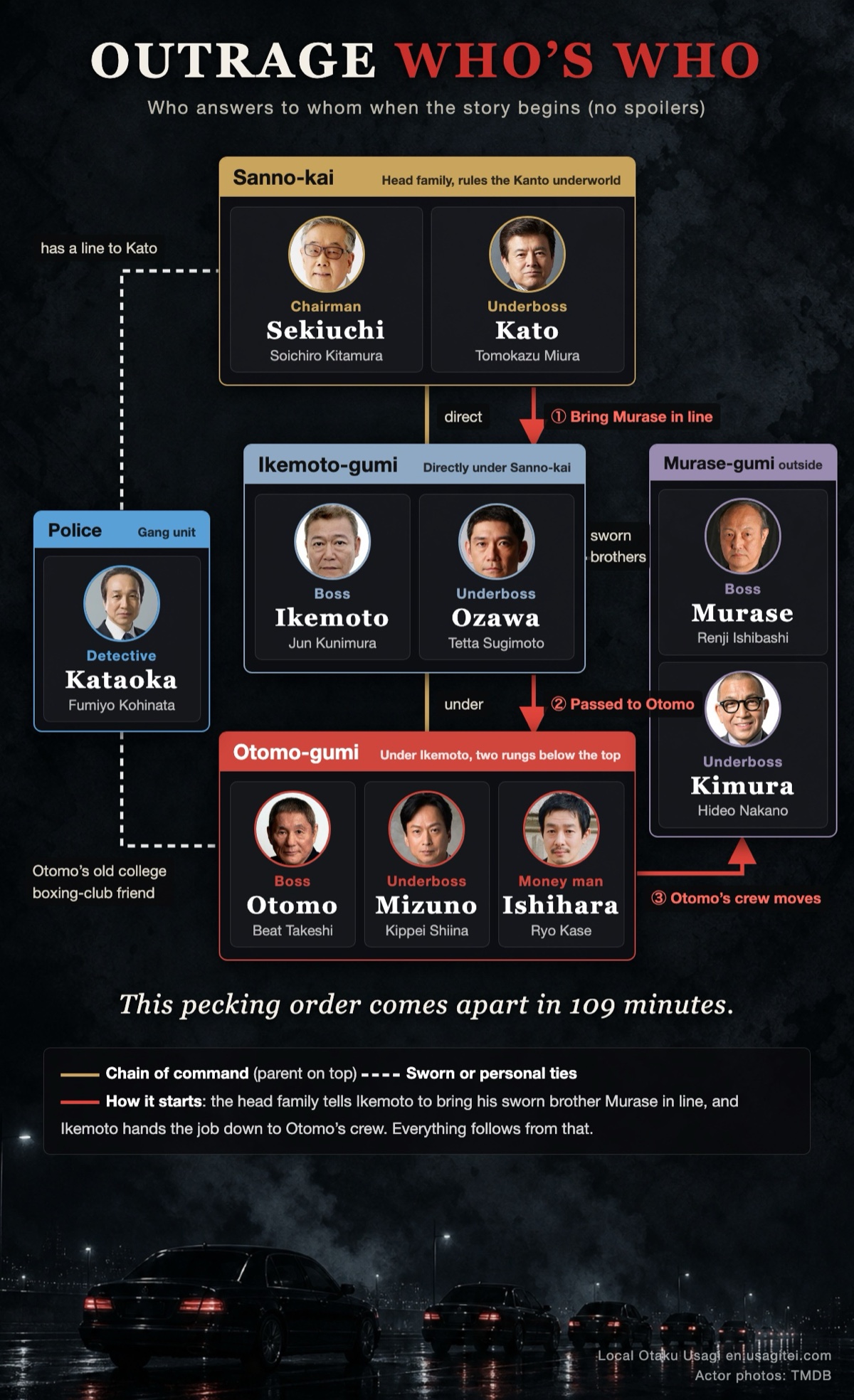
Read it from the top down. At the summit is the Sanno-kai, the huge syndicate that runs the Kanto region around Tokyo, with Sekiuchi as chairman and Kato as his underboss. Directly below sits the Ikemoto family, and below Ikemoto is the crew of our lead, Otomo (played by Kitano himself under his performing name, Beat Takeshi). From Otomo’s position, the Sanno-kai is his boss’s boss.
The sideways line is what sets the story moving. Ikemoto has sworn brotherhood with Murase, the boss of a gang outside the Sanno-kai. The top of the Sanno-kai is unhappy about that, and Ikemoto is told to bring Murase in line. Ikemoto keeps his own hands clean and passes the job down to Otomo. An order travels down one rung at a time, and the crew at the very bottom does the actual work. Keep that in mind and everything after it is easy to follow.
The one figure outside the gangs is Kataoka, a detective from the organized crime unit. He knows Otomo from their college boxing club and also has a line to Kato. Watch him as a policeman with one hand reaching into the gangs.
| Group | Position | Character | Actor |
|---|---|---|---|
| Sanno-kai | Chairman | Sekiuchi | Soichiro Kitamura |
| Sanno-kai | Underboss | Kato | Tomokazu Miura |
| Ikemoto-gumi | Boss | Ikemoto | Jun Kunimura |
| Ikemoto-gumi | Underboss | Ozawa | Tetta Sugimoto |
| Otomo-gumi | Boss | Otomo | Beat Takeshi |
| Otomo-gumi | Underboss | Mizuno | Kippei Shiina |
| Otomo-gumi | Money man | Ishihara | Ryo Kase |
| Murase-gumi | Boss | Murase | Renji Ishibashi |
| Murase-gumi | Underboss | Kimura | Hideo Nakano |
| Murase-gumi | Member | Iizuka | Takashi Tsukamoto |
| Police | Detective | Kataoka | Fumiyo Kohinata |
🎬 Trailer
This is the US trailer from the channel of Magnolia Pictures, the film’s American distributor.
Work Info
- Title: Outrage (Japanese title: Autoreiji)
- Released: June 12, 2010 (Japan)
- Director and screenplay: Takeshi Kitano
- Cinematography: Katsumi Yanagijima
- Music: Keiichi Suzuki
- Cast: Beat Takeshi, Kippei Shiina, Ryo Kase, Tomokazu Miura, Jun Kunimura, Tetta Sugimoto, Takashi Tsukamoto, Hideo Nakano, Renji Ishibashi, Fumiyo Kohinata, Soichiro Kitamura
- Runtime: 109 minutes (rated R15+ in Japan)
- Festival: In competition at the 63rd Cannes Film Festival (2010)
- Sequels: Beyond Outrage (2012), Outrage Coda (2017)
- Source: TMDB
📖 Synopsis – No Spoilers
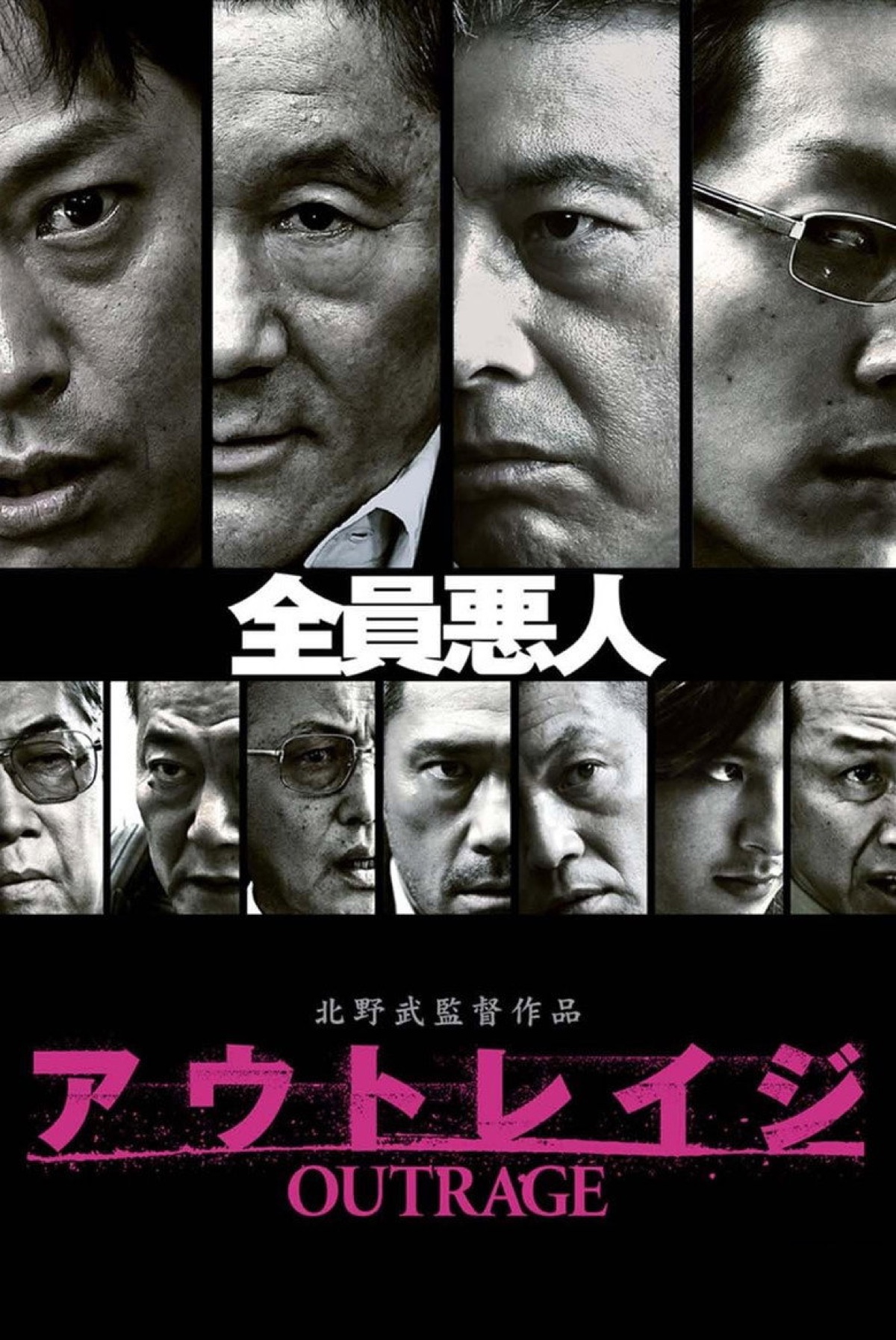
The Sanno-kai controls organized crime across the Kanto region. Its chairman, Sekiuchi, is unhappy that one of his direct affiliates, the Ikemoto family, has grown friendly with the Murase family, a drug-dealing outfit whose boss is Ikemoto’s sworn brother. Word comes down that Ikemoto is to bring Murase in line.
Ikemoto hands the whole messy job to Otomo’s crew. Otomo takes it without complaint and starts by having his men pick a fight with the Murase family. It was supposed to be a small dispute. But every apology and every act of payback raises the stakes a little more, until the fight with Murase is only the surface. Underneath, it becomes a question of who ends up on top inside the Sanno-kai.
✨ What Makes It Special
Why It’s Exceptional
- A yakuza power struggle where talk, not guns, moves the pecking order
- The lead is not at the center of the board, so you cannot guess who survives
- Every act of violence is staged differently, so you start waiting for the next one
- Actors known for gentle roles all turn into villains
- The detached camera and dry violence of Kitano’s earlier films are still here
Every shouting match moves the ladder one rung
What I enjoyed most was watching Outrage as political infighting inside the yakuza. Conversation moves power before a gun ever does. How do you treat a man who has come to apologize? Whose sake cup do you accept? When your superiors summon you, what do you say, and what do you swallow? Each answer redraws one line on the chart above. A scene that seems to be two bosses making small talk is quietly shifting the ranking.
And the lead is not standing at the center of that board. Otomo is the protagonist, but he is nowhere near high enough to run anything. His own boss, Ikemoto, keeps handing him the dirty jobs, the top calls him in whenever it suits them, and he takes the blame for his men’s mistakes. An old-school yakuza loyal to his boss is slowly squeezed by people who only think about their own gain. Even Otomo cannot see who is actually moving the pieces.
So you genuinely cannot tell who will be left standing. There is no promise that the hero makes it through, and no guarantee your favorite is in the next scene. All you can do is track the shifting order, and that tracking becomes its own mystery. There is almost no inner life on screen, only positions and profit, and still I could not look away for close to two hours.
Orders from the top roll downhill, and the people at the bottom bleed for them. That shape is not unique to gangsters. Map it onto a subcontractor jerked around by one word from a client and the screaming suddenly feels close to home. Anyone who has worked inside a big organization will recognize the unfairness.
He came up with the killings first and wrote the story after
Kitano has said that on this film he worked out how people would be killed first and fitted the story around those ideas afterward. You can feel it. No method of violence repeats. By the middle of the film I was watching with one question in my head: what are they going to come up with next?
I know I keep praising the violence in a film about gangsters. Hear me out.
Once you watch that way, the violence starts to become a show. More than once, a dry, sudden blow is followed by a beat of silence and something close to a laugh, as if the cruelty has gone so far it tips into comedy. It is a completely different direction from Violent Cop or Sonatine, where violence dropped out of the quiet and frightened you. Here the humor is Kitano crossed with pure entertainment, and I enjoyed it as that.
It never turns into a pure spectacle, though. The camera keeps its distance from the characters, the way it always has in Kitano’s films. The temperature of the image stays low. Only what happens inside the frame got louder.
Mild-mannered faces, all of them villains
The casting has a trick in it. Kitano deliberately gathered actors with a nice-guy image who had almost never done yakuza films. The Japanese marketing ran on the slogan “Zen’in akunin”: everyone’s a villain. The clearest case for a Japanese audience is Soichiro Kitamura, the chairman. In Japan he is best known as the comic, harmless police chief of the Bayside Shakedown franchise, and here he runs the entire underworld. Tomokazu Miura, a romantic lead in the 1970s, plays his underboss. American viewers may know Ryo Kase as the young soldier in Clint Eastwood’s Letters from Iwo Jima; here he is Otomo’s English-speaking money man. Because their faces and voices are soft, you cannot read what is underneath. Fumiyo Kohinata’s Kataoka belongs on the same list: among gangsters who growl, the one detective chatting away lightly is the man who shows the least of himself.
My own favorite sits on the other side of that line: Mizuno, played by Kippei Shiina. He is Otomo’s underboss, completely loyal to his boss and merciless with any subordinate who slips. Loyalty and savagery live on the same face, and a scene tightens the moment he walks into it.
Deeper Themes
Outrage is also about the end of the old code, what Japanese gangster films call ninkyo, the chivalrous yakuza. Otomo follows orders without argument and settles things with his own hands. Beside him, his money man Ishihara runs the crew on English and arithmetic and quietly looks down on the muscle. The men above them act on profit, not obligation. A man who plays by the rules loses his place in a world that no longer runs on them. The heroes of Kitano’s early films chose their own road. Otomo gets shoved off his by the people around him. If you have seen a few of Kitano’s earlier gangster films, that change in the hero is what lands hardest.
🎭 Memorable Scenes
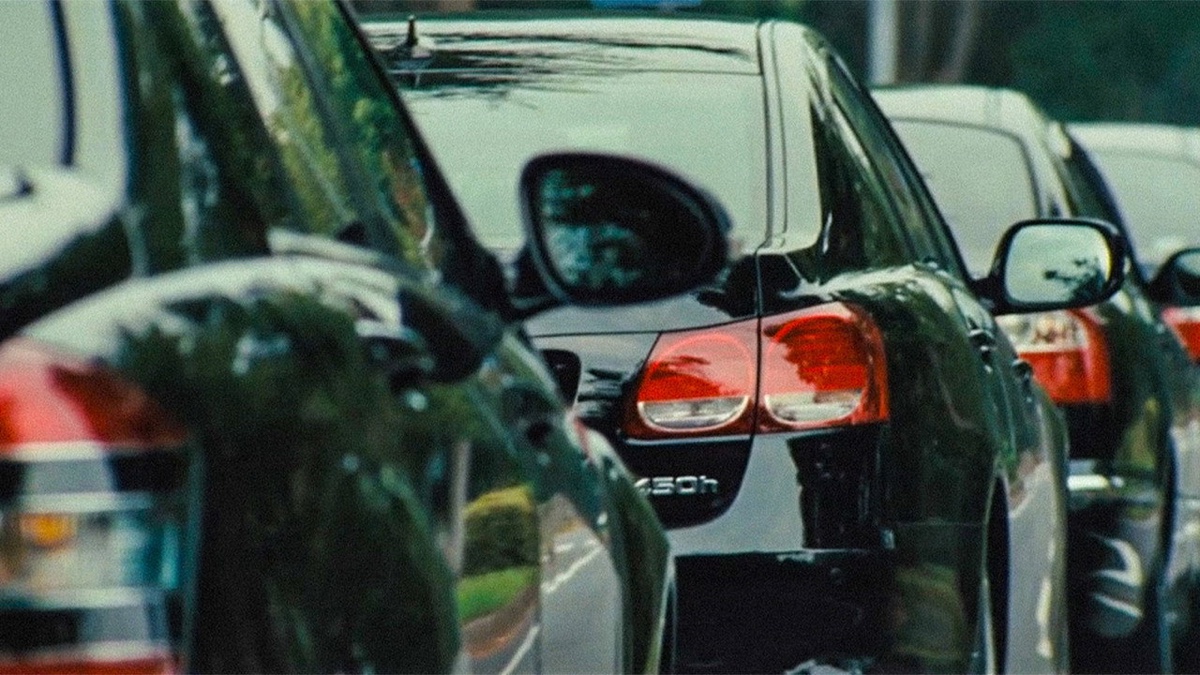
First, the line of black cars in the opening. Luxury sedans roll in one after another while gang members stand beside them waiting for their bosses. Before the title card even appears, the film has shown you that this world is built on rank. Look at it again after reading the chart and the order of the cars starts to read as the order of power.
Second, the dentist’s office. A man is in the chair, mouth wide open, when Otomo and his men walk in. Where the dental tools end up is exactly where you fear. Of all the violence in the film, this is the one that stays with you. The soundtrack even has a cue called “At the Dentist.”
Third, a road along the sea. A man with a rope around his neck, and a car that starts to move. Up to that point the violence comes in hard, choppy bursts. Here the rhythm changes, and the image against the blue sea goes strangely still. I am not saying whose scene it is. Which box on the chart he came from is for you to find out.
💭 How It Made Me Feel
It did not leave me with the heavy weight the early films do. What it left instead was the feeling of being pulled along for almost two hours by “what happens next.” For sheer excitement, this one clearly wins. In Japan it earned about 750 million yen at the box office and became the first Kitano film ever to get a sequel. I understand completely why it was a hit.
I went on to watch Beyond Outrage and Outrage Coda as well. The names you learn here come back in the sequels, so the chart pays off more than once.
Who Should Watch This?
- Anyone who has never seen a Kitano film and feels wary of art-house cinema
- Viewers curious about yakuza films who want an easy way in
- Anyone who has been pushed around by unfair orders from above at work (the strongest reason)
😅 Where It Falls Short
I have been talking up how much fun this was, but I owe you the other side too. Two things snagged.
A big cast leaves little room for any one person
The skeleton of the plot is classic, and you can partly predict the order of the betrayals. With no single lead at the center and a crowd spread across the screen, nobody gets much time. There are almost no scenes that step into anyone’s past or inner life, and the characters are told apart by rank and dialogue alone. That is the price of a good ensemble piece: if you want to go deep with one person, it will feel thin.
Come looking for the early films’ quiet and it feels different
The direction Kitano took here is completely valid, and I did enjoy it. Still, in my personal order this film sits behind the early ones. If you press play hoping for that stripped-down, dialogue-light texture where the pauses do the work, the volume of the shouting will throw you first. Nor does it leave the kind of aftertaste you carry around for days. If quiet is what you want from Kitano, start with Sonatine instead.
Who Might Not Enjoy This?
- Anyone expecting the quiet, lingering Kitano of the 1990s
- Viewers who want to bond with a single hero from start to finish
- Anyone who finds violence you can almost feel hard to sit through (rated R15+ in Japan)
📺 Streaming Guide by Service
The Available Routes
- Amazon Prime Video: included with Prime (listed through November 11, 2026)
- Tubi and The Roku Channel: free with ads
- Kanopy: free with a participating library card
- Apple TV, Fandango at Home: rent or buy
- Netflix, Hulu, HBO Max, Crunchyroll: not available
If you have Prime, that is the simplest route, with the November date in mind. If you do not, Tubi costs nothing. Watch in order: Outrage (2010), then Beyond Outrage (2012), then Outrage Coda (2017). Beyond Outrage is also on Prime Video and free on Kanopy and Tubi. Outrage Coda is not included with Prime; it streams free with ads on Tubi and The Roku Channel. For a copy of your own, the US Blu-ray and DVD are on Amazon. In Japan the film has aired on network TV, but with the cruelest scenes heavily cut, so a streaming or disc copy is the way to see it as made.
Soundtrack
The score is by Keiichi Suzuki, who also scored Kitano’s Zatoichi. The soundtrack album runs 27 tracks: 15 from the film plus 12 alternate takes and demos. The cues are named after scenes (“High-class Nightclub,” “At the Dentist,” “Cars and Pursuers”), so reading the track list alone brings the film back. It streams on Apple Music in Japan, but when I checked the US store it was not listed, so I have no US link to give you.
🎬 If You Loved Outrage, Watch These 3 Next
Three directions out of Outrage: where its “everyone’s a villain” gang war came from, the cop-and-mole tension it only touches, and a film that fixes the one thing I missed here.
Battles Without Honor and Humanity (1973)
Kinji Fukasaku’s film for Toei, based on real gang wars in postwar Hiroshima. If Outrage is an ensemble where everyone is bad, this is where that idea comes from. Bosses use up their men for their own convenience, sake cups are exchanged for profit, and yesterday’s sworn brother is today’s enemy. The top-down cruelty of Outrage was already on film 37 years earlier. I have not seen it myself yet, but for anyone who has the Outrage chart in their head, it is the most natural next step. In the US it streams on Arrow’s own subscription service, ARROW, and rents on Amazon and Apple TV.
Infernal Affairs (2002)
Take someone in Kataoka’s position, standing between the police and the underworld, and push the idea as far as it goes: you get this film. The Hong Kong police and a triad have each planted a mole inside the other. The fun of tracking “who is above whom” in Outrage becomes “who is on which side.” There is almost no shouting, only held-breath tension all the way through. Set it beside Outrage’s noise and you are struck by how quietly the same underworld can be filmed. Martin Scorsese remade it as The Departed. US viewers can stream it on HBO Max and the Criterion Channel.
The Blood of Wolves (2018)
This one flips my main complaint about Outrage, that nobody gets much depth. It is set in a fictional town in late-1980s Hiroshima, where a veteran detective deep in bed with the gangs (Koji Yakusho) and the rookie paired with him (Tori Matsuzaka) wade into a war between rival families. Instead of spreading across a crowd, it dives deep into one detective’s way of living. He is a cop tied to the gangs, the same as Kataoka, but this one stays at the center of the frame. In the US it streams on Shudder and AMC+. My full review: The Blood of Wolves.
👉 More Japanese crime and yakuza movies, and where to stream them in the US
📝 Final Thoughts
One conversation flips the gang ladder, and even the hero gets shoved to the edge of the board. Kitano took the yakuza he used to film in silence and rebuilt them as a shouting ensemble. The cold look of the image runs straight on from his early work, while the heat inside it has swung toward entertainment.
As a Kitano film and as a yakuza film, it is about as easy to watch as either gets. And it still carries an air you will not find in any other movie. If it is on your Prime account, press play before November. Just look at the chart once before you do. You will follow the whole 109-minute collapse of the pecking order without getting lost.
⭐ Series at a Glance
| Category | Rating |
|---|---|
| Story | ★★★☆☆ |
| Ensemble & casting | ★★★★★ |
| Inventive violence | ★★★★★ |
| Visuals | ★★★★☆ |
| Music | ★★★☆☆ |
| Ease of watching | ★★★★☆ |
Usagi’s Recommendation Score
⭐⭐⭐⭐⭐⭐⭐⭐☆☆
7.5 / 10
Kitano’s yakuza film at full entertainment volume, where one shout can move the whole ladder.

 streams on Prime Video in the US and free on Tubi, yet nowhere in Japan. A Japanese f)