*This page contains affiliate links. We may earn a commission if you make a purchase through these links.
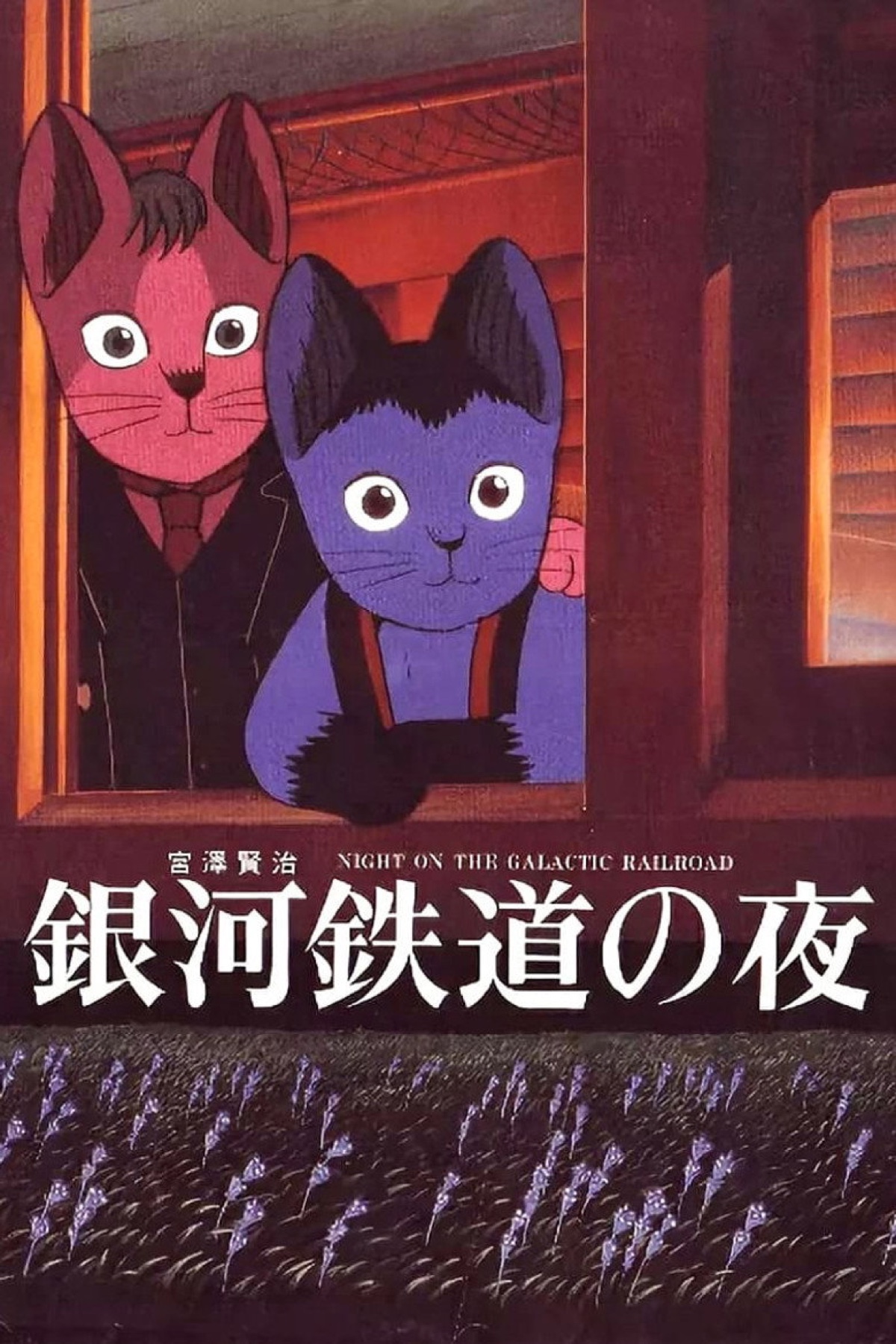
Giovanni is a cat. Campanella is a cat. So is the boy who bullies them, so is the teacher at the blackboard, so is the bird catcher three rows down the carriage. They walk upright, they wear school uniforms, and not one frame of it is played for charm. The 1985 film puts the whole of Kenji Miyazawa’s most famous story into a cast of cats and then refuses to be cute about it, which is the question almost everybody arrives with. The director went on the record about it in 2013, and his reason is better than the one people usually guess.
I should say my position up front, because it is a divided one. I like this film. I also stall when somebody asks whether they should watch it, and I stall for reasons I can name: the pace is slow enough to lose people, and the character animation has not aged the way the backgrounds have. What has not dated at all is the sound. Haruomi Hosono’s score, and the blue night the film builds around it, still have no substitute forty years later. Streaming first, then the cats.
📺 Where to Watch Night on the Galactic Railroad (October 2026)
| Service | Status | Notes |
|---|---|---|
| Crunchyroll | Streaming | Any paid plan. Subtitled, with the 2001 English dub too |
| The Roku Channel | Streaming | Free with ads, no account needed |
| Pluto TV | Streaming | Free with ads, a different ad load |
| Fawesome | Streaming | Free with ads |
| Prime Video Channels | Add-on | Via the Crunchyroll channel, also RetroCrush |
| Amazon Video | Rent / Buy | A Prime membership alone does not include it |
| Netflix | Not available | Not in the US catalog. Not in the Japanese one either |
| Hulu | Not available | Hulu in Japan is a separate company that does carry it |
Right now it streams on Crunchyroll with any paid plan, and it runs free with advertising on The Roku Channel, Pluto TV and Fawesome. Prime members can get to it through the Crunchyroll or RetroCrush channels on Amazon, and a straight rental is a few dollars on Prime Video.
Worth flagging, because it is unusual: a film with this reputation being free and legal in the US is not the normal state of affairs for 1980s anime. For years the American answer here was an out-of-print Central Park Media DVD going for silly money on the second-hand market. If you looked for this once, failed, and filed it under lost causes, that memory is accurate. The situation changed.
One warning about the ads. This film runs long stretches on ambient sound with no dialogue at all, and a commercial break landing in one of those does more damage here than it would in almost anything else. If you have a Crunchyroll subscription already, use it.
👉 If quiet Japanese work with sound doing the heavy lifting is your register, the other one I would send you to is Mushishi.
📖 Is Night on the Galactic Railroad Based on a Book?
Yes. It adapts Kenji Miyazawa’s novel of the same name, and Miyazawa never finished it. He began it around 1924 and kept reworking it until he died in 1933. It came out the following year from his papers, four drafts of it survive, and a stretch in the middle was never completed at all.
Knowing that changes how the film reads. When it declines to explain something, I suspect there is often nothing upstream to explain from, because the book has gaps of its own. I take the film’s refusal to tidy those up as loyalty to the source rather than vagueness, even on the nights its pace loses me.
One detail from the novel lands differently once you know who scored this film. Miyazawa put passengers from the Titanic on that train, writing a decade and more after the ship went down. The composer’s family history, which comes up further down, makes that page of the book heavier than Miyazawa could have planned. English editions are covered in the source novel section near the end.
🎬 Trailer
No official channel is carrying the original 1985 theatrical trailer, so that is the classic-anime service Eternal Family cutting a short promo instead. Forty-eight seconds, and it is enough for the two things that matter: the cats hold still, and you can hear what Hosono is doing underneath them.
Work Info
- Title: Night on the Galactic Railroad (Ginga Tetsudo no Yoru)
- Released: July 13, 1985 in Japan, about 108 minutes
- Director: Gisaburo Sugii / Screenplay: Minoru Betsuyaku / Art direction: Mihoko Magoori
- Based on the unfinished novel by Kenji Miyazawa, drafted from the mid-1920s and published in 1934, the year after his death
- Character designs taken from Hiroshi Masumura’s manga adaptation, which is where the cats come from
- Music: Haruomi Hosono of Yellow Magic Orchestra
- Japanese cast: Mayumi Tanaka as Giovanni, Chika Sakamoto as Campanella, Chikao Ohtsuka as the birdcatcher
- English dub: Veronica Taylor as Giovanni, Crispin Freeman as Campanella, recorded for the 2001 Central Park Media release
- Awards: the Ofuji Noburo Award at the 40th Mainichi Film Awards, Japan’s long-running prize for a single outstanding animated work
- US home video: Discotek Media, DVD in 2015 and Blu-ray in 2016
📖 Synopsis – No Spoilers
Giovanni’s father went to sea and has not come back. His mother is ill in bed. So the boy sets type at a print shop after school, then walks across town for her milk, and gets mocked in the classroom for the state of his family. The one classmate who never joins in is Campanella, though lately the two of them cannot manage a conversation either. Tonight the town is holding its star festival and everybody is out celebrating. Giovanni is on the edge of it, the way he is on the edge of most things.
Alone on a hill above the lights, he hears a train. Then he is sitting in a carriage with the Milky Way pouring past the window, and Campanella is in the seat opposite. The train stops at station after station. People get on. People get off, and the ones who get off do not come back. Between stops the two boys talk about what real happiness might be, while the line runs south toward the Southern Cross. Giovanni has a ticket, and he has not yet worked out how far his own ticket is good for.
✨ What Makes It Special
Why It’s Exceptional
- The faces are deliberately blank, so the feeling has to arrive by sound and by pause
- A handful of passengers are drawn as people rather than cats, and the film never says why
- Hosono built the score largely out of what he decided not to play
- Every sign, ticket and blackboard in the film is written in Esperanto
The cats were not a decision about cuteness, and the director has said so
Gisaburo Sugii answered this himself in an interview run by WOWOW in 2013, put together by the critic Ryusuke Hikawa. He starts from what sort of writer Miyazawa was, someone who kept concrete description out of the way so that a reader’s own reading had room, and then explains what that meant for filming him. My rough translation from the Japanese:
I thought that putting this on screen with human beings would come out too raw, too fleshy. Around that time I came across the picture book of Night on the Galactic Railroad drawn by Hiroshi Masumura, and I thought: with cats, I can get that transparency.
Gisaburo Sugii, WOWOW director feature, 2013 (interview edited by Ryusuke Hikawa; my translation)
Watch ten minutes and the logic lands. These cats barely emote. They do not smile or weep, and the film will hold on a pair of wide unmoving eyes looking out of a window for a very long time. Put a human face in that same shot and the performance decides the scene for you. A sad face means the character is sad, you receive the information, and the moment closes. A cat’s face does not hand over the answer.
With nothing written on the face, emotion has to travel some other way, and the route the film chooses is sound. During the long silences where the boys just look out at the galaxy, either Hosono’s low end is running or it is not, and that single fact sets the temperature of the scene. Japanese viewers who have seen this repeatedly describe the same odd effect: they cannot recall the shots, only the feeling. That happens because the memory was never attached to a face. Subtracting expression changed the way the film gets stored.
The cats buy the film one more thing, and this is the detail that rewards a second viewing. Not everybody on the train is a cat. A young man and two children board partway along the line, and they are drawn as human beings. Where they came from is established in ordinary carriage conversation, and it is the one point where the fantasy touches something that actually happened in the world. Cats belong to Miyazawa’s invented night; people belong to the record. Once you notice the boundary has been drawn, the whole carriage reads differently. Most viewers walk straight past it the first time.
Since the design credit will mean nothing outside Japan, Masumura is worth a sentence. He is a manga artist from Yamagata, best known at home for Atagoal, a long-running series set in a country where cats and people live side by side and the cats do the talking. He shares a region with Miyazawa and has spent decades adapting him, always in cats. As far as I can find, none of that work has ever been licensed in English, which means the visual idea this film is built on has never been available to English readers in its original form. The film is the only way in.
Hosono scores this by declining to play
Half of why I like this film is the sound, so let me be specific about what it does rather than just admiring it.
Haruomi Hosono had already been through Happy End and Yellow Magic Orchestra by 1985, and he brought none of the obvious moves with him. What he wrote is not music for lifting a scene. A clock in a classroom, machinery in the print shop, a steam locomotive coming up from a distance: those sit in the same mix as the score, and the border between the two is left deliberately vague. There is a passage where a ticking clock and a low synthesiser swell run on separate rhythms until you cannot tell which one is the film’s music and which one is furniture in the room. For 1985 this is startling. It is closer to a modern ambient record than to a film soundtrack of its decade.
Then there is the amount of nothing. Between lines of dialogue, during the half minute a train sits at a platform, across a shot of an empty station with no one on it, the film simply leaves the space open. Those are exactly the places a normal score fills. A film composer more noticeable for subtraction than for addition is a rare thing. Play this in a quiet room and your own room starts joining in.
I should be straight about what that praise is worth, though, because it cuts both ways. A score built on restraint gives you nothing to hold when your attention drifts. There is no swell telling you a moment has arrived. If you have gone twenty minutes without a scene change, the music will not come and rescue you, and it was never trying to.
Every sign in the film is in Esperanto
Look at the blackboard in the classroom scene, the destination boards on the platforms, the lettering on the tickets. None of it is Japanese. All of the on-screen text in this film is Esperanto, down to the title card, which reads Nokto de la Galaksia Fervojo.
That is a nod to Miyazawa, who studied the language and was taken with the idea of it. He gave his imagined home region the name Ihatov, an Esperanto-shaped rendering of Iwate, the real prefecture he lived and taught in. Sugii’s production carried the habit into the design. The practical effect is that the film’s written world belongs to nobody. A Japanese audience cannot read those signs either. For once an English-speaking viewer is not missing something the domestic audience gets for free, which almost never happens with a Japanese film of this vintage.
Deeper Themes
The phrase the film keeps returning to is hontou no saiwai, everyone’s true happiness, and it is never resolved. The clue it hands you instead is a story told on the train about a scorpion who spent his life eating other creatures, came to regret it, and burned his own body to become a light for others. That raises the question of whether giving yourself away is what happiness actually is. The film declines to sell it as a noble ending. It stays with what happens to the people standing underneath, looking up at the fire, which is why what you carry out of the last scene is closer to an unanswered question than to a feeling.
🎭 Memorable Scenes: standing in front of the hole in the sky
Late on, the boys look out at the Coal Sack, a dark nebula sitting in the Milky Way as an enormous black absence. There is no reading how deep it goes or what is at the bottom of it. Giovanni flinches at the sight, and then says this. The line comes from Miyazawa’s text.
I am not afraid of that great darkness any more. I am going to go and look for everyone’s true happiness. Let us go on together, however far it is, however far.
Kenji Miyazawa, Night on the Galactic Railroad (my translation from the Japanese)
He says he is not frightened directly after being frightened, and he does not say I, he says we. A boy who has not once put himself forward for anything steps forward here. The strongest line in the film is spoken in its darkest place. In the minutes immediately after it, Giovanni finds out what his own word “together” was covering. Those minutes are not going in this article.
💭 How It Made Me Feel
Reactions to the ending vary more than usual, and the reason is structural rather than personal. The film is not built to make you cry. The score never pushes, the faces never change, so there is no moment engineered to hand you a feeling. Whatever you end up with, you assembled yourself.
What I am left with is a flavor I cannot find anywhere else. I could keep analyzing the construction, but the shorter version is that I simply enjoy it. That would be easier to pass on if I could name a comparable film, and I cannot think of one. Being unable to say what it resembles is exactly why it is hard to hand to somebody.
😅 Where It Falls Short
To an eye trained on modern anime, the character art is thin
Enough about the sound. The drawing is where I bounce off this film, and I do not think that is only a question of age.
The background art holds up completely. The galaxy in blue and black, the row of telegraph poles beside the track, the crystalline riverbed: any of those would work framed on a wall. The figures are another matter. Close-ups repeat the same composition again and again, the wider shots are frontal and static, and the whole picture is dark enough that small acting choices are hard to read. Nobody in this film is putting anything across by moving. If your reference point is contemporary anime, where a strand of hair or the tension in a hand carries the scene, this will feel underfed. Japanese reviewers who rate the film highly say the same thing, usually in the resigned form of “the animation is 1980s, that cannot be helped.” That bothered me for the whole running time. I still like the film.
The pace will send people to sleep, and it is not close
I have spent a good deal of this page defending the slowness. Let me stop defending it for a paragraph.
Nothing in this film hurries. There is no incident to speak of. A train stops, somebody boards, a conversation happens, somebody leaves, and then it happens again. Out of about 108 minutes, it feels as though close to half is landscape and sound. It is by design rather than a defect, but a design does not stop you nodding off. Japanese reviews for this film contain a steady trickle of people admitting they fell asleep, and the striking part is the tone: they are not embarrassed about it. The usual formulation is roughly “dozed off again, still love it.” Press play on a night when you are actually awake.
It reaches for symbols where a plot should be
This objection is not mine, but it turns up often enough in Japanese reviews to be worth recording, and it is fair. The complaint runs that the story itself is weak, and that when the film needs to carry something it reaches for an image rather than for a scene. One reviewer I read put it bluntly: a plot that works on the page does not automatically work on screen, and this one escapes into symbolism too readily.
The defence is that Miyazawa left the book unfinished and the film is unusually faithful to it, so a certain amount of the vagueness is inherited rather than chosen. Both things are true at once. If you want a story with load-bearing structure, this is not going to give you one, and no amount of atmosphere will substitute.
The Weak Points
- Character animation repeats the same close-up compositions, and the picture is dark throughout
- So little happens that a tired viewer will lose the thread, or the evening
- Symbols do work a plot should be doing, which leaves literal-minded viewers with nothing to hold
Who Should Watch This?
- Anyone who saw the poster and stopped on the question “why are they all cats”. The film has a real answer
- Listeners who know Hosono from Yellow Magic Orchestra or from the solo records. Treat it as an album with pictures and you will get on fine
- Readers who bought a Miyazawa translation, hit his invented words and strange onomatopoeia, and put it down again
- People who came to anime through Ghibli and want to know what else Japan was making in the same decade
Who Might Not Enjoy This?
- Viewers who want a tightly built plot with the joints visible
- Anyone expecting a bright space adventure. The carriage is dim and the mood is uneasy from early on
- Second-screen watchers. Miss the sound and you have missed half of what is here
📺 Streaming Guide by Service
Is it worth paying for Crunchyroll when Roku and Pluto have it free?
If you already subscribe, yes, and the reason is the ad breaks rather than the picture. This film runs minutes at a time on nothing but ambient sound and a held shot. An advertisement dropping into one of those does not merely interrupt, it deletes the effect the scene was building. The free tiers are a good deal for a title of this reputation, and I would still route the last half hour through a paid service if you have one open.
On subtitles against the dub, both exist and both are on Crunchyroll. The English track was recorded in 2001 for Central Park Media, with Veronica Taylor as Giovanni and Crispin Freeman as Campanella. That is a strong pairing, and it is worth knowing what the Japanese track does that no dub can reproduce. Giovanni is played by Mayumi Tanaka and Campanella by Chika Sakamoto, two of the most recognizable voices in the country. A year after this film Tanaka voiced Pazu in Castle in the Sky, and she later became Luffy in One Piece and Krillin in Dragon Ball. Sakamoto went on to be Mei in My Neighbor Totoro and Agumon in Digimon. A Japanese viewer sitting down to this hears two voices they have known since childhood being asked to hold completely still, and that friction is part of the experience here. It does not translate. The dub is good; it is simply playing a different game.
Where to Stream
- Crunchyroll: Streaming, subtitled and dubbed, no advertising on a paid plan
- The Roku Channel: Free with ads, nothing to sign up for
- Pluto TV: Free with ads, the same film with a different break pattern
- Prime Video: Rent / Buy, and the Crunchyroll and RetroCrush Amazon channels carry it as paid add-ons
- Blu-ray: the Discotek Media disc from 2016, the version nobody can quietly remove from a catalog later
The Music
The soundtrack stands on its own, and playing it beforehand is a reasonable way to get ready for what the film does. It is on Spotify as the original soundtrack album.
There is also a coincidence attached to this score that Japanese viewers pass around, and it is true. Hosono’s grandfather, Masabumi Hosono, was the only Japanese passenger aboard the Titanic in 1912. He survived, and was then condemned at home for years for having survived. His written account of the night was made public by the family in the late 1990s, and his grandson said at the time that honor had been restored to the Hosonos. Whether anybody involved in this production thought about that, I have no idea. Knowing it does change how heavy one particular cue sounds.
📚 The Source Novel
Miyazawa is not an author Japanese people choose. He is assigned. His stories sit in the elementary school textbooks, so most of the country met him at eight or nine years old, understood very little, and kept the images anyway. That shared history is why a 2020 Yonezu Kenshi album opens with a track called Campanella, and why NHK’s education channel put this 1985 film back on the air in August for the 130th anniversary of Miyazawa’s birth.
The book is short and is out of copyright, so English editions are plentiful and uneven. The one I would point at is Night on the Galactic Railroad and Other Stories from Ihatov from One Peace Books, which puts the story next to enough of his other work that the world it belongs to becomes visible. Read it after the film rather than before. The film is much the gentler door of the two, because Miyazawa’s invented vocabulary and his very strange sound words are exactly where English readers tend to stop.
🎬 If You Loved Night on the Galactic Railroad, Watch These 3 Next
Millennium Actress
Satoshi Kon, premiered in 2001. An old actress starts recounting her life and the film she is currently inside, the films she used to make, and her actual memories begin bleeding into one another until the question of what really happened stops having a clean answer. Like the railroad film, it declines to settle up at the end. Where Giovanni’s journey never gets ruled in or out as something that happened in his head, this one never tells you who the man with the key was. Take this next if you treat unresolved as a quality rather than as a fault to be put up with.
👉 Read the Millennium Actress review
The Garden of Words
This one is here for the opposite reason. If the thin character art was your sticking point, put on Makoto Shinkai’s forty-six minutes of rain immediately afterwards: individual droplets, the light coming off the underside of a leaf, creases in a school uniform. The 1985 film builds its world out of what it leaves empty, and this one reaches the same stillness by putting everything in. Two directly opposed methods, and the oddity is that both films are about people who barely move.
👉 Read The Garden of Words review
Mind Game
Masaaki Yuasa’s first feature. It opens with the protagonist dead, and the art style and the frame rate change every few minutes from there. Put it on after the railroad film and it will throw you off. Both are journeys half a step outside the ordinary world, but one stops you dead to think and the other refuses to give you the room. Watching them back to back shows what Japanese animation can do with almost identical raw material. If the pace here defeated you, start with this instead and come back.
Night on the Galactic Railroad is the slowest entry on my list of train anime, and deliberately so: the film moves at the pace of the night train it rides.
📝 Final Thoughts
Put it on at night with the room kept dim, and go in accepting that you might not reach the end in one sitting. If you drop off, pick it up from there tomorrow. Plenty of people in Japan have finished this film across two or three attempts and lost nothing by it, which is a sentence I would not write about most films and can write about this one.
Films you are allowed to not understand the first time are rare. Because this one refuses to resolve, your age and your circumstances end up doing part of the work, and the same scene reads differently later. A forty-year-old film streaming free and legal on several American services is a better situation than this title has had in decades. So here is my position, which has not changed since the first paragraph: when somebody asks me for something to watch, I do not name this one. That is a statement about how hard it is to hand over, and not at all about how good it is. If the cats are what got you this far, get on the train.
⭐ The Film at a Glance
| Category | Rating | Note |
|---|---|---|
| Story | ★★★☆☆ | Faithful to an unfinished book, and it inherits the vagueness |
| Animation | ★★★☆☆ | Backgrounds excellent, figures repetitive and dim |
| Art and atmosphere | ★★★★★ | The blue night is the reason this film survived |
| Music | ★★★★★ | Hosono working mostly by subtraction |
| Pacing | ★★☆☆☆ | Roughly half of it is landscape and sound |
| Rewatch value | ★★★★☆ | The human passengers only register the second time |
Usagi’s Recommendation Score
⭐⭐⭐⭐⭐⭐⭐☆☆☆
7.5 / 10
An unusual 7.5. I can say without hesitation that I like it, and I still cannot recommend it to everybody. There is room in a life for one of those.

